

Webinar

Webinar: Terry Steiner – Training Plan Development Webinar

By United World Wrestling Press

CORSIER-SUR-VEVEY, Switzerland (June 1) -- Terry Steiner, USA Wrestling's Head National Coach Women’s Freestyle coach, joined Zach Errett, UWW's Education Manager, to discuss training plan development and periodization.  

Click the link below to download the Coach Steiner's Powerpoint presentation.

UWW Periodization Plan Presentation - Coach Steiner - USA WFS

Breakdown of the Webinar
0:01:58 – Introduction
0:06:40 – Start of his presentation
0:06:51 – Why do you need a plan?
0:08:04 – Why do we need a plan? Athlete perspective
0:10:04 – Important to have Openness and Transparency in Planning
0:10:35 – Biggest Job as National Team Coach
0:12:08 – Challenging the plan is a good thing
0:13:24 – Challenging and rewarding journey
0:14:16 – Job is helping the athletes see the value in the plan – showing the vision and including them in the process
0:14:57 – How do you start making the plan? (Things to start with)
0:16:15 – Story on Helen Maroulis
0:18:16 – How do we learn and develop the qualities? 
0:20:00 – What are you going to get the most return on your investment?
0:20:53 – Basis of his 4-year plan
0:21:09 – Year 1 – Filling the Backpack
0:22:34 – Year 2 – Process Oriented
0:23:54 – Year 3 – Starting to Focus on Results
0:25:59 – Year 4 – Performing 
0:27:00 – Overview of 4-year plan – Competitions and Camps
0:27:49 – Developing a Yearly Plan – Basic Process and Thoughts
0:29:52 – Science and Art in Planning
0:30:39 – Phases of the yearly plan
0:30:44 – Phase – Break time – Getting away
0:31:24 – Transition – time after the break
0:31:39 – Preparation – team focus
0:32:04 – Competition – more individual focus
0:32:34 – Peaking – rest and recovery
0:33:47 – Yearly Plan – Spreadsheet
0:36:02 – Challenge – quantifying volume and intensity
0:37:01 – Managing intensity and volume for peaking
0:38:19 – Developing a Competition Plan – last 45 days
0:38:50 – Struggle area as a young coach
0:39:21 – Story on Adeline Gray – Including in the planning process
0:41:59 – What he learned from working with Adeline Gray
0:42:49 – Managing intensity and volume during the Competition Plan
0:43:46 – Post Competition Reflection
0:44:26 – Reflection – Athlete Perspective
0:44:49 – Reflection – Coach Perspective
0:45:22 – Reflection – Data Analysis
0:46:49 – Important Data – Points by minute in a match
0:47:37 – As a coach, we need to realize it is their career
0:48:42 – Start of Q & A
0:48:52 – Can you inform the group about training load during competition phase?
0:51:22 – Is there any effects on a women’s monthly menstruation cycle?
0:53:41 – What type of information are you trying to get or asking for input when developing their training plans?
0:57:35 – How do manage to monitor athletes when they are not conducting training camps and do you perform any technical test under
these conditions?

0:59:41 – What are the strategies for nutrition planning on competition days?
1:02:53 – How do you work the emotions during training and competitions?
1:06:05 – Do you arrange any fitness testing before camps and competitions?
1:07:14 – How do you measure the intensity during a macrocycle (example during pre-competition/competition phases)?

'I Wanted to Change My Life': Nouri's Story of Resilience on World Refugee Day

By Vinay Siwach

LONDON (June 20) -- "I wanted to change my life."

Farhad NOURI doesn't mince words when explaining his decision to compete as a refugee since 2026.

Born in Tehran, Nouri is one of the 17 new refugee athletes supported by the Olympic Refuge Foundation (ORF) and United World Wrestling, with hopes of competing at the LA28 Olympic Games.

Nouri began wrestling when he was 13 and competed for Iran in the early stages of his career. He even won a silver medal at the U23 Asian Championships in 2019. But then, he wanted to change his life.

Back in 2022, Nouri competed at the British National Championships, an open tournament that does not require a wrestling licence, and won gold. His skill and success surprised everyone, and British wrestling became interested in helping him.

Nouri decided to stay and pursue his wrestling career but had no country to represent. Earlier this year, he was granted refugee status and, on the occasion of World Refugee Day on June 20, Nouri recalled his journey from Iran to becoming the first wrestler with refugee status to win a continental medal.

"At that first British Championships, I weighed in at 67kg but won gold at 74kg," Nouri told United World Wrestling. "One of the coaches said that if I won gold, they could work on getting me to compete internationally. That's how it began."

Farhad NOURI (UWW)Farhad NOURI (UWW) won a bronze medal at 74kg at the European Championships. (Photo: United World Wrestling / Kadir Caliskan)

Nouri went unbeaten at the English and British Championships for three years and, when he was allowed to compete internationally in 2026, he did not wait.

The 27-year-old began competing again under United World Wrestling's refugee status at the Zagreb Open in 2026. He did not win a medal in Zagreb or at the Muhamet Malo Ranking Series in February.

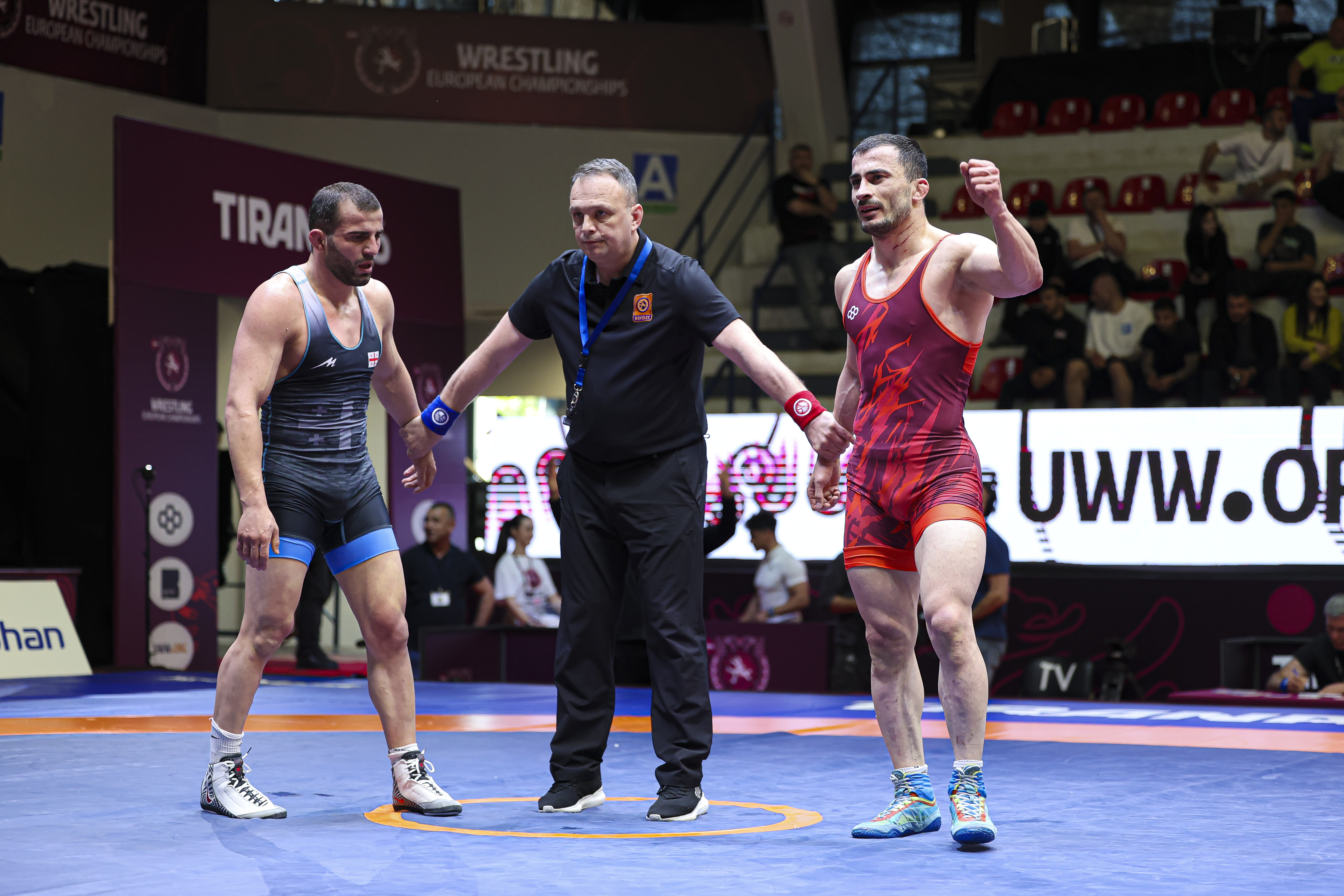
But Nouri became the first refugee wrestler to win a continental medal in April in Tirana, Albania, when he claimed bronze in the 74kg weight class at the European Championships.

In his first bout, Nouri was leading against Turan BAYRAMOV (AZE) but lost 3-2. As Bayramov reached the final, Nouri earned a place in the repechage, where he defeated Nikita DMITRIJEVS MAYEUSKI (BLR), 9-6, to reach the bronze-medal bout.

In what turned out to be a thrilling contest against Giorgi ELBAKIDZE (GEO), Nouri came out on top, 10-8. He trailed Elbakidze 6-2 with 1:41 remaining when the Georgian was put on the activity clock.

Nouri scored a takedown to cut the lead to 6-4 before a stepout and the activity point made it 6-6, with Elbakidze holding the criteria lead and 1:12 left in the bout. A go-behind gave Nouri an 8-6 lead, but Elbakidze turned it around again with a takedown with 20 seconds remaining to take an 8-8 criteria lead.

Elbakidze went for a double-leg to protect his lead in the final seconds, but Nouri managed to get out of the hold and score an easy go-behind for two points to claim a 10-8 victory.

"That medal gave me the energy to compete and win in wrestling," Nouri said. "Now I have the energy to train for the World Championships and prepare for the Olympics as well."

Nouri achieved it without much support, as he only began receiving financial assistance this year. He works part-time as an accountant in London to fund his training and travel, but that does not demotivate him.

"There are fewer facilities and I lack support, but this is my life," he said. "I like wrestling and want to dedicate my life to it. And I want to tell everyone that if I can do it, then you can do it as well."

After the historic bronze medal at the European Championships, Nouri now has his sights set on a World and Olympic medal.

"I will participate in the Ranking Series in Budapest," he said. "I am preparing for the World Championships so I can win a medal. I believe I can."