TIRANA, Albania (April 24) -- After three gold medals on Thursday, Ukraine added three more in Women's Wresting on Friday to win the team title at the European Championships in Tirana.
Two young stars in Mariia YEFREMOVA (UKR) and Nadiia SOKOLOVSKA (UKR) and two-time Olympic medalist Iryna KOLIADENKO (UKR) were the three champions for Ukraine. The six gold medals is record in the country's history, improving on last year's performance of four golds.

It also won a silver and a bronze medals to finish with 193 points, well ahead of second-placed Turkiye which had 122 points. Poland finished third with 114 points.
"This performance for Ukraine was historic because we’ve never had a result like this before," Koliadenko said. "We’ve broken our previous record. Our previous record was seven finals and four golds. The team gave it their all. I’m so happy for the whole team."
Magdalena GLODEK LISZEWSKA (POL) won gold for Poland at 57kg while Wiktoria CHOLUJ (POL) earned at silver at 76kg which helped the country to third place. With the gold medal, Glodek became the first wrestler from Poland to win gold at European Championships in six years and first in Women's Wrestling in nine years.
The one remaining gold, at 62kg, was won by Grace BULLEN (NOR) in dramatic fashion, coming back from 9-0 down to pin Amina TANDELOVA (UWW).
Yefremova, 19, got the session to a good start for Ukraine with a win over 34-year-old defending champion Maria PREVOLARAKI (GRE) in a tight 53kg final. Prevolaraki, who had won gold in 2025 on her 14th attempt, looked good to repeat when she got the first points on board in the final through Yefremova's passivity.
But in the second period, Yefremova used a fireman's carry to put Prevolaraki's back on the mat for two points. While she did not get the fall, Yefremova's 2-1 lead was enough for her to defend even as Prevolaraki made continuous attacks.
"Such intense emotions for me," Yefremova said. "I came here convinced I’d win a medal, but I didn’t think I’d make it to the final because I knew there were more experienced athletes here. But I still had a little bit of hope in myself that I could reach the final and win that gold. I didn’t think it would all turn out this way for me."
Yefremova, a former U17 world champion and U20 world silver medalist, was making waves in Women's Wrestling before being suspended for 18 months a positive dope test.
"I can’t say I’m particularly worried about the fact that the wrestlers are more experienced than me," she said. "I’m just used to forging ahead, regardless of the obstacles. I’ve got a goal, and I’m going for it. I don’t really have anything else on my mind."
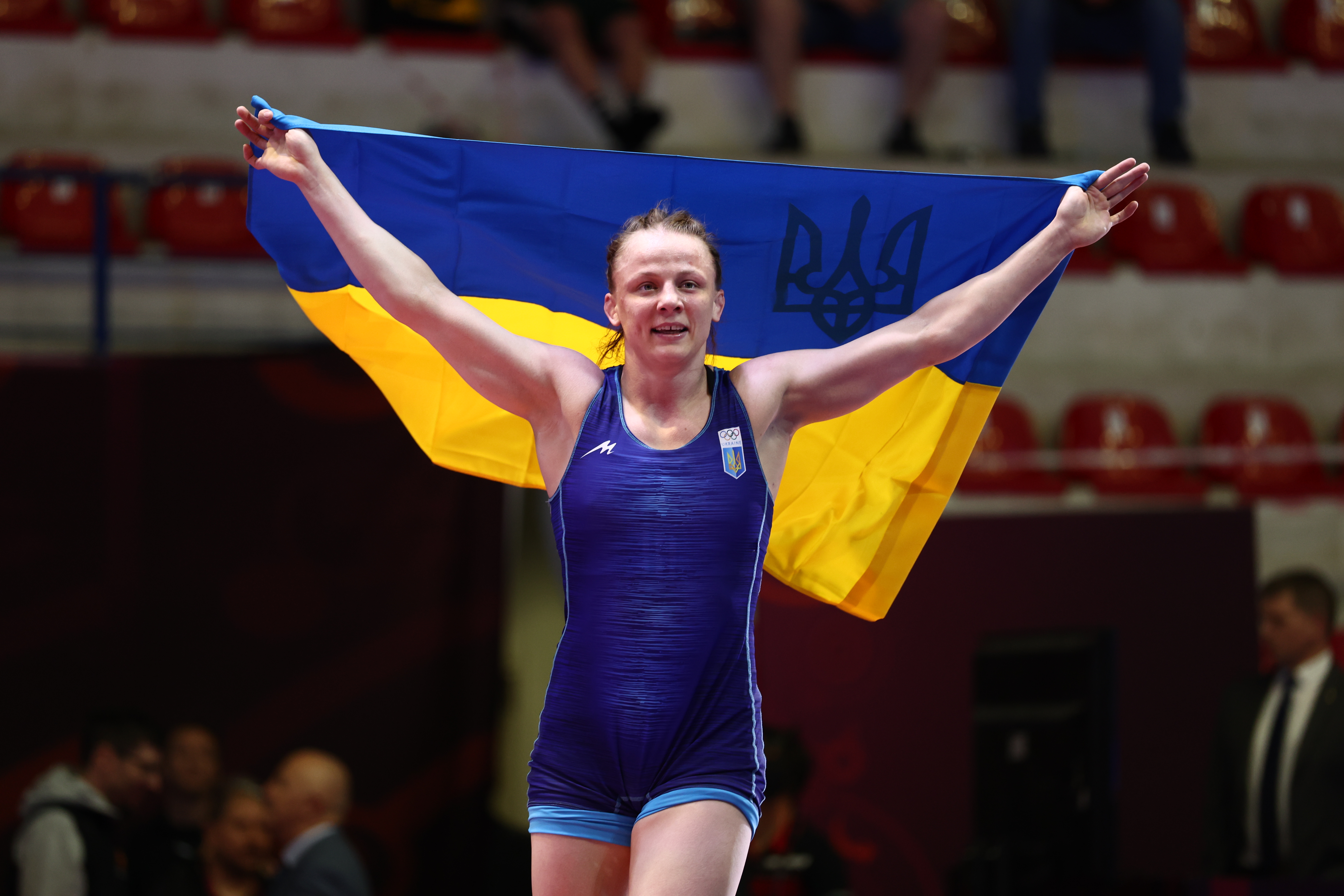 Iryna KOLIADENKO (UKR) celebrates after winning the 65kg final. (Photo: United World Wrestling / Jake Kirkman)
Koliadenko earned her fourth European title without giving up a single point throughout the tournament, a fact that left even her surprised. After two technical superiority wins in the quarterfinal and semifinal, Koliadenko faced world silver medalist Alina KASABIEVA (UWW) in the 65kg final. She controlled the final throughout and forged a 9-0 victory.
"I hadn’t planned on finishing with a clean slate -- not losing a single point throughout this European Championship. It went quite smoothly for me," Koliadenko said.
The 27-year-old first wrestled at the European Championships in 2020, winning a bronze medal. Her gold medals came in 2021, 2023, 2024 and 2026. In 2025, she finished with a bronze as well, taking her total medal count to six.
"I suppose experience does play a part, and over the years every competition becomes quite a challenge psychologically," she said. "Physically, you’re always prepared, but mentally it’s a bit tough. Especially given the rather uncomfortable situation in Ukraine at the moment and all of that affects our results."
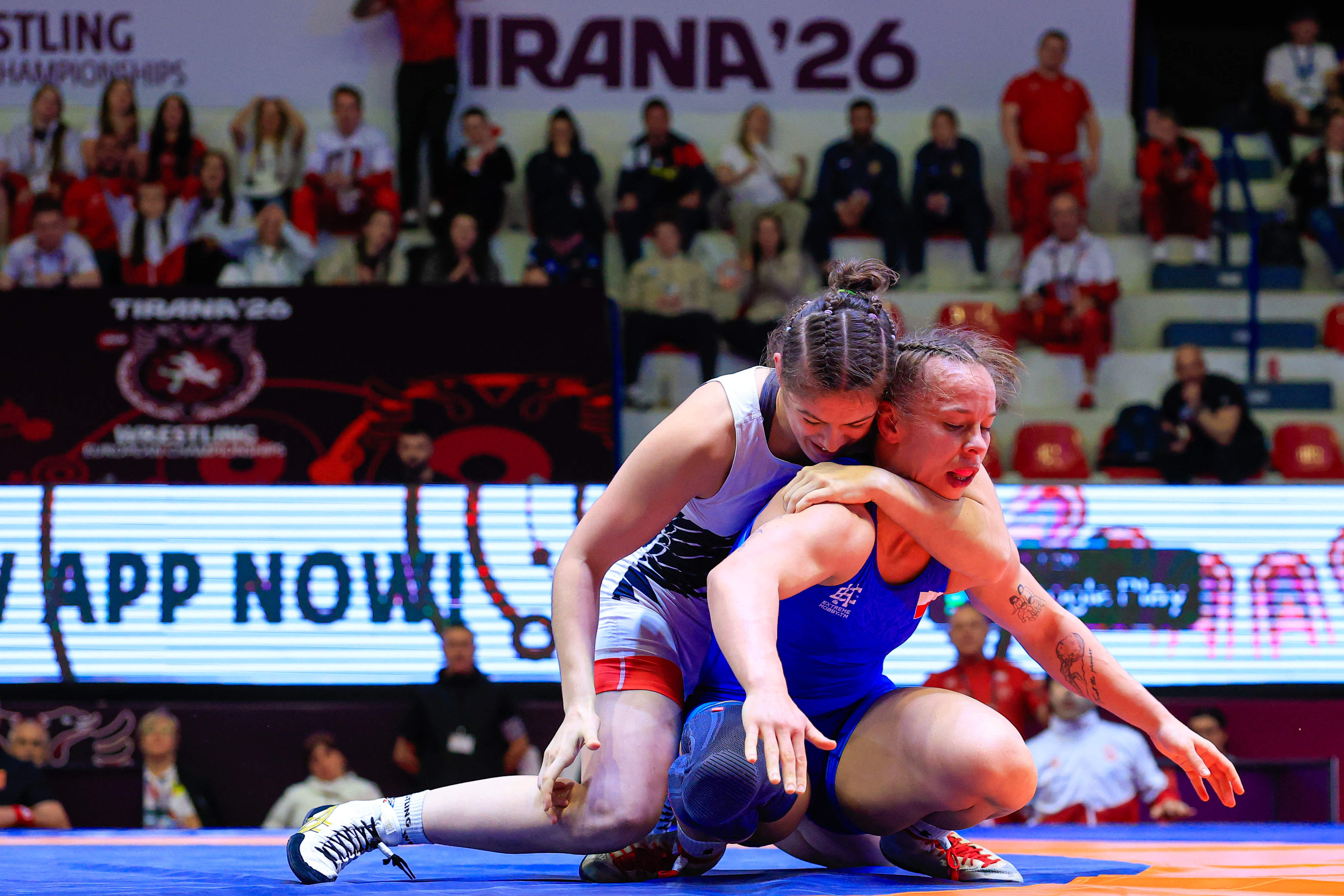 Nadiia SOKOLOVSKA (UKR) scores exposure points on Wiktoria CHOLUJ (POL) in the 72kg final. (Photo: United World Wrestling / Kostadin Andonov)
At 72kg, U20 and U23 world champion Sokolovska found a way to beat Choluj despite trailing for four points. Choluj was put on activity clock but she used a double-leg attack during the 30-second period to score a takedown which was scored two points.
As the match progressed Choluj found it difficult to answer the pressure from Sokolovska who managed a go-behind to score her first point before getting two more for exposure in the same scramble to lead 4-2 with 1:34 remaining.
Choluj challenged the call but it was a takedown and a clear cradle with no foul. The lost challenge added one more point to Sokolovska's score. Choluj managed a stepout with 28 seconds left but failed to score a takedown in the remaining time which could have given her the criteria victory.
Sokolovska, trained by her Greco-Roman wrestler father, won the gold at her debut European Championships to cap off a memorable tournament for Ukraine.
Apart the these three, Oksana LIVACH (UKR), Mariia VYNNYK (UKR) and Anastasiya ALPYEYEVA (UKR) were the other three champions for Ukraine in Tirana.
Glodek Ends Poland's Wait
Poland's gold medal winner Glodek who denied Elvira SULEYMAN (TUR), who finished with a silver medal for a second time in a row.
After both wrestlers exchanged passivity points, Suleyman led 1-1 on criteria as her point was the latest. But Glodek used a strong snapdown to score a quick takedown and lead 3-1.
Suleyman tried her best to score a match-winning takedown including an arm throw but landed on her own back to give two more points to Glodek who ended a six-year wait for Poland to have a European champion in wrestling.
For Poland, Maogmedmurad GAZHIEV (POL) had won gold in Freestyle in 2020 while Monika MICHALIK (POL) won gold in Women's Wrestling in 2017.

RESULTS
53kg
GOLD: Mariia YEFREMOVA (UKR) df. Maria PREVOLARAKI (GRE), 2-1
BRONZE: Natalia MALYSHEVA (UWW) df. Vanesa KALADZINSKAYA (UWW), via inj. def.
BRONZE: Annika WENDLE (GER) df. Roksana ZASINA (POL), via fall (2-3)
57kg
GOLD: Magdalena GLODEK LISZEWSKA (POL) df. Elvira SULEYMAN (TUR), 5-1
BRONZE: Zhala ALIYEVA (AZE) df. Aryna DZEMCHANKA MARTYNAVA (UWW), via fall
BRONZE: Solomiia VYNNYK (UKR) df. Evelina HULTHEN (SWE), via fall
62kg
GOLD: Grace BULLEN (NOR) df. Amina TANDELOVA (UWW), via fall (5-9)
BRONZE: Bilyana DUDOVA (BUL) df. Johanna LINDBORG (SWE), 3-1
BRONZE: Naemi LEISTNER (GER) df. Ruzanna MAMMADOVA (AZE), 5-1
65kg
GOLD: Iryna KOLIADENKO (UKR) df. Alina KASABIEVA (UWW), 9-0
BRONZE: Natalia KUBATY (POL) df. Iris THIEBAUX (FRA), 11-6
BRONZE: Beyza AKKUS (TUR) df. Birgul SOLTANOVA (AZE), 4-2
72kg
GOLD: Nadiia SOKOLOVSKA (UKR) df. Wiktoria CHOLUJ (POL), 5-3
BRONZE: Kristina BRATCHIKOVA (UWW) df. Zsuzsanna MOLNAR (SVK), 3-0
BRONZE: Buse TOSUN (TUR) df. Karolina POK (HUN), 9-6


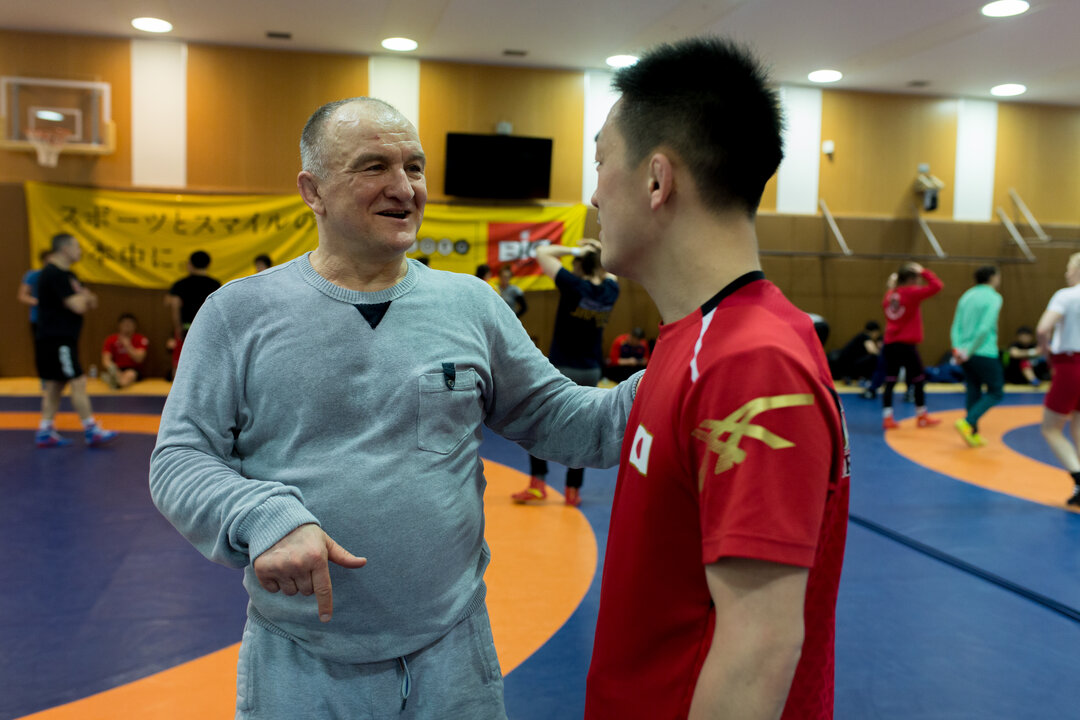 China's coaching staff has a new face in Simon ATANASSOV. The Bulgarian national recently came off a coaching stint in Azerbaijan (Photo: Max Rose Fyne)
Share your thoughts.
Comments