TOKYO (December 21) -- It was one of those unimaginable scenes that suddenly appears like a mirage. Was that really Akari FUJINAMI, the Paris Olympic champion and two-time world champion who had not lost since 2017, on her back and fighting to prevent an upset of epic proportions?
Alas, Fujinami being Fujinami, she managed to avoid the fall, then came back with a late takedown to escape with a 4-2 victory over a gutsy Himeka TOKUHARA in the women's 57kg final at the Emperor's Cup All-Japan Championships on Sunday.
"I came up against reality at this tournament," said Fujinami, who extended her current winning streak to 150 matches dating back to junior high school, while continuing to make the tough adjustment from 53kg up to 57kg.
"To give up those points isn't a good thing, but it shows I have room for growth. Close matches like this are exciting. This down-to-the-wire, thrilling wrestling was really fun. I came out of this tournament with the feeling that I will become even stronger."
The final day of the four-day tournament at Tokyo's Komazawa Gym spotlighted much of the cream of the Japanese crop, with six medalists from the Paris Olympics in action and one weight class featuring a clash of reigning world champions.
Among the other Paris gold medalists, the lone one to taste defeat was Sakura MOTOKI, who fell to nemesis and Paris bronze medalist and defending champion Nonoka OZAKI 3-3 in a nail-biting women's 62kg final. Kotaro KIYOOKA triumphed amid a stacked field at freestyle 65kg, while Nao KUSAKA continued his domestic dominance at Greco 77kg.
The tournament is also serving as the qualifier for the Asian Championships in April, as well as one of two qualifiers for the World Championships and Asian Games, to be held in fall. The latter holds additional significance in that it will be held in Japan.
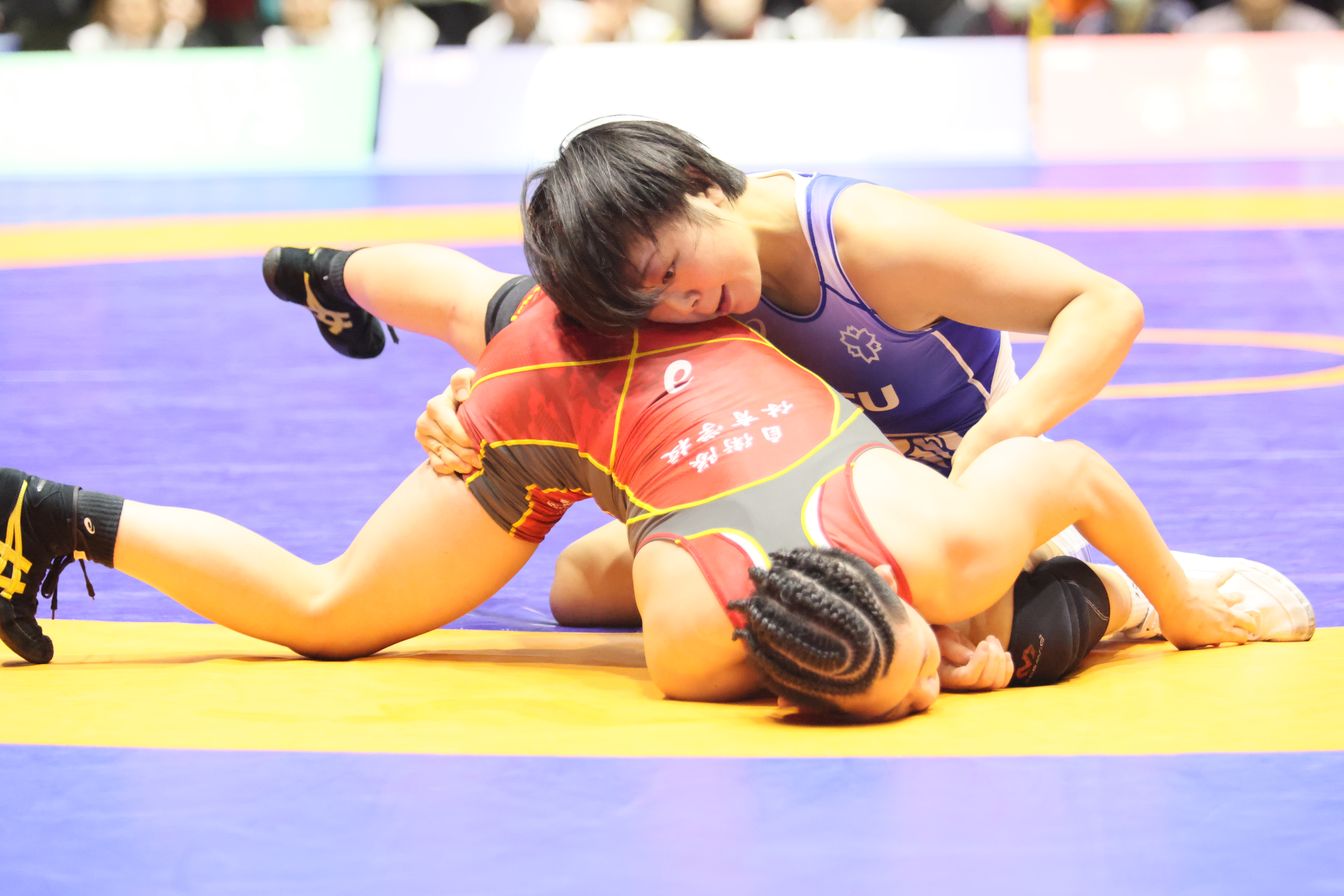 Akari FUJINAMI finishes up the winning takedown against Himeka TOKUHARA in the final minute of the women's 57kg final. (Photo: Takeo Yabuki / wrestling-spirits.jp)
The 22-year-old Fujinami, the Paris champion at 53kg, announced earlier this year that she was moving straight up to the next Olympic weight class at 57kg. But she opted to not even try to qualify for this year's senior World Championships, feeling she wouldn't be physically ready, and instead had her first test run of sorts with a victory at the world U23.
The two days at the All-Japan seemed to validate her decision to not rush the process, as she had her hands full with two of Japan's more powerful wrestlers.
In the semifinals on Saturday, she was never in danger of losing to Asian champion Sara NATAMI, but she gave up two 2-point exposures on counters late in a 7-4 victory. Then against Tokuhara, it was like she ran into a brick wall that crashed down on top of her.
Tokuhara, a member of the Japan Self-Defense Force team who was a world U23 champion at 59kg in 2022, relies on her power, which earned her the ticket at 57kg to this year's World Championships in Zagreb, where she lost in a bronze-medal match.
"Tokuhara and Natami are both strong, physical wrestlers," Fujinami said. "When I moved up to 57kg, those are the two I most needed to beat. Beating them both is a plus. Of course, everyone looks at the points I gave up, but I became the challenger when I moved up in weight, and I'm glad to have been able to come out with the win."
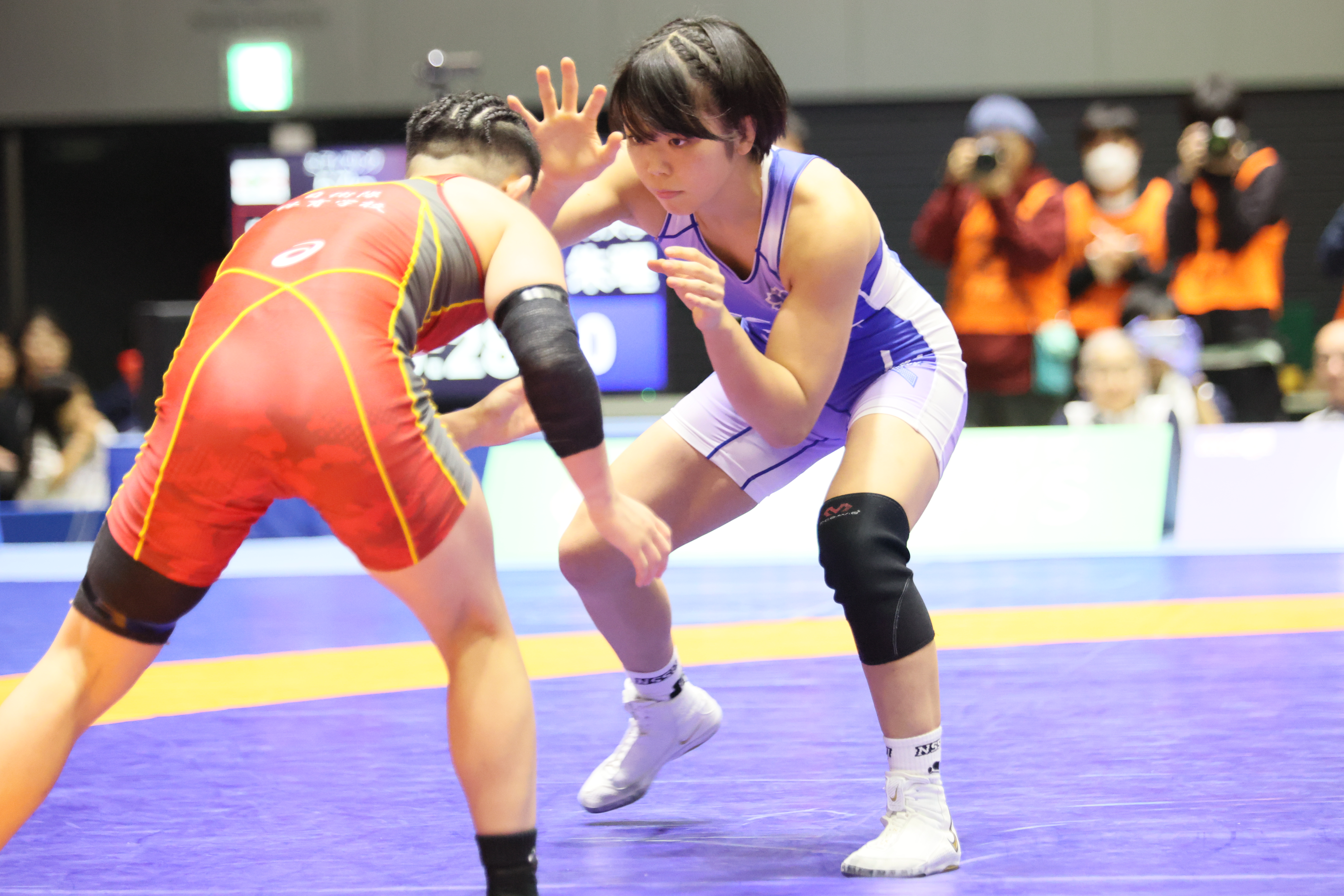 Akari FUJINAMI squares off with Himeka TOKUHARA in the women's 57kg final. (Photo: Takeo Yabuki / wrestling-spirits.jp)
After her win, which gave her a fourth career title and first since 2022, she showed a vulnerable side, acknowledging she has a fear of failure and concerns over her ability to continue her incredible success amid the new challenge. Speaking about the pressure brought her to tears at one point.
"I'm really afraid of losing," she said. "It's strange for me to start crying now. My goal is to win the titles at the Asian Games and Los Angeles Olympics, and every day, I wonder to myself, is this the right thing to do? Is this making me better?
"I am also human, and there are things that scare me. It's that fear that makes me work hard every day. I'm sure I will have even tougher matches ahead. It feels like a given that I will win, and if I lose, everything will fall apart."
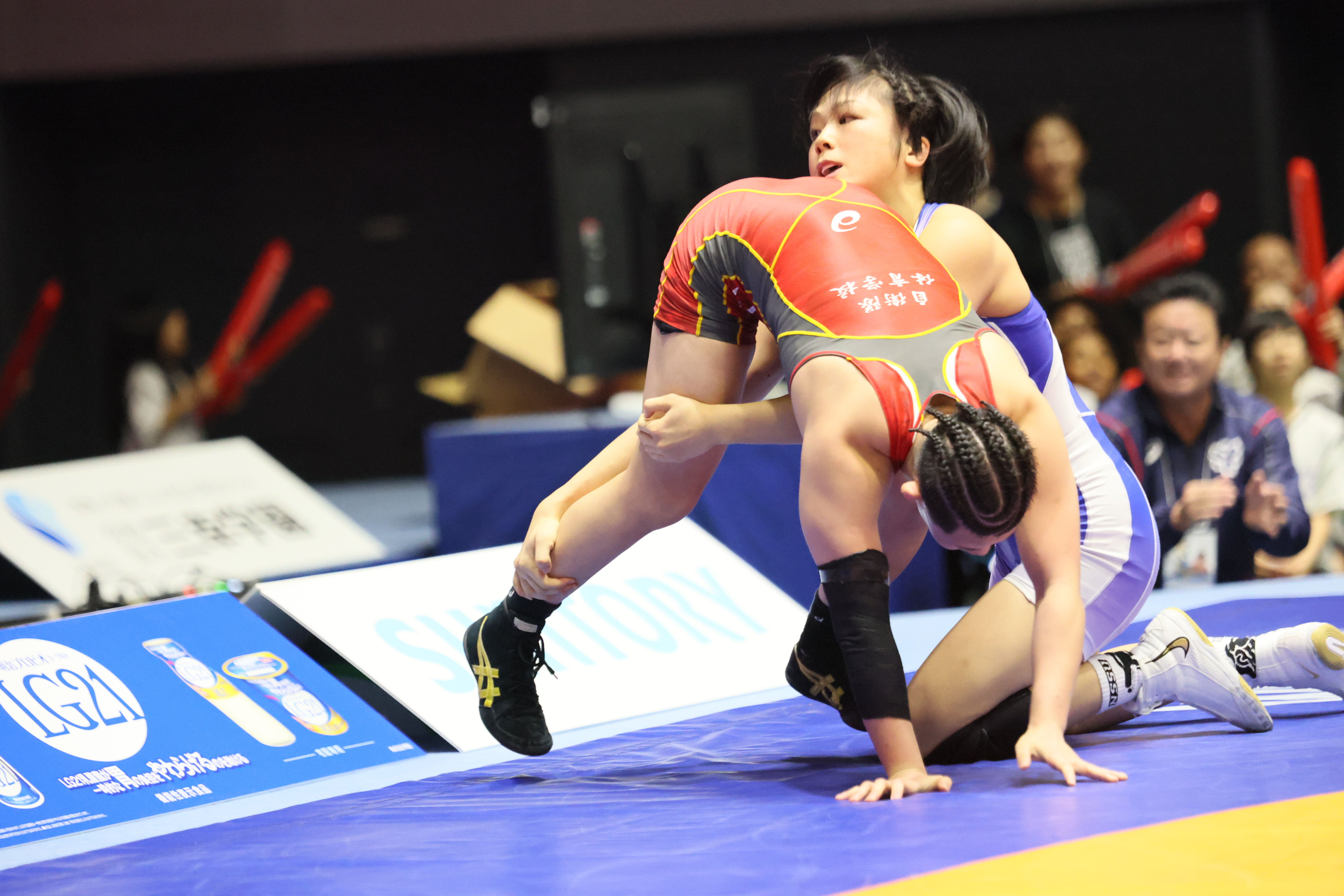 Akari FUJINAMI gets a stepout in the second period of the women's 57kg final. (Photo: Takeo Yabuki / wrestling-spirits.jp)
In the final, Fujinami found her takedown attempts consistently blocked by Tokuhara, who relied on an effective whizzer or a front head lock, and had only an activity point to show for the first 2:30 of the first period. That was when the wall fell on her.
When Fujinami shot in for a single, Tokuhara whizzered to get Fujinami to straighten up. Then she pivoted around with a fierce pancake that slammed Fujinami straight to her back for 2 points with :25 left on the clock.
Fujinami set her left elbow on the mat to keep her shoulder up as Tokuhara pressed for the fall.
With only a few seconds left, Fujinami transitioned to a bridge, but at one point her shoulders hit the mat for a split second. The mat referee indicated a fall, but neither side judge confirmed, and time ran out.
Asked when the last time she was in danger of a fall, Fujinami laughed and replied, "I can't even remember the [opponent's] name."
Fujinami said she knew how much time was left and that she was confident she could ride it out. She said she constantly practices for such a situation, even though it would seem that the odds of it happening were somewhere in the Powerball range.
"I thought the way she had the hold, I wouldn't be pinned," Fujinami said. "I do bridges every day in practice. I had prepared for the possibility of this situation, so I wasn't thinking, 'Oh no, what should I do?' And even though I don't have much actual experience, I stayed calm.
"I knew that move was in her arsenal, but I couldn't stop it. It showed that I still have weakness. I also practiced what to do after failing to get in on a tackle, but she still hit the move, so there's still some work to be done."
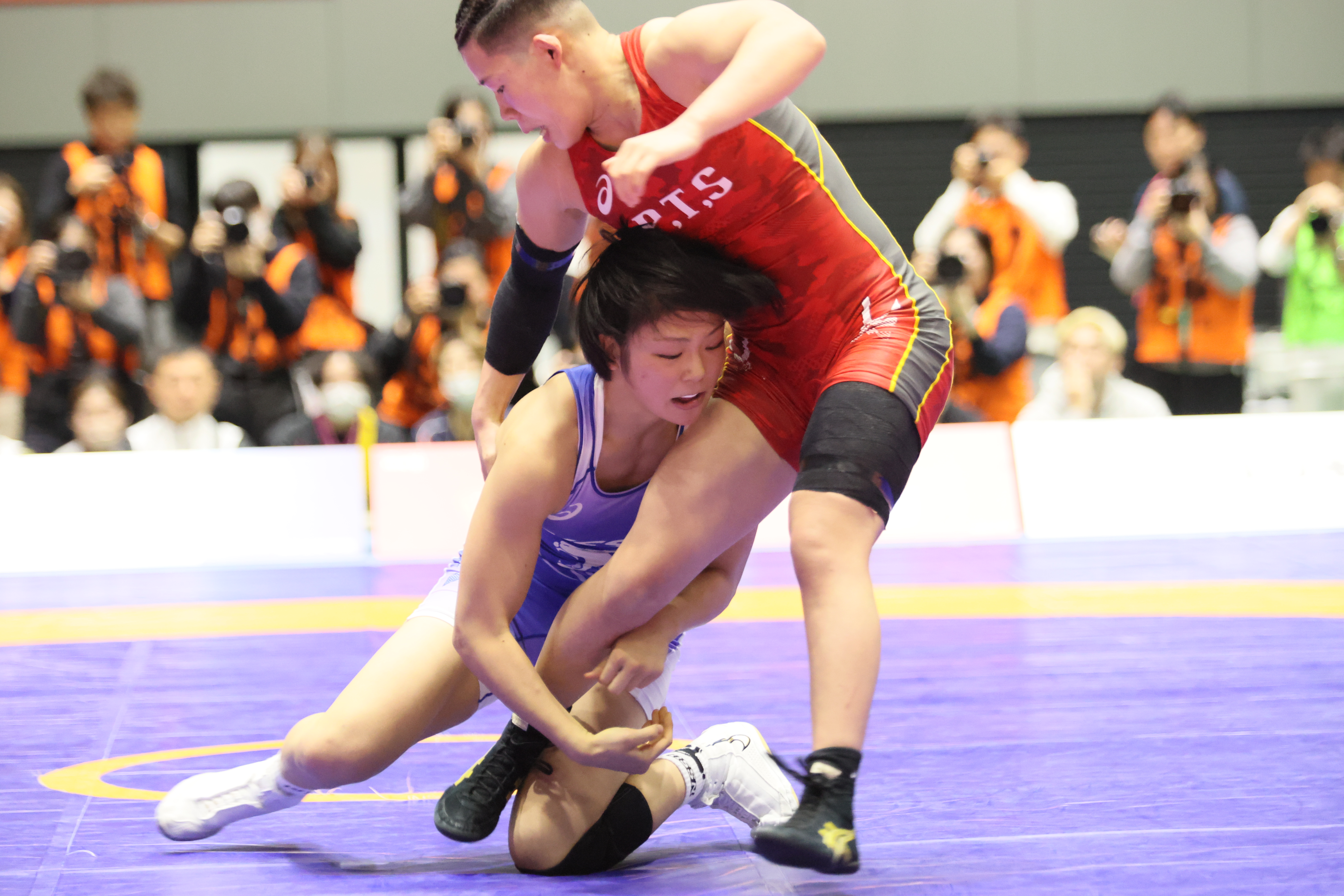 Akari FUJINAMI shoots for the winning takedown against Himeka TOKUHARA in the final minute of the women's 57kg final. (Photo: Takeo Yabuki / wrestling-spirits.jp)
There was also still the match to be won, as she trailed 2-1 and had yet to come close to a takedown, which in this weight class, she has had to depend on more. In the 21 points she scored over three matches, none came from ground wrestling.
Midway through the second period, she was stopped again and close to being forced out with her back to the edge. But she nimbly used Tokuhara's momentum to slip around and force her out for a stepout that made it 2-2, but still left her trailing on criteria.
With a minute to go, Fujinami finally connected with a single-leg attempt. As Tokuhara reached over for a counter, Fujinami pressed ahead and gradually finished up the takedown with :45 left.
She then put up a wall of defense that Tokuhara could not penetrate to secure the victory. "I'm really happy to have come out with a win," Fujinami said. "It was a daily fight to prepare for this tournament."
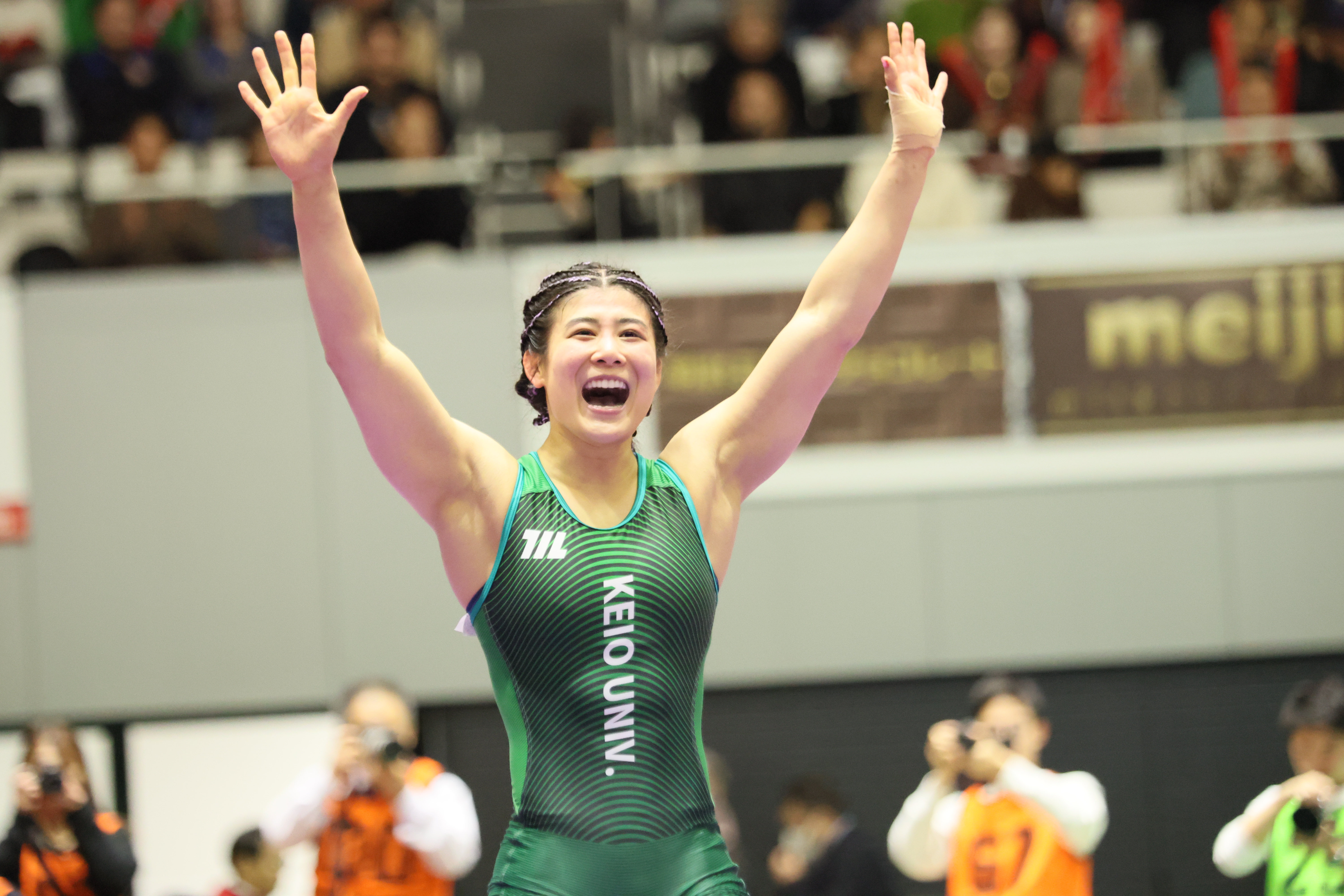 Nonoka OZAKI celebrates her victory over nemesis and Olympic champion Sakura MOTOKI in the women's 62kg final. (Photo: Takeo Yabuki / wrestling-spirits.jp)
There was more drama to follow in the next and final match of the tournament, which paired Motoki and Ozaki for supremacy at 62kg once again.
Last June at the Meiji Cup All-Japan Championships -- the second of the two domestic qualifiers for major global competitions -- Motoki squeaked out a 3-3 victory over Ozaki in the final. She then followed that with a 6-5 victory in the world team playoff in which she literally scored the winning takedown in the final second.
Ozaki could then only watch as Motoki went on to win her first senior world title, which she then followed up by winning the world U23 gold. That made her just the third wrestler in history to achieve the "Golden Grand Slam" of Olympic, senior world and all three world age-group golds.
On Sunday, it was Ozaki's turn for late dramatics, albeit she didn't cut it that close. She was leading 1-1 on criteria after an exchange of activity points when Motoki scored a single-leg takedown with 1:30 left. Ozaki kept up the pressure before securing a single-leg takedown of her own with :18 left for the victory.
"The last time, I lost with less than a second left, which taught me that that's something that can happen," Ozaki said. "I thought, if my opponent can do it, then I can do it as well. I thought to imitate, or learn from, Motoki's fighting style and her mental strength.
"In the second period, I gave up points, but I thought I would do to her what she did to me. I kept fighting and looked to take advantage of any chance."
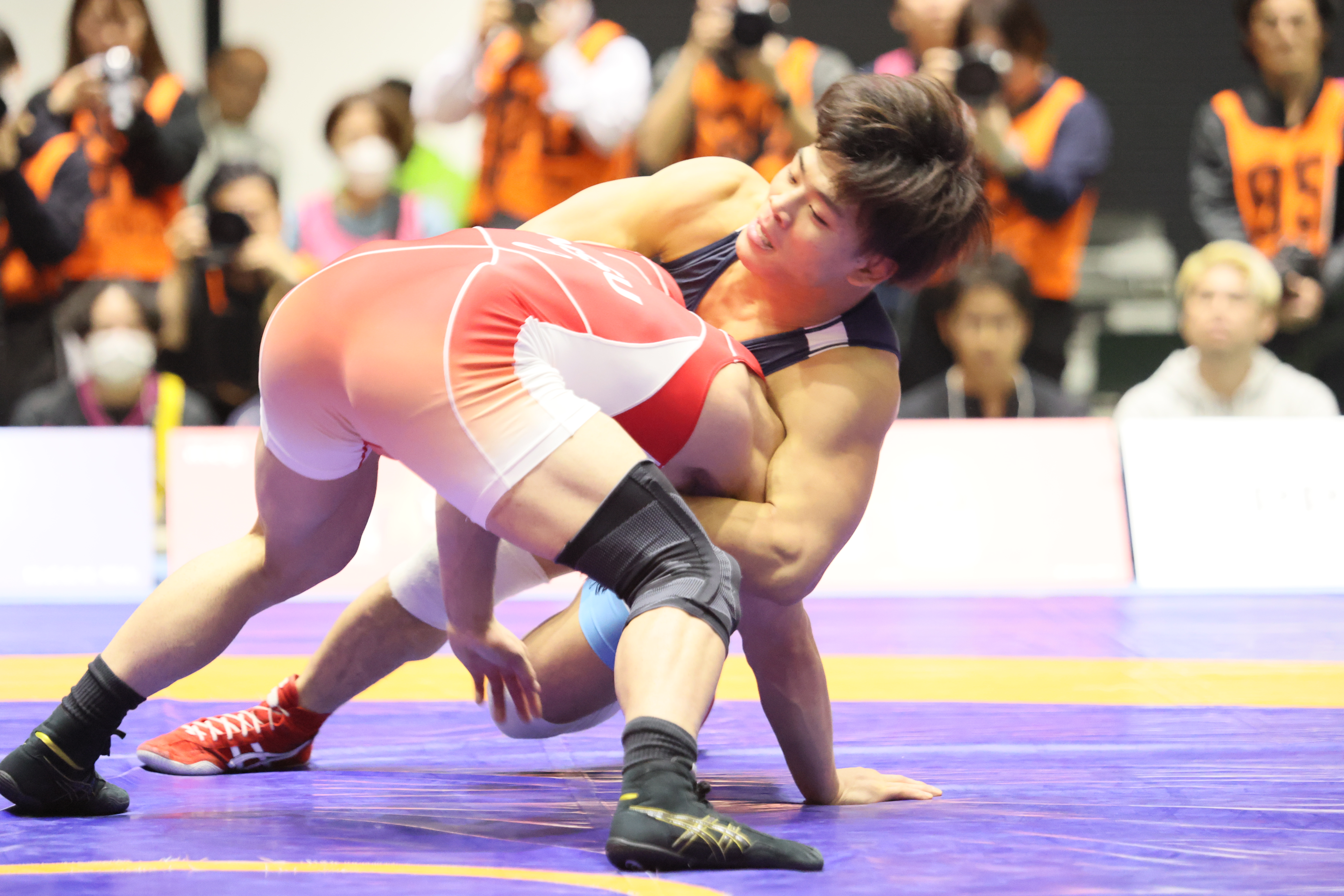 Yoshinosuke AOYAGI unsuccessfully attempts a front body lock roll in the freestyle 74kg final against Kota TAKAHASHI. (Photo: Takeo Yabuki / wrestling-spirits.jp)
Aoyagi prevails in clash of world champions
In the second final of the tournament that pitted reigning world champions, Yoshinosuke AOYAGI made a successful incursion into the freestyle 74kg territory currently ruled by Kota TAKAHASHI.
Aoyagi, the freestyle 70kg champion in Zagreb, scored a takedown and roll combination with 40 seconds left, then held on for a 4-4 victory on criteria for his first All-Japan title.
While happy with the victory, Aoyagi was left less than satisfied by his lack of an effective offense. His winning combination came after he spun behind in countering a takedown attempt.
"I'm still small in build, and he controlled the flow of the match," Aoyagi said. "Honestly speaking, I thought if it stayed that way I would lose. I didn't score any points with my moves, so there is much to reflect on from this match."
He says he plans to enter a Ranking Series tournament and, without going into specifics, said he would like to go overseas to train with U.S. and Russian wrestlers which "is the best way to improve one's skills and which benefits both sides."
He is also looking forward to testing himself at the Asian Championships, "Where I can show that I can be competitive at 74kg on the global stage," he said.
"I'm still in the stage where it's really tough, and I lack the power and get pushed around," Aoyagi said. "After the match, my legs were burning. There's so much more I need to do. I will look for ways to make improvements."
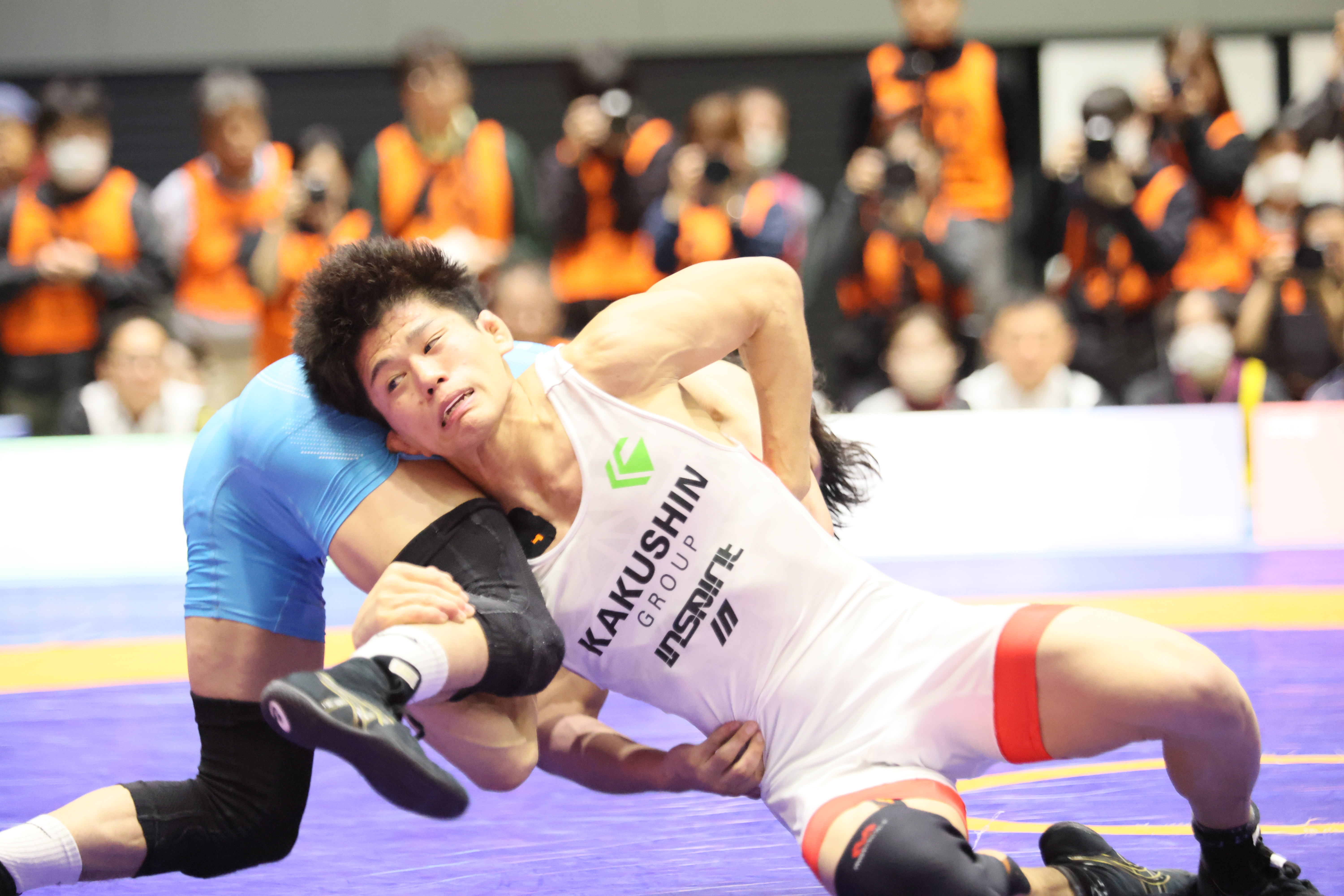 Kotaro KIYOOKA sweeps to the side for a takedown against Takara SUDA in the freestyle 65kg final. (Photo: Takeo Yabuki / wrestling-spirits.jp)
At freestyle 65kg, Kiyooka used his low single and dynamic speed to scrape together a 5-2 victory in the final over Asian 61kg champion Takara SUDA.
Kiyooka swept to a low single-leg takedown in each period, but said he needs to work on setting it up closer.
"I wanted to cut the distance a little more, and use more variation for my shots," he said. "There's still many things I need to work on."
Kiyooka said he gained inspiration from his sister Moe's victory at 53kg on Saturday. It marks the second time that the two have completed a sibling double after 2023, when he won his lone other title.
Kiyooka, who had never medaled on the world level when he came out of nowhere and triumphed at the Olympics, got a wakeup call of sorts in Zagreb, where Rahman AMOUZAD (IRI) avenged his loss in the Paris final by beating him for the world gold.
"I realized my weakness," Kiyooka said. "As I said during the World Championships, I felt I wasn't the true champion. Wrestling is very deep and it made me feel I can still grow, so I took [the loss] in a positive light."
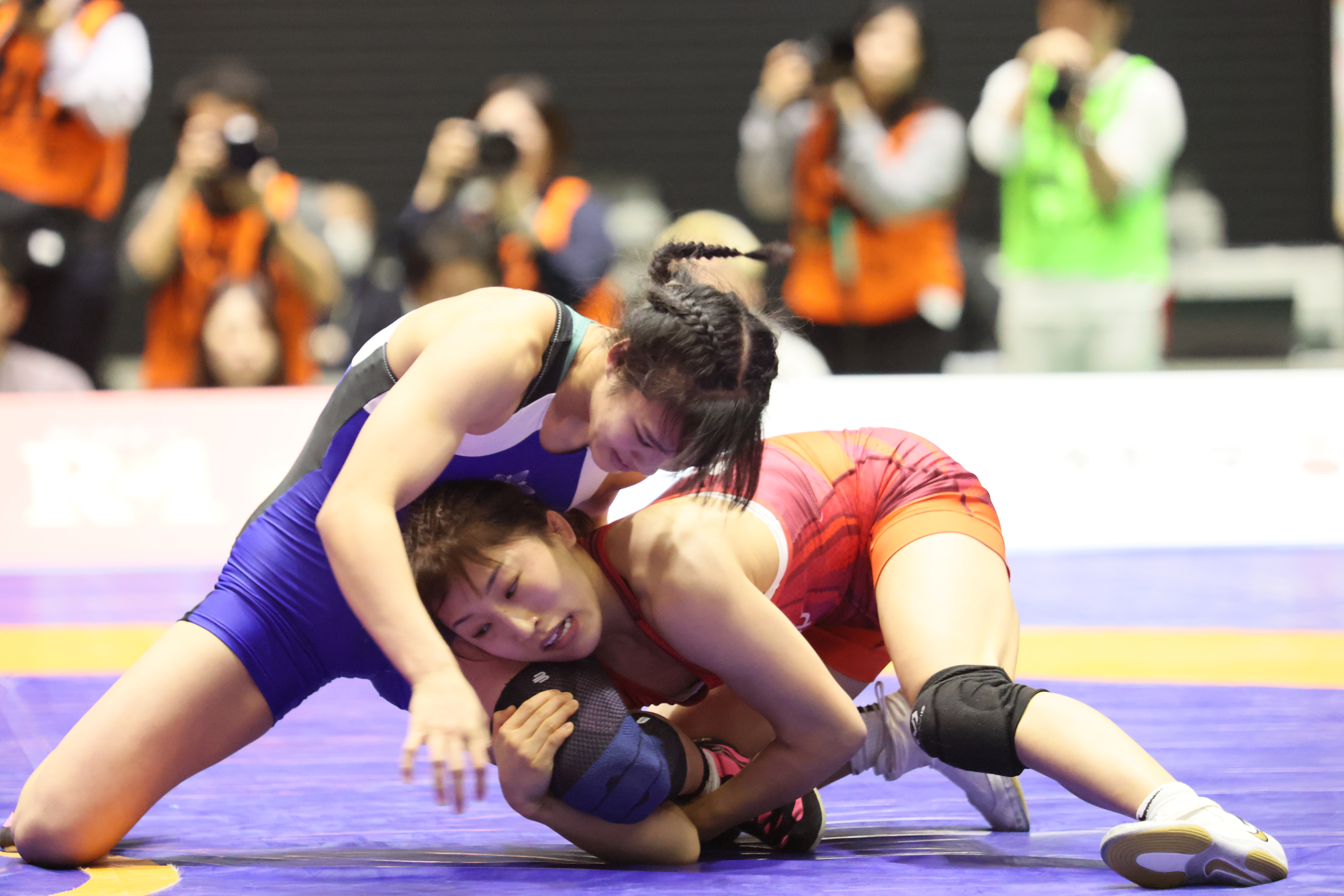 Yui SUSAKI shoots for a takedown against Haruna MORIKAWA in the women's 50kg final. (Photo: Takeo Yabuki / wrestling-spirits.jp)
At women's 50kg, Tokyo Olympic champion and Paris bronze medalist Yui SUSAKI turned a bit more conservative than she would have liked, but was never in danger in coming away with a 3-0 victory in the final over world U23 champion Haruna MORIKAWA.
Susaki scored a single-leg takedown and stepout in the first period, then spent the second trading underhook positions and fending off Morikawa's lone shot of the match to secure her fourth career title and first since 2022.
"It was my first All-Japan in awhile and I definitely wanted to win," Susaki said. "Although that feeling was strong, I wasn't aggressive enough in the second period. It was a match that brought up things to work on."
Susaki, a four-time world champion and another member of the "Golden Grand Slam" trio, took advantage of the absence of main rivals Remina YOSHIMOTO, who sat out the tournament, and Umi ITO, who withdrew due to injury.
"With the Los Angeles Olympics ahead and my main rivals not competing, I also considered this a tournament I couldn't lose," she said.
Susaki said the victory culminates a rough span since the disappointment of Paris, from which she still feels the sting of failing to defend her Olympic crown.
"There was the loss at the Paris Olympics, there were injuries and various hardships that I went through that I had never faced before," she said. "It was really a trying year and a half. If it wasn't for the support of many people, I would not have been able to make it back here."
In Greco 77kg, Kusaka executed a 2-point throw in his second chance from par terre -- there was some discussion over whether it should be scored as 4 -- which was enough for a 4-0 victory over 2023 champion Isami HORIKITA.
The victory added to Kusaka's lone other title, won at 72kg in 2019, and capped a year in which he also won a silver medal at the World Championships.
At Greco 67kg, defending champion Katsuaki ENDO won the latest in the seemingly endless series of finals with former Nippon Sports Science University teammate and top rival Kyotaro SOGABE, scoring a second-period gut wrench for a 3-1 victory.
It was Endo's fourth career title as he and Sogabe have now combined to win the last five golds.
Day 4 Results
Freestyle
65kg (15 entries)
GOLD: Kotaro KIYOOKA df. Takara SUDA, 5-2
BRONZE: Kaiji OGINO df. Shinnosuke SUWAMA, 3-0
BRONZE: Kaisei TANABE df. Futa MIYAZAKI by TF, 11-0, 3:45
74kg (11 entries)
GOLD: Yoshinosuke AOYAGI df. Kota TAKAHASHI, 4-4
BRONZE: Toki OGAWA df. Yujin TAKIZAWA, 4-1
BRONZE: Hikaru TAKATA df. Tatsuki KAMIYA by TF, 12-0, 2:35
Greco-Roman
67kg (13 entries)
GOLD: Katsuaki ENDO df. Kyotaro SOGABE, 3-1
BRONZE: Kensuke SHIMIZU df. Takaku SUZUKI by Fall, 4:30 (8-0)
BRONZE: Haruto YABE df. Kojiro HASEGAWA by TF, 13-2, 2:25
77kg (13 entries)
GOLD: Nao KUSAKA df. Isami HORIKITA, 4-0
BRONZE: Kiriru SHIMABUKURO df. Naoki KADODE, 7-1
BRONZE: Issei HONNA def. Kodai SAKURABA by Inj. Def.
Women's Wrestling
50kg (17 entries)
GOLD: Yui SUSAKI df. Haruna MORIKAWA, 3-0
BRONZE: Mako ONO df. Yuu SAKAMOTO, 3-1
BRONZE: Rinka OGAWA df. Kurumi KANAYAMA, 9-0
57kg (10 entries)
GOLD: Akari FUJINAMI df. Himeka TOKUHARA, 4-2
BRONZE: Rin KINOSHITA df. Risa MOTOHARA, 2-1
BRONZE: Sara NATAMI df. Miyu IWASAKI by Fall, 1:59 (4-0)
62kg (9 entries)
GOLD: Nonoka OZAKI df. Sakura MOTOKI, 3-3
BRONZE: Yuzuka INAGAKI df. Hana YOSHIKAWA by TF, 10-0, 3:38
BRONZE: Sakura ONISHI, no opponent



 Participants of the Referee Course go through in-match scoring situations. (Photo: United World Wrestling)
  Attendees go through a drill session during one of the training sessions in Australia. (Photo: United World Wrestling)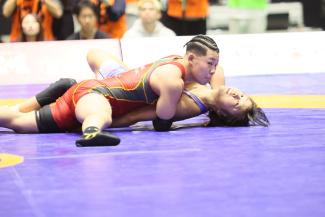
Share your thoughts.
Comments