TOKYO (December 19) -- The buzzing that had barely died down from the epic clash of reigning world champions in the previous match turned to gasps when Paris Olympic champion Yuka KAGAMI was dealt a shocking loss to spoil her return to competition.
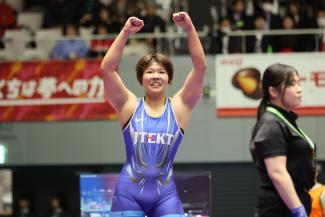
Yasuha MATSUYUKI notched one of the biggest wins of her career, scoring a buzzer-beating takedown to defeat Kagami 4-2 in the women's 76kg final on the second day of the Emperor's Cup All-Japan Championships on Friday.
"I was continually finishing second, so I'm happy to finally win the championship," said Matsuyuki, a longtime fixture on the podium but whose lone previous title came in 2019.
Matsuyuki's victory overshadowed one of the most anticipated matches of the four-day tournament, in which world 65kg champion Miwa MORIKAWA moved up to 68kg and notched a well-earned 5-3 win over Ami ISHII, the reigning world champion in the weight class.
The national championship at Tokyo's Komazawa Gym carries with it additional perks, as it is also serving as the qualifier for the Asian Championships in April, and as one of two qualifiers for the Asian Games and World Championships in the fall.
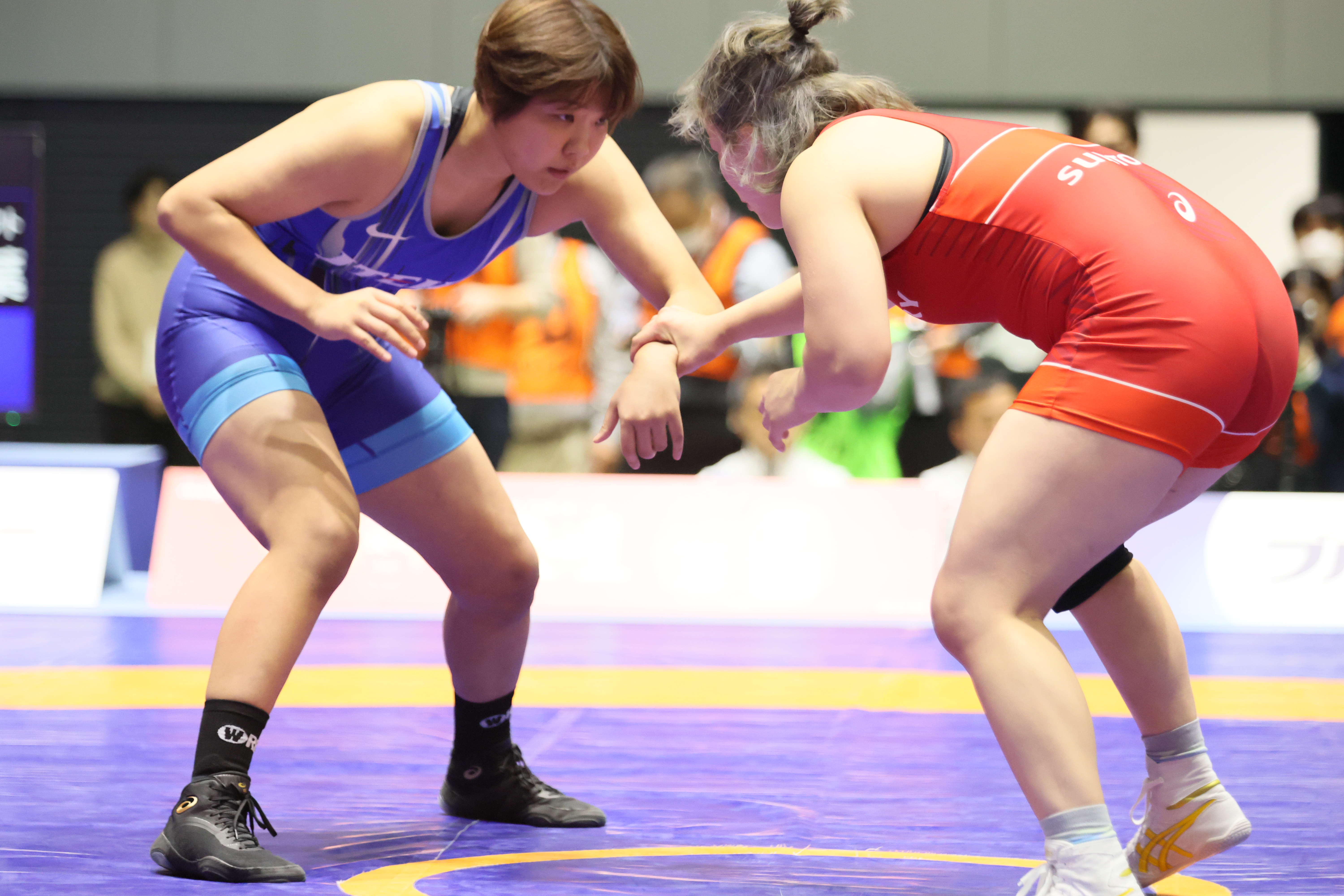 Yasuha MATSUYUKI, left, fends off Paris Olympic champion Yuka KAGAMI in the women's 76kg final. (Photo: Takeo Yabuki / wrestling-spirits.jp)
The 26-year-old Matsuyuki has an added incentive to get to the Asian Games, as the event will be held in her native Aichi Prefecture. But getting there will likely mean having to repeat her victory over Kagami at the second domestic qualifier, the Meiji Cup All-Japan Invitational Championships in the late spring.
Whatever her fate, the three-time world age-group bronze medalist can always look back on pride at having defeated an Olympic champion, even if it was in the latter's first competition in 16 months.
"I focused doing what I wanted to do, and keeping the opponent from doing what they wanted to do. In the final in particular, my thought was to keep the points I give up to a minimum," said Matsuyuki, one-half of a set of twin sisters who have a long list of podium finishes at national competitions.
In the final, Kagami took a 2-0 lead into the second period after scoring a stepout while Matsuyuki was on the activity clock.
"When she got her second point, I thought that if I give up any more, that would really put me in a bind," Matsuyuki said. "Anyway, I didn't want to give up any more points. At the very end, I thought only of how to go ahead."
After cutting the gap with an activity point, Matsuyuki was trying to work for an opening as the clocked ticked down and Kagami put up a stiff resistance. Matsuyuki managed to secure a body lock from the side, which Kagami countered with a hard whizzer, leaving the two battling side-by-side on their knees.
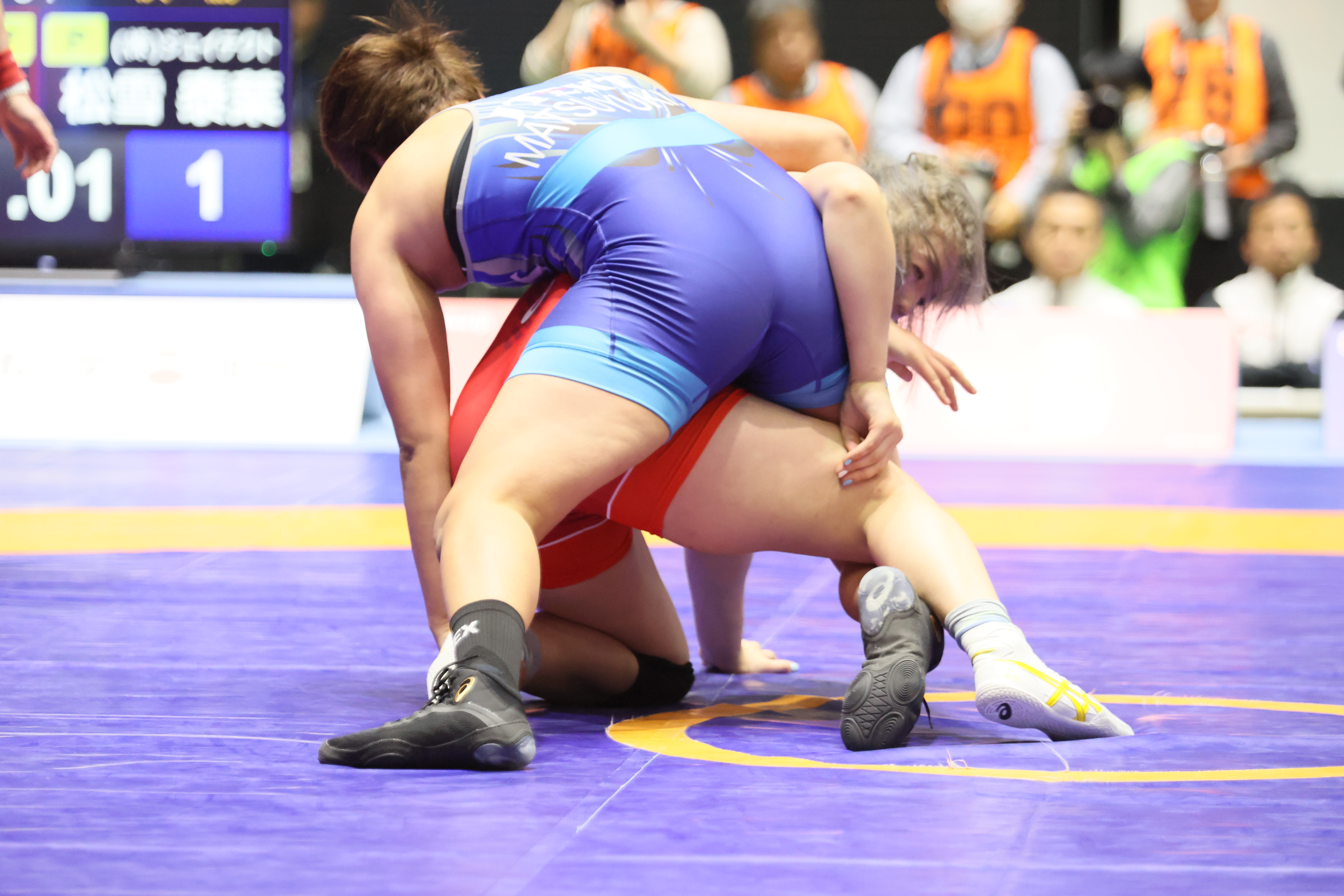 Yasuha MATSUYUKI, top, completes the winning takedown in the final seconds of the women's 76kg final. (Photo: Takeo Yabuki / wrestling-spirits.jp)
With time running out, Matsuyuki, using her decided height advantage, went over the top and slipped a grapevine in from the opposite side. From there, it was a matter of getting her arm out of the whizzer -- which she did with :01 on the clock to the shock of the crowd. The takedown was upheld on challenge, making the final score 4-2.
Asked what was going through her mind during the challenge, Matsuyuki replied, "When I got behind and got my arm out, the clock was still going, so I thought I would be alright."
Kagami, who had been aiming for her fourth career title and first since 2021, has gained quite a national following after her triumph in Paris, affably appearing on a wide range of TV variety shows.
"I'm sorry to everyone who came to support me," Kagami said. "I was thinking about defending the lead."
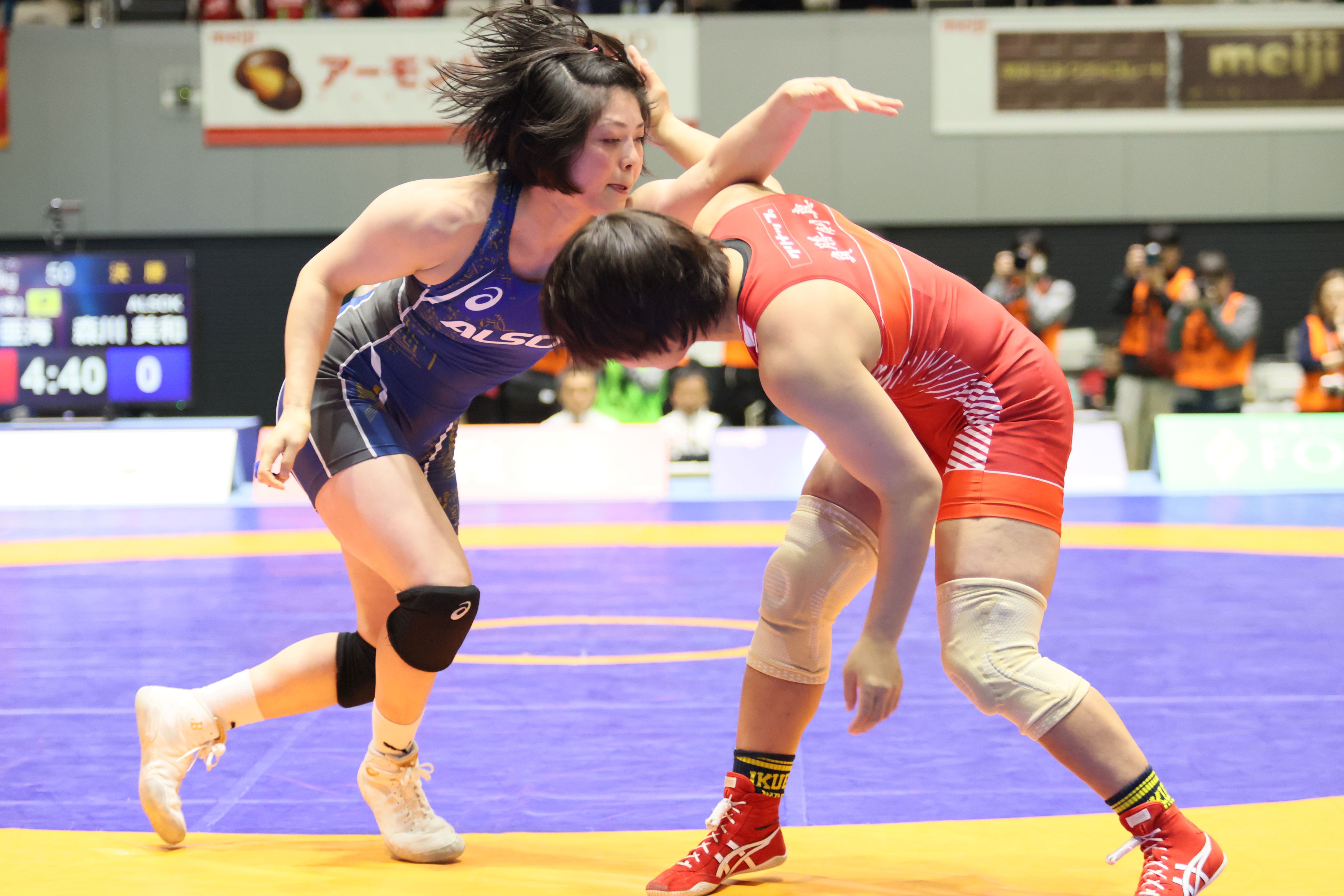 Reigning world champions Miwa MORIKAWA, left, and Ami ISHII battle in the women's 68kg final. (Photo: Takeo Yabuki / wrestling-spirits.jp)
The clash between Morikawa and Ishii lived up to its billing, and portends a fierce competition all the way up to the 2028 Los Angeles Olympics after both came up short of Paris.
"It's been awhile since I've competed at 68kg, but I decided to move up after the World Championships," Morikawa said. "I think this is a good first step toward Los Angeles."
Morikawa struck first, withstanding Ishii's underhook attack to score a stepout, gain an activity point, then counter a single-leg attempt to get behind for a takedown. Ishii gained a stepout herself to make it 4-1 at the break.
In the second period, Morikawa picked up another stepout, then survived a dicey predicament that could have been far worse. Ishii got in on a low single, which Morikawa countered by reaching to the side and grabbing a leg.
But Ishii managed to step over and pressured her leg into Morikawa's chest, which gained an exposure and put her dangerously close to a fall. Morikawa opted to keep hold of the leg and managed to squirm out of the situation, thus limiting Ishii to just two points.
"If I had let go of the leg, she might have been able to turn me a few times," Morikawa said. "I just tried to avoid the fall, and that kept it to two points."
Morikawa had lost to Ishii in two of three bouts between the two over a six-month span from late 2022 to mid-2023 in the qualifying process for Paris (in which Ishii eventually lost out to Nonoka OZAKI). She knows that she has not seen the last of her rival.
"I know she is a strong opponent," Morikawa said. "She is the world champion, and I had disappointed losses to her before and missed out on Paris.
"I kept believing that if I can give everything I have, the results will come. I do everything that needs to be done, just as my coach [four-time Olympic champion Kaori ICHO] tells me. Today the result was a victory, which is great, but with my win, it means my opponent is going to be training even harder. I have to do the same."
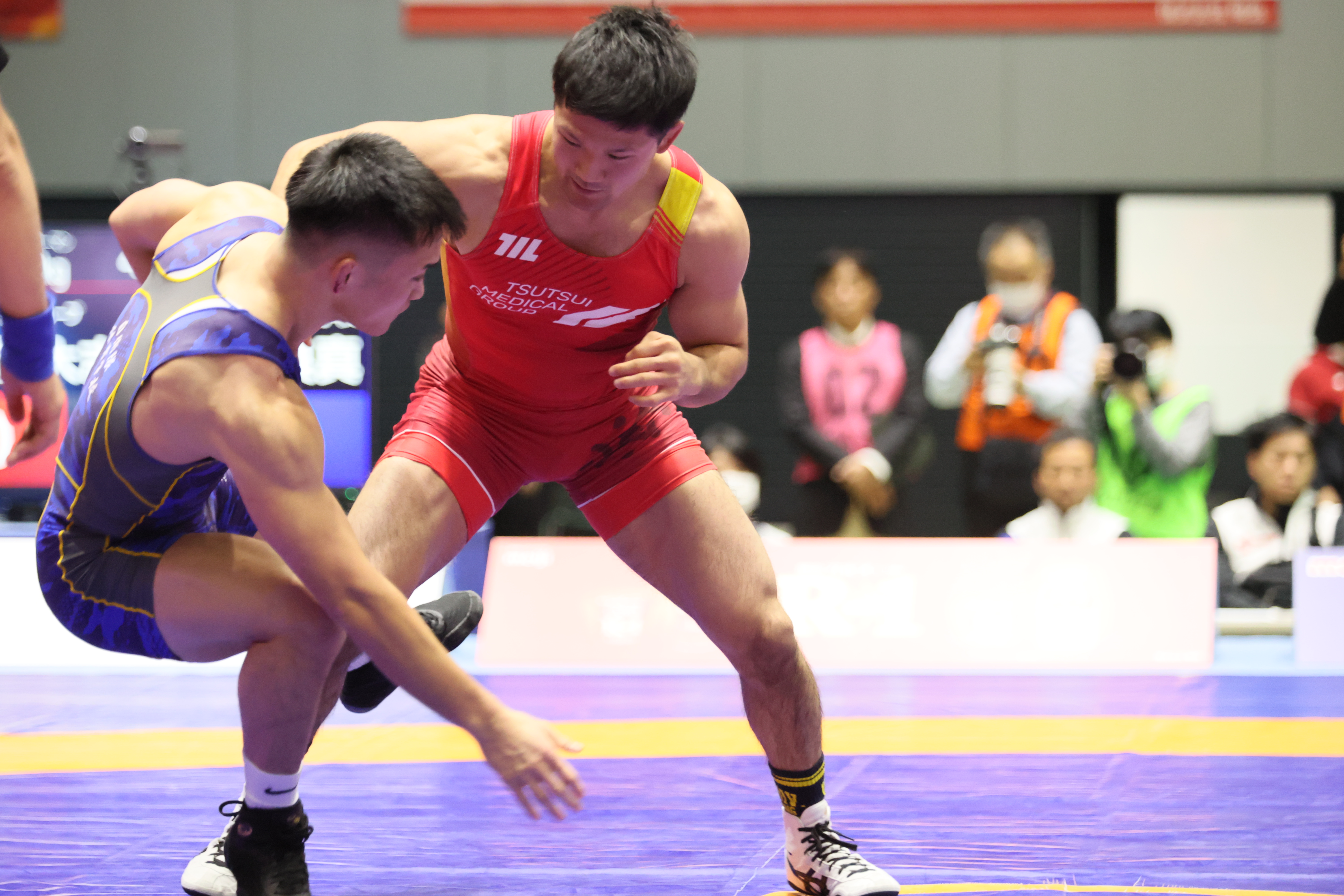 Taishi NARIKUNI, right, knocks Ryoma HOJO temporarily off balance during the Greco 72kg final. (Photo: Takeo Yabuki / wrestling-spirits.jp)
Narikuni emulates Tanabe, achieves Greco half of two-style double
In the tournament, Olympic weight classes are being competed over two days, while non-Olympic divisions are completed in a single day.
In a case of the latter, Taishi NARIKUNI joined Kaisei TANABE as a winner of a Greco title as part of their attempts to complete the first Greco-freestyle double in over 50 years.
Narikuni gained a second-period takedown that gave him a 3-1 victory over Ryoma HOJO in the 72kg final for his first Greco title at the Emperor's Cup.
"My mind is on tomorrow," Narikuni said when asked how he felt about his victory.
Having previously won the freestyle 70kg title in 2021, he joined a select group of wrestlers who have won titles in both styles over their careers.
But the 2022 world freestyle 70kg champion is looking to complete the double in the same tournament, when he competes in that weight class on Saturday. That hasn't been done since 1973.
In doing so, Narikuni would beat Tanabe to the punch. Tanabe won the Greco 63kg title on Thursday, but to complete the double, he needs a victory in the final at freestyle 65kg -- which won't be until Sunday.
Narikuni's ultimate goal is to win world titles in both styles -- his way of exceeding his mother, who was a two-time world champion. That has caused him to put immense pressure on himself.
"My value will only be recognized if I get it tomorrow," Narikuni said. "If I don't make it, entering this tournament will be meaningless."
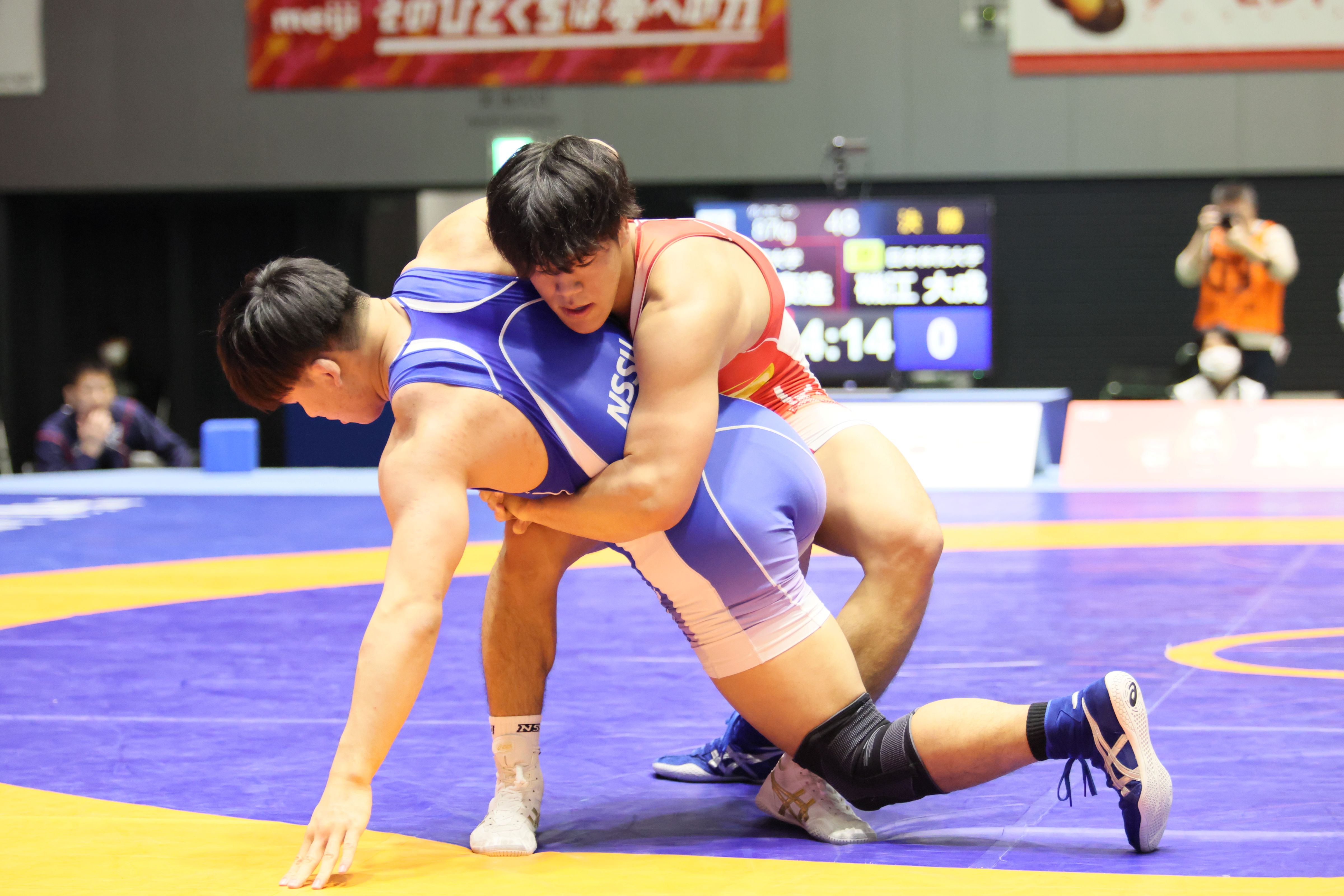 Taizo YOSHIDA, right, gets a grip on Daisei ISOE, but is unable to complete the lift. (Photo: Takeo Yabuki / wrestling-spirits.jp)
In other finals, teen phenom Taizo YOSHIDA, a senior world bronze medalist at Greco 82kg, made a successful move up to 87kg, defeating Nippon Sports Science University teammate Daisei ISOE 6-1.
The weight difference might have been seen in Yoshida's inability to complete a lift, but he was never in danger of losing after combining three stepouts and a go-behind takedown for his second senior national title.
At freestyle 61kg, former world bronze medalist Toshihiro HASEGAWA won his first Emepror's Cup title in four years with a 14-4 victory over world U23 bronze medalist Akito MUKAIDA.
In a rematch of the final from the Meiji Cup last June won by Hasegawa, he gave up a pair of takedowns in the first period to trail 4-0 going into the second. But fate dealt Mukaida a heavy blow, as Hasegawa caught him with an ankle-low single, then went right to the lace lock. Mukaida appeared to suffer a knee injury as Hasegawa easily rolled him six times.
Teenager Yamato OGAWA, a 2023 world U17 champion, became the sixth different champion in six years at freestyle 57kg, overcoming a five-point deficit in the second period to defeat Fuga SASAKI 6-5.
Ogawa's comeback featured a 4-point arm throw as he won in a weight class that was missing, among others, the U.S.-based pair of defending champion Rin SAKAMOTO and former world 61kg champion Masanosuke ONO.
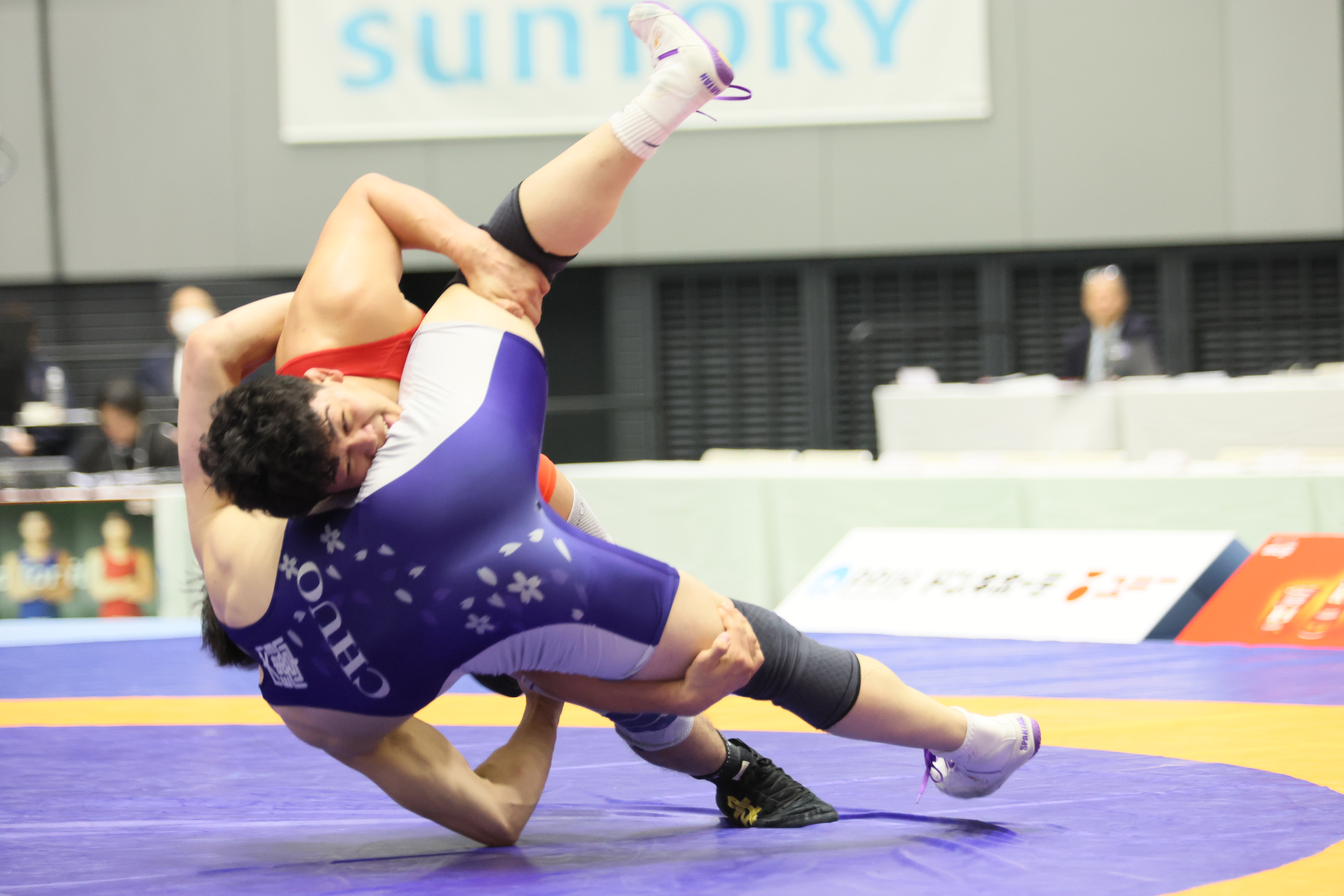 Arash YOSHIDA completes a takedown to the back against Toyoki HAMADA in their freestyle 97kg semifinal. (Photo: Takeo Yabuki / wrestling-spirits.jp)
Yoshida powers into final
In Olympic weight classes that were run up to the semifinals, rising star Arash YOSHIDA set himself up for a three-peat at freestyle 97kg by advancing to Saturday's final.
With entries limited in the division he now dominates, the 21-year-old Yoshida received a forfeit that put him directly into the semifinals, where he demolished Toyoki HAMADA by fall after building an 11-1 lead.
In the final, Yoshida will face high schooler Noah LEIBOWITZ in a rematch of the gold-medal match at the Meiji Cup that Yoshida won by fall. The match will be sort of a proxy fight between Iran and the United States, given that their fathers are natives of those wrestling powerhouses, respectively.
A victory would cap a breakout year for Yoshida, highlighted by his bronze medal at the senior World Championships in Zagreb. He also won the senior Asian and world U23 titles.
Meanwhile, the irrepressible Sohsuke TAKATANI, who won 12 consecutive titles over four freestyle weight classes from 74kg to 92kg starting in 2011, earned a shot at his first in three years by making the final at 86kg.
Takatani, now 36 and the head coach at Takushoku University, edged Tatsuya SHIRAI 2-1 in the semifinals, with all of the points scored on the activity clock. In the final, he will take on Kodai TAKAHASHI, an 8-2 winner over Natsura OKAZAWA.
Ironically, both Takatani and Takahashi have seen their younger brothers outshine them of late. Daichi TAKATANI won the 74kg silver medal in Paris, while Kota TAKAHASHI struck gold at the Zagreb worlds in the same weight class.
At women's 53kg, defending champion Moe KIYOOKA dealt Tokyo Olympic champion Mayu SHIDOCHI another setback in her return from a hiatus for marriage and childbirth, scoring takedowns in both periods in a 5-2 victory in the semifinals.
In the final, she will face 2023 world U23 55kg champion Umi IMAI, a 5-0 winner over Saki YUMIYA. Kiyooka will be aiming for a fourth straigt national crown, having won back-to-back at 55kg in 2022 and 2023.
World champion Haruna MURAYAMA OKUNO is skipping the tournament.
An enticing final was set up at Greco 60kg, in which Yu SHIOTANI, a former world bronze medalist and the 2021 Emperor's Cup champion at 55kg, will face current world U23 champion Koto GOMI.
Shiotani, a two-time Asian champion who won the Tirana Ranking Series event in February, advanced with a 5-2 victory over Takuma NAKASHIMA. Gomi knocked off 2023 Asian Games silver medalist and three-time former champion Ayata SUZUKI 9-4.
Day 2 Results
Freestyle
57kg (18 entries)
GOLD: Yamato OGAWA df. Fuga SASAKI, 6-5
BRONZE: Kento YUMIYA df. Kentaro KAWANO by TF, 11-0, 1:48
BRONZE: Rikuto NAGAI df. Yamato FURUSAWA, 8-4
61kg (20 entries)
GOLD: Toshihiro HASEGAWA df. Akito MUKAIDA by TF, 14-4, 4:51
BRONZE: Shosuke TAKASUGI df. Atsushi KATO, 2-1
BRONZE: Meiryu AKAMINE df. Kodai OGAWA, 4-0
SF 1: Toshihiro HASEGAWA df. Atsushi KATO by Fall, 2:59 (7-0)
SF 2: Akito MUKAIDA df. Kodai OGAWA, 9-4
86kg (10 entries)
SF 1: Kodai TAKAHASHI df. Natsura OKAZAWA, 8-2
SF 2: Sohsuke TAKATANI df. Tatsuya SHIRAI, 2-1
97kg (8 entries)
SF 1: Arash YOSHIDA df. Toyoki HAMADA by Fall, 2:07 (11-1)
SF 2: Noah LEIBOWITZ df. Keita KOBAYASHI by TF, 10-0, :32
125kg (10 entries)
GOLD: Taiki YAMAMOTO df. Taira SONODA, 3-0
BRONZE: Hosei FUJITA df. Akinari ORIYAMA, 4-0
BRONZE: Hibiki ITO df. Yuta MITSUHASHI by TF, 10-0, 1:22
Greco-Roman
60kg (16 entries)
SF 1: Yu SHIOTANI df. Takuma NAKASHIMA, 5-2
SF 2: Koto GOMI df. Ayata SUZUKI, 9-4
72kg (18 entries)
GOLD: Taishi NARIKUNI df. Ryoma HOJO, 3-1
BRONZE: Rintaro SOGABE df. Takara FUKUSAWA, 6-0
BRONZE: Takeru KOZUKA df. Rei NAGAMATSU, 10-6
SF 1: Taishi NARIKUNI df. Takara FUKUSAWA by Fall, 1:51 (4-0)
SF 2: Ryoma HOJO df. Takeru KOZUKA by TF, 9-0, 2:01
87kg (9 entries)
GOLD: Taizo YOSHIDA df. Daisei ISOE, 6-1
BRONZE: Genki YAHAGI df. Takahiro MURAYAMA, 4-3
BRONZE: Chihiro MOTOHASHI df. Takahiro INAMOTO by Fall, 2:02 (6-1)
97kg (16 entries)
GOLD: Takahiro TSURUTA df. Yuri NAKAZATO, 1-1
BRONZE: Atsuki CHIDA df. Koki MATSUMOTO, 3-2
BRONZE: Kanta SHIOKAWA df. Sorato NAKAZAWA, 7-5
130kg (9 entries)
SF 1: Yuta NARA df. Ayumu IWASAWA by TF, 9-0, 2:07
SF 2: Shion OBATA df. Sota OKUMURA, 3-3
Women's Wrestling
53kg (10 entries)
SF 1: Moe KIYOOKA df. Mayu SHIDOCHI, 5-2
SF 2: Umi IMAI df. Saki YUMIYA, 5-0
59kg (19 entries)
GOLD: Sena NAGAMOTO df. Sae NANJO, 3-2
BRONZE: Konami ONO df. Sae NOGUCHI by Inj. Def.
BRONZE: Yuri KOSHIBA df. Hiyori MOTOKI, 6-4
SF 1: Sena NAGAMOTO df. Sae NOGUCHI by TF, 10-0, 3:10
SF 2: Sae NANJO df. Hiyori MOTOKI by TF, 10-0, 1:06
68kg (8 entries)
GOLD: Miwa MORIKAWA df. Ami ISHII, 5-3
BRONZE: Momoko KITADE df. Kaede MATSUYAMA, 5-3
BRONZE: Ray HOSHINO df. Rua YOKOYAMA by Fall, 1:51 (8-0)
76kg (8 entries)
GOLD: Yasuha MATSUYUKI df. Yuka KAGAMI, 4-2
BRONZE: Nodoka YAMAMOTO df. Sakura NAKANO by Fall, 2:08 (10-0)
BRONZE: Mahiru FUJITA df. Makoto KOMADA by TF, 10-0, 3:50




Share your thoughts.
Comments