Development

Wrestling Enters a New Era in Southern Africa with Namib Storm and SADC Open Championships

By United World Wrestling Press

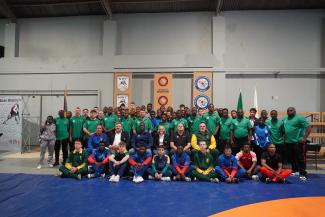
WINDHOEK, Namibia — July 2025 The Namibian Wrestling Federation (NWF), in partnership with United World Wrestling (UWW) and Olympic Solidarity, launched a landmark initiative to boost wrestling development in Southern Africa: the Namib Storm Wrestling Week and SADC Open Championships, held from 30 June to 5 July 2025 at the Windhoek Showgrounds.

Speaking at the official launch in Windhoek, NWF President Colin Steytler emphasized the significance of this new chapter for the sport:

“This is where everything comes together — grassroots, elite, and development levels. It’s the most important step we’ve taken to date in bringing our strategic goals to life.”

A New Benchmark for Regional Wrestling Development

The week-long event featured two core components:

  • REDT – Namib Storm Training Camp (30 June – 3 July)
    This high-performance camp delivered Level 3 Coaching and Level 2 Refereeing Certification under the guidance of UWW instructors — a first for Namibia and a major milestone for the region.

“You can’t grow grassroots wrestling without qualified coaches,” Steytler noted.
Coaches and officials from multiple countries, including Zambia, Zimbabwe, South Africa, and Mauritius, took part in intensive technical sessions.

  • SADC Open Championships (4 July)
    This tournament gathered elite athletes from Angola, South Africa, Zimbabwe, and beyond — many of whom are continental medallists. Importantly, the SADC Open became the first UWW-rated event in Southern Africa, enabling both athletes and referees to earn international exposure without needing to travel abroad.

“This changes the game,” said Steytler. “We can now compete regionally and still gain global recognition — this saves costs and boosts participation.”
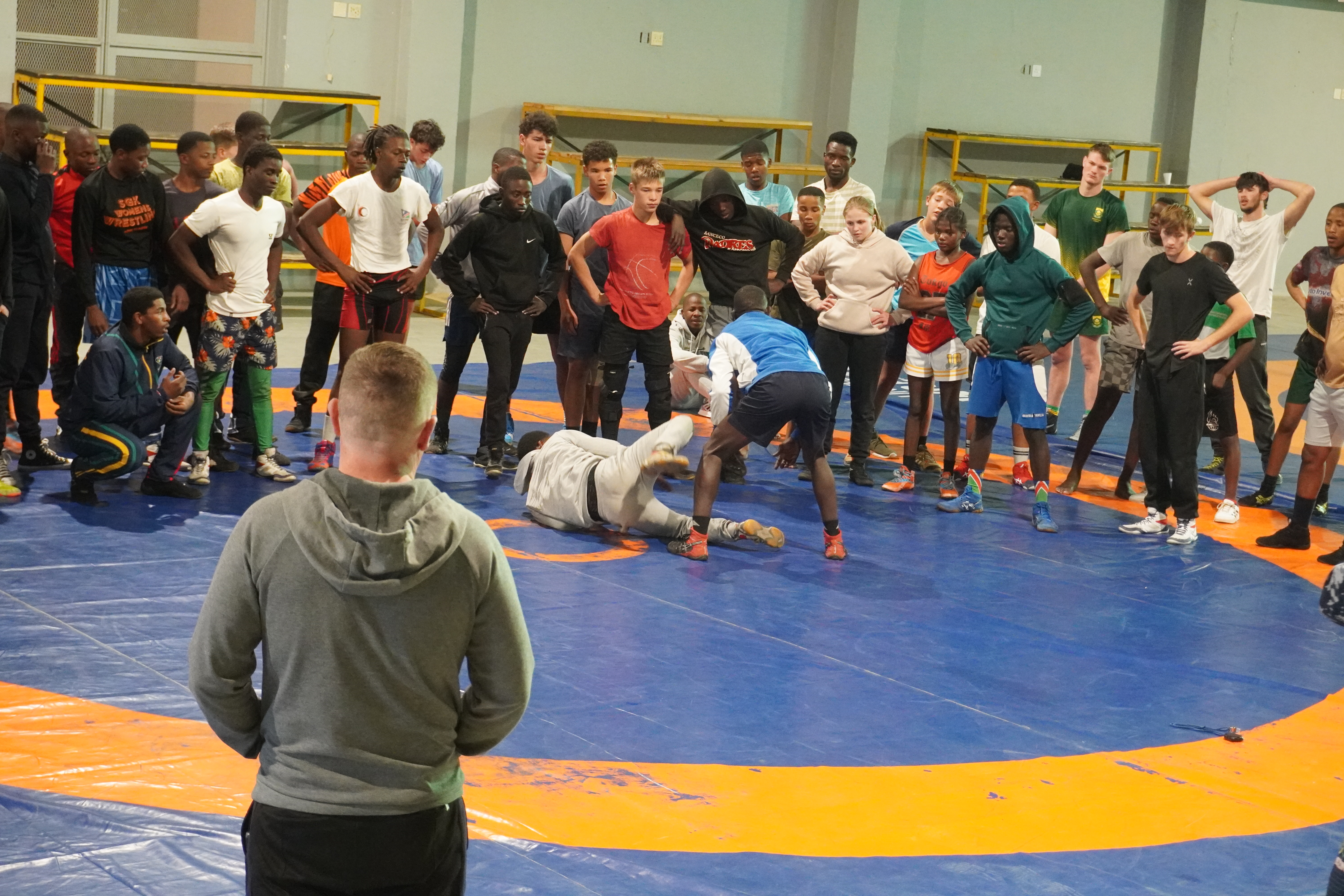
NAMAttendees go through the Level 3 Coaching and Level 2 Refereeing Certification under the guidance of UWW instructors. (Photo: United World Wrestling)

Beach Wrestling: Taking the Sport to New Shores

The week concluded on 5 July with a Beach Wrestling showcase, reinforcing UWW’s commitment to accessibility and outreach.

“Beach wrestling will be the only wrestling discipline featured at the 2026 Youth Olympic Games in Senegal,” Steytler reminded. “And we are proud to host Namibia’s first-ever beach wrestling event in Swakopmund on 7 December 2025.”

Beach wrestling, requiring only sand and a rope, offers a practical and inclusive way to expand the sport into rural and underserved communities — a cornerstone of UWW’s vision.

Towards a Self-Sustaining Wrestling Future

The REDT initiative and Namib Storm programme are part of the NWF’s five-year strategy to develop a self-sustainable wrestling ecosystem, bridging the gap between grassroots and elite competition and aiming for future Olympic qualification and medals.

“The Namib Storm Week and SADC Open pull all of our strategic elements together,” said Steytler. “From here, we take what we’ve built back to the regions and expand wrestling further than ever before.”

This event highlights Southern Africa’s growing role in the global wrestling community and reflects UWW’s dedication to regional empowerment, education, and international competition access.

#JapanWrestling

Fujinami to move up to 57kg in quest for consecutive Olympic golds

By Ken Marantz

TOKYO (November 26) -- Akari FUJINAMI (JPN) won't be defending her Olympic gold at women's 53kg at the 2028 Los Angeles Games. That's bad news for anyone aiming to strike gold at 57kg.

Fujinami has announced that she will move up to the next Olympic weight class starting next year, the Japan federation website and Japan media widely recently reported.

Fujinami, who turned 21 on November 11, cited the difficulty of cutting weight for the decision, as well as the historic aspect that no woman wrestler has ever won a second straight Olympic gold after moving to a higher weight class.

"I have decided to move up to the 57kg weight class," Fujinami said after Sunday's East Japan Collegiate Women's League, a team tournament that marked her first competition since winning the gold at the Paris Olympics in August. "Considering my height and my normal weight, I think I can give my best performance at 57."

Fujinami competed at 59kg in the five-team league tournament (one school was a no-show), which was run in a round-robin, duel-meet format with only three weight classes -- 53kg, 59kg and 76kg.

She won both of her matches by fall, extending her current winning streak to 139 matches dating back to her junior high school days in September 2017.

The 1.64-meter Fujinami was actually wrestling near her natural weight, which she says is "about 61kg." But even against two opponents from higher weight classes -- Ikuei University's Ichika ARAI (JPN) was the 2023 world U20 silver medalist at 57kg -- her skills and speed were still overwhelming.

"It has been really hard to cut down to 53kg," Fujinami said. "I felt I lost muscle during the process. I feel I can give my best performance by going down three kilos from my natural weight."

Asked when she expects to make her full-fledged "debut" at the new weight, she replied in a text message, "It will be sometime next year. I haven't decided exactly when yet."

With a full schedule of post-Olympic TV appearances and local events curtailing her training, she has already ruled out appearing at next month's Emperor's Cup All-Japan Championships.

It is likely she will compete at the Meiji Cup All-Japan Invitational Championships in the spring, as that tournament, along with the Emperor's Cup, will serve as qualifiers for the 2025 World Championships.

The move up to 57kg will likely put her on a collision course with the reigning Olympic champion, Tsugumi SAKURAI (JPN). The two met last year at the East Japan Collegiate tournament, with Fujinami coming away with a 5-0 victory.

The challenge of possibly accomplishing a historic first appeals to Fujinami, who last year won her second career world title at 53kg in Belgrade.

"I heard that no [woman] has moved up a weight class and won another Olympic gold," Fujinami said. "It will difficult, but that's what makes it challenging. I hope I can become stronger at the next [Olympics] in Los Angeles."

Two Japanese women -- Saori YOSHIDA (JPN) and Kaori ICHO (JPN) -- have won an additional Olympic gold after going down a weight, but that was mainly because the number of weight classes was expanded from four to six, allowing them to compete more closely to their normal weight.

Among men, the legendary Aleksandr MEDVED (URS) won the freestyle 97kg gold in 1964, then triumphed again at 97+kg in 1968, while Levan TEDASHVILI (URS) won at freestyle 82kg in 1972 and 90kg in 1976. More recently, Abdulrashid SADULAEV claimed the freestyle 86kg gold in 2016, then won again at 97kg in 2021.

Fujinami said she doesn't expect to make any major alterations to her wrestling style at the heavier weight.

"I have no intention of making any big changes in my wrestling style," she said. "I will still try to keep the opponent from getting at my legs, and take the initiative to score points. Still, I can feel the extra weight of four kilos, so how I increase my weight could affect how I perform."

At this year's East Japan league tournament, Fujinami's Nippon Sport Science University was relegated to second by Ikuei University, which won 2-1 in their duel meet. Ikuei got victories from Moe KIYOOKA (JPN) and Ami ISHII (JPN), who both won gold medals at last month's Non-Olympic Weight Category World Championships.