

#WrestleOslo: Intrepid Geraei Adds World 67kg Greco Title to Olympic Gold
Sunday, October 10, 2021 - 23:31 By Ken Marantz

OSLO, Norway (October 10) -- Mohammadreza GERAEI (IRI) ended the World Championships just as did at the Tokyo Olympics two months ago. At the top of the medal podium.
Geraei was one of two Iranian champions on the final night of the nine-day tournament in Oslo, winning the 67kg gold with a 5-2 victory over Nazir ABDULLAEV (RWF) as the last three titles in Greco-Roman were decided on Sunday night at the Jordal Amfi arena.
"After the lockdown, I was able to win the gold medal at the Olympics and World Championships, so 2021 is the best year of my life," Gereai said.
Meysam DALKHANI (IRI) preceded his fellow Shiraz city native as a world champion by taking the title at 63kg, while Tokyo Olympic bronze medalist Zurabi DATUNASHVILI (SRB) capped the tournament with a dazzling 5-point throw that gave him the 87kg title and a long-awaited world gold.
The Russian Wrestling Federation, which earlier won the freestyle team title, had already clinched its fifth straight Greco-Roman crown heading into the final night. With Iran's two golds, the final tally put the RWF on top with 152, followed by Iran with 146. Azerbaijan was third with 107.
Geraei, the 2019 world U23 champion at 72kg, had a pair of very close calls in the opening rounds, but never wavered nor panicked as he battled his way to his first final on the senior level.
Against 2020 European silver medalist Abdullaev, Geraei was unable to score off the par terre in the first period and took a tenuous 1-0 lead into the second.
But the 25-year-old took matters into his own hands, transitioning from a body lock to a headlock and throwing Abdullaev to the mat for 4. Abdullaev, the 2020 Individual World Cup, picked up 2 points countering a throw attempt at the edge, but that was all he could muster against the cagey Iranian.
 Mohammadreza GERAEI (IRI) scored four points through a headlock. (Photo: UWW / Martin Gabor)
Geraei's triumph came two days after older brother Mohammadali won a bronze at 77kg. "I want to thank everyone from my hometown Shiraz as we won medals," he said.
If Mohammadali is nicknamed "The Falcon," then Mohammadreza could be called "The Phoenix" for how he continually arose from the ashes of near-defeat.
In his opening match, Geraei fell behind 1-6 against Asian champion Tsuchika SHIMOYAMADA (JPN), only to pull off a miracle comeback and score a fall with a bear hug. In the semifinals, a pair of 2-point fleeing penalties and an unsuccessful challenge in the final seconds gave him a 7- 6 win over Ramaz ZOIDZE (GEO).
"I know most of my victories were last-second, but I believed in myself and thank God that I was able to pull it off," Geraei said.
The 30-year-old Abdullaev made the final despite coming to Oslo without a long list of honors. He had a triumph at the Individual World Cup, however, that was noteworthy in that his quarterfinal victory over Davor STEFANEK (SRB) ended up being the final match of the 2016 Rio Olympic champion's career.
 Meysam DALKHANI (IRI) won the 63kg in Oslo. (Photo: UWW / Kadir Caliskan)
In a seesaw battle between young, upcoming stars at 63kg, 2019 world U23 champion Dalkhani scored a decisive stepout with 1:08 left to defeat European bronze medalist Leri ABULADZE (GEO) 5-4.
"I am very happy and I was expected to get this gold," Dalkhani said. "It's been difficult since the corona pandemic and it's been an endeavour to get this title and I am happy that I would reach the expectations of my coaches and country. I am just a soldier for my country."
Dalkhani, this year's Asian silver medalist, took a 3-1 lead when he scored with a gut wrench from the par terre, off of which Abuladze gained a reversal. Abduladze then went up 4-3 in the second period when he mirrored Dalkhani with a gut wrench from par terre.
 Meysam DALKHANI (IRI) won one of the four gold medalists from Iran. (Photo: UWW / Kadir Caliskan)
With the clock winding down, Dalkhani kept the pressure on, and just managed to force Abuladze to step outside the ring before the Georgian slapped him down and spun behind, putting the Iranian ahead on criteria.
The Georgian side challenged the call but was rejected, giving Dalkhani a fifth point, and he held on for the win. Abuladze flopped to the mat in misery, while Dalkhani's coach flung him to the mat in celebration.
The 24-year-old Dalkhani won a bronze medal at the 2016 world juniors, and finished fifth in his senior world debut in Nursultan in 2019. Abuladaze, 22, was a world junior silver medalist in 2019, and has a full set of European junior medals with a 2017 gold, 2019 silver and 2018 bronze.
"I was in Nursultan and I did not manage to get anything, but I thank God that I managed to get gold here," Dalkhani said.
 Zaurabi DATUNASHVILI (SRB) won the 87kg gold medal after a big five point throw. (Photo: UWW / Martin Gabor)
The final match of the tournament ended with a bang, or more specifically, a thud -- the sound of Kiryl MASKEVICH (BLR) hitting the mat after being majestically tossed for 5 by four-time European champion Datunashvili in the 87kg final.
"It was a hard match but I had the strategy," Datunashvili said. "Me and my coach worked it out."
Datunashvili scored all of his points in the second period, capped with his arching 5-point throw that finished off a 9-1 technical fall at 3:46 and made his first medal in four senior world appearances a gold one.
Behind 0-1 in the second period, the Georgian-born Datunashvili stopped a lateral drop attempt for 2, then got 2 more when Maskevich was penalized for fleeing by bridging out of bounds. That also put Datunashvili into par terre, and he thrilled the crowd with the spectacular throw.
"I know a lot about him, his wrestling," Datunashvili said. "He made a mistake and I won at that moment."
 Zaurabi DATUNASHVILI (SRB) is the third Greco-Roman world champion from Serbia. (Photo: UWW / Kadir Caliskan)
The two met twice before over the past 10 months, with each winning one. Maskevich won 11-3 in the semifinals en route to the gold at the 2020 Individual World Cup, while Datunashvili avenged the loss with a 5-1 win in the European final this past April.
"He is one of the best wrestlers in our weight category," Datunashvili said. "He won, then I won, and now I won. It was now the final. I am king."
The European gold preceded Datunashvili's run to the Olympic bronze, where he lost in the first round to eventual champion Zhan BELINIUK (UKR) but worked his way back through the repechage.
"In Tokyo, I won bronze and my psychology was very good after that," Datunashvili said. "I rested for one month and prepared for Oslo for one month."
Datunashvili, who began competing for Serbia in 2020, had qualified for his third Olympics at the last-chance qualifier by defeating 2016 Olympic champion Davit CHAKVETADZE (RUS).
Maskevich also qualified for Tokyo, but was eliminated after a first-round loss. The 2019 world U23 bronze medalist had been hoping to become Belarus' first senior world champion since 2011.
In the bronze-medal matches, Lasha GOBADZE (GEO), unable to win a second straight world gold, came away with a second career bronze by defeating Turpan BISULTANOV (DEN) 5-2 at 87kg.
Gobadze, the 2019 world champion at 82kg, scored 4 points with a crafty move from the par terre position to avenge a 4-3 loss to the 20-year-old Bisultanov in the 2019 European final.
Gobadze lifted Bisultanov into the air, but finding he could not get enough leverage for a throw, he just fell forward and dumped him onto his back for 4. Bisultanov scrambled behind for a 1-point reversal, but could not get points from par terre himself in the second period, sealing the win for Gobadze.
Bisultanov, just three years removed from winning a bronze at the world cadets, had lost in the bronze-medal match at this year's European Championships to Milad ALIRZAEV (RWF) -- who Gobadze defeated in the repechage earlier in the night.
In the other 87kg match, Arkadiusz KULYNYCZ (POL) took the lead in the second period, then scored a fall at 4:54 when he stuffed a desperate lateral drop attempt by Istvan TAKACS (HUN).
The unheralded Kulynycz, who had notched only one win at two previous World Championships, trailed 2-0 in the second period when he received a passivity point. From the par terre, he scored a 2-point exposure from a front reverse lock to go ahead 3-2.
The two had met earlier this year at the Poland Open in June, where Takacs defeated Kulynycz in the quarterfinals en route to taking the silver medal.
At 63kg, 2017 world junior champion Kensuke SHIMIZU (JPN) scored six points off the par terre position en route to a 10-1 technical fall over 2020 European bronze medalist Erik TORBA (HUN).
After Torba scored an early stepout, Shimizu received a passivity point. The 22-year-old made the most of the par terre, launching a 4-point throw, then adding a 2-point roll. He finished the match with a takedown at 2:47.
Shimizu hails from the northern island of Hokkaido, where winter sports hold sway, and his family is a household name in Japan for speed skating. His uncle, Hiroyasu SHIMIZU, was a three-time Olympic medalist, including a gold in the 500 meters at the 1998 Nagano Games, and former world record-holder.
Shimizu took a somewhat curious path to Oslo. He won the first of the two national championships that serve as domestic qualifiers for the world championships, and would have clinched his ticket outright with a win at the second. But he missed the tournament because his entry form was submitted too late, and he was forced to defeat the champion in a playoff.
At this year's Asian Championships, Shimizu was hampered by a knee injury suffered two weeks before the tournament and lost in the quarterfinals, making him the only Japanese in the four lightest weight classes to fail to win a medal.
Ironically, Sultan ASSUTULY (KAZ), whom Shimizu beat 4-1 in the repechage on Sunday, went on to win the Asian gold by fall over Dalkhani.
In the other 63kg match, Lenur TEMIROV (UKR) won his second career world bronze, going ahead in the second period with an arm-drag takedown and defeating European silver medalist Taleh MAMMADOV (AZE) 5-4.
Temirov, a two-time European bronze medalist who finished fifth at the Tokyo Olympics, fell behind 4-2 in the first period, but went ahead on criteria with the takedown in the second. He received a passivity point to account for the final score as he added to the world bronze he won in 2018.
Mammodov came up short of the medals in his fourth World Championships, with his highest previous finish a seventh place in 2018.
At 67kg, Zoidze took teenager Hasrat JAFAROV (AZE) to task, blasting his way to a quick-fire 8-0 technical fall to rebound from a fifth-place finish in Tokyo with his first senior world medal.
Zoidze used a slick arm throw for a 4-0 lead, then got 2 points tacked on when Jafarov, this year's world junior champion, was called for fleeing while on bottom. At the restart from par terre, Zoidze quickly executed a gut wrench to finish the match in 1:24.
Zoidze had previous success on the age-group levels, winning a world U23 silver and a European U23 gold, two world junior golds, and world cadet gold and silver medals.
Veteran Almat KEBISPAYEV (KAZ) captured his fourth world bronze over an 11-year span by rallying to a 7-4 victory over European bronze medalist Murat FIRAT (TUR) in the other 67kg match.
The 33-year-old Kebispayev, who won his third Asian silver medal this year, fell into a three-point hole after Firmat scored with a gut wrench from par terre in the first period.
But in his chance on the ground in the second, Kebispayev resourcefully changed direction after being unable to execute a roll, shifting to a front headlock and scoring a 4-point throw that he followed with a 2-point exposure.
Kebispayev, a two-time Olympian who missed out on Tokyo, and Firat had previously met in the semifinals at the 2018 Takhti Cup, with the Kazakh coming out on top 4-2.
Kebispayev previously won world bronzes in 2010, 2015 and 2019, and also has a silver medal from 2011. He was the Asian champion in 2011 and 2018.
 Russian Wrestling Federation won the Greco-Roman team title. (Photo: UWW / Martin Gabor)
Results
Greco-Roman
63kg (21 entries)
GOLD: Meysam DALKHANI (IRI) df. Leri ABULADZE (GEO), 5-4
BRONZE: Kensuke SHIMIZU (JPN) df. Erik TORBA (HUN) by TF, 10-1, 2:47
BRONZE: Lenur TEMIROV (UKR) df. Taleh MAMMADOV (AZE), 5-4
67kg (27 entries)
GOLD: Mohammadreza GERAEI (IRI) df. Nazir ABDULLAEV (RWF), 5-2
BRONZE: Ramaz ZOIDZE (GEO) df. Hasrat JAFAROV (AZE) by TF, 8-0, 1:24
BRONZE: Almat KEBISPAYEV (KAZ) df. Murat FIRAT (TUR), 7-4
87kg (25 entries)
GOLD: Zurabi DATUNASHVILI (SRB) df. Kiryl MASKEVICH (BLR) by TF, 9-1, 3:46
BRONZE: Lasha GOBADZE (GEO) df. Turpan BISULTANOV (DEN), 5-2
BRONZE: Arkadiusz KULYNYCZ (POL) df. Istvan TAKACS (HUN) by Fall, 4:54 (5-2)


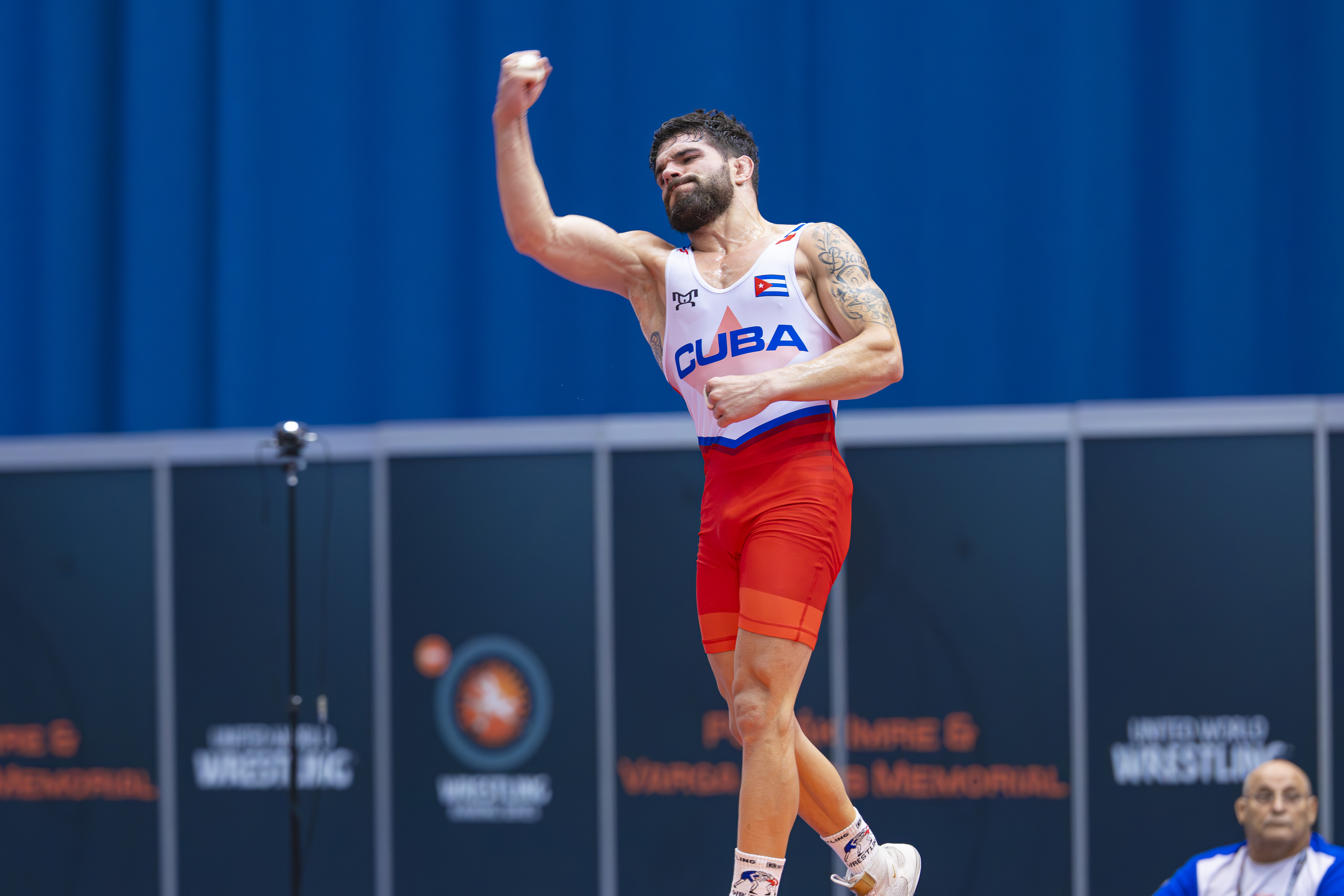 Luis ORTA (CUB) will be wrestling at 67kg. (Photo: United World Wrestling / Kadir Caliskan)
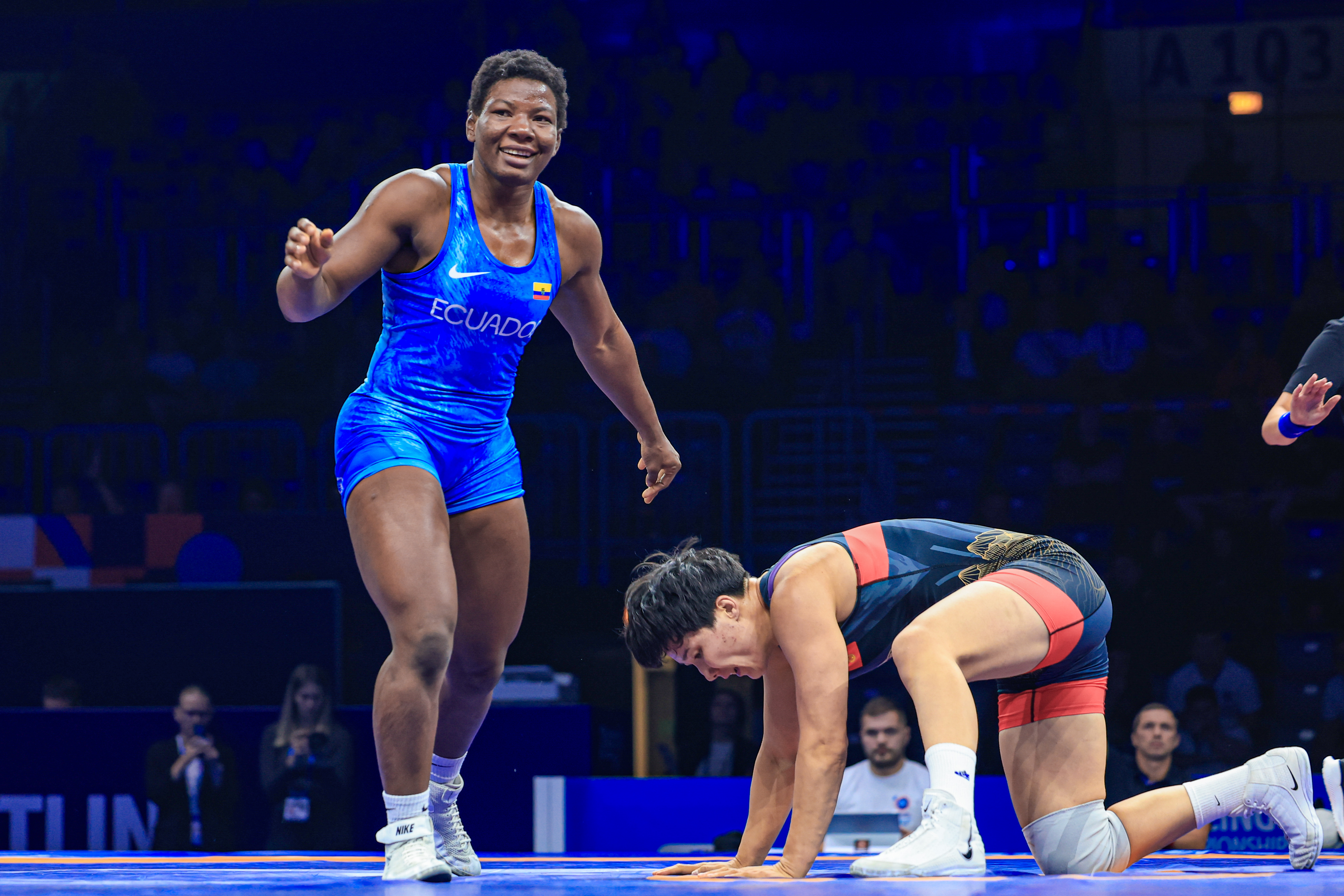 World champion Genesis REASCO (ECU) will be at 76kg. (Photo: United World Wrestling / Amirreza Aliasgari)
Share your thoughts.
Comments