TOKYO (May 24) -- Not even an untimely knee injury, much less any opponent on the mat, was going to deter Paris Olympic champion Akari FUJINAMI from her next major objective.
Fujinami showed little effects of a knee injury suffered three weeks ago in capturing the women's 57kg title at the Meiji Cup All-Japan Invitational Championships on Sunday, stretching her amazing winning streak to 153 matches dating back to 2017 and her junior high school days.
With her 8-0 victory in the final over Sena NAGAMOTO on the final day of the four-day tournament at Tokyo's Komazawa Gym, Fujinami earned a ticket back home, so to speak -- a spot on Japan's team to this year's Asian Games, which will be near her Mie Prefecture hometown in neighboring Nagoya and Aichi Prefecture.
"The Asian Games will be in my home area of Nagoya, so I have strong feelings about it," Fujinami said. "I know the competition is going to be tough, but that only makes me look forward to it even more. I will go into it imagining the people from back home seeing me crowned as champion."
The Meiji Cup was serving as the second of two qualifiers, along with the Emperor's Cup All-Japan Championships held in December, for not only the Asian Games, but also for the World Championships to follow three weeks later in late October.
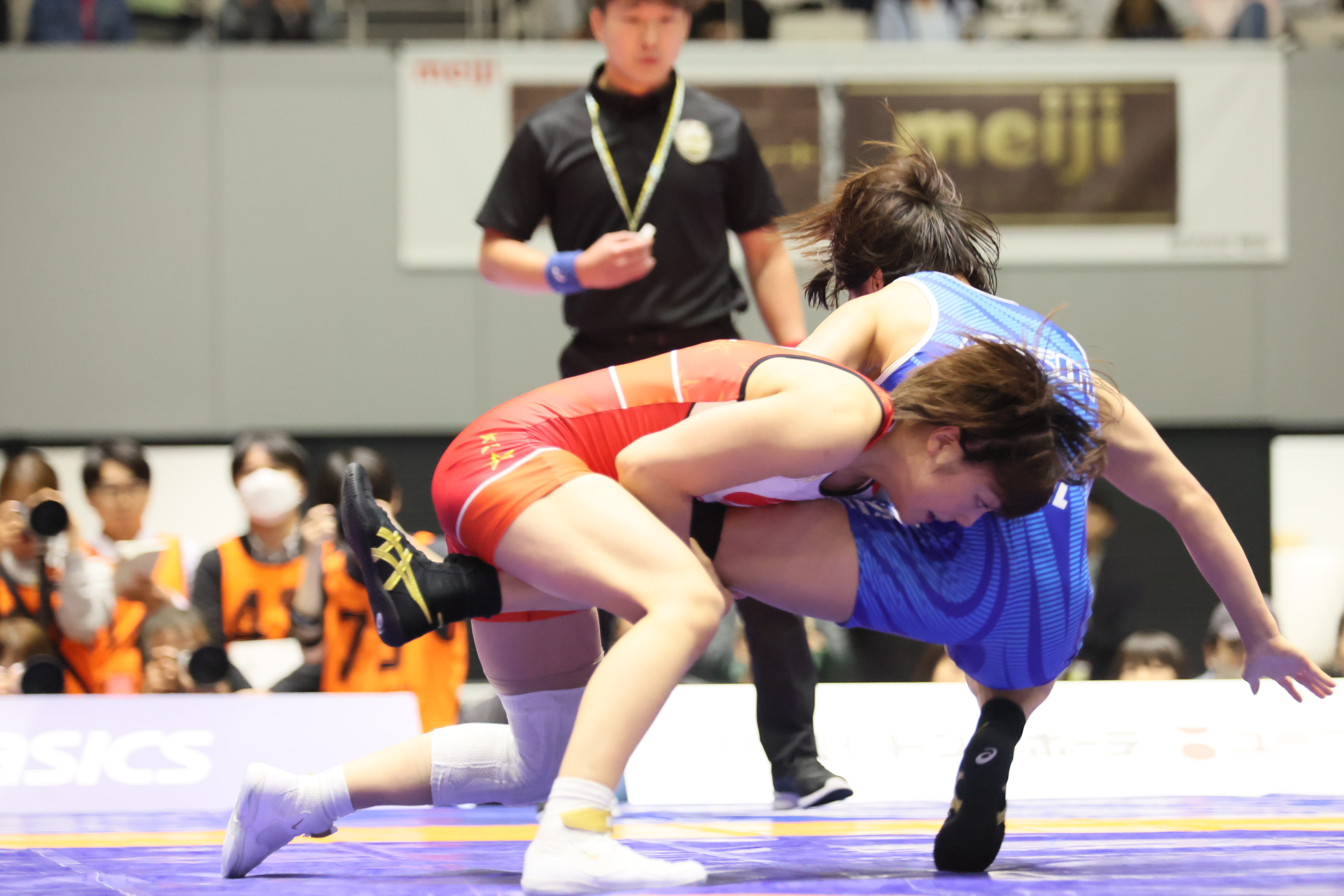 Akari FUJINAMI (JPN) defeated Sena NAGAMOTO (JPN) in the 57kg final. (Photo: wrestling-spirits.jp / Takeo Yabuki)
Fujinami would not commit making the trip to Astana for the World Championships, where she could win a third world gold and first since moving up to 57kg after winning the 53kg gold at the Paris Olympics.
Another factor weighing on the Japanese wrestlers is that the World Championships is just two months before this year's Emperor's Cup, which will have increased importance as the starting point in the qualifying process for the 2028 Los Angeles Olympics.
"I will consult with my coach. There is also the Emperor's Cup, and we will discuss it seriously and make a decision," said Fujinami, who has made no secret of her ultimate goal of an Olympic repeat and whose demeanor showed her leaning toward giving the worlds a pass.
Two days earlier, Paris Olympic champion Rei HIGUCHI passed on a chance to compete in a playoff for the world team spot at Freestyle 61kg because he is solely focused on a return to the Olympics at 57kg. For him, a shot at another world title has no bearing on his plans.
Meanwhile on Sunday, two-time former world champion Nonoka OZAKI fended off world 59kg champion Sakura ONISHI in a blockbuster women's 62kg final, then expressed her excitement over earning a ticket to both big events, as did fellow Paris Olympic bronze medalist Yui SUSAKI, who cruised to victory at women's 50kg.
Two Paris gold medalists -- Kotaro KIYOOKA at Freestyle 65kg and Nao KUSAKA at Greco-Roman 77kg -- also emerged victorious, with the former saying he will be going to both global competitions, but the latter stating definitively he will skip the World Championships.
Fujinami, who is still making the adjustment to the higher weight, won the world U23 gold at 57kg last October before capturing the Emperor's Cup title, although that included the biggest threat to her winning streak when she had to fight off her back in a 4-2 win in the final over Himeka TOKUHARA.
Her next big test was to have come at last month's Asian Championships in Bishkek, but she was forced to pull out due to an ankle injury. No sooner had that healed when she suffered a left knee injury in preparation for the Meiji Cup.
But, with the Asian Games in mind, as well as having new obligations and an increased fan base after gaining a corporate sponsorship upon her graduation from Nippon Sports Science University, she was determined to press on.
“I injured my knee three weeks ago," Fujinami said. "My ankle had finally healed and was I training for the Meiji Cup when I got injured, and at that time I could barely even walk. At that moment, I thought, ‘Why again, why now?’
"But for the first time, I pictured the faces of the people supporting me. If it were my old self, I probably would have just given up, but when those faces came to mind and I thought about what to do, the people around me helped. I came to realize that I am able to do wrestling thanks to various people.”
In Sunday's final, Fujinami relied solely on her unstoppable single-leg attack against Nagamoto, the Asian silver medalist at 59kg. She twice used it to gain a 2-point exposure when Nagamoto tried for counter lifts, and twice finished it off for proper takedowns.
Asked if she was concerned about her lack of ground points, Fujinami inferred she was working on it by saying, "Please look forward to [seeing me at] the Asian Games."
An expanded reportoire would seem essential in what Fujinami herself acknowledges is one of the stronger women's weight class.
"In the world, the level of the 57kg weight class is very high, and also in Asia," she said. "I expect very good wrestlers to be entered at the Asian Games, and I want to start preparing for that right away."
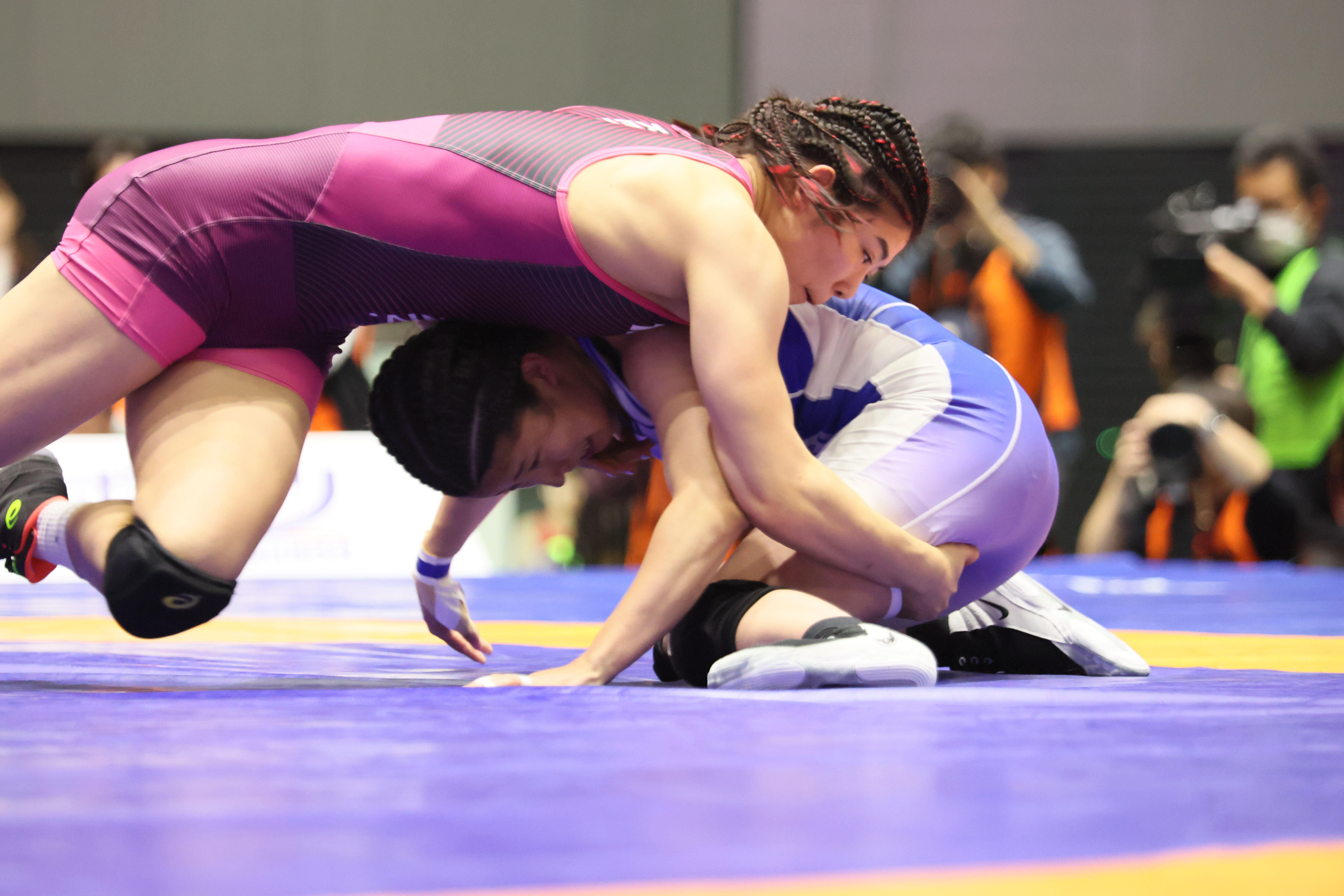 Nonoka OZAKI (JPN) managed a close 2-1 victory over Sakura ONISHI (JPN) at 62kg. (Photo: wrestling-spirits.jp)
Ozaki, who has had her fill of missing out on national team spots for major competitions, assured she won't miss the two coming up this year with a well-executed 2-1 victory over rising star Onishi in their highly anticipated 62kg final.
Ozaki scored a single-leg takedown in the first period, then limited Onishi to a stepout after she got in deep on a single leg of her own in the second.
"While I was thinking what I should do on the mat, I kept my heart strong until the end," Ozaki said.
The victory came a day after Ozaki defeated Paris Olympic champion Sakura MOTOKI in the semifinals, a repeat of her win in the Emperor's Cup final. That had avenged a loss to Motoki in last year's Meiji Cup final and subsequent playoff that kept Ozaki out of the 2025 World Championships.
"When it comes to Japanese opponents, we all pretty much know each other well, and it makes it more difficult to fight," Ozaki said. "We are all preparing for the Olympic qualifying.
"Separately from opponents from around the world, dealing with Japanese opponents, I have already experienced the Olympic qualifiers, so I understand very well how emotionally tough it can be, and I think various things can go out of sync."
Ozaki, the world champion at 62kg in 2022 and at 65kg in 2023, also has some unfinished business at the Asian Games, which Japan will be hosting for the first time in 30 years.
"First of all, I finished second at the last Asian Games [in 2023]," she said. "As for making the World Championships, last year I lost out in a playoff and didn't go. Now I have the chance to become a three-time world champion."
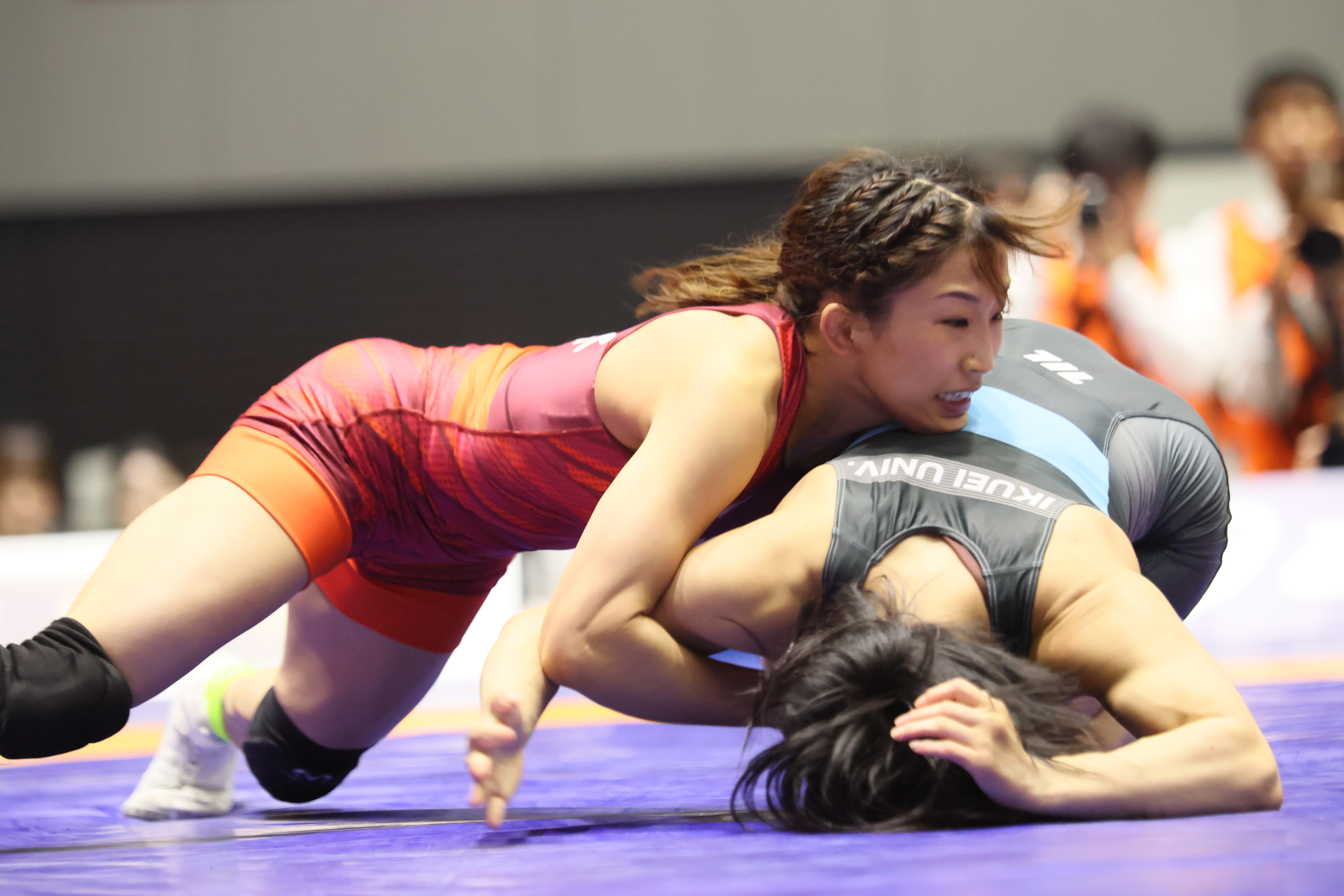 Yui SUSAKI (JPN) secured a fall over Rinka OGAWA (JPN) in the 50kg final on Sunday. (Photo: wrestling-spirits.jp / Takeo Yabuki)
Susaki, the Tokyo Olympic champion who had to settle for a bronze in Paris, let out an uncharacteristic roar after completing the Emperor's Cup-Meiji Cup double with a victory by fall over Rinka OGAWA in the 50kg final.
"I definitely wanted to win and make it to my first Asian Games and to my first World Championships in three years, and the moment I won, I was truly ecstatic," Susaki said.
Susaki opened with a pair of takedowns, but her chicken wing after the second one slipped off, allowing Ogawa to get behind to make it 4-1 at the break. Early in the second period, Ogawa slipped in an underhook, but Susaki deftly clamped down and blocked the opposite inner thigh to slam Ogawa to the mat. She completed the fall in 3:33.
"When she got the underhook, I thought she had the advantage, but I didn't panic, knowing I had a move for that situation," Susaki said. "I had confidence and was able to use a throw technique.
"It was just instinct. In my first match yesterday, I also used a throw for a fall. I think that I've become better at making the most of lone chances. I've included it in my practice, so I can use it any situation."
Susaki's domination bodes well in her quest to regain the Olympic gold in Los Angeles.
"At this tournament, the 50kg field had everyone who will be competing to go to the Los Angeles Olympics, so to win here is a big step forward," she said. "I was able to use a winning pattern that I practiced and won the title, so it was a very good tournament."
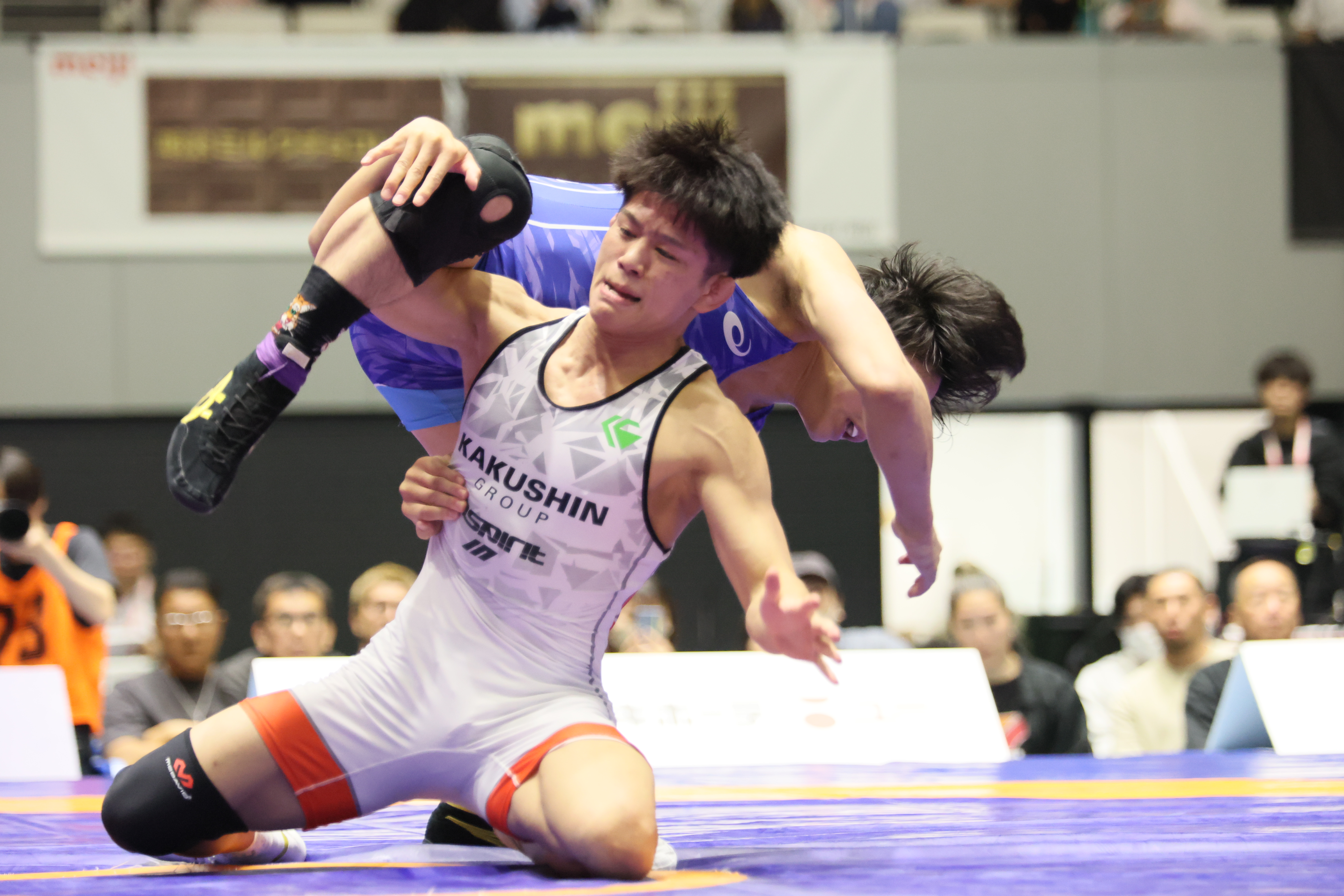 Kotaro KIYOOKA (JPN) won the 65kg gold medal at the Meiji Cup. (Photo: wrestling-spirits.jp / Takeo Yabuki)
Kiyooka, not to be outdone by his younger sister Moe, defeated longtime practice partner and fellow NSSU alum Kaisei TANABE 3-0 in a repeat of last year's 65kg final.
Kiyooka scored a first-period takedown, then added a stepout in the second period to beat Tanabe, with whom he participated -- and even faced -- during a stint in the German Bundesliga.
"It's been almost exactly a year since [Tanabe and I] met in this same final, and there are things we were both aware of about each other," Kiyooka said. "Last year he was injured and couldn't give his all. I went back and reviewed our matches, and I came up with a strategy. Looking back on what I actually did, I felt the main thing was that I was able to stay calm."
Last year, Kiyooka defeated a hampered Tanabe in a playoff for the world team spot after beating him in the final, in which Tanabe was injured. Kiyooka then lost in the final in Zagreb to Rahman AMOUZAD (IRI), whom he had beaten for the gold in Paris.
"Getting to the World Championships, it gives me a chance for revenge and to win my first world title, making it an important event," Kiyooka said.
"As for the Asian Games, it gives my family, those in my company and people who otherwise would not have the chance to see me compete overseas to see me up close. And just like at the Olympics, I hope to give them the best result possible."
On Saturday, Kiyooka's sister Moe won the women's 53kg title to clinch her national team place. She has already one-upped her in the world gold department, having won the 55kg title in 2024.
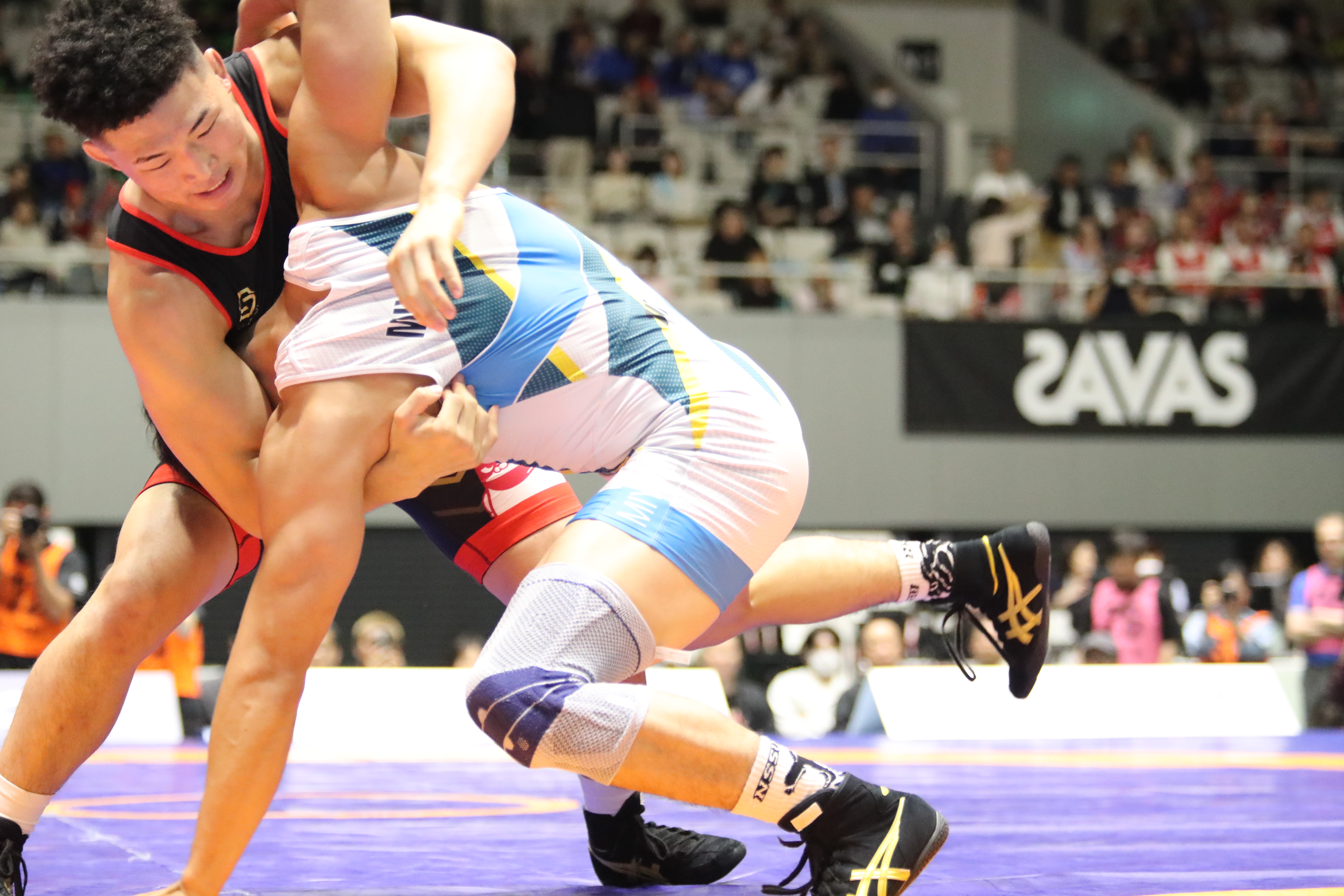 Nao KUSAKA (JPN) managed a 6-3 victory in the gold medal bout at 77kg. (Photo: wrestling-spirits.jp / Takeo Yabuki)
At Greco-Roman 77kg, Kusaka took issue with a mysterious penalty called against him and a phantom stepout that produced no point, but otherwise was untroubled in notching a 6-3 victory in the final over Isami HORIKITA, a repeat of the Emperor's Cup final.
Kusaka was leading 3-0 when his challenge of an apparent stepout that was not awarded a point was unsuccessful. He then added an indisputable stepout to lead 4-1 at the break. In the second period, he sandwiched two more stepouts around a 2-point penalty that he was at a loss to explain.
"I really don't know," he said, while imploring that he was not being critical of the referees. "The referee kept telling me, 'Head up, head up.' It's the first time I've ever been penalized in that situation."
What Kusaka made crystal clear was his decision to bypass the World Championships in favor of the Asian Games, saying he lacked motivation for the former. Like Kiyooka, he won a silver medal at last year's worlds in Zagreb.
"I don't have loads of motivation and like to channel it all into one thing," Kusaka said. "Winning the Asian Games title, that's my objective for this year."
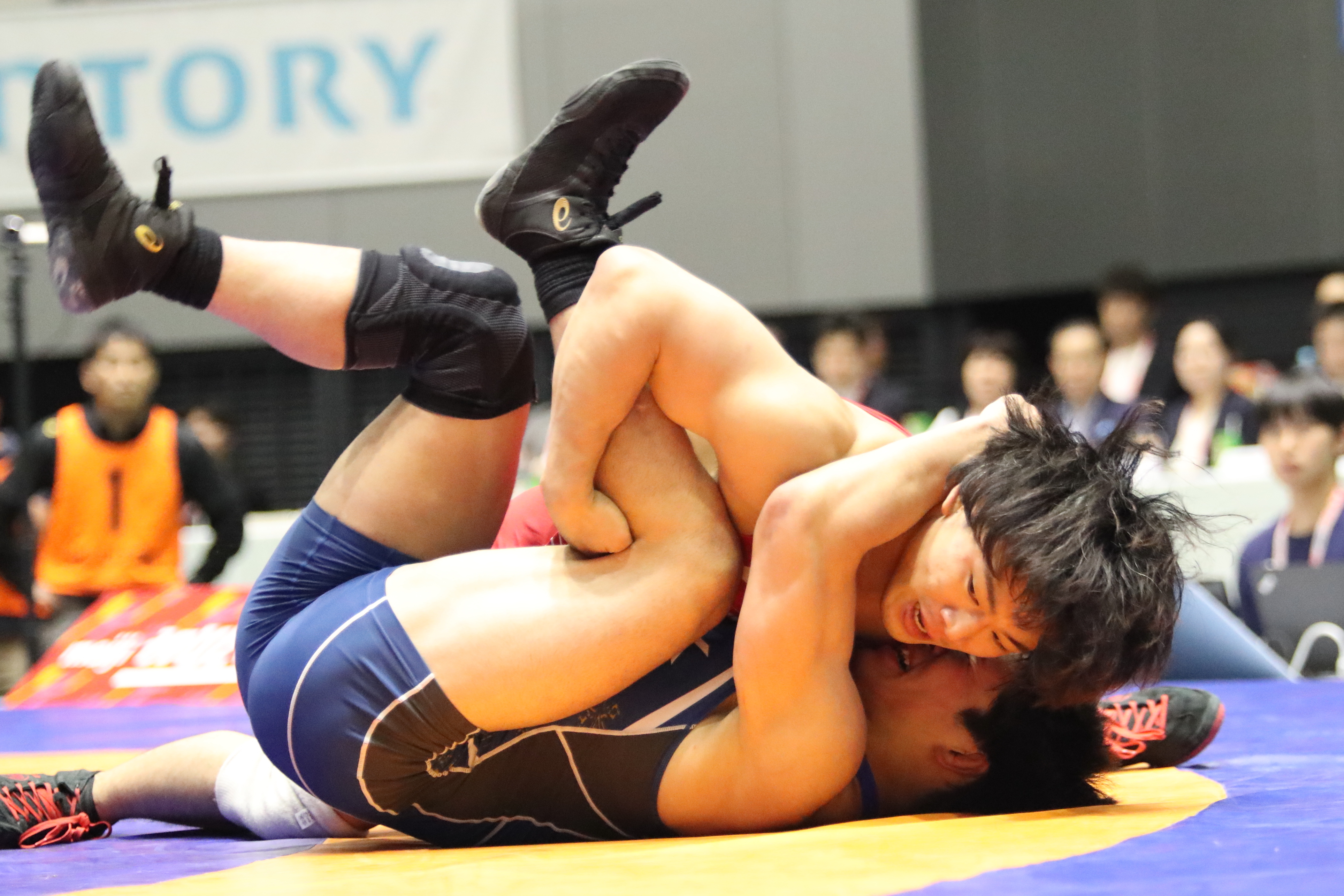 Yoshinosuke AOYAGI (JPN) pinned Kota TAKAHASHI (JPN) in the 74kg final. (Photo: wrestling-spirits.jp / Takeo Yabuki)
In a battle between reigning world champions, Yoshinosuke AOYAGI defeated Kota TAKAHASHI in the Freestyle 74kg final to earn a return trip to the World Championships.
Aoyagi, the world 70kg champion last year, was leading 7-0 when Takahashi launched a comeback late in the second period. He pulled to within 7-4, helped by a penalty point against Aoyagi for kicking and a fleeing point during a stepout.
But a desperation throw in the final seconds was stopped dead by Aoyagi, and Takahashi stayed motionless on the mat, allowing a fall to be called just before the buzzer.
At Greco-Roman 60kg, 2023 Asian Games silver medalist Ayata SUZUKI defeated reigning Meiji Cup champion Kaito INABA 3-3 in the final, then edged Emperor's Cup champion Koto GOMI 7-6 in the playoff for the national team.
Suzuki trailed 6-2 in the playoff when he hit a 4-point arm throw to go ahead on criteria, then added a stepout for good measure.
Day 4 Results
Freestyle
57kg
GOLD: Rikuto NAGAI df. Kento YUMIYA, 13-4
BRONZE: Isami TAKATA df. Yuta KIKUCHI, 8-2
BRONZE: Daito KATSUME df. Rin SAKAMOTO by Inj. Def.
World team playoff: Yamato OGAWA df. Nagai, 9-8
65kg
GOLD: Kotaro KIYOOKA df. Kaisei TANABE, 3-0
BRONZE: Kaiji OGINO df. Kaito MORIKAWA by Inj. Def., :02 (0-0)
BRONZE: Takara SUDA df. Shuya MIURA, 2-1
74kg
GOLD: Yoshinosuke AOYAGI df. Kota TAKAHASHI by Fall, 5:59, 11-4
BRONZE: Ryoya YAMASHITA df. Yujin TAKIZAWA, 2-0
BRONZE: Hikaru TAKATA df. Shingo ANDO, 6-1
Greco-Roman
60kg
GOLD: Ayata SUZUKI df. Kaito INABA, 3-3
BRONZE: Daijiro SONE df. Koto GOMI by Def.
BRONZE: Maito KAWANA df. Yu SHIOTANI, 8-1
World team playoff: Suzuki df. Gomi, 7-6
77kg
GOLD: Nao KUSAKA df. Isami HORIKITA, 6-3
BRONZE: Kodai SAKURABA df. Naoki KADODE, 3-2
BRONZE: Issei HONNA df. Ariya YOSHIDA, 12-9
87kg
GOLD: Taizo YOSHIDA df. So SAKABE, 5-4
BRONZE: Rondo KODAMA df. Takahiro INAMOTO by TS, 8-0, 2:24
BRONZE: Daisei ISOE df. Genki YAHAGI, 4-1
Women's Wrestling
50kg
GOLD: Yui SUSAKI df. Rinka OGAWA by Fall, 3:33 (8-1)
BRONZE: Umi ITO df. Minoriho YONEHARA by TS, 13-2, 5:59
BRONZE: Haruna MORIKAWA df. Miyu NAKAMURA, 7-0
57kg
GOLD: Akari FUJINAMI df. Sena NAGAMOTO, 8-0
BRONZE: Sara NATAMI df. Rin KINOSHITA by Fall, 1:30 (2-0)
BRONZE: Himeka TOKUHARA df. Sae NOGUCHI, 9-4
62kg
GOLD: Nonoka OZAKI df. Sakura ONISHI, 2-1
BRONZE: Sakura MOTOKI df. Yuzuka INAGAKI, 10-2



 UWW Congress was held in Belgrade, Serbia. (Photo: UWW / Kadir Caliskan)
 UWW is keen on a digital-first approach. (Photo: UWW / Kadir Caliskan)
 Grappling is one of UWW's most important Associated Styles. (Photo: UWW / Max Rose-Fyne)
Share your thoughts.
Comments