

U20 Worlds: Zakriev dominates to gold; Abdevali repeats
Wednesday, September 4, 2024 - 09:57 By Vinay Siwach

PONTEVEDRA, Spain (September 3) -- Erzu ZAKRIEV (AIN) was unsure if he would be participating in the U20 World Championships. Zakriev began preparing only two days before the start of the tournament in Spain.
"We were told that we wouldn’t come here," Zakriev said. "I went into relaxed mode. It was only three days before we were told that we could go. The way was really long and difficult, we were cutting weight at the airport. We had to change four flights on our way. We arrived at midnight and early next day I had my first match in the morning. I didn’t even have time to rest."
Zakriev did not show any signs of distress as he began the competition with a technical superiority win and reached the final with two more wins. On Tuesday, the 19-year-old won the gold medal at 63kg in Pontevedra, Spain, being the final against Otto BLACK (USA) 8-0.
A minute into the final and Zakriev had Black on the backfoot with a stepout and takedown. Black never got a chance to come back into the final as Zakriev finished it in two minutes and 40 seconds.
 Erzu ZAKRIEV (AIN) tries to complete a throw against Otto BLACK (USA) in the 63kg final. (Photo: United World Wrestling / Kadir Caliskan)
"I was very confident," he said. "Last year I was third at the national championships, and this year I finished first. I haven’t lost any single match for a year now."
The dominance of Zakriev was evident in the U20 European Championships as well as he outscored his opponents 29-0 in four bouts, winning the gold medal over Anri KHOZREVANIDZE (GEO), an opponent he defeated 16-4 in the semifinals on Monday.
Hailing from Chechnya, Zakriev grew up in Goyty village and began training after his parents took him to the academy when he was eight years old.
"I will be moving to the Olympic weight class of 67kg from next year," he said.
The United States suffered another heartbreak in the final as Isaiah CORTEZ (USA) lost the 55kg final against Ali AHMADI VAFA (IRI).
Unlike Black, Cortez had his chances to take the lead against Ahmadi Vafa in the final. He even had the Iranian in a fall position but failed to finish it. Ahmadi Vafa eventually won the final 11-3 in a match that was closer than the scoreline shows.
Ahmadi Vafa got the first par terre advantage and he used a high gut-wrench to take a 5-0 lead over Cortez. He used an arm spin to score two more points to make the lead 7-0. Cortez cut it to 7-2 just before the break with exposure.
Cortez, however, failed to score from par terre and Ahmadi Vafa led 7-3 with 1:25 left on the clock. Two desperate bodylock throws ended up in Cortez giving up points.
 Ali AHMADI VAFA (IRI) scores two points over Isaiah CORTEZ (USA) in the 55kg final. (Photo: United World Wrestling / Kadir Caliskan)
"I wrestled really well to reach the final. I had analyzed my American opponent’s wrestling style, and thank God, I was able to wrestle with the best results and win the gold medal," Ahmadi Vafa said.
A former U17 world champion, Ahmadi Vafa finished without a medal last year at the U20 Worlds. A gold medal in Pontevedra gave him some relief from his medalless campaign from last year.
"Last year, I couldn’t win a good medal and lost in the world championships," he said. "This year, I managed to win gold. Next year, I have the junior competitions again, but my main goal is to be selected for the senior competitions."
This was the first time since 2017 that the U.S. had two finalists in Greco-Roman at the U20 World Championships. Kamal BEY (USA) won the title in 2017. However, the wait for a new U20 world champion just grew for the U.S.
 Alireza ABDEVALI (IRI) won his second U20 world gold medal at 77kg. (Photo: United World Wrestling / Kadir Caliskan)
Defending U20 world champion Alireza ABDEVALI (IRI) added the second gold medal, winning the 77kg weight class. Wrestling Magomed IARBILOV (AIN) in the final, Abdevali got the par terre advantage but failed to score and Iarbilov scored a reversal to lead 1-1 on criteria.
Abdevali scored an arm-drag takedown in the second period to lead 3-1 and defended it till the end of the time to win his second gold medal at this level.
"I feel great that I was able to win my second world championship medal," he said. "It felt even better than when I won the first time. I’m just at the beginning of my journey, and there’s a long way to go until the Olympics."
Alireza is the fourth of the five Abdevali brothers but said that he felt no pressure to win because of his family name.
"I didn’t feel any pressure. My older brother, Saeid, is a great wrestler, and he gives me motivation and spirit to be a fighter."
 Laszlo DARABOS (HUN) scores on Abolfazl FATHITAZANGI (IRI) in the 130kg final. (Photo: United World Wrestling / Jake Kirkman)
Iran could have won three gold medals on Tuesday but former U20 European champion Laszlo DARABOS (HUN) denied Abolfazl FATHITAZANGI (IRI), 5-3, in the 130kg final.
Darabos trailed 3-0 at the break after giving up a turn from par terre. However, when he got the par terre in the second period, he turned Fathitazangi twice and took a 5-3 lead and defended it.
This is the first U20 world champion for Hungary since 2019 and the first since 2012 in the highest weight class.
 Asan ZHANYSHOV (KGZ) won the 87kg gold medal after beating Joju SAMADOV (AZE) in the final. (Photo: United World Wrestling / Jake Kirkman)
Zhanyshov upgrades
Returning bronze medalist Asan ZHANYSHOV (KGZ) upgraded to gold after he defeated Joju SAMADOV (AZE), 8-0, in the 87kg final to win Kyrgyzstan's first U20 world title in Greco-Roman since 2019. Incidentally, the last U20 world champion -- Erbol BAKIROV (KGZ) -- also hails from the same village, Taygaray, as Zhanyshov.
In the final, Samadov found it difficult to match the pace of Zhanyshov and failed to stop any of his attacks. He gave up five stepouts in the final.
"I had a great training camp with the senior team," Zhanyshov said. "I already have experience wrestling at the senior level. The difference is that on age-group levels you have to be prepared technically, performing throws and moves, while at the senior level that won’t be enough. You have to be physically and functionally very well prepared. So, my level is now senior."
Having trained with world champions Akzhol MAKHMUDOV (KGZ) and Zholaman SHARSHENBEKOV (KGZ), Zhanyshov felt motivated by his seniors and was determined to win the gold medal.
"Makhmudov and Sharshenbekov are my wrestling role models," he said.

RESULTS
55kg
GOLD: Ali AHMADI VAFA (IRI) df. Isaiah CORTEZ (USA), 11-3
BRONZE: Alibek AMIROV (11) df. Rahim HASANOV (AZE), 10-0
BRONZE: Aibek AITBEKOV (KAZ) df. Maxim SARMANOV (MDA), 10-1
63kg
GOLD: Erzu ZAKRIEV (AIN) df. Otto BLACK (USA), 8-0
BRONZE: Erfan JARKANI (IRI) df. Anri KHOZREVANIDZE (GEO), 6-2
BRONZE: Yurik HOVEYAN (ARM) df. Enes ULKU (TUR), 2-1
77kg
GOLD: Alireza ABDEVALI (IRI) df. Magomed IARBILOV (AIN), 3-1
BRONZE: Levente LEVAI (HUN) df. Irfan MIRZOIEV (UKR), 3-2
BRONZE: Tornike MIKELADZE (GEO) df. Karl BAFF (SWE), 5-3
87kg
GOLD: Asan ZHANYSHOV (KGZ) df. Joju SAMADOV (AZE), 8-0
BRONZE: Achiko BOLKVADZE (GEO) df. Patrik GORDAN (ROU), 10-0
BRONZE: Ruben GEVORGYAN (ARM) df. Temirlan TURDAKYN (KAZ), 3-1
130kg
GOLD: Laszlo DARABOS (HUN) df. Abolfazl FATHITAZANGI (IRI), 5-3
BRONZE: Aden ATTAO (USA) df. Aleksandr MELEKHOV (AIN), via fall
BRONZE: Samagan ORMONOV (KGZ) df. Aramayis HARUTYUNYAN (ARM), via fall
Semifinals
60kg
GOLD: Servet ANGI (TUR) vs. Mohammadmehdi GHOLAMPOUR (IRI)
SF 1: Servet ANGI (TUR) df. Ongdassyn KHAMITOV (KAZ), 9-8
SF 2: Mohammadmehdi GHOLAMPOUR (IRI) df. Papik DZHAVADIAN (AIN), 9-8
67kg
GOLD: Ahmadreza MOHSEN NEZHAD (IRI) vs. Yussuf ASHRAPOV (KAZ)
SF 1: Ahmadreza MOHSEN NEZHAD (IRI) df. Kojiro HASEGAWA (JPN), 10-0
SF 2: Yussuf ASHRAPOV (KAZ) df. Grair OGANESIAN (AIN), 7-5
72kg
GOLD: Zaur BESLEKOEV (AIN) vs. Ashot KHACHATRYAN (ARM)
SF 1: Zaur BESLEKOEV (AIN) df. Muhammed GOCMEN (TUR), 1-1
SF 2: Ashot KHACHATRYAN (ARM) df. Ruslan NURULLAYEV (AZE), 4-1
82kg
GOLD: Islam YEVLOYEV (KAZ) vs. Alperen BERBER (TUR)
SF 1: Islam YEVLOYEV (KAZ) df. Abdurakhman ABDULKADYROV (AIN), via inj. def.
SF 2: Alperen BERBER (TUR) df. Taizo YOSHIDA (JPN), 12-0
97kg
GOLD: Yehor YAKUSHENKO (UKR) vs. Darius KIEFER (GER)
SF 1: Yehor YAKUSHENKO (UKR) df. Anatolii AVERIN (AIN), 7-4
SF 2: Darius KIEFER (GER) df. Ahmet EREMEKTER (TUR), via fall
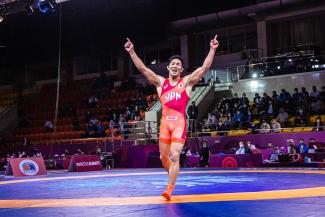
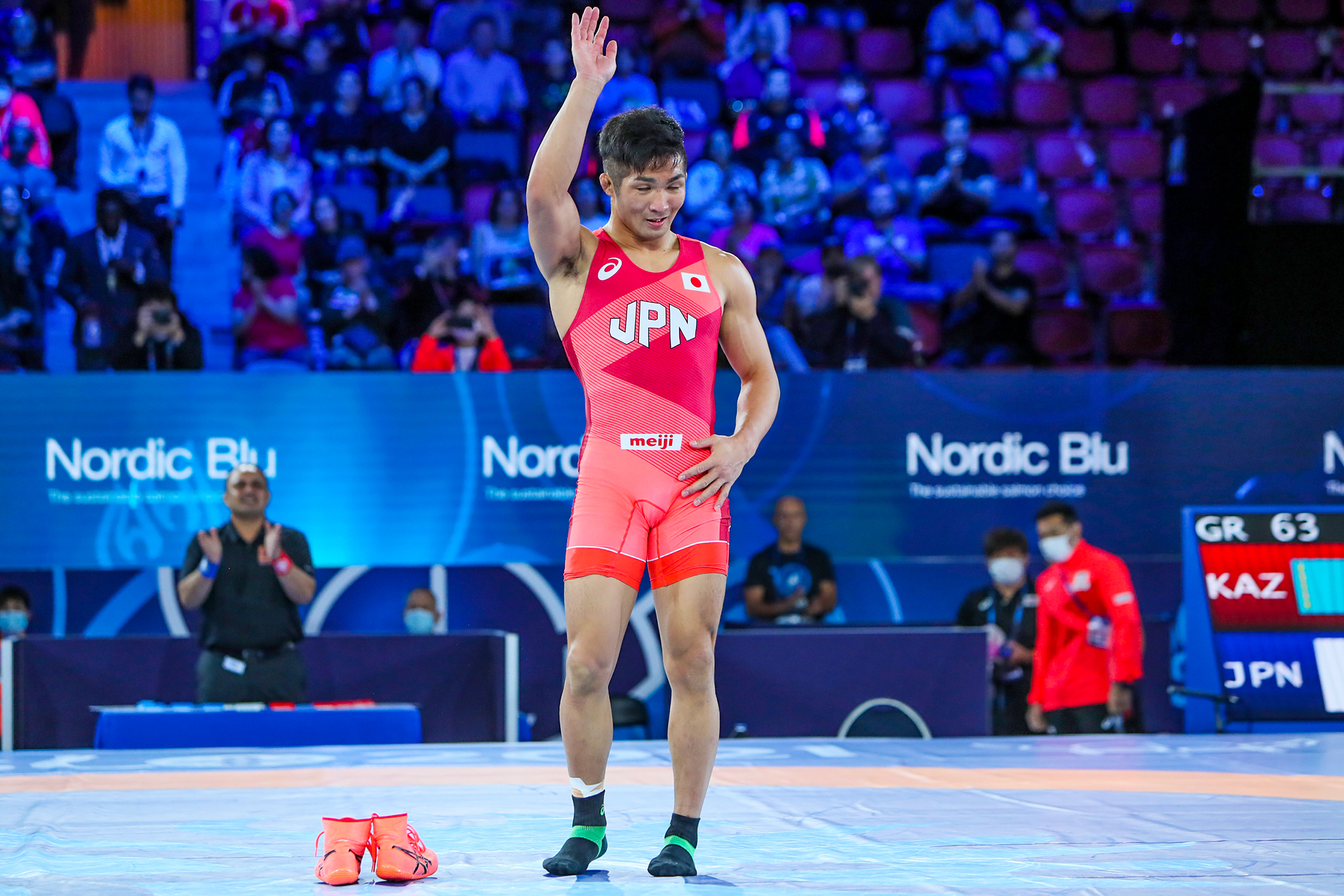 Tsuchika SHIMOYAMADA (AUS) had left his shoes on the mat during the 2021 World Championships to mark his retirement. (Photo: United World Wrestling / Martin Gabor)
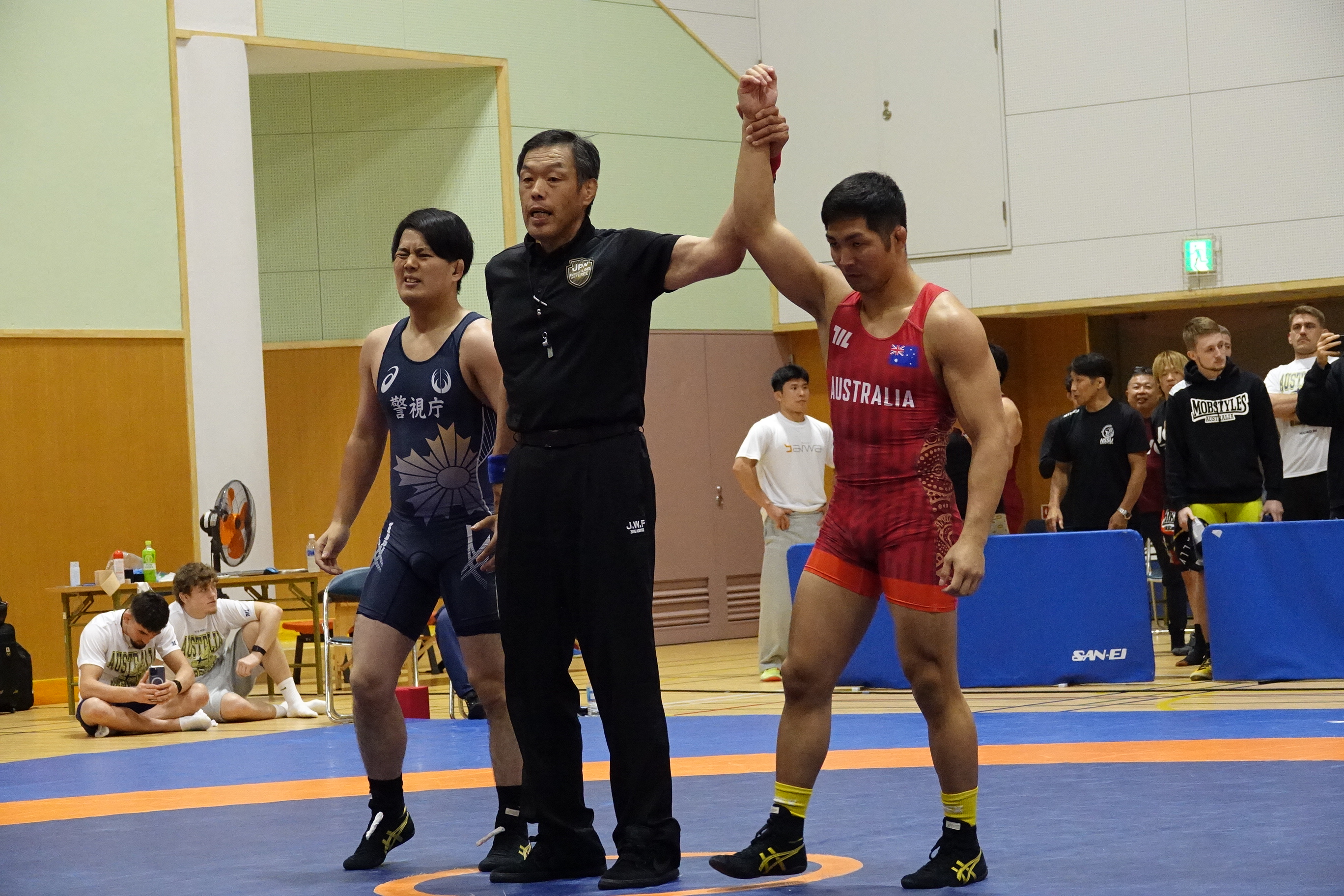 Tsuchika SHIMOYAMADA advances to the semifinals at the All-Japan Non-Student Championships in July with a 52-second win over Kokoro GOTO. (Photo: Koji Fuse / wrestling-spirits.jp)
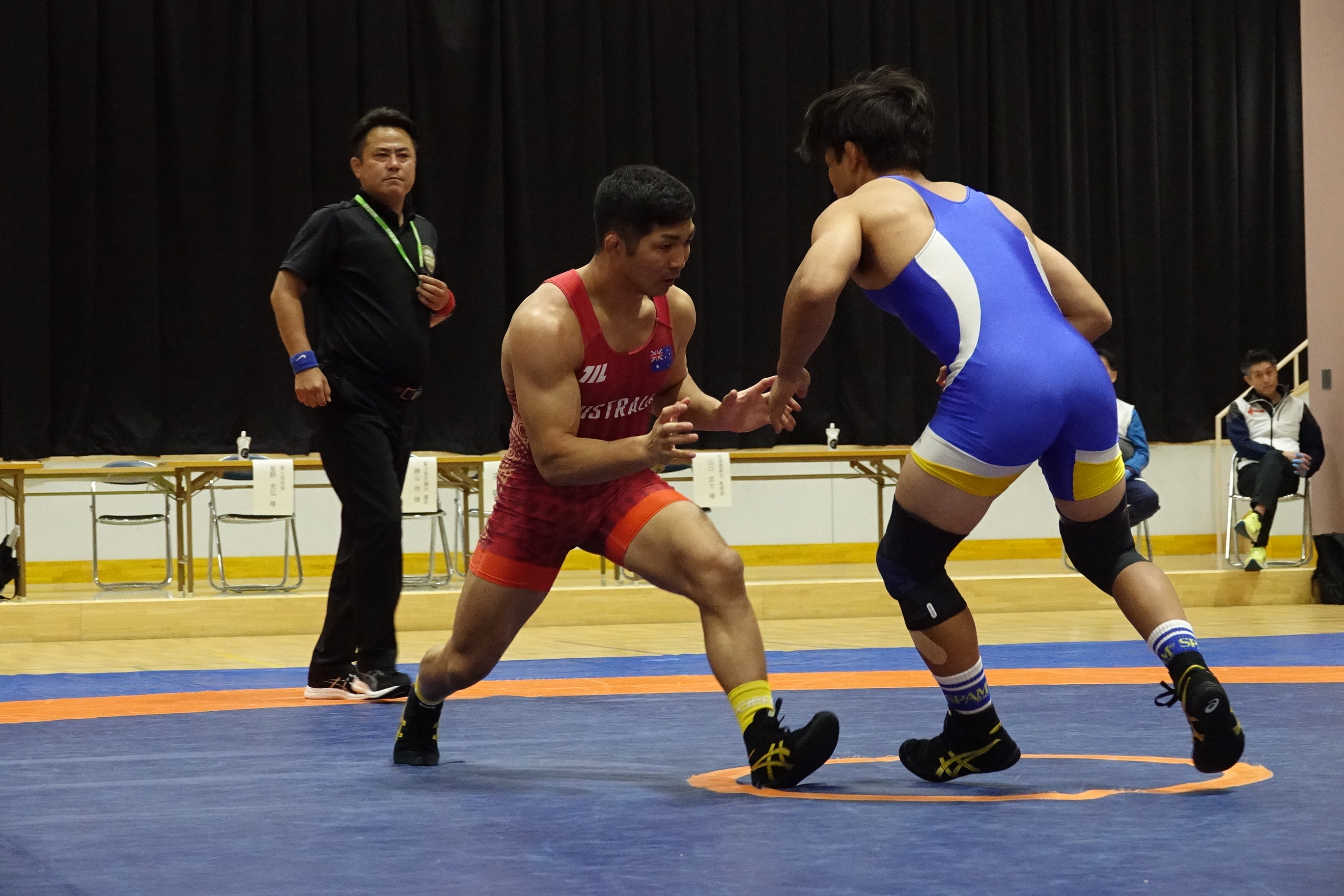 Tsuchika SHIMOYAMA faces Keitaro ONO in his opening match at the All-Japan Non-Student Championships in July. (Photo: Koji Fuse / wrestling-spirits.jp)
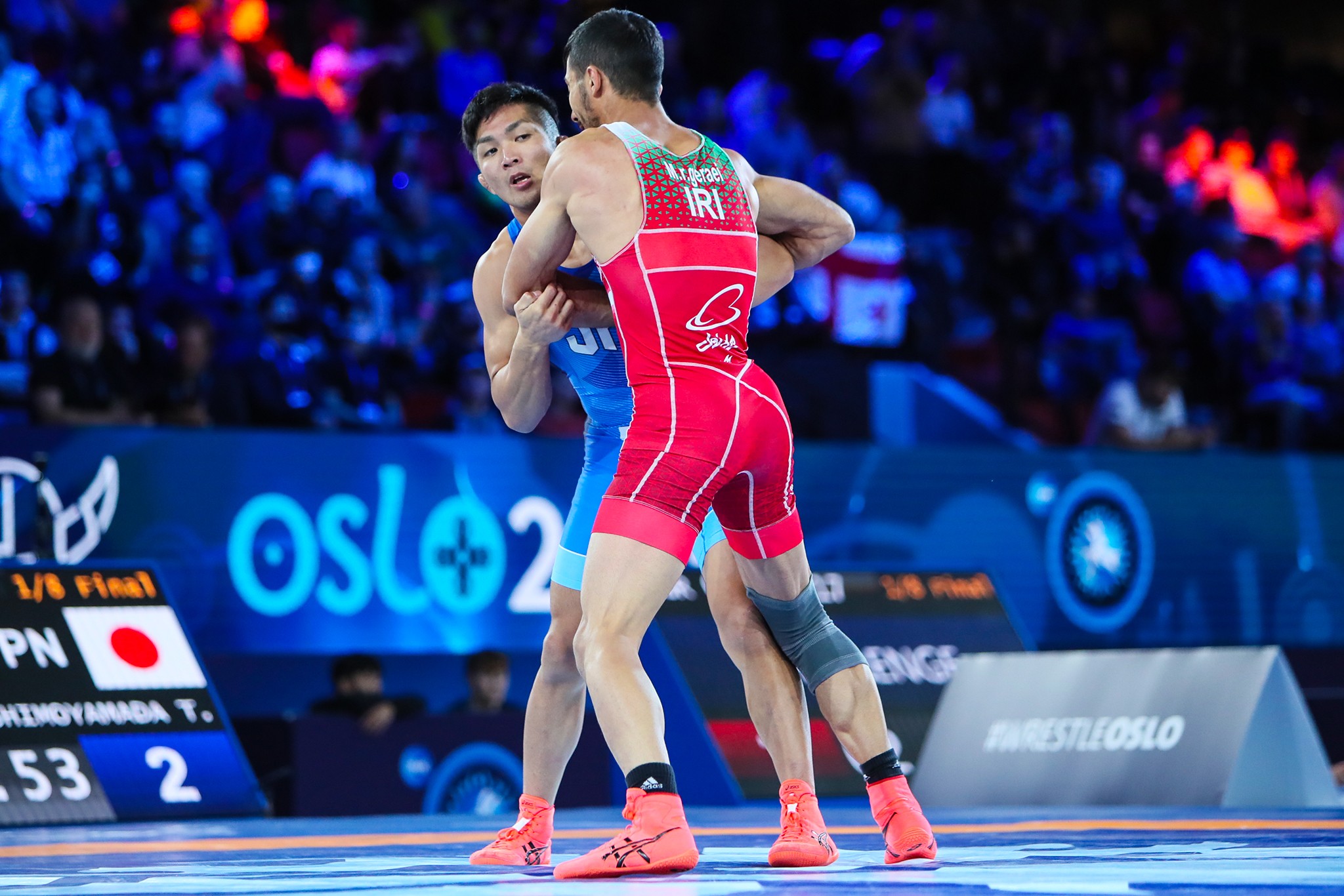 Tsuchika SHIMOYAMADA (AUS) was dominating Mohammadreza GERAEI (IRI) in their match at the 2021 World Championships before being pinned. (Photo: United World Wrestling / Martin Gabor)
Share your thoughts.
Comments