

#development

South Africa completes phase one of UWW DNSS Program

By United World Wrestling Press

PRETORIA, South Africa (November 17) --  The South African Wrestling Federation successfully completed the first phase of the United World Wrestling National Development and Support Strategy (DNSS) from October 17 to 26.

Under the supervision of Vincent AKA, UWW International Development Officer for Africa, and the coordination of Markus DEKKER, member of the SAWF Coaches Council, a nationwide development mission was undertaken. The UWW-SAWF team visited provincial associations, conducting technical assessments, talent identification sessions, and workshops for coaches.
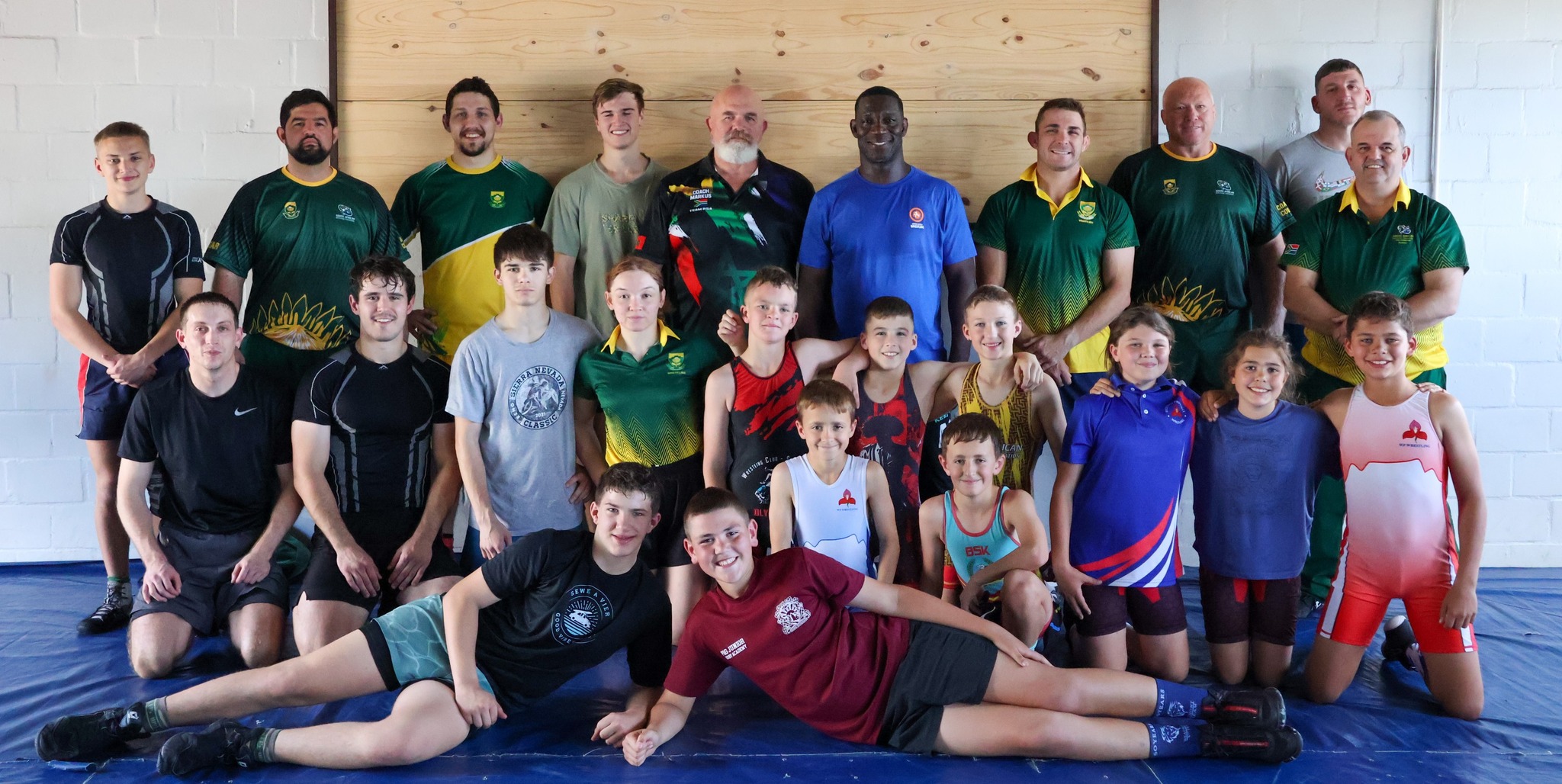
South Africa

Using the UWW National Federation Assessment Tool (NFAT), the mission provided a detailed overview of the current state of wrestling in South Africa -- from grassroots participation to elite athlete preparation.

The tour covered major provinces including Western Cape, Eastern Province, Free State, Northern Cape, Gauteng North, Limpopo, Mpumalanga, and North West, engaging hundreds of athletes, coaches, and local administrators.

The assessment revealed strong technical potential among the U15 and U17 categories, as well as a growing passion for wrestling across communities and schools.

The mission also identified the need for stronger governance structures and more consistent communication between SAWF, provinces, and clubs to unify efforts under a national development plan.

Both teams will continue to work towards second phase of the program which will include establishing two regional pilot centers [Pretoria and Western Cape] to act as training and coordination hubs, launch a "School Integration" program linking PE teachers, schools, and wrestling clubs, developing a national athlete database to monitor and support emerging talents.

It will also aim to organize governance and compliance workshops to reinforce management capacity, implementing UWW coaching courses nationwide, forming a National Technical Committee to coordinate DNSS implementation and introducing measurable evaluation indicators to ensure accountability and progress tracking.
#WrestleZagreb

Tazhudinov in search for answers despite bronze medal

By Vinay Siwach

ZAGREB, Croatia (September 16) -- A World Championships medal might be a career milestone for most wrestlers, but for Akhmed TAZHUDINOV (BRN), the bronze he won in Zagreb is a prize he hopes to forget.

Coming into the tournament in Zagreb, Tazhudinov was considered as the best wrestler in the world and the favorite to win the gold medal at the 97kg. He had built a reputation of a wrestler who bulldozes anyone who stands in his path, as he did to win the gold medal at the 2024 Paris Olympics.

But Tazhudinov was anything but an Olympic and world champion in Zagreb.

He almost dropped his quarterfinal match with Mogomed KURBANOV (UWW), needing a front headlock roll to survive. The thrill of victory was short lived, as Amirali AZARPIRA (IRI) showed that Tazhudinov is indeed human, winning their semifinal 5-2 to end Tazhudinov's golden run.

"My initial goal was the gold medal," Tazhudinov said. "I wanted to become a two-time world champion. Unfortunately, it didn't happen -- maybe it was meant to be this way. It's very painful to lose."

As he searched for answers for his performance, Tazhudinov said that recent shoulder surgery may have affected his wrestling at the World Championships.

"I was coming back after surgery, after a serious injury," Tazhudinov said. "Maybe that had an effect, I don't even know. It took me a very long time to get myself together. At the beginning, training sessions were very difficult."

Tazhudinov returned from surgery to win two gold medals in a one-month span -- first at the Spain Grand Prix and then at the Budapest Ranking Series in June.

After the semifinal loss to Azarpira, Tazhudinov returned the next night for the bronze-medal bout with 34-year-old Akhmed MAGAMAEV (BUL), which only further put Tazhudinov under the scanner despite winning the match.

Magamaev was on the activity clock when he bodylocked Tazhudinov and slammed him for four points just before the 30 seconds elapsed. Tazhudinov rebounded with a takedown to make it 4-2 at the break.

He began the second period with another takedown to make it 4-4, but Magamaev continued the scramble and both wrestlers were awarded two exposure points each, putting the Bulgarian ahead 6-6 on criteria.

A counter lift to exposure gave Tazhudinov the lead for the first time, 8-6, and as Magamaev tried doing the counter lift, he gave up two as Tazhudinov blocked him. The final scramble, which gave Tazhudinov an 11-10 win, was challenged by Bulgaria. Eventually, it was scored 13-10.

Despite winning the bout, Tazhudinov shook his head as he left the mat, perhaps surprised himself by his lackluster performance.

"Honestly, I don't even know what went wrong," he said. "It means I wasn't well enough prepared. It means I wasn't in my best shape. It means I need to work even more."

Tazhudinov said he had difficulty preparing mentally for the bronze-medal bout after the loss to Azarpira.

"After the semifinal loss, I couldn't motivate myself at all for the bronze-medal match," he said. "I don't even know how I stepped onto the mat. I wasn't mentally ready to wrestle at all, and that's why the match was so difficult.

"But I will not give up -- I'll go home, work on my mistakes, and train even harder to come back stronger."