

Quartet of Russians Reach Tuesday Night's GR Finals
Monday, June 3, 2019 - 18:22 By Eric Olanowski

PONTEVEDRA, Spain (June 3) – The Russian Federation entered Monday night's session at the Junior European Championships undefeated and had all five wrestlers vying for a spot in Tuesday night's finals. They closed out the session by inserting four of five wrestlers into the finals and only dropped one match on the day. In total, they were victorious in 14 of 15 matches and shutout nine of their opponents.
The quartet of Russian wrestlers who'll be wrestling for gold on Tuesday night is Anvar ALLAKHIAROV, Khamid ISAEV, Ilia ERMOLENKO, and Osman SHADOV. They'll compete for the top spot at 55kg, 77kg, 87kg, and 130kg, respectively.
Of the four Russian finalists, Osman Shadov will arguably have the toughest road to winning a gold medal. Shadov, who picked up a 4-0 semifinals win over Raman ULASAU (BLR), will take on defending cadet world champion Muhammet BAKIR (TUR) in the 130kg gold-medal bout.
Bakir, who remains undefeated during his time representing Turkey at the World and Continental Championships, opened up his day with a 6-0 routing of Poland's cadet world bronze medalist Tomasz WAWRZYNCZYK (POL). He followed that victory up with a 6-0 win over Robinzon ESADZE (GEO), then pitched an 8-0 shutout against Hungary's Dariusz Attila VITEK (HUN) who was fresh off a surprising 6-2 upset over reigning cadet world silver medalist Sarkhan MAMMADOV (AZE). In total, Bakir outscored his three opponents on Monday 20-0 and reached his second consecutive age-level continental finals. Last year, Bakir won the 110kg cadet European title.
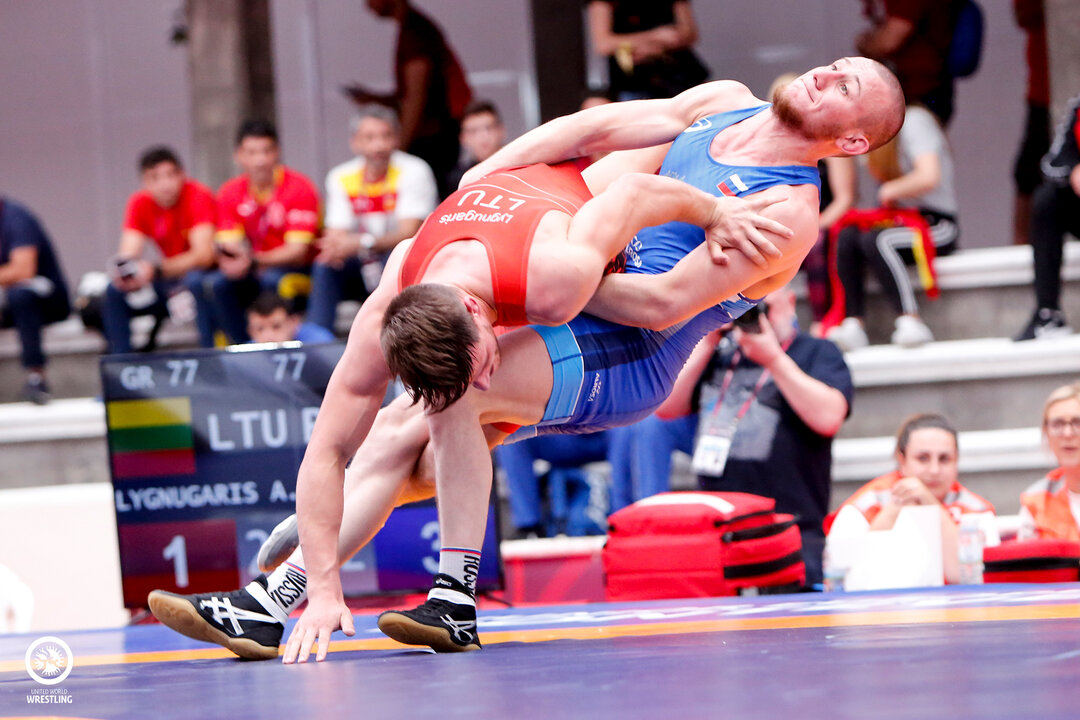 Khamid ISAEV (RUS) will wrestle returning European bronze medalist Tamas LEVAI (HUN) in the 77kg finals. (Photo: Gabor Martin)
Khamid Isaev will also have an uphill battle in his finals bout when he takes on Hungary's defending junior European bronze medalist Tamas LEVAI in the 77kg finals. Isaev grabbed the 3-1 victory over Arminas LYGNUGARIS (LTU) to reach the finals, while Levai improved on his third-place finish from last year with a 9-0 semifinals shutout win over Mikita KAZAKOU (BLR).
Russia's 2018 junior world bronze medalist Ilia Ermolenko will also take on a Hungarian opponent when he meets David LOSONCZI (HUN) in the 87kg gold-medal match. Ermolenko reached the finals with an exhausting 2-0 win over Giorgi KATSANASHVILI (GEO), and Losonczi survived a 27-point barn burner against Belarus' Ihar YARASHEVICH to reach his first continental finals in his third attempt.
Russia's remaining finalist is Anvar Allakhirov. In the 55kg semifinals, Allakhirov trailed 1-0, but scored three unanswered points against Vladyslav KUZKO (UKR) and inserted himself into the finals against Pridon ABULADZE (GEO). In his semifinal match, Abuladze also trailed but scored a come-from-behind win to reach the finals. The Georgian wrestler fell behind against Zaur ALIYEV (AZE) but used a high hip shot, then transition to a four-point throw to grab the 8-5 win.
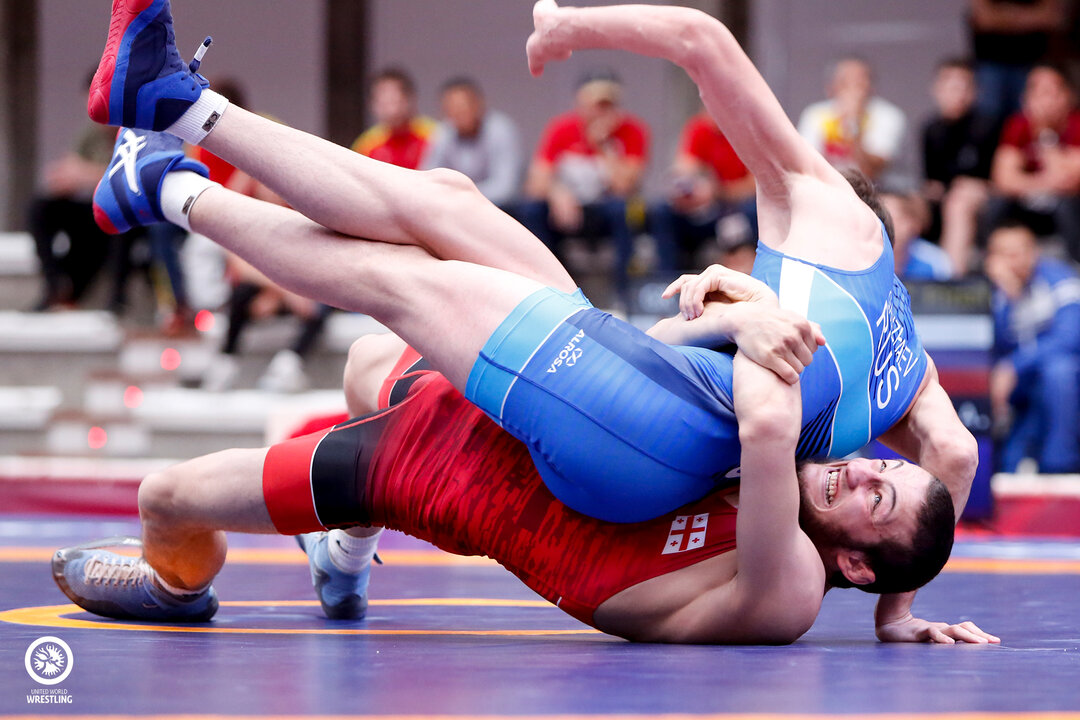 Leri ABULADZE (GEO) handled Adam GAUZHAEV (RUS), 10-1, and stopped Russia from putting five wrestlers into Tuesday night's finals. (Photo: Gabor Martin)
Abuladze Stops Russian Perfection
The lone weight that won't feature a Russian wrestler in the gold-medal bout will be 63kg, where Leri ABULADZE (GEO) will square off against Abdullah TOPRAK (TUR). Abuladze was the man who stopped Russian perfection after bottling up Adam GAUZHAEV (RUS), 10-1, to reach the finals. He'll take on Abdullah Toprak, who narrowly escaped his semifinals bout with a 4-3 win over Hrachya POGHOSYAN (ARM).
Wrestling resumes tomorrow in Pontevedra, Spain, at 11:30 (local time) and can be followed live on www.unitedworldwrestling.org.
55kg
GOLD - Anvar ALLAKHIAROV (RUS) vs. Pridon ABULADZE (GEO)
SEMIFINAL - Anvar ALLAKHIAROV (RUS) df. Vladyslav KUZKO (UKR), 3-1
SEMIFINAL - Pridon ABULADZE (GEO) df. Zaur ALIYEV (AZE), 8-5
63kg
GOLD - Abdullah TOPRAK (TUR) vs. Leri ABULADZE (GEO)
SEMIFINAL - Abdullah TOPRAK (TUR) df. Hrachya POGHOSYAN (ARM), 4-3
SEMIFINAL - Leri ABULADZE (GEO) df. Adam GAUZHAEV (RUS), 10-1
77kg
GOLD - Tamas LEVAI (HUN) vs. Khamid ISAEV (RUS)
SEMIFINAL - Tamas LEVAI (HUN) df. Mikita KAZAKOU (BLR), 9-0
SEMIFINAL - Khamid ISAEV (RUS) df. Arminas LYGNUGARIS (LTU), 3-1
87kg
GOLD - David LOSONCZI (HUN) vs. Ilia ERMOLENKO (RUS)
SEMIFINAL - David LOSONCZI (HUN) df. Ihar YARASHEVICH (BLR), 18-9
SEMIFINAL - Ilia ERMOLENKO (RUS) df. Giorgi KATSANASHVILI (GEO), 2-0
130kg
GOLD - Muhammet BAKIR (TUR) vs. Osman SHADOV (RUS)
SEMIFINAL - Muhammet BAKIR (TUR) df. Dariusz Attila VITEK (HUN), 8-0
SEMIFINAL - Osman SHADOV (RUS) df. Raman ULASAU (BLR), 4-0

 Iran's national Greco-Roman coach Hassan RANGRAZ during the 2024 Paris Olympics. (Photo: United World Wrestling / Jake Kirkman)
Share your thoughts.
Comments