BUDAPEST, Hungary (July 16) -- It was a flashback to the 2023 World Championships. A then little-known Akhmed TAZHUDINOV (BRN) turned Kyle SNYDER's (USA) double-leg attempt into a four-point throw that launched his rise to world champion.
On Thursday at the Budapest Ranking Series, Batyrbek TSAKULOV (SVK) put Tazhudinov in almost the same position. Tazhudinov reached for the same counter. This time, it failed.

Tsakulov got the four points and a surprised Tazhudinov threw a challenge that he lost. At that point Tsakulov led the 97kg final in Budapest 5-3. Though he rallied to win the final 13-7, the difference between those two counters sums up Tazhudinov's journey over the past two years.
He won the 2023 World Championships and then stormed to the gold medal at the 2024 Paris Olympic. Following multiple surgeries, he returned at the 2025 Budapest Ranking Series and won gold with ease.
Despite the comeback gold, Tazhudinov never looked like the dominant wrestler who swept through the 2023 Worlds and Paris Olympics. He fell in the World Championships semifinals, finished fifth at the Islamic Solidarity Games and opened 2026 with bronze at the Asian Championships after a 15-6 loss to Arash YOSHIDA (JPN).
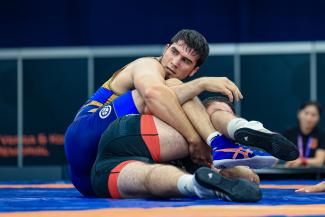
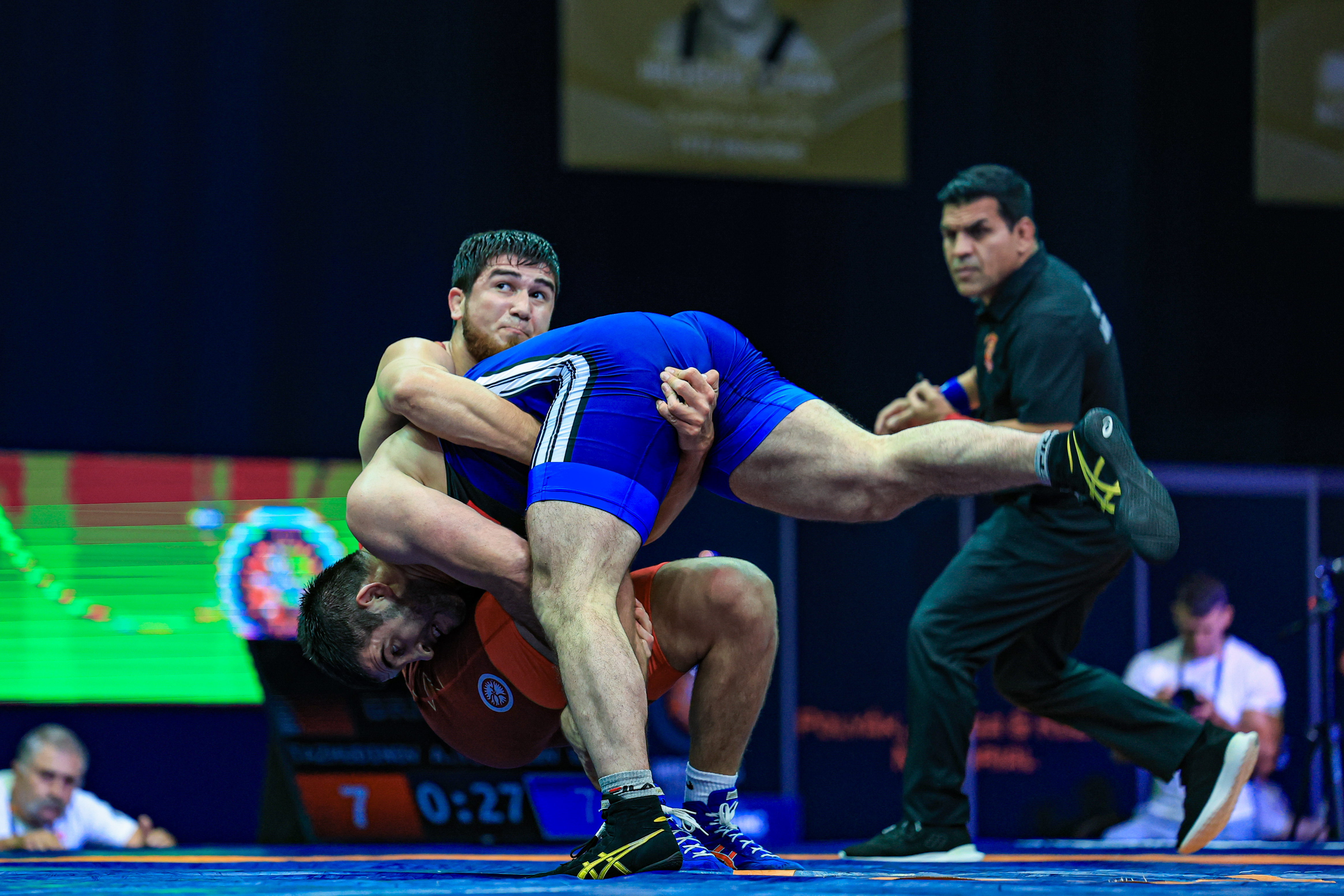 Akhmed TAZHUDINOV (BRN) tries to counter a move from Batyrbek TSAKULOV (SVK) during the 97kg final. (Photo: United World Wrestling / Amirreza Aliasgari)
The final suggested that while Tazhudinov is still working his way back to his best, he is learning to win without the overwhelming dominance that once defined him.
After trailing Tsakulov, Tazhudinov regrouped and scored a stepout and exposure to take a 6-5 lead at the break. He scored another stepout in the second period to lead 7-5 but Tsakulov answered with a duckunder for two points to lead 7-7 on criteria.
With 30 seconds remaining, Tsakulov attacked the legs again and tried to finish with forward pressure. This time, Tazhudinov landed the same counter that had failed him earlier in the bout, flinging Tsakulov over for four points and an 11-7 lead. A takedown at the end gave him a 13-7 win and the gold medal, a confidence booster as he prepares to reclaim the world title in Astana.
"I had some setbacks," Tazhudinov said. "I wasn't in my best form and I wasn't fully focused, so I was extremely motivated for this tournament. I managed to get into great shape. This is the second time I've become champion at this tournament, and I'm very happy with the result."
Though he is the 97kg defending champion at the Asian Games, Tazhudinov said he is more focused on the World Championships this year.
"We have the Asian Games coming up, followed two weeks later by the World Championships," he said. "However, our main focus will be on the World Championships. I want to prepare as well as possible, reach peak form."
The World Championships in Astana will see Tazhudinov joined by world champion Snyder, Asian champion Yoshida, former Olympic champion Hassan YAZDANI (IRI) and potentially 97kg star Abdulrashid SADULAEV (RUS), among others.
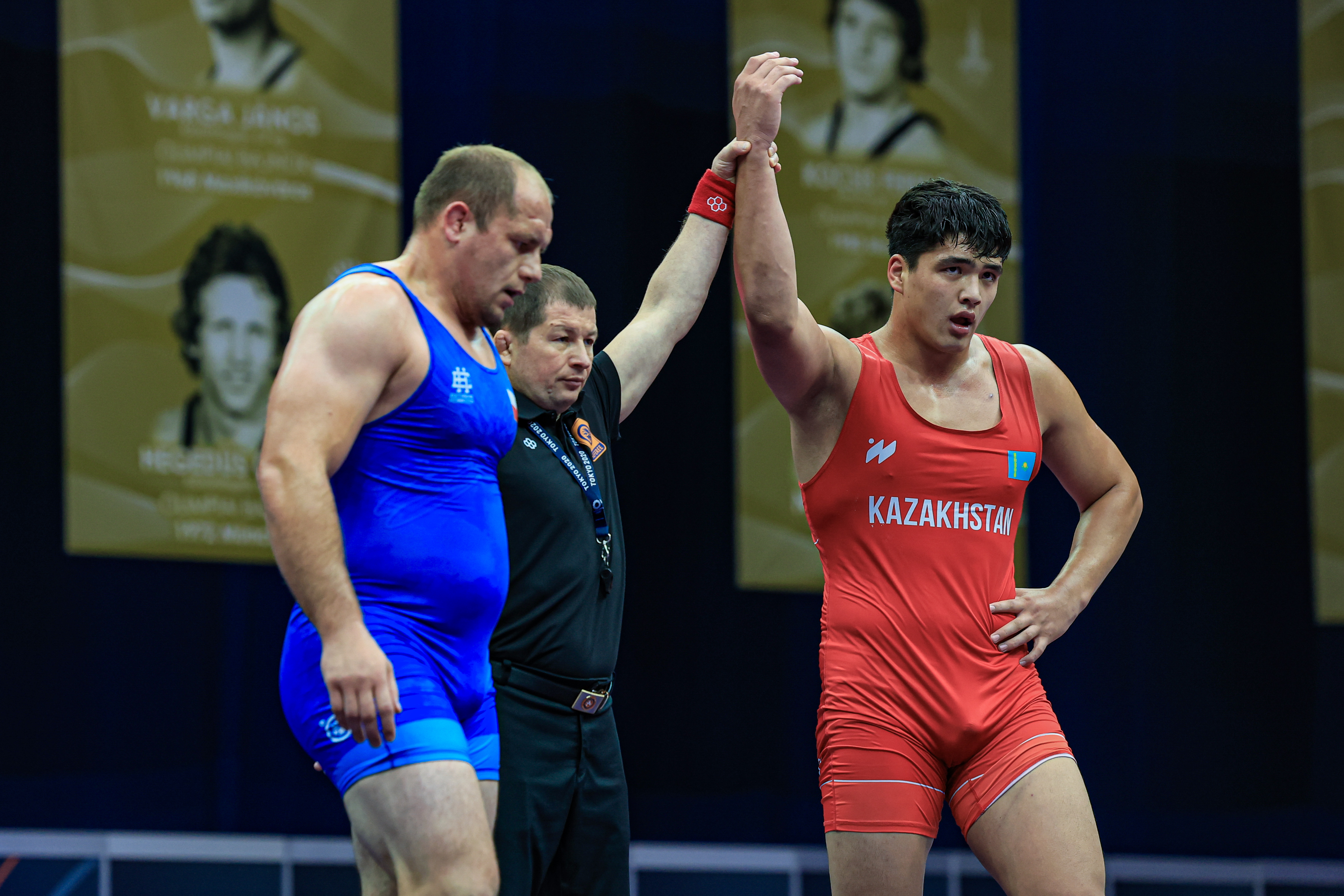 Yedige KASSIMBEK (KAZ) captured the 125kg gold medal in Budapest. (Photo: United World Wrestling / Amirreza Aliasgari)
Kassimbek Earns Gold
While the spotlight at the World Championships will be on the established stars, one youngster could emerge as a surprise. U20 world champion Yedige KASSIMBEK (KAZ) will have home-mat advantage after taking another step forward with the 125kg title in Budapest.
The 19-year-old, who won silver at the Ulaanbaatar Open in June, posted a clutch win over Asian Championships silver medalist Shamil SHARIPOV (BRN) in the quarterfinals, scoring a takedown in the final 10 seconds.
Sharipov led 3-2 after a scramble in the first period and he tried defending that lead and managed to do that well. However, Kassimbek got to Sharipov's legs in the closing seconds and finished a head-outside takedown to seal a 4-3 victory before blanking BUHEEERDUN (CHN), 10-0, in the semifinals.
Kamil KOSCIOLEK (POL) advanced from the opposite side of the bracket but was unable to trouble Kassimbek, who claimed his first senior international gold with a 5-0 victory.
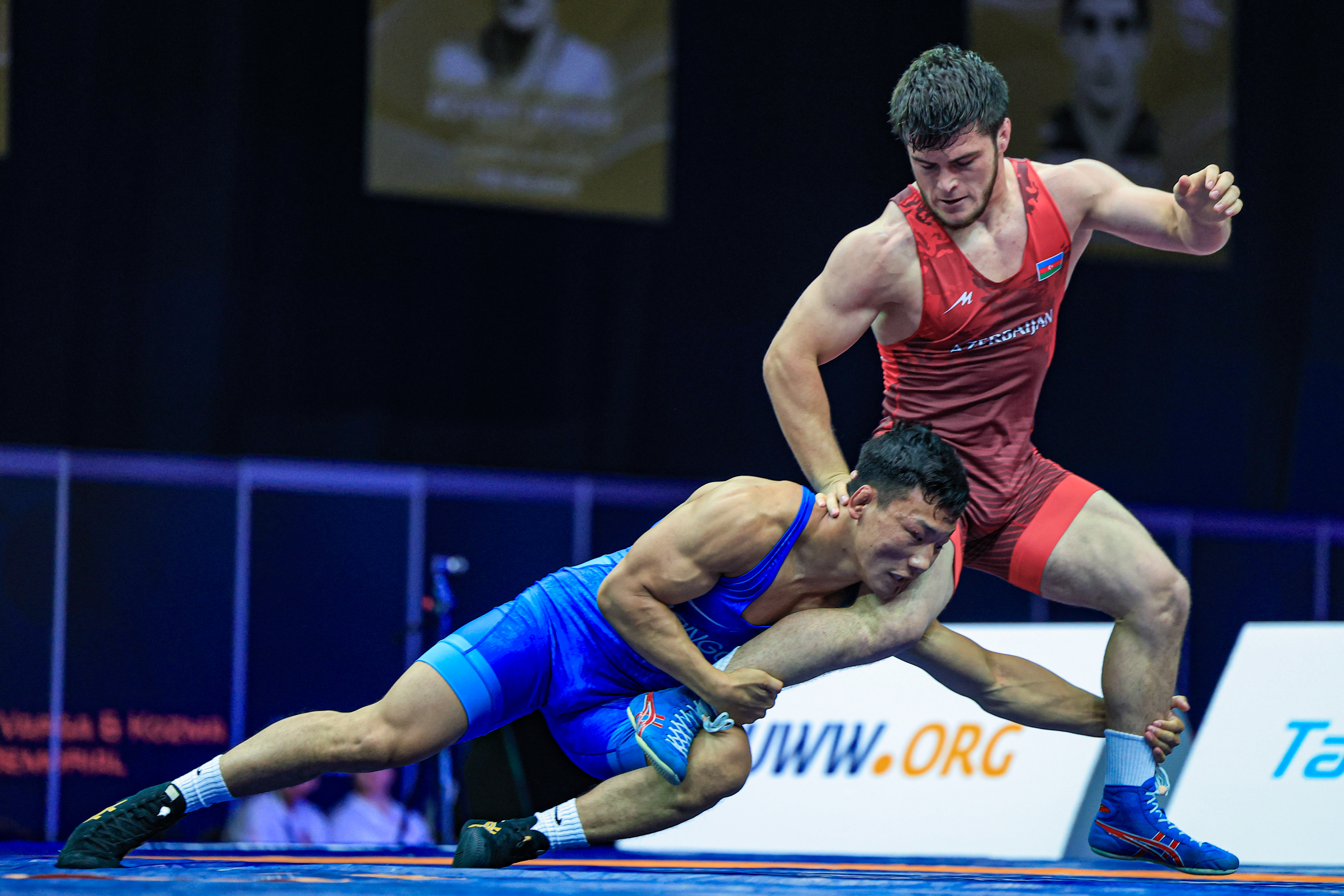 Suldkhuu OLONBAYAR (MGL), blue, won the 79kg final against Dzhabrail GADZHIEV (AZE), 5-1. (Photo: United World Wrestling / Amirreza Aliasgari)
Asian bronze medalist Suldkhuu OLONBAYAR (MGL) frustrated and defeated Dzhabrail GADZHIEV (AZE), 5-1, in the 79kg final to capture his first career gold at a United World Wrestling event.
Gadzhiev was put on the activity clock and as he failed to score in the 30 seconds, Olonbayar went up 1-0. The Mongolian then scored a takedown using a leg attack to extend his lead to 3-0. A quick counter when Gadzhiev attacked the legs resulted in another takedown, making the score 5-0.
As he fell behind, frustration crept in for Gadzhiev who was warned for an eye-poke. But Olonbayar kept his cool, gave up a harmless stepout at the end and won the gold medal.
At 92kg, European champion Ali TCOKAEV (AZE) won the gold medal after Mukhammed ALIIEV (UKR) injured defaulted in the final. Prior to the final ending by injury default, both Tcokaev and Aliiev scored come-from-behind victories at some stage.
Tcokaev defeated Dustin PLOTT (USA), 8-6, after falling behind early while Aliiev pinned Anton VYHIVSKYI (SVK) despite being down 9-1 at the break. He scored a takedown as soon as the second period began and again brought down the tiring Vyhivskyi to secure the fall.
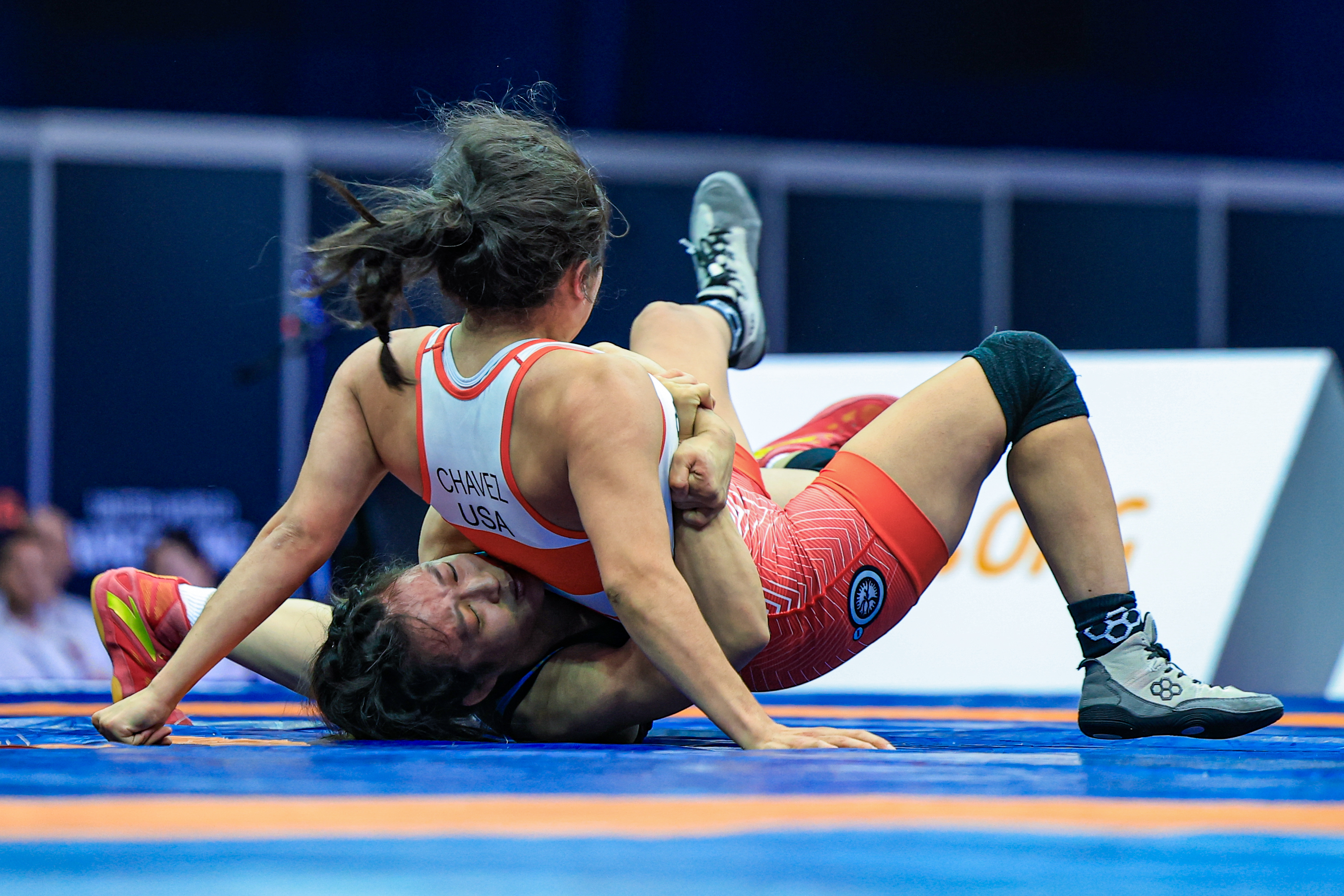 Ziqi FENG (CHN) scores using the gut-wrench in the 50kg final. (Photo: United World Wrestling / Amirreza Aliasgari)
Feng Gut-Wrenches to Gold
Ziqi FENG (CHN) captured the 50kg gold medal in Women's Wrestling, showcasing the powerful gut-wrench that has long been a hallmark of Chinese Women's Wrestling. She faced unheralded Samara CHAVEZ (USA) in the final and the American scored the first takedown for two points.
However, Feng took a 2-2 criteria lead and then turned Chavez five times using a high gut-wrench to claim a 12-2 victory and the gold medal. The Paris Olympic bronze medalist had won the gold medal in Budapest in 2024 as well.
At 55kg, Nataliia KLIVCHUTSKA (UKR) emerged champion after she posted a 5-0 win over Hansika LAMBA (IND) in the final.
RESULTS
Freestyle
79kg
GOLD: Suldkhuu OLONBAYAR (MGL) df. Dzhabrail GADZHIEV (AZE), 5-1
BRONZE: Aykan SEID (BUL) df. Nurdaulet KUANYSHBAY (KAZ), 2-0
BRONZE: Luka CHKHITUNIDZE (GEO) df. Shamsat TAIR (KAZ), 9-8
92kg
GOLD: Ali TCOKAEV (AZE) df. Mukhammed ALIIEV (UKR), via inj. def.
BRONZE: Dustin PLOTT (USA) df. Fatih ALTUNBAS (TUR), 10-0
BRONZE: Anton VYHIVSKYI (SVK) df. Zeteny GANGL (HUN), via fall (4-0)
97kg
GOLD: Akhmed TAZHUDINOV (BRN) df. Batyrbek TSAKULOV (SVK), 13-7
BRONZE: Vasyl SOVA (UKR) df. Rizabek AITMUKHAN (KAZ), via inj. def.
BRONZE: Zbigniew BARANOWSKI (POL) df. Ivan PRYMACHENKO (UKR), 5-3
125kg
GOLD: Yedige KASSIMBEK (KAZ) df. Kamil KOSCIOLEK (POL), 5-0
BRONZE: Rajat RUHAL (IND) df. Mason PARRIS (USA), via inj. def.
BRONZE: BUHEEERDUN (CHN) df. Omar SAREM (ROU), 10-0
Women's Wrestling
50kg
GOLD: Ziqi FENG (CHN) df. Samara CHAVEZ (USA), 12-2
BRONZE: Jacqueline MOLLOCANA (ECU) df. Priyanshi PRAJAPAT (IND), 4-2
BRONZE: Zeinep BAYANOVA (KAZ) df. Oksana LIVACH (UKR), via inj. def.
55kg
GOLD: Nataliia KLIVCHUTSKA (UKR) df. Hansika LAMBA (IND), 5-0
BRONZE: Karla GODINEZ (CAN) df. Gultakin SHIRINOVA (AZE), 5-0
BRONZE: Anastasia BLAYVAS (GER) df. Tuba DEMIR (TUR), 9-8



Share your thoughts.
Comments