

India Wins Historic Title; Eight Nations in #WrestleBudapest WW Finals
Wednesday, July 21, 2021 - 20:51 By Vinay Siwach

Ever since the cadet World Championships were reinstated in the wrestling calendar, only two countries have shared the team title. In the past nine tournaments, Russia and Iran shared the top honors with the former winning eight times while Iran won once in 2018.
But on Wednesday, that streak was broken as India claimed their first-ever freestyle team title at the cadet World Championships in Budapest, Hungary. This is the country's first freestyle team title at any Worlds.
India, USA and Russia were involved in a three-way battle but with India winning two medals on Wednesday and USA losing the 92kg bronze medal bout, India jumped ahead on the lead. Russia needed to win two of their three finals on Wednesday but they failed to capture even one, place them third behind USA.
Iran claimed the fourth spot after two gold medals while Kazakhstan ended at the fifth spot as freestyle wrestling came to and end in Budapest. Iran had two finalists on Wednesday and both won gold medals while USA, Uzbekistan and Turkey claimed the remaining three titles.
Ali KHORRAMDEL (IRI) and Seyedhassan ESMAEILNEZHAD ARCHI (IRI) captured the gold medals at 51kg and 71kg as Iran finished the tournament with three gold medals, the most for any country.
 Ali KHORRAMDEL (IRI) celebrates after winning the 51kg world title. (Photo: UWW / Martin Gabor)
In the 51kg final, Khorramdel overcame a stiff challenge from Nodirbek JUMANAZAROV (UZB) to claim a 2-0 win and the gold medal. He scored a takedown in the first period and maintained that lead going into the final few seconds.
Jumanazarov's continus attacks were too little too late to give him the gold as the young wrestler failed to control his emotions in the end.
Esmaeilnezhad Archi had a more convincing win in the final over Akhmed MUSAEV (RUS) as he wrestled back in the second period to win 3-1.
Musaev led 1-0 at the break after a step out point but gave up a takedown and push out to trail 1-3. With Musaev's energy running out, Esmaeilnezhad Archi managed to keep him away in the dying seconds.
Another disappointment for Russia came at 92kg as Rifat GIDAK (TUR) defeated Zhorik DZHIOEV (RUS) in a thrilling final. Dzhioev lead 3-0 after a stepout and takedown but as the second period began, Gidak paced up the bout.
Gidak got a takedown and then a stepout to lead on criteria and claim the win and the first gold medal for Turkey at this tournament.
“It was hard [in the final],” Gidak said. “But I prepared very well. I will now go back home with the gold medal, everybody is waiting for me there.”
 Bowen BASSETT (USA) won the 45kg gold in Budapest. (Photo: UWW / Kadir Caliskan)
USA added a gold medal to the one from Tuesday as Bowen BASSETT (USA) maintained his perfect record of winning by fall or superiority.
In the 45kg final, Bassett and Alikhan ASHINOV (RUS) traded a takedown each before the USA wrestler defended a big double leg attack from Ashinov. He then scored two exposures and on the latest, managed to keep Ashinov on his back.
The 14-year-old, with his family watching in the stands, was expecting a tough challenge from Ashinov but was prepared for anything that came towards him.
“It feels amazing to be a world champion,” Bassett said. “My match went great. I expected it to be tough, a lot of respect to the guy from Russia, I knew he was well-prepared. But it’s great to win by pin, especially at the World Championships.”
Uzbekistan crowned a world champion as well as Kamronbek KADAMOV (UZB) defeated Jaskaran SINGH (IND) 6-2 in the final at 60kg.
 Kamronbek KADAMOV (UZB) won the gold medal at 60kg. (Photo: UWW / Martin Gabor)
The Uzbek went on the attack from the beginning as he countered Singh's trademark snap-down to go-behind takedown and instead got a takedown on the edge before a gut wrench made it four points.
Singh then tried to get his single leg attacks going but Kadamov held on to his defence and did concede any points. On once such attack, Singh ended giving up a point for step out.
With a 5-0 lead going into the second period, Kadamov took a step back and wrestled less aggressively. Singh got two points for head pinch exposure but then gave up a stepout in the final 20 seconds as Kamadov held on to a 6-2 win.
Singh failed to replicate his strong defence and sneak attacks that he used on Tuesday to reach the final. Kamadov said that it was the 'toughest bout of his career.'
“I feel great after my victory. I still can’t believe I have become the world champion,” Kamadov said. “It was a tough final. I can say that it was the toughest bout in my career. The Indian wrestler was very strong.”
The Uzbek now plans to move up to the junior age group and planning to wrestle the at the continental and world championships.
“My next competition will be among juniors in my country Uzbekistan,” he said. “Then we are planning to compete at the Asian championships and World championships.”
Eight nations in WW finals
 Svenja JUNGO (SUI) became her country's first-ever cadet World finalist in women's wrestling. (Photo: UWW / Kadir Caliskan)
Women's wrestling began at the cadet World Championships in Budapest with five weight classes – 43kg, 49kg, 57kg, 65kg and 73kg -- getting their finalists, including a historic one for Switzerland.
Eight different nations qualified their wrestler for the finals as India and Belarus qualifying two each. Ukraine, Switzerland, Turkey, Sweden, Russia and Hungary were the other six countries to enter a finalists each.
Incidentally, the two wrestlers that India and Belarus advanced to the finals will face off against each other. Valeryia MIKITSICH (BLR) will take on TANNU (IND) in the 43kg final and PRIYA (IND) will face Kseniya PATAPOVICH (BLR) in the 73kg final on Thursday.
Svenja JUNGO (SUI) made history as she became Switzerland's first-ever medalist in women's wrestling at cadet Worlds. This also their first in 18 years at age group Worlds. In the last 39 years at cadet Worlds, no wrestler from Switzerland won a medal in any style until Jungo did it Wednesday.
She will now look to become Switzerland first-ever cadet world champion when she takes on Mariia YEFREMOVA (UKR) in the 49kg final Thursday.
Jungo defeated Audrey JIMENEZ (USA) in the semifinal 8-6, coming back every time Jimenez looked like taking the lead. She had defeated cadet European champion Delia VOICULESCU (ROU) 2-2 in the quarterfinals.
“I train in Switzerland and Germany,” Jungo said. “She did a leg attack and I defended. She scored some points and I thought I need to do more.
“I will train mentally and then looking forward to the final.”
But it won't be easy against Yefremova, who outscored her opponents 29-0 in the morning session. She made it to the final after beating Sevim AKBAS (TUR) 9-0 in the semifinal.
 TANNU (IND) won the semifinal via fall at 43kg. (Photo: UWW / Martin Gabor)
At 43kg, Tannu made a mockery of her competition winning her three bouts via fall, technical superiroty and fall. In the three bouts, she did not let her opponents score a single point and herself scored 31. She will face Mikitsich who defeated local girl Liliana KAPUVARI (HUN) 6-2 in the semifinal.
15-year-old Mikitsich knows that it won't be easy for her in the final but she will leave no stone unturned to win the gold medal.
“The semifinal was tough.” Mikitsich said. “It is never easy at the World Championships. My opponent was well prepared. I will prepare for the final just like I did before. I will listen to some music in my headphones, I’ll concentrate, I’ll plan ahead the match.”
To the delight of the Hungarian team, Eniko ELEKES (HUN) reached the final as well. She will take on Ekaterina OLEINIKOVA (RUS) in the 65kg final. The cadet European champion prevented India from having a third finalist with a 4-2 win over VARSHA (IND).
Oleinikova, 15, had a close semifinal against Daria KONSTANTYNOVA (UKR) and pulled off a 4-4 win, thanks to her four-point move over the two takedowns of the Ukrainian.
 Eniko ELEKES (HUN) will wrestle for the 65kg gold medal. (Photo: UWW / Martin Gabor)
“In last seconds of the match the score was 4-4, but I knew that I was still winning because the 4 point throw [fireman’s carry]saved me,” she said. “That’s one of my best techniques. I was so scared to lose everything after such a long preparation, I went through injuries, broken bones. I can’t believe I am in the final now.
“I’ll prepare for the final in a better way than I did for that match. I realize there is no way back.”
At 57kg, Tindra DALMYR (SWE) scored four points in the second period to beat Tancholpon KYBALBEKOVA (KGZ) 5-5 in the semifinal against book a final against Selvi ILYASOGLU (TUR).
The 17-year-old Turk defeated cadet Euros silver medalist Angelina PERVUKHINA (RUS) 4-2 in the semifinal.
“When there was a challenge in the last seconds, it was a very risky position, but I was confident, so I won, and now I have to win the gold medal tomorrow,” Ilyasoglu said.
At the super-heavyweight, Priya maintained a perfect record and defeated cadet European champion Mariia AKULINCHEVA (RUS) 9-0 in the semifinal. She will take on Patapovich in the final after the Belarusian defeated Lillian FREITAS (USA) 3-1 in her semifinal.
"I came here to just win the gold medal,” Priya said.
Wrestling will continue with remaining five women's weight classes – 40kg, 46kg, 53kg, 61kg and 69kg – on Thursday along with the medal bouts in the evening session.
 India won the freestyle team title with USA second and Russia third. (Photo: UWW / Kadir Caliskan)
RESULTS: FS Medal Bouts
45kg
GOLD: Bowen BASSETT (USA) df Alikhan ASHINOV (RUS), via fall
BRONZE: Umidjon ISKANDAROV (UZB) df Yusif ISPAROV (AZE), 11-1
BRONZE: Imronbek RAKHMANOV (KGZ) df Shourya KUMAR (IND), 6-0
51kg
GOLD: Ali KHORRAMDEL (IRI) df Nodirbek JUMANAZAROV (UZB), 2-0
BRONZE: CHIRAG (IND) df Elman MAMMADOV (AZE), 9-6
BRONZE: Nathanael JESUROGA (USA) df Tigran BUNIATYAN (ARM), 6-2
60kg
GOLD: Kamronbek KADAMOV (UZB) df Jaskaran SINGH (IND), 6-2
BRONZE: Abdulrahman IBRAHIMOV (AZE) df Mohammad Reza SHAKERI (IRI), 8-7
BRONZE: Alex GOMBOS (HUN) df Baris UNSAL (TUR), via fall
71kg
GOLD: Seyedhassan ESMAEILNEZHAD ARCHI (IRI) df Akhmed MUSAEV (RUS), 3-1
BRONZE: Yerkhan BEXULTANOV (KAZ) df Raul CASO (ITA), 8-3
BRONZE: JAIDEEP (IND) df Gigi SUBTIRICA (ROU), 7-3
92kg
GOLD: Rifat GIDAK (TUR) df Zhorik DZHIOEV (RUS), 3-3
BRONZE: Kamil KURUGLIYEV (KAZ) df Gavin NELSON (USA), 6-0
BRONZE: Yusif DURSUNOV (AZE) df Roland ROSZ (HUN), 4-0
 Tindra DALMYR (SWE) will wrestle for the 53kg gold medal. (Photo: UWW / Kadir Caliskan)
RESULTS: Women's Semifinals
43kg
GOLD: Valeryia MIKITSICH (BLR) vs TANNU (IND)
SF 1: Valeryia MIKITSICH (BLR) df Liliana KAPUVARI (HUN), 6-2
SF 2: TANNU (IND) df Aida ALZHANOVA (KAZ), via fall
49kg
GOLD: Mariia YEFREMOVA (UKR) vs Svenja JUNGO (SUI)
SF 1: Mariia YEFREMOVA (UKR) df Sevim AKBAS (TUR), 9-0
SF 2: Svenja JUNGO (SUI) df Audrey JIMENEZ (USA), 8-6
57kg
GOLD: Selvi ILYASOGLU (TUR) vs Tindra DALMYR (SWE)
SF 1: Selvi ILYASOGLU (TUR) df Angelina PERVUKHINA (RUS), 4-2
SF 2: Tindra DALMYR (SWE) df Tancholpon KYBALBEKOVA (KGZ), 5-5
65kg
GOLD: Ekaterina OLEINIKOVA (RUS) vs Eniko ELEKES (HUN)
SF 1: Ekaterina OLEINIKOVA (RUS) df Daria KONSTANTYNOVA (UKR), 4-4
SF 2: Eniko ELEKES (HUN) df VARSHA (IND), 4-2
73kg
GOLD: PRIYA (IND) vs Kseniya PATAPOVICH (BLR)
SF 1: PRIYA (IND) df Mariia AKULINCHEVA (RUS), 9-0
SF 2: Kseniya PATAPOVICH (BLR) df Lillian FREITAS (USA), 3-1
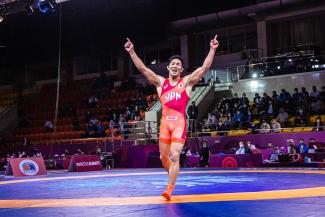
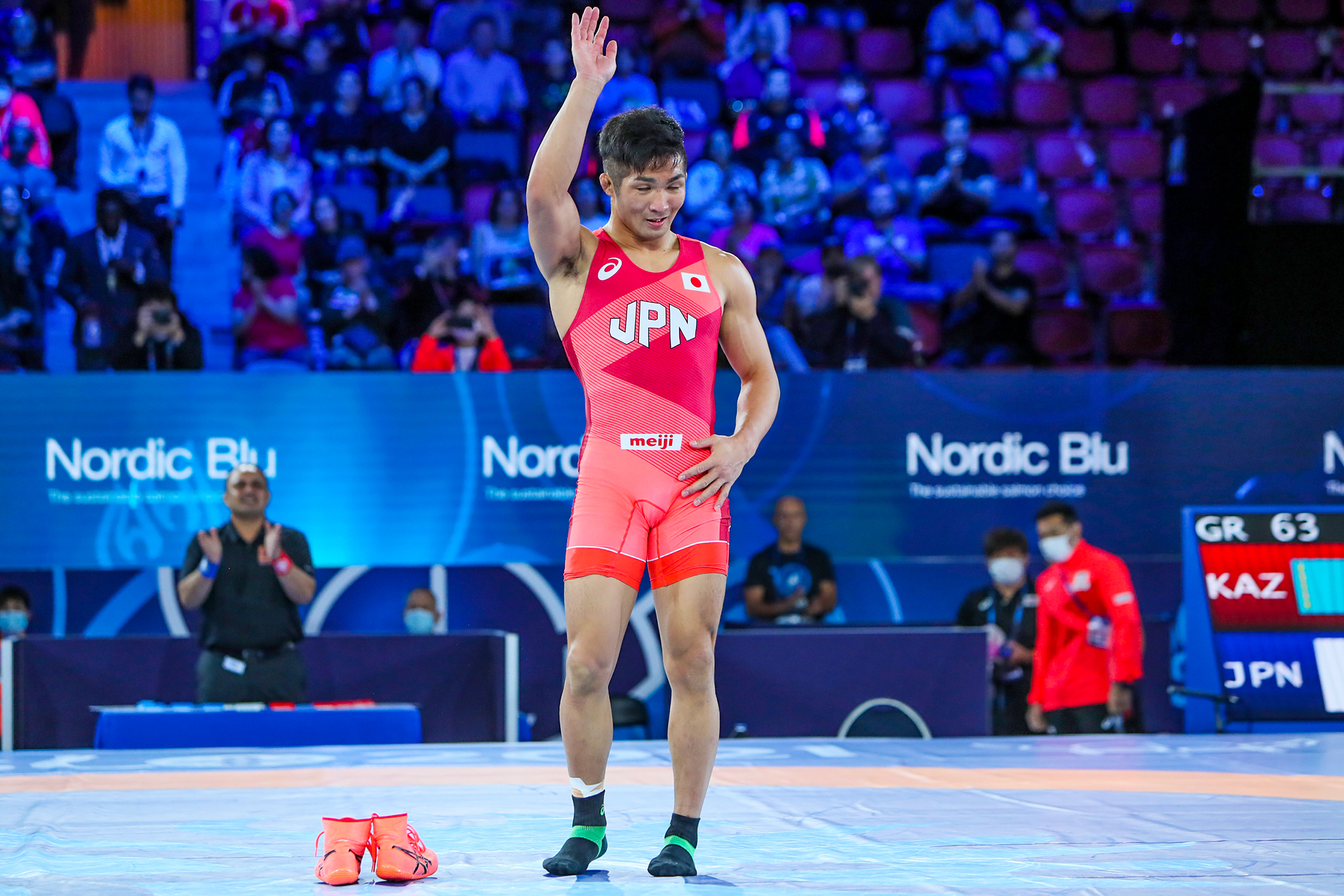 Tsuchika SHIMOYAMADA (AUS) had left his shoes on the mat during the 2021 World Championships to mark his retirement. (Photo: United World Wrestling / Martin Gabor)
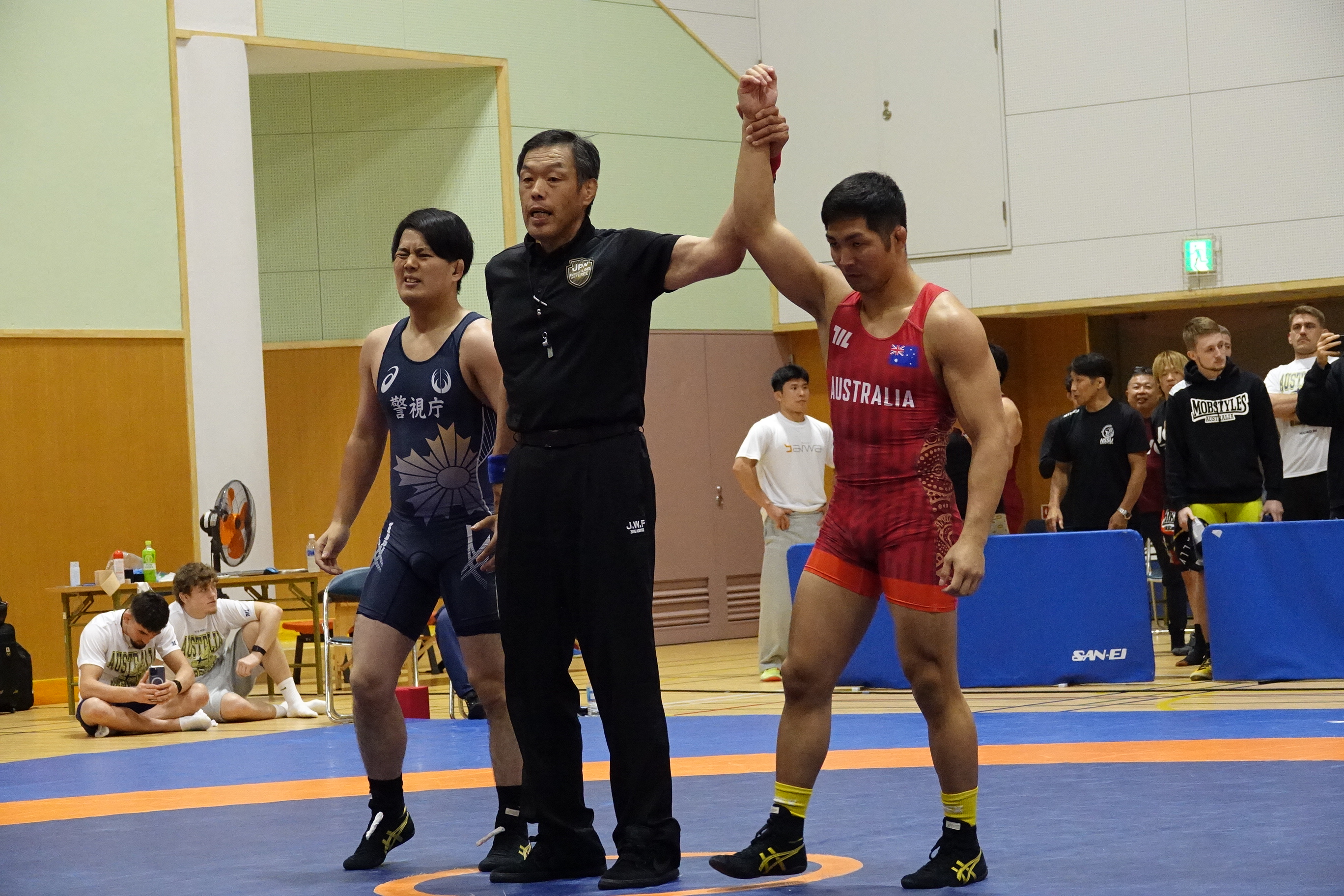 Tsuchika SHIMOYAMADA advances to the semifinals at the All-Japan Non-Student Championships in July with a 52-second win over Kokoro GOTO. (Photo: Koji Fuse / wrestling-spirits.jp)
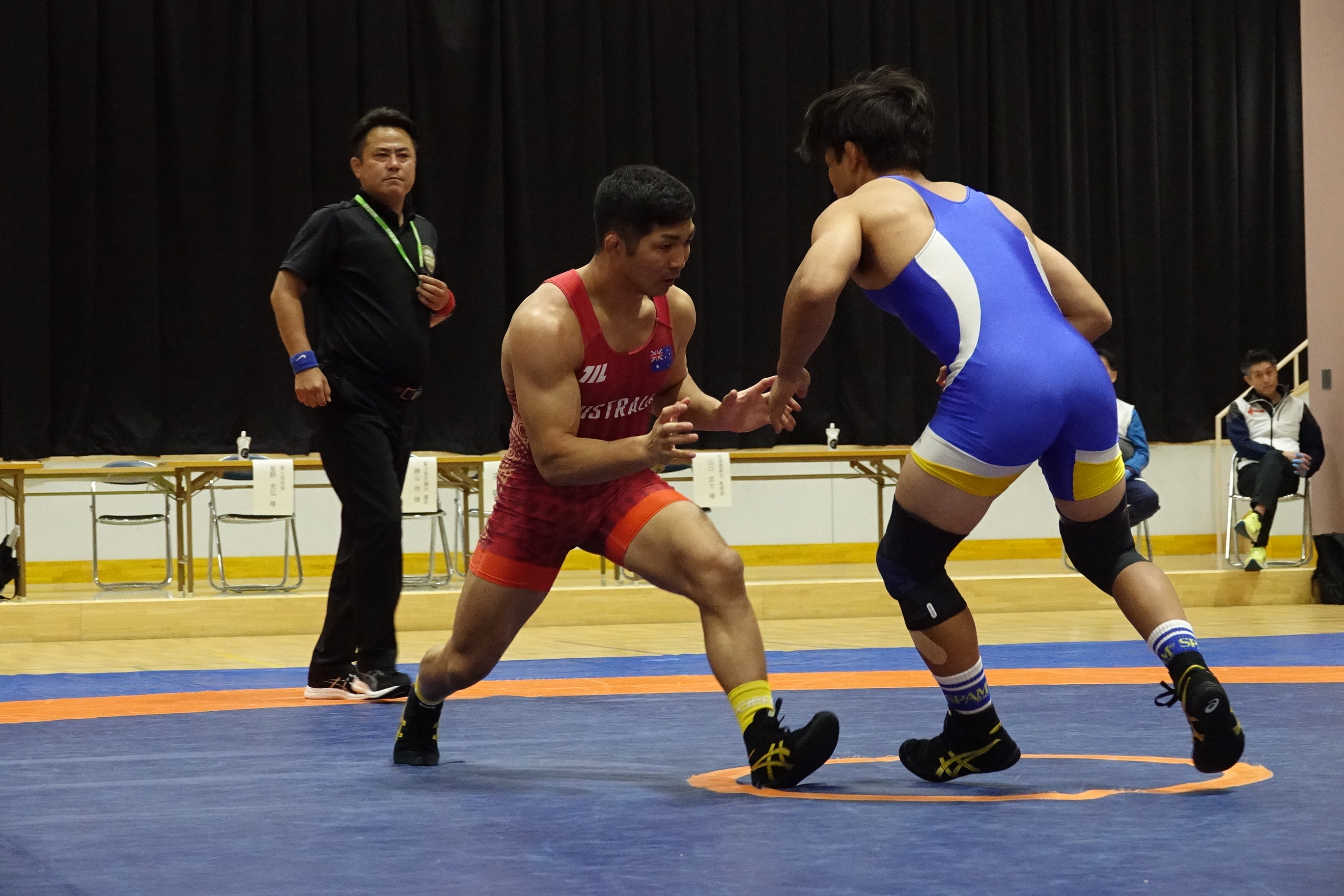 Tsuchika SHIMOYAMA faces Keitaro ONO in his opening match at the All-Japan Non-Student Championships in July. (Photo: Koji Fuse / wrestling-spirits.jp)
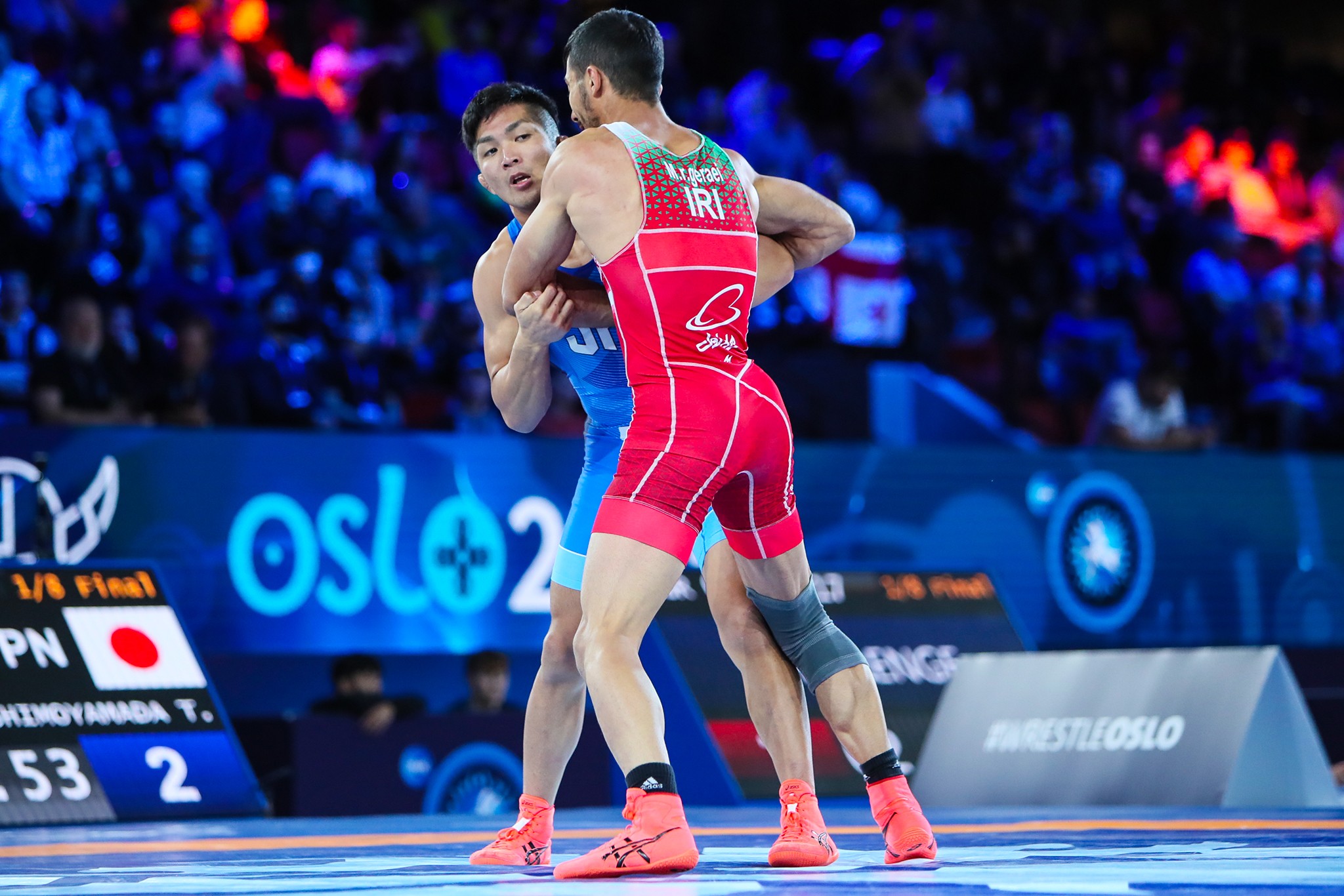 Tsuchika SHIMOYAMADA (AUS) was dominating Mohammadreza GERAEI (IRI) in their match at the 2021 World Championships before being pinned. (Photo: United World Wrestling / Martin Gabor)
Share your thoughts.
Comments