CORALVILLE, IOWA, United States (May 10) -- The United States captured six out of seven gold medals in Freestyle to close out the Pan-American Championships in Coralville, Iowa.
After winning the Greco-Roman and Women's Wrestling team title, the U.S. also won the Freestyle title with 240 points and Puerto Rico finished second with 150 points. Canada was third with 129 points.

The three 2025 world medalists in action on Sunday for the U.S., all came back with gold medals. World champion Trent HIDLAY (USA) won gold medal at 92kg, defending his Pan-Am title, world silver medalist Levi HAINES (USA) won gold at 70kg while world bronze medalist Real WOODS (USA) prevailed at 65kg to win the title.
Other three champions were Liam CRONIN (USA) at 57kg, improving from his bronze medal last year, Ridge LOVETT (USA) at 70kg and Wyatt HENDRICKSON (USA) who defended his 125kg title.
Arturo SILOT (CUB) was the only wrestler to deny the U.S. gold medal as he defeated Stephen BUCHANAN (USA), 15-4, in the 97kg final. This was his first-ever Pan-Am gold after being denied for four straight years in the finals.
In the marquee match of the night, Woods faced Peiman BIABANI (CAN) in the 65kg final, a rematch of the World Championships bronze-medal bout which Woods won 3-1.
On Sunday, Woods dictated the pace of the final, getting the first point for Biabani's passivity in the first period. Woods opened the second period with a quick leg-attack before elevating Biabani's leg as the Canadian tried to defend on one leg. Woods did not let go and scored a takedown to lead 3-0 with 2:33 left.
Under pressure to score, Biabani got rewarded when Woods was put on the activity clock and when the American did not score, Biabani got a point. But Biabani could find a takedown which would have given him the win and the gold medal. He only managed a stepout as the clock expired.
Hidlay was in a five-wrestler round-robin bracket at 92kg and the world champion was clearly the best among all. He opened with an 11-0 win over Lucas BORDEAUX (BRA) in Round 1 before scoring a similar 11-0 win over Pool AMBROCIO (PER) in Round 2. Andrew JOHNSON (CAN) wasn't spared either as Hidlay added another 11-0 win in Round 3.
Shane JONES (PUR) managed to score two points on Hidlay who remained unfazed and worked on a 13-2 win but secured the victory fall in Round 4, thus outscoring his opponents 46-2 in four bouts.
Haines was also in a round-robin bracket with five wrestlers at 79kg and followed a similar path like Hidlay to the gold medal. He scored an 11-0 victory over Michael LABRIOLA (PUR) before beating Sergio ESPINOZA (MEX), 10-0, in Round 2.
Patrick LEDER (CAN) almost pinned Haines when the Canadian blocked his head between the legs lace using his legs but Hains quickly escaped before winning 13-2. In Round 4, Haines picked an easy 10-0 win over Jhoan SERNA (VEN) to claim gold.
The 125kg final between Hendrickson and Jorawar DHINSA (CAN) was all fireworks as both wrestlers went for the throws. Dhinsa managed an arm throw for four points against Hendrickson who countered two other lateral drop attempts to score his points. When Dhinsa tried another lateral drop, Hendrickson landed on top and kept the Canadian's back on the mat to win the final via fall.
Cronin upgraded his bronze to gold after a close 5-4 win over Darian CRUZ (PUR) in the 57kg final. In an actionless first period, Cronin went up 1-0 at the break as Cruz was put on the activity clock in which he failed to score.
Cronin was put on the activity clock in the second period but eight seconds in, he countered Cruz to score a stepout and lead 2-0. Cruz fired a takedown with a minute left and took a 2-2 criteria lead. However, that was short lived as he hit a deep attack and Cronin caught him in a tangle with his legs and scored two points. Cruz challenged the decision but lost as the reviews showed that Cronin was the only one with control in the exchange.
Down 5-2 with 22 seconds left, Cruz managed a stepout and a point for Cronin's fleeing as the clock expired.
Ridge LOVETT (USA) earned a gold medal at 70kg with a win over Victor SOTO (PUR) in the final. He secured the fall over Soto after building an 11-0 lead. Lovett did not give up a single point in the tournament.
Silot Wins 97kg Gold
Kyle SNYDER (USA) denied him for three years and then Justin RADEMACHER (USA) stopped him last year. But Silot made sure that Zagreb Open champion Stephen BUCHANAN (USA) did not stop him from winning his first Pan-Am gold after four disappointments.
In the 97kg final, Silot came out firing and hit an arm throw for four points before Buchanan scored a takedown and lace to make it 4-4. However, Silot continued the exchange and used double armlock to throw Buchanan again for four points and then turned him to lead 10-4 at the break.
Silot needed 25 seconds in the second period to once again throw Buchanan using double arm locks and score four points. The U.S. challenged the four-point call but it was upheld, the lost challenge adding one more point to Silot's score to make it 15-4.

RESULTS
57kg
GOLD: Liam CRONIN (USA) df. Darian CRUZ (PUR), 5-4
BRONZE: Edwin SEGURA (GUA) df. Justin ROSALES (NCA), 8-6
BRONZE: Pedro MEJIAS (VEN) df. Juan RAMIREZ (DOM), via inj. def.
65kg
GOLD: Real WOODS (USA) df. Peiman BIABANI (CAN), 3-2
BRONZE: Joseph SILVA (PUR) df. Joshua KRAMER (ECU), 5-4
BRONZE: Shannon HANNA (BAH) df. Tommy GARCIA (DOM), 7-3
70kg
GOLD: Ridge LOVETT (USA) df. Victor SOTO (PUR), via fall (11-0)
BRONZE: Michael ZALE (CAN) df. Mauricio LOVERA (ARG), via inj. def.
79kg
GOLD: Levi HAINES (USA)
SILVER: Michael LABRIOLA (PUR)
BRONZE: Patrik LEDER (CAN)
92kg
GOLD: Trent HIDLAY (USA)
SILVER: Shane JONES (PUR)
BRONZE: Andrew JOHNSON (CAN)
97kg
GOLD: Arturo SILOT (CUB) df. Stephen BUCHANAN (USA), 15-4
BRONZE: Cristian SARCO (VEN) df. Steven BURRELL (JAM), 6-5
BRONZE: Luis PEREZ (DOM) df. Edwin MORALES (PUR), 4-3
125kg
GOLD: Wyatt HENDRICKSON (USA) df. Jorawar DHINSA (CAN), via fall (12-4)
BRONZE: Gabriel DE SOUSA (BRA) df. Brandon ANGUIANO (MEX), via fall (4-0)
BRONZE: Jose DIAZ (VEN) df. Jonovan SMITH (PUR), 2-1



 Participants of the 'Learn, Wrestle, Use' camp work on technique with the Croatian coastline in the background. (Photo: United World Wrestling)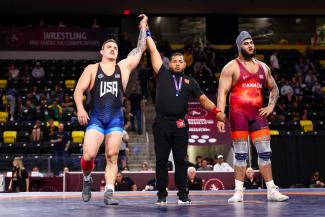
Share your thoughts.
Comments