

Women's coaches and referees course held in Colombia
Thursday, April 24, 2025 - 12:59 By United World Wrestling Press

RIONEGRO, Colombia (April 23) -- An unprecedented international course, exclusively for Spanish-speaking female coaches and referees, was held in Rionegro, Colombia from April 16 to 18.
Organized by United World Wrestling (UWW) with support from Olympic Solidarity, the event took place at the Recinto Quirama, gathering 33 participants from 15 Latin American countries.
The course was inaugurated by UWW Development Director Deqa NIAMKEY, UWW Sport and Development Officer Yuri Maier and member of the UWW Americas Executive Committee Fanny ECHEVERRY.
The educational sessions were led by Rafael GALVA LEBRON, an Olympic referee and member of the UWW Referee Commission, known for his passionate and dynamic teaching style and Raul TRUJILLO DIAZ, one of the most respected Greco-Roman wrestling coaches globally, recognized for guiding the legendary Olympic champion Mijain LOPEZ (CUB).
Throughout three days filled with camaraderie, learning, and solidarity, the participants engaged in integrated theoretical and practical sessions conducted in a shared venue.
This approach facilitated dynamic exchanges, ongoing dialogue between coaches and referees, and created a supportive and collaborative learning environment. The course activities included live simulations, technical analyses, motivational talks, and workshops on leadership and personal development.
Notably, the event featured motivational speeches by Jackeline RENTERIA, Colombia's two-time Olympic medalist and a leading figure in Women's Wrestling on the continent, and Jessica ECHEVERRY, President of the Risaraldense Wrestling League.
Both speakers emphasized shared experiences and the importance of women supporting each other beyond individual differences.
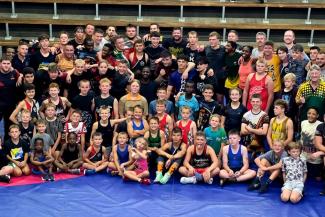
 Participants listen to United World Wrestling's Development Department's opening remarks. (Photo: United World Wrestling)
"This course was a significant opportunity to continue learning and to give back to the sport that has given me so much," Nes RODRIGUEZ (PUR) said. "Now, as a sports director, my goal is to inspire children and youth by showing them that sports can provide a life full of opportunities beyond any hardships."
Other expressed how motivated they were after attending the courses.
"It reminded me of the importance of never giving up, not only as a coach but also as a woman," Keliyojana VAZQUEZ (MEX) said. "I'm returning home with new tools to improve my work and appreciate myself more in every aspect."
"I leave with the commitment to build networks of support and communication among us," Paula GRAJALES (COL) said. "We are friends and colleagues who must unite to grow together and continue transforming our communities and the sport."
The pioneering course, aligned with the Gender Equality, Diversity, and Inclusion (GEDI) agenda of the International Olympic Committee, represented a historic milestone for women's wrestling in Latin America
The notable personal growth experienced by the participants confirmed that when women come together and put aside competition, they significantly amplify their transformative power, strengthening the future of women's sports in the region.
Share your thoughts.
Comments