TIRANA, Albania (April 25) -- "Six-time world champion, six-time European champion."
Abdulrashid SADULAEV (UWW) says the sentence has a "nice ring to it."
In 2024, Sadulaev wrestled at his first World Championships in three years in Tirana and won his sixth world title. On Saturday and in Tirana, Sadulaev wrestled at his first European Championships in six years and won his sixth European gold medal.

Sadulaev, who is now unbeaten in 26 bouts in Europe, outwrestled Batyrbek TSAKULOV (SVK), 14-3, in the 97kg final. However, it was Tsakulov who opened the scoring in the final.
"Tirana has become such a lucky place for me," Sadulaev said. "In just two months, I’ve already managed to visit here for the second time. Two years ago, I won the World Championships here. The welcome here is so warm. The crowd and the atmosphere were absolutely top-notch."
In front of a packed Feti Borova Olympic Park Arena, Sadulaev lived up to the expectation of a world champion he was crowned at the same arena in 2024.
Barring the first attack from Tsakulov, Sadulaev remained in complete control of his final, and completed his 17th win via technical superiority in all European history.
Tsakulov surprised Sadulaev as he shot a double-leg early in the match and the latter tried to defend using a chest-wrap. But Tsakulov kept the pressure and put Sadulaev in danger to get his two points. Sadulaev quickly reversed and scored one point before turning Tsakulov three times for a 7-2 lead.
Sadulaev challenged the decision, which he later realized that he shouldn't have, and lost it as all the scoring was accurate. Tsakulov was awarded a point for the lost challenge.
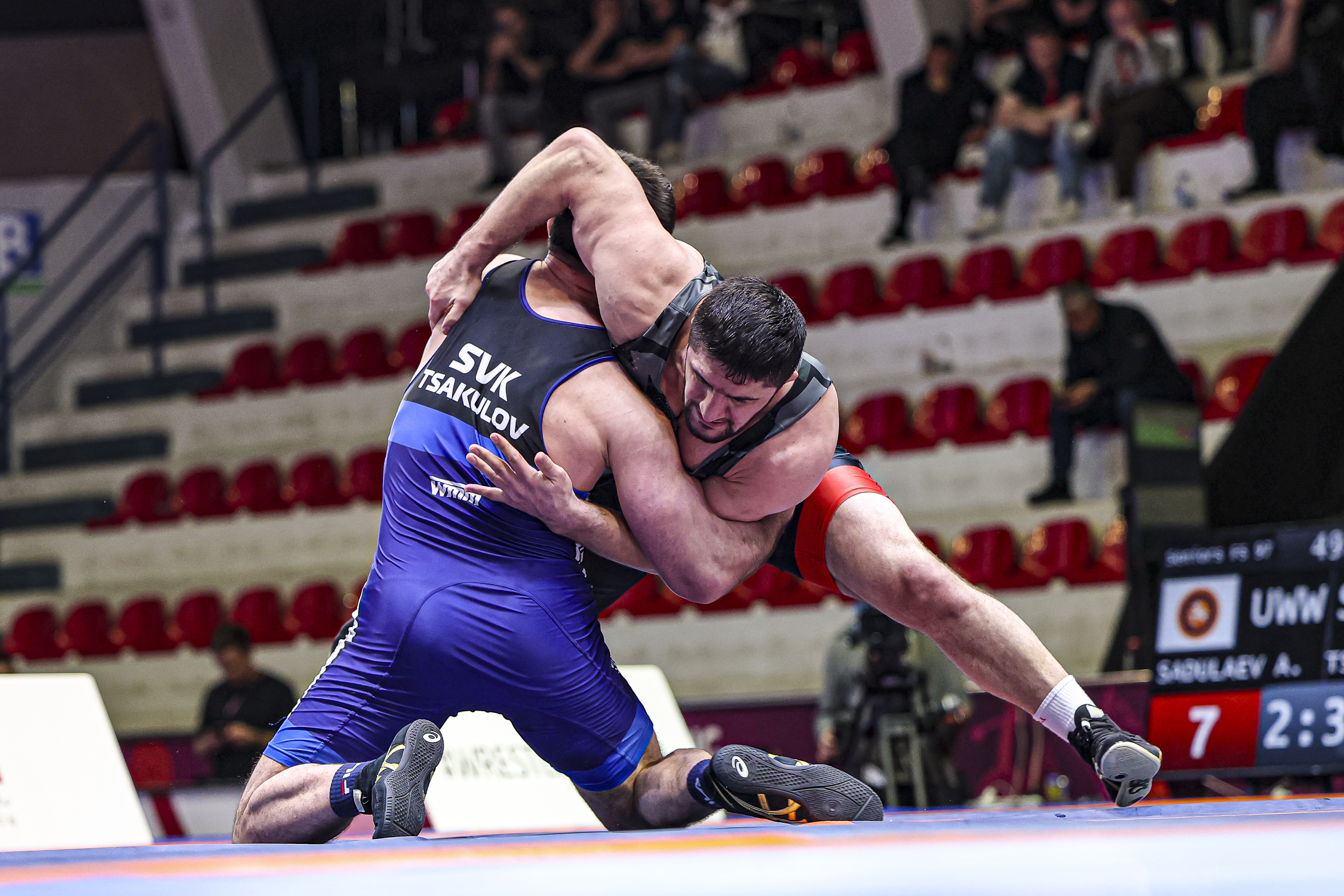 Abdulrashid SADULAEV (UWW), red, battles it out against Batyrbek TSAKULOV (SVK) in the 97kg final. (Photo: United World Wrestling / Kadir Caliskan)
In the second period, Tsakulov threatened with some quick attacks but Sadulaev was quick on his feat to escape. He managed to score a stepout to extend his lead to 8-3. With 20 seconds remaining, Tsakulov tried another double-leg attack but Sadulaev was ready for it, countering it with a go-behind and scored a takedown.
Sadulaev could have well defended his lead but in the final 10 seconds, he hit his own attacks, scoring a takedown and then a turn to finish the bout 14-3.
"I’ve known Tsakulov since 2012," he said. "Back then we were both in the junior ranks, and he was already competing for the national team. We were competing in almost the same weight class at the time. Ever since then, I’ve known that you really can’t let your guard down against him at all. He’s capable of attacking at any moment."
After winning the final, Sadulaev was relieved to regain the top spot in the continent and said it gave him "peace."
"The last time I competed at the European Championships was six years ago in Rome," he said. "I really missed the international stage and the official competitions like the European Championships, the World Championships and the Olympic Games. They’re not like other ranking events, no other competition can compare to these.
"That’s why this victory was particularly important to me, so that I could have peace and a place in Europe."
But when asked to pick his most memorable European title among the once won in 2014, 2015, 2018, 2019 and 2020, Sadulaev picked his first gold he won in 2014 in Finland. Wrestling at 86kg then, Sadulaev defeated Murad GAIDAROV (BLR), 5-2, in the final and outscored his opponents 50-3 in five bouts.
"The first one I ever won," he said. "It was in Finland, in the town of Vantaa, I remember. I won quite easily and confidently there. But I was probably hungry back then, and I still am now."
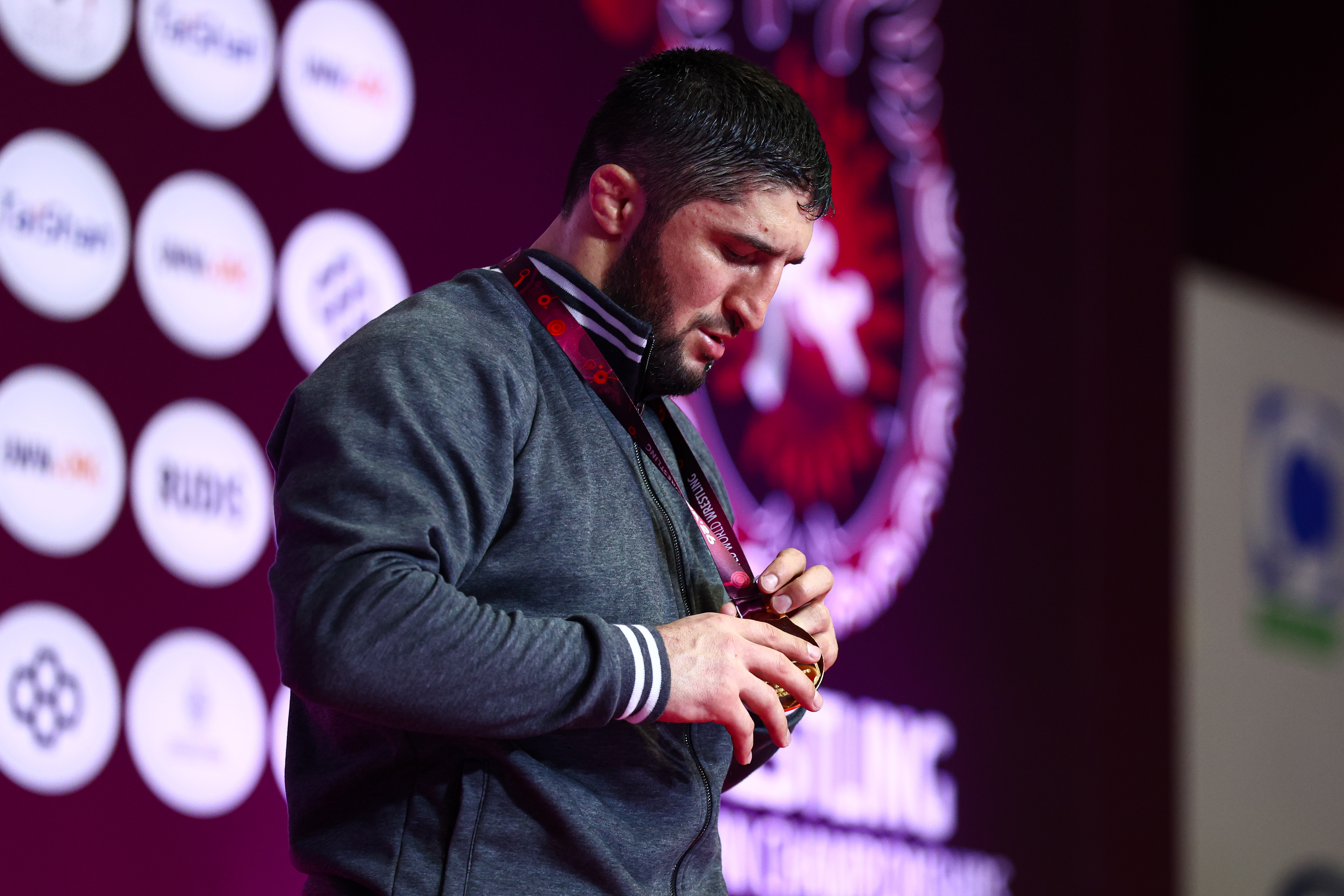 Abdulrashid SADULAEV (UWW) looks at his medal during the European Championships in Tirana. (Photo: United World Wrestling / Kadir Caliskan)
Sadulaev is perhaps hungry for his seventh world title that he could win later this year after winning them in 2014, 2015, 2018, 2019, 2021 and 2024.
"I’ve been keeping an eye on them [97kg opponents]," he said. "Unfortunately, last year I had to watch them on TV, both at the European Championships and the World Championships. So I’m keeping an eye on them, watching them, and moving forward."
But it won't be a straightforward quest. He would have to win the national championships, a virtual qualification for the World Championships.
"If I do qualify, I think the 97kg category will be one of the most exciting World Championships in history. I really do," he said.
While that is still six months away, Sadulaev will be keen on regaining his 97kg world title which he last won five years ago in Oslo and change his record to seven-time world champion.
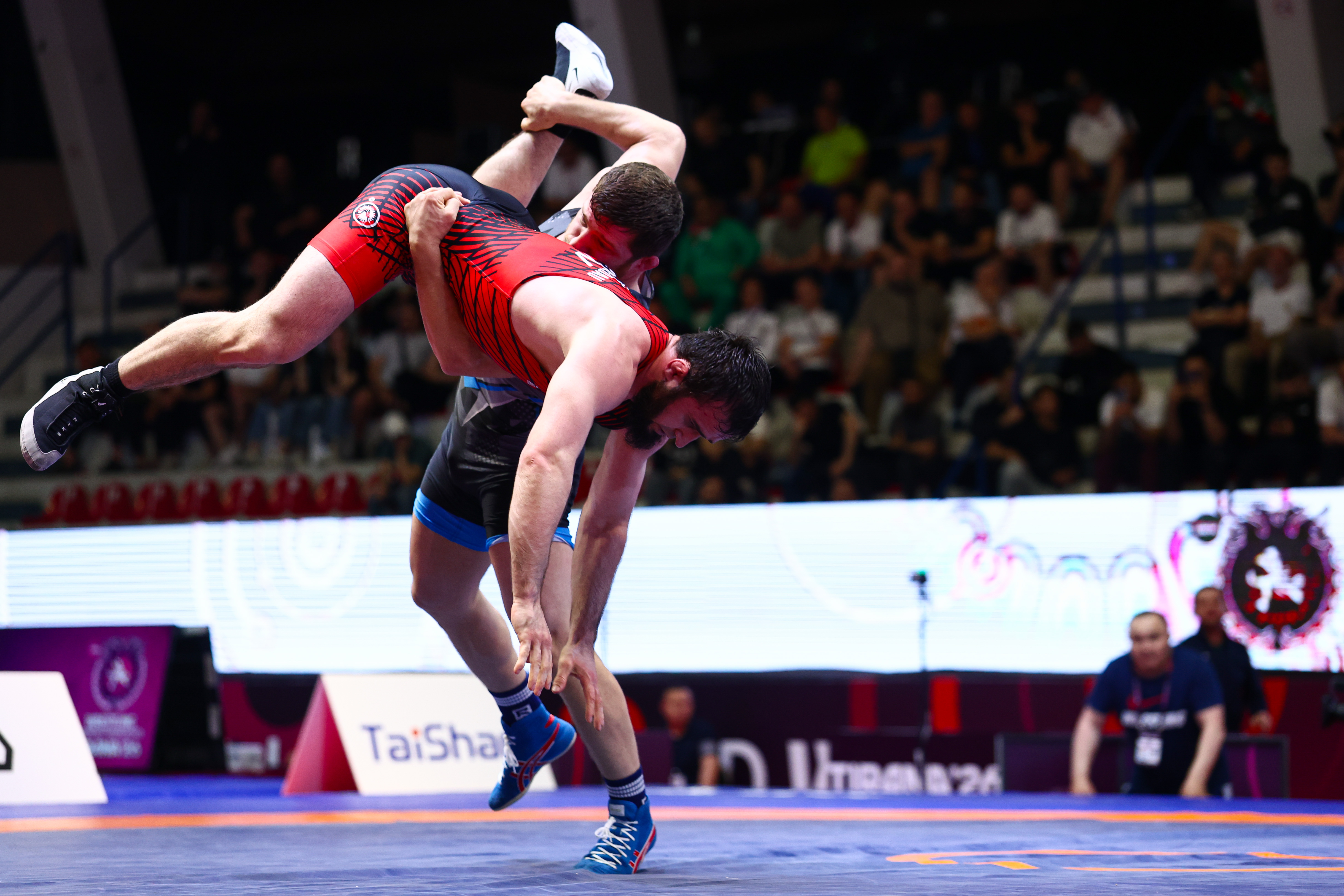 Akhmed USMANOV (UWW) completes a takedown against Mahamedkhabib KADZIMAHAMEDAU (UWW) during the 79kg final. (Photo: United World Wrestling / Jake Kirkman)
In other marquee match on Saturday, Akhmed USMANOV (UWW) got the better of Mahamedkhabib KADZIMAHAMEDAU (UWW), 4-2, in the 79kg final. Usmanov was awarded an activity period point after Kadzimahamedau was warned for passivity in the first period.
Kadzimahamedau was put on the activity clock again in the second period and it was during this that Usmanov hit a double-leg attack to make it 3-0. When the activity clock expired, his lead extended to 4-0. It was only in the final few seconds that Kadzimahamedau managed a takedown but failed to get anything more.
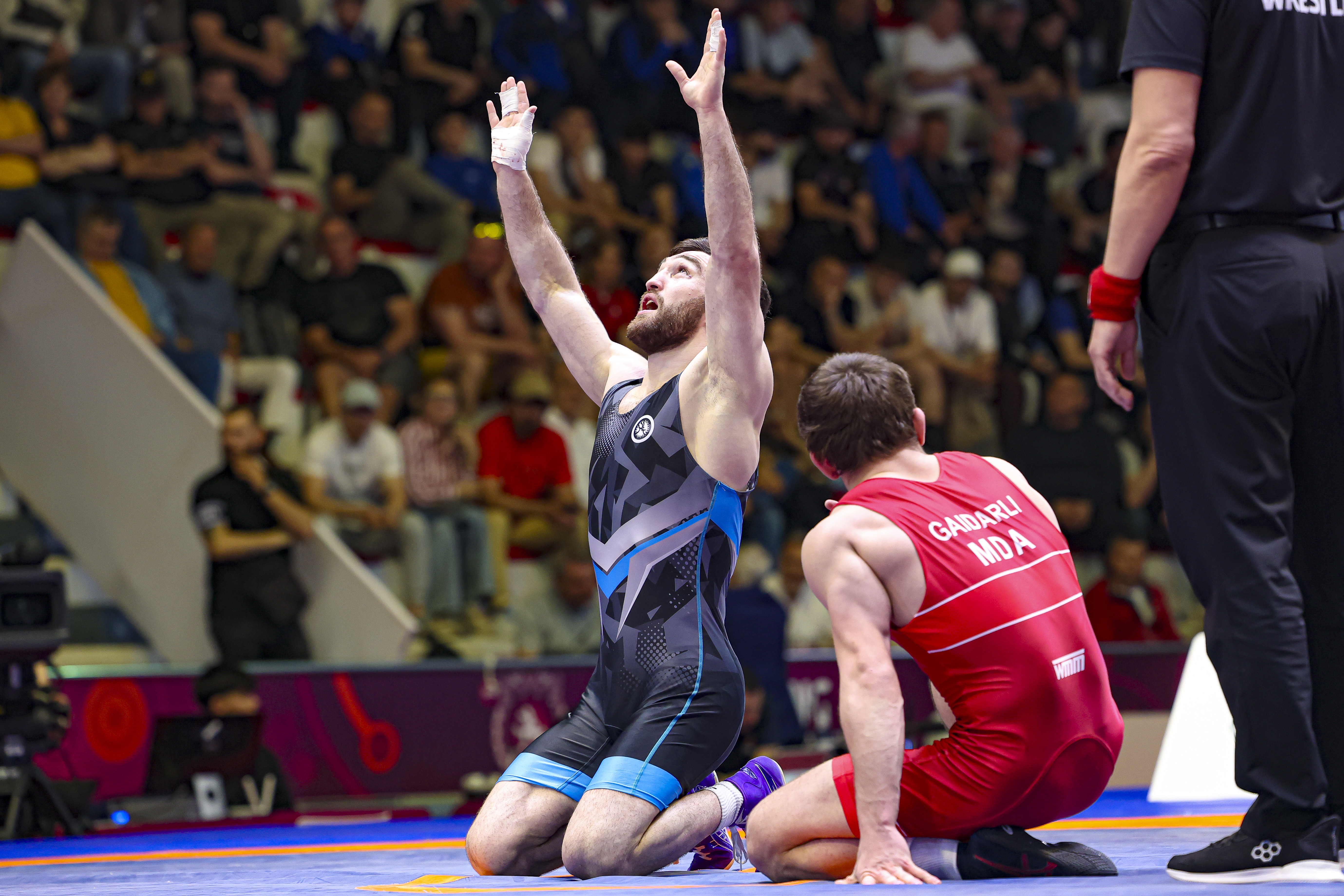 David BAEV (UWW) celebrates his 2-1 victory over Alexandr GAIDARLI (MDA) in the 70kg final. (Photo: United World Wrestling / Kadir Caliskan)
Defending champion at 70kg David BAEV (UWW) saw off the challenge of rising star and U23 European champion Alexandr GAIDARLI (MDA) and retained his gold medal after a 2-1 victory in the final.
Baev needed a stepout in the second period to take a clear one-point lead and then kept Gaidarli at a distance to win his second consecutive Euro title.
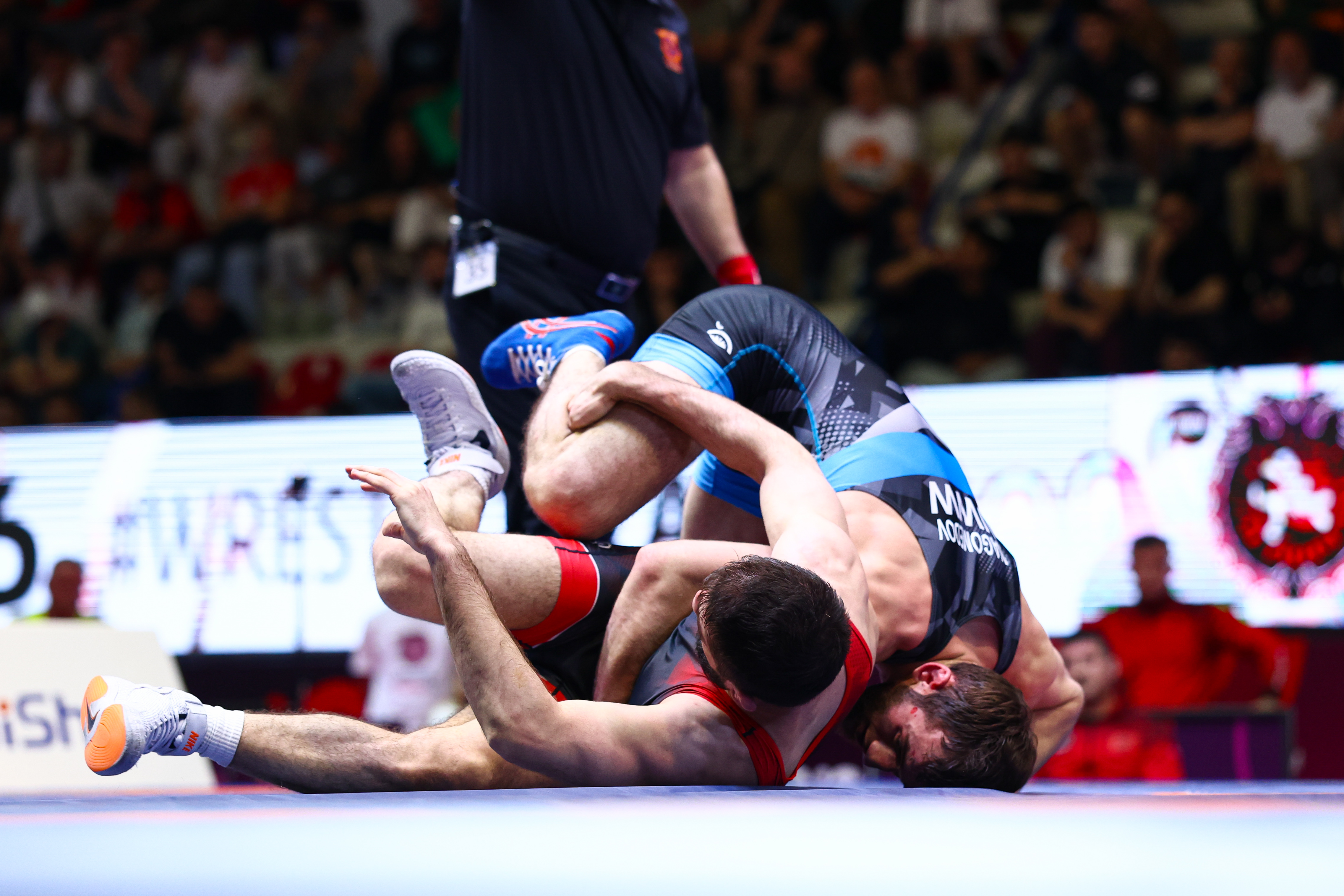 Bashir MAGOMEDOV (UWW) scores two points on Islam DUDAEV (ALB) in the 65kg final. (Photo: United World Wrestling / Jake Kirkman)
At 65kg, Bashir MAGOMEDOV (UWW) stunned the home fans by beating home-favorite and Olympic bronze medalist Islam DUDAEV (ALB) in what turned out be a very one-sided final, beating Dudaev 10-0.
After a slow start to the final, it was Dudaev who blinked first, shooting for a far-fetched attack and Magomedov defended. It resulted in both wrestlers being in a tangle, but Magomedov came out on top for two points.
Magomedov wrapped his hands around Dudaev's legs and brought him down for another two points before turning him for two more, leading 6-0 at the break.
Dudaev gave up two easy takedowns in the second period as Magomedov completed the technical superiority with two minutes left in the final.
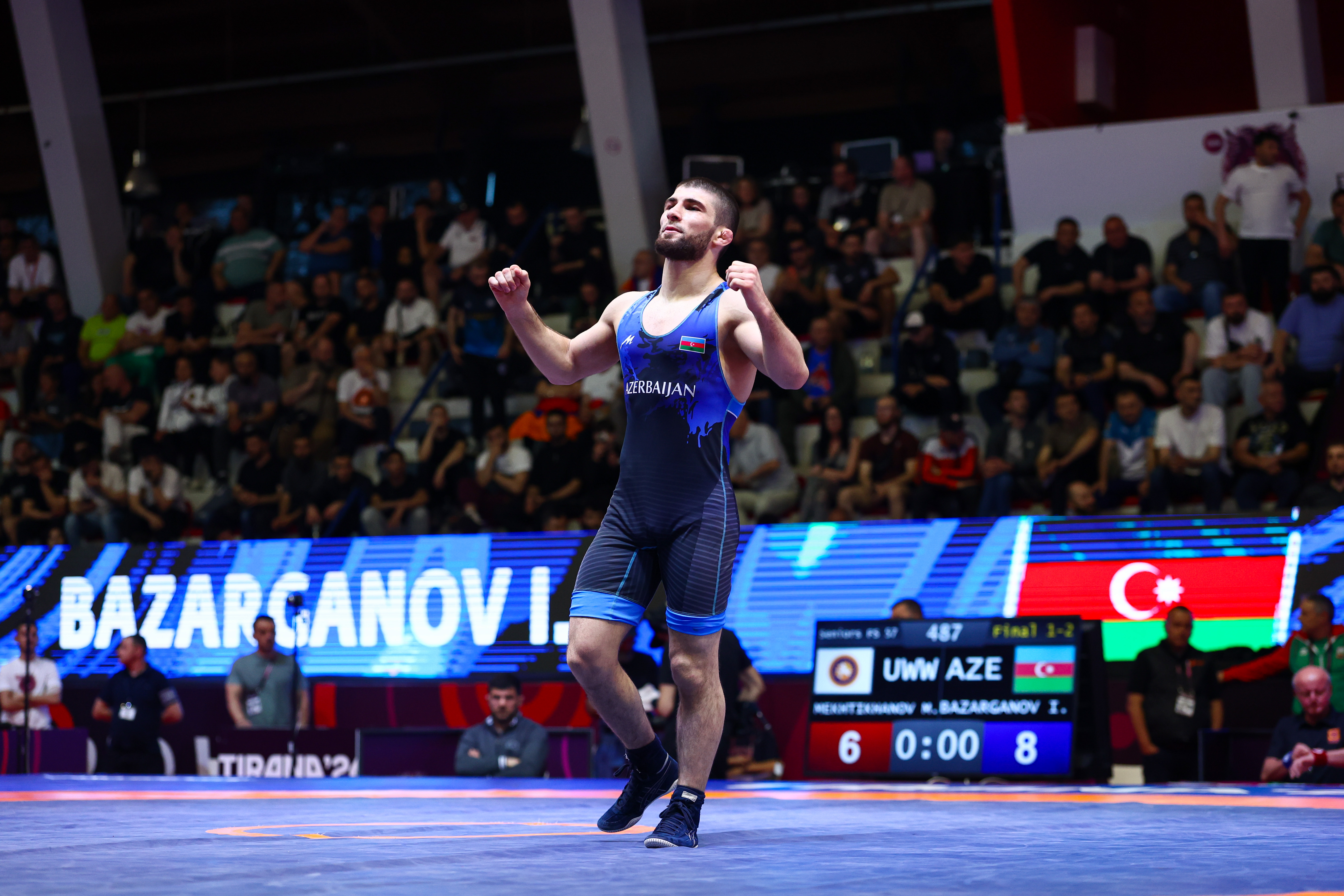 Islam BAZARGANOV (AZE) celebrates after winning the 57kg final. (Photo: United World Wrestling / Jake Kirkman)
The 57kg final saw Musa MEKHTIKHANOV (UWW) stage an impressive comeback against Islam BAZARGANOV (AZE) only to be denied in the final moments. Bazarganov led 8-0 before Mekhtikhanov scored six points in the second period. But he failed to score the making winning takedown and Bazarganov took the gold medal home.
Bazarganov used a slide-by to score the opening takedown for two points before an easy snapdown gave him two more points. He also rolled Mekhtikhanov to lead 6-0 after 1:12 in the match.
His third takedown also came using a slide-by and Mekhtikhanov fell on the mat as if he did not have any defense. Bazarganov led 8-0 at the break.
Mekhtikhanov woke up in the second period and managed to score a takedown after much effort to get on board with two points. A single-leg takedown made it 8-4 as Mekhtikhanov continued to reduce the gap. He used a sweep single to take off two more points but was left with only 17 seconds to score the match winning takedown.
But Bazarganov locked fingers, fled and threw his legs back when Mekhtikhanov attacked to save his lead and win the gold medal.

RESULTS
57kg
GOLD: Islam BAZARGANOV (AZE) df. Musa MEKHTIKHANOV (UWW), 8-6
BRONZE: Aryian TIUTRIN (UWW) df. Roberti DINGASHVILI (GEO), 8-5
BRONZE: Manvel KHNDZRTSYAN (ARM) df. Azamat TUSKAEV (SRB), 16-6
65kg
GOLD: Bashir MAGOMEDOV (UWW) df. Islam DUDAEV (ALB), 10-0
BRONZE: Vazgen TEVANYAN (ARM) df. Rashid BABAZADE (AZE), 7-0
BRONZE: Islam GUSEINOV (UWW) df. Ahmet DUMAN (TUR), 9-8
70kg
GOLD: David BAEV (UWW) df. Alexandr GAIDARLI (MDA), 2-1
BRONZE: Akaki KEMERTELIDZE (GEO) df. Oleksii BORUTA (UKR), 4-0
BRONZE: Iszmail MUSZUKAJEV (HUN) df. Mikyay NAIM (BUL), 10-0
79kg
GOLD: Akhmed USMANOV (UWW) df. Mahamedkhabib KADZIMAHAMEDAU (UWW), 4-2
BRONZE: Zelimkhan KHADJIEV (FRA) df. Hrayr ALIKHANYAN (ARM), 11-1
BRONZE: Dzhabrail GADZHIEV (AZE) df. Rasul SHAPIEV (MKD), 8-0
97kg
GOLD: Abdulrashid SADULAEV (UWW) df. Batyrbek TSAKULOV (SVK), 14-3
BRONZE: Givi MATCHARASHVILI (GEO) df. Richard VEGH (HUN), 5-3
BRONZE: Akhmed MAGAMAEV (BUL) df. Radu LEFTER (MDA), via fall (4-2)
Semifinals
61kg
SF 1: Zavur UGUEV (UWW) df. Arsen HARUTYUNYAN (ARM), via fall (4-3)
SF 2: Zelimkhan ABAKAROV (ALB) df. Nuraddin NOVRUZOV (AZE), 9-2
74kg
SF 1: Taimuraz SALKAZANOV (SVK) df. Murad KURAMAGOMEDOV (HUN), 1-1
SF 2: Turan BAYRAMOV (AZE) df. Giorgi ELBAKIDZE (GEO), 1-1
86kg
SF 1: Ibragim KADIEV (UWW) df. Vladimeri GAMKRELIDZE (GEO), 9-4
SF 2: Arsenii DZHIOEV (AZE) df. Ivars SAMUSONOK (LAT), 12-2
92kg
SF 1: Ahmed BATAEV (BUL) df. Amanula GADZHIMAGOMEDOV (UWW), 3-2
SF 2: Ali TCOKAEV (AZE) df. Samuel SCHERRER (SUI), 6-0
125kg
SF 1: Vladislav BAJCAJEV (HUN) df. Mohsen SIYAR (GER), 4-3
SF 2: Giorgi MESHVILDISHVILI (AZE) df. Hakan BUYUKCINGIL (TUR), 3-1




Share your thoughts.
Comments