

Younger Kawai Captures Elusive National Title with Victory in 59kg Final
Thursday, December 21, 2017 - 19:32 By Ken Marantz

TOKYO (Dec. 21) - Yukako KAWAI is still quite a ways from catching up to her older sister, world and Olympic champion Risako. But she moved a step closer by capturing her first Japan national title on Thursday.
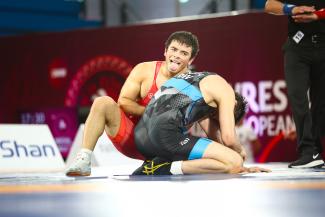
Kawai, with her sister at matside in her corner, forged out a hard-fought 3-2 victory over recently crowned world under-23 Yuzuru KUMANO in the women's 59kg final on day two of the Japan national championships.
"As sisters, she's extremely close to me as a senior teammate, but in terms of ability, the difference is like heaven and earth," Kawai said. "But I'm using the fact that we wrestle as sisters as a positive, and am working to catch up."
The four-day tournament at Komazawa Gym, a venue used for the 1964 Olympics located in western Tokyo, is following the newly adopted UWW format of having each weight class competed over two days. The finals in 10 divisions were held Thursday, along with competition up to the semifinals in 10 others.
While Kawai's clash with Nihon University's Kumano was their lone match of the day, much of it lacked the energy expected from two fresh wrestlers.
Kawai scored the lone point of the first period when Kumano, a two-time world junior champion, was on the activity clock, then padded the lead to 3-0 with a takedown early in the second.
The action amped up as Kumano desperately fought to close the gap, but could only manage a last-second takedown that proved too little, too late.
"Naturally I'm really happy, but there is also a feeling of disappointing over the way I wrestled in the final," said the 20-year-old Kawai, who competes for powerhouse Shigakkan University.
Kawai said that before taking the mat, Risako told her: "You train with the world and Olympic champion. There will be nobody stronger than me. Go out there with confidence."
After taking those words to heart and coming off the mat in triumph to be greeted by her elated sister, it was Risako who was in tears.
"Risako is the person who is most concerned about me," Kawai said. "When I saw Risako crying, it hit me, 'ah, I am the national champion'. It was my way of repaying her."
While her older sister captured the 60kg gold this summer in Paris, Kawai's first appearance at a senior world championships ended with her finishing out of the medals at 63kg.
Japan teams are chosen based on results from the All-Japan championships (known as the "Emperor's Cup") in December and the national invitational championships (the "Meiji Cup") in the spring, but Kawai did not earn automatic qualification. Instead, she was selected by the Japan federation among several candidates. Now she has a chance to go on her own merits.
"I went to the world championships this year, but I didn't win at the Meiji Cup to earn a place on the team," Kawai said. "I told myself that next time for sure, I would win the All-Japan and earn a place on the national team. First, it's good I was able to win at the Emperor's Cup this year."
In other action, world 75kg bronze medalist Hiroe SUZUKI survived a close call of her own in edging high schooler Yasuha MATSUYUKI 2-0 in the women's 76kg final, giving her a second straight national title and fourth overall.
Suzuki scored both of her points in the first period, the first on the activity clock and the second on a step-out. After that, it was just a matter of withstanding the pressure from Matsuyuki, whose twin sister Naruha made Friday's final at 72kg earlier in the day.
"The final turned into a match in which I did nothing," Suzuki lamented. "I regressed to the person I was before I finished third in the world."
To her credit, she had been plagued recently with injuries, and wrestled with her right shoulder heavily taped. But the problem, she said, was not physical.
"More and more during practice when I went in for a takedown, I felt a tingling sensation. I had it taped, but during the match, the reason I couldn't get in on my tackles was more of a mental problem [than physical]."

The other women's gold on offer went to world under-23 and junior champion Ayana GEMPEI at 65kg. As with Kawai, her 3-1 win over Miwa MORIKAWA in the final made her a first-time senior national champion.
"If you don't win at home, you can't go to world competitions," a tearful Gempei said. "It's a tough selection process. To become champion here means so much."

In the men's competition, Shota TANOKURA capped off a dominating performance at Greco-Roman 55kg with a flashy 4-point throw that gave him a 8-0 technical fall in 4:55 over Shota OGAWA in the final.
Tanokura regained the national title he won in 2012 and 2013, but had relinquished to eventual Olympic silver medalist Shinobu OTA and world champion Kenichiro FUMITA.
With those two opting for the Olympic weight class of 60kg with eyes on Tokyo 2020, Tanokura is expected to focus on going for gold at next year's world championships in Budapest.
In other Greco-Roman finals, Yuta NARA won a second straight national title by rallying with five points in the second period for a 6-3 win over Masaaki SHIKIYA at 97kg, while Takayuki INOGUCHI earned his first gold with a 9-7 win over Ryo MATSUI at 63kg.
In freestyle, Nobuyoshi ARAKIDA earned his first national crown in three years and sixth overall when he overwhelmed two-time defending champion Taiki YAMAMOTO, 6-1, at 125kg.
Keisuke OTOGURO, a national champ in 2015, got the best of Yamanashi Gakuin University teammate Kirin KINOSHITA in the 70kg final, scoring all of his points in the first period and holding on for a 6-2 victory.
Two others made their first forays to the top step of the podium: Kazuya KOYANAGI (61kg) and Takashi ISHIGURO (92kg).
Nihon University's Ishiguro could hardly have cut it closer. Trailing 2-0 against Seiji SUZUKI, he got in on a double-leg takedown in the last five seconds and managed to lift and dump his opponent to pull out a 4-2 win.
Koyanagi, the runner-up at 57kg at the Meiji Cup to eventual world champion Yuki TAKAHASHI, charged out to a 9-0 lead in the first period against Shingo ARIMOTO, then finished him off with a barrel roll for a 13-0 technical fall at 3:26.
Among the weight classes that had preliminary rounds to set up finals on day three, the featured match saw world 70kg bronze medalist Yuhi FUJINAMI advance to the freestyle 74kg final by storming to a 10-0 technical fall in 1:48 over Momojiro NAKAMURA, the 2016 national champion and 2017 Asian gold medalist at 70kg.
In the quarterfinals, Nakamura barely squeezed out a 11-9 win over 2015 national champion Nobuyoshi TAKOJIMA, a fifth-place finisher at both the 2016 world and Asian championships.

Former world 74kg silver medalist Sosuke TAKATANI, moving up to 79kg as part of his preparation to make Tokyo 2020 at 86kg, got off to a good start with a pair of technical falls, both in less than two minutes.
In Greco-Roman, former freestyle champion Atsushi MATSUMOTO's bid for a second straight title since switching styles ended when he was blitzed out in the 87kg semifinals by Taichi OKA. Matsumoto, put in the newly adopted par-terre position, never got out of it, as Oka reeled off four straight rolls for an 8-0 technical fall in 2:28.
Women's world silver medalist Miyu MUKAIDA had little trouble in dispatching Arisa TANAKA with a 10-0 technical fall in 2:53 to make the 55kg final.
Results of Day 2 Finals
Freestyle
61 kg (15 entries)
Kazuya KOYANAGI def. Shingo ARIMOTO by TF, 13-0, 3:26
Bronze medals: Takuya FUNAKI and Yudai FUJITA
70 kg (23 entries)
Keisuke OTOGURO def. Kirin KINOSHITA, 6-2
Bronze medals: Ryo IZUTSU and Yuto MIWA
92 kg (13 entries)
Takashi ISHIGURO def. Seiji SUZUKI, 4-2
Bronze medals: Masayoshi SAKURABA and Keiwan YOSHIDA
125 kg (8 entries)
Nobuyoshi ARAKIDA def. Taiki YAMAMOTO, 6-1
Bronze medals: Katsutoshi KANAZAWA and Tetsuya TANAKA
Greco-Roman
55 kg (13 entries)
Shota TANOKURA def. Shota OGAWA by TF, 8-0, 4:55
Bronze medals: Hiromu KATAGIRI and Tomoya MARUYAMA
63 kg (10 entries)
Takayuki INOGUCHI def. Ryo MATSUI, 9-7
Bronze medals: Masashiro KAGEYAMA and Mitsunaga OYAMA
97 kg (13 entries)
Yuta NARA def. Masaaki SHIKIYA, 6-3
Bronze medals: Yukihito YAMADA and Masayuki AMANO
Women's Wrestling
59 kg (9 entries)
Yukako KAWAI def. Yuzuru KUMANO, 3-2
Bronze medals: Saki KAWAUCHI and Yui SAKANO
65 kg (6 entries)
Ayana GEMPEI def. Misuzu ENOMOTO, 3-1
Bronze medals: Miyu IMAI and Miwa MORIKAWA
76 kg (6 entries)
Hiroe SUZUKI def. Yasuha MATSUYUKI, 2-0
Bronze medals: Miku SAITO and Rino ABE
Results of Day 2 Semifinals
Freestyle
74kg (14 entries)
Yuhi FUJINAMI def. Momojiro NAKAMURA by TF, 10-0, 1:48
Ken HOSAKA def. Mao OKUI, 4-1
79kg (11 entries)
Sosuke TAKATANI def. Yuta ABE by TF, 12-2, 1:28
Tsubasa ASAI def.Hayato ISHIGURO, 8-0
97kg (13 entries)
Takeshi YAMAGUCHI def. Naoya AKAGUMA, 4-0
Taira SONODA def. Hiroto NINOMIYA, 6-1
Greco-Roman
67kg (15 entries)
Tsuchika SHIMOYAMADA def. Shogo TAKAHASHI by TF, 9-1, 5:56
Katsuyoshi KAWASE def. Taiki KOBAYASHI, 6-2
72kg (19 entries)
Tomohiro INOUE def. Muuto SAWADA by TF, 9-0, 3:58
Kazuhiro HANAYAMA def. Takahiro YAMAMOTO, 15-7
87kg (12 entries)
Taichi OKA def. Atsushi MATSUMOTO by TF, 9-0, 2:28
Masato SUMI def. Kanta SHIOKAWA by TF, 10-0, 2:32
130kg (13 entries)
Arata SONODA def. Naoto YAMAGUCHI by TF, 8-0, :31
Masahiro TANITA def. Yuya FUJITA, 3-0
Women
55kg (6 entries)
Mayu MUKAIDA def. Arisa TANAKA by TF, 10-0, 2:53
Saki IGARASHI def. Momoka KADOYA, 5-0
57kg (7 entries)
Katsuki SAKAGAMI def. Akie HANAI, 4-2
Chiho HAMADA def. Sae NANJO, 2-1
72kg (4 entries)
Masako FURUICHI def. Mei SHINDO by TF, 10-0, 2:18
Naruha MATSUYUKI def. Rin MIYAJI by TF, 10-0, 3:48
Share your thoughts.
Comments