

#UnitedWorldWrestling

Wrestling for schools: UWW, ISF take steps to encourage students

By United World Wrestling Press

LAUSANNE, Switzerland (December 14) -- United World Wrestling and International School Sport Federation entered into a Memorandum of Understanding (MoU) to cooperate and facilitate collaboration between ISF and UWW for the promotion of wrestling and beach wrestling in schools.

The two federations will strive to establish wrestling and beach wrestling as recognized sports among National School Sport Federations and strengthen overall cooperation and partnership between the two organizations and their members.

UWW President Nenad LALOVIC and ISF President Laurent PETRYNKA, along with other representatives from both organizations, met in Lausanne during the International Federation Forum to ink the cooperation.

"Wrestling is a sport that prepares you both physically and mentally," Lalovic said. "It is a sport that transcends the lessons learned on the mat to those needed through life. This is why it is important to have the opportunities the sport of wrestling provides embedded in the school curriculum."

UWW and ISF will now work on similar lines and look to bring wrestling into education at both local and international levels, attracting school-age enthusiasts of the sport and fostering cooperation between UWW and ISF with local authorities.

"Wrestling provides a pathway that can uniquely prepare the youth of tomorrow by building their confidence, improving their self-esteem and sense of belonging, and creating mental and physical discipline from a young age," Lalovic added. "Wrestling is a sport that continues to stand the test of time and I am confident the more people who wrestle the more we prepare youth to have a bright future."

The focus will also be on promoting girls' school sports and encouraging students of all genders to practice wrestling, on the mat and the beach.

The cooperation will extend to the field of play as well and both organizations will work to identify and implement synergies, establish a training and assessment unit for International/National Technical Officials, promote sustainability, the principles of fair play and integrity, and join the fight against all forms of racism in sport.

School wrestling can be used as a development platform for experimenting with new rules and formats or any other innovation as well.

Off the mat, both UWW and ISF will work to organize workshops, seminars, and other educational events for technical officials and teachers, especially PE teachers and a Technical Officials Education Program, specifically targeting youth, will be developed and implemented. This program will aim to ensure the future participation of youth officials at various events.

To help countries that suffer from a lack of school sports, UWW will provide experts for teaching and coaching sessions for the School Sport Foundation to promote wrestling in such countries. It will also define an educational calendar with ISF before the ISF competitions to provide experts to deliver education courses.

The partnership is a step towards taking wrestling to a wider sphere, especially at the school level.
Obituary

Japanese legend and Olympic champ Obara passes away aged 44

By Ken Marantz

TOKYO (July 19) — Legendary Japanese wrestler Hitomi OBARA, the 2012 London Olympic gold medalist at women's 48kg and an eight-time world champion, passed away on Friday, the Japanese media reported on Saturday. She was 44.

The Japan Self-Defense Force Physical Training School, where Obara was a women's coach, said it was withholding the cause of death "out of consideration for the privacy and emotions of the bereaved family," according to The Yomiuri Shimbun.

Obara, the mother of two elementary school-aged children, was a director in the Japan Wrestling Federation, and had just been appointed in June as a coach of the women's national team for the run-up to the 2028 Los Angeles Olympics along with fellow former Olympic champion Kaori ICHO.

Obara, who won six of her world titles at 51kg under her maiden name of SAKAMOTO, became a model case for the ups and downs of high-level sports and the ability to overcome grave disappointment. Her victory at the London Olympics, at age 31, came after being denied spots on Japan's team at both of the two previous Olympics by fellow legend Saori YOSHIDA.

Born in 1981 in the wrestling hotbed of Hachinohe, Aomori Prefecture, in northern Japan, Obara went on to attend Chukyo University (now Shigakkan), which she helped turn into a national powerhouse along with Yoshida and fellow Hachinohe native Icho.

"It's hard, it's hard, I can't keep from crying," former Shigakkan and national team coach Kazuhito SAKAE was quoted as telling the Japanese media. "She was a wrestling prodigy. At the least, she was a hard worker with a strong sense of responsibility. She was wrestling's heaven-sent child. I still can't believe it." 

Obara won back-to-back world 51kg titles in 1999 and 2000. A serious knee injury would keep her from returning to the world championships until 2005, from which she won four in a row.

In between, she attempted to make the Japanese's squad to the 2004 Athens Olympics, but that dream ended with a loss by fall to Yoshida in the 55kg final at the All-Japan Championships in December 2002. She would only compete once in 2003 before returning in earnest in 2004 and beginning her streak of world titles the following year.

But more disappointment came her way in the qualifying process for the 2008 Beijing Olympics. Again it was Yoshida who squashed her dreams, beating her 2-0 (2-0, 4-0) in the 2006 All-Japan final. After the match, Obara sat for hours sobbing in a corner of the warm-up room, a towel draped over her head.

Obara managed to rebound from the defeat to win a playoff for the 51kg spot at the 2007 World Championships, where she won gold No. 5. After adding No. 6 a year later with a run to the gold that included a victory over future Olympic champ Helen MAROULIS (USA), she decided to retire.

But despite all of her success, the lack of a Olympic gold -- or even an appearance, for that matter -- still left a sting that would not abate. That, and the decision of her younger sister Makiko to retire, led her to attempt the difficult path of cutting down to 48kg to make it to London.

Makiko was a world bronze medalist at 48kg in 2005 and 2008, but decided to end her career after placing eighth in 2009. Hitomi had never wanted to displace her sister from the national team, but now the door to 48kg was open.

Her biggest battle may have been with the scale. On the mat, she was as unbeatable as ever, storming to world golds in 2010 and 2011 -- now as Obara after getting married in 2010.

There was one slip-up along the way -- a semifinal loss to So Sim HYANG (PRK) at the 2010 Asian Games that ended her 70-match winning streak in international matches. But she regained her confidence with a decisive win at the All-Japan, and it was with a full head of steam that she headed to the London Olympics, which she had announced would be her swan song.

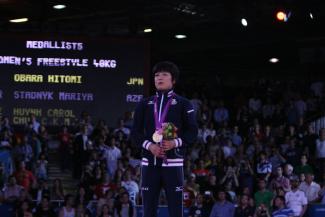
In London, Obara knocked off defending Olympic champion Carol HUYNH (CAN) in the semifinals before coming from behind in the final to defeat Mariya STADNIK (AZE) 2-1 (0-4, 1-0, 2-0) -- a replay of the gold-medal match at the 2011 worlds.

"If you keep doing what you love and never give up, you can achieve your dream," Obara told students at the junior high school she attended during a visit in January last year.

Upon retiring, Obara joined the staff at the Self-Defense Force Physical Training School, where she was also an officer. Among the members she coached were Haruna MURAYAMA OKUNO, Himeka TOKUHARA and Masako FURUICHI, who all made Japan's team to this year's World Championships.

In 2022, Obara was inducted into UWW's Hall of Fame along with Yoshida and Icho.