

Wrestling prodigy Ono takes big strides, with family's support
Wednesday, January 8, 2025 - 14:23 By Vinay Siwach

JAPAN (January 8) -- Ben ASKREN calls him the 'best wrestler on the planet.' Jordan BURROUGHS (USA) invited him as a special guest to his academy. Kids are lining up to take his autograph. Wrestling social media pages have numerous highlights of him.
No wrestler has been talked about as much as Masanosuke ONO (JPN) in recent times, and not because he has a soy sauce named after him.
Two months have passed since he won the World Championships on the first attempt, but Ono remains the hottest topic in wrestling. Currently in the United States for various commitments, Ono first broke out by winning the U20 World Championships in October, and two weeks later, he rocked the world with his run at the World Championships in Tirana.
The 20-year-old, using his speed and a lethal gut wrench, dominated Olympic champion Zavur UGUEV (AIN), blanked world champion Vitali ARAJAU (USA) and posted three other technical superiority wins en route to the gold medal at 61kg. All that with a broken ankle.
"One month ago, I broke my ankle, and I couldn't practice at all," Ono had said after winning the gold in Tirana. "The Uguev match was my first live wrestling match after the fracture, and I was very unsure how I would do."
"It's like a dream for us," said Noriko, Ono's mother, who watched her son in the arena in Tirana. She was joined by her husband Masaharu, who was equally elated with his son's success.
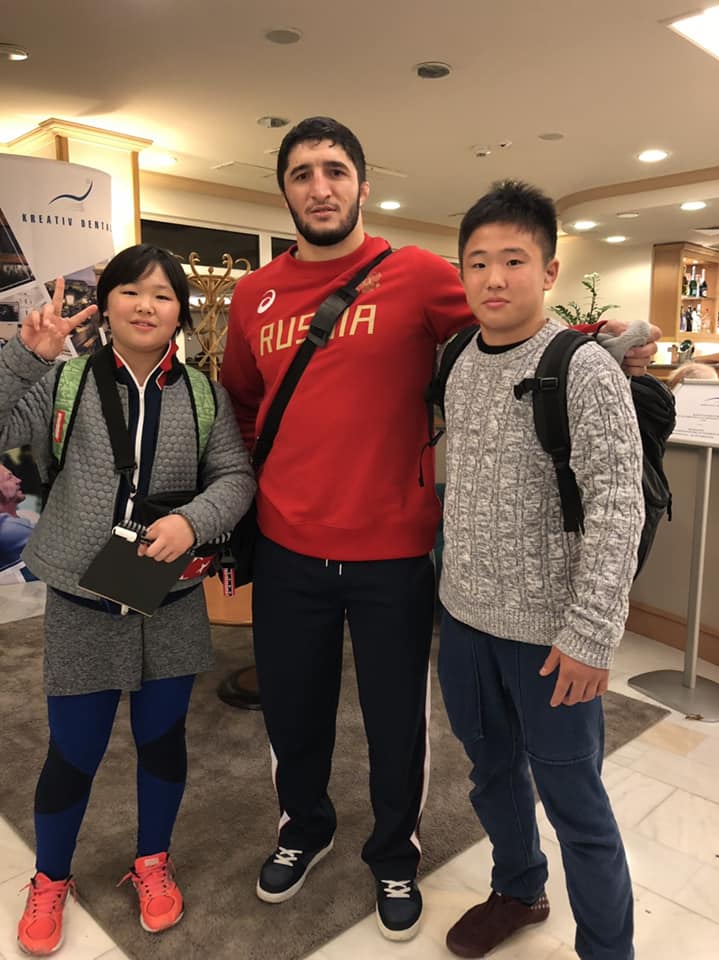
Masanosuke ONO (JPN) with his with sister Konami, left and Abdulrashid SADULAEV (center).
This was not the first time the couple had traveled with the Ono for a wrestling tournament. Well before Masanosuke became a world-known wrestler, the Ono household had been traveling for wrestling. In 2015, they traveled to Las Vegas for the World Championships. Photos of Ono with Burroughs and other wrestlers went viral on social media after he won.
Masaharu has several anecdotes of his son Ono's childhood, especially from wrestling tournaments.
"We stayed at the same hotel as the wrestlers in 2015," Masanharu recounts. "One day, he was missing. We searched for him in the hotel and later found that he was eating with Haji Aliyev and going around wrestlers' rooms to get autographs."

Jordan BURROUGHS (USA) poses for a picture with Masansuke and Konami ONO in 2015.
Ono's parents were not the only ones surprised. Former world champion Yuki TAKAHASHI (JPN), who was wrestling at 57kg in the 2015 World Championships, heard a rumor that a little wrestler from Japan had come to Las Vegas to watch the World Championships.
"It's very rare in Japan, and he's the only little wrestler I've ever known who has traveled all the way overseas to watch matches like this," Takahashi says. "That was the first time I saw him, in the hotel. I was the same age at the time as he is now, a third-year university student. I don't remember talking to him directly, but I remember feeling very happy watching him running around with a big smile on his face."
Takahashi, a two-time Olympian for Japan, is now a coach at Yamanashi Gakuin University, the school that produced Tokyo Olympic champion Takuto OTOGURO (JPN) and where Ono is a third-year student now.

Masanosuke ONO (JPN) wrestling in school.
His story, however, begins way back -- when Ono was in kindergarten. Or, more specifically when he was removed from a music class.
Unable to sit still and constantly interrupting his teacher, Ono was asked to leave the class. "The teacher was angry and told him to take up wrestling," Masaharu says.
Turns out, music's loss is wrestling's gain.
Ono's father Masaharu had no experience in wrestling, he practiced Kendo, a form of martial arts that uses sticks. Yet, he trained Ono, and himself fell in love with the sport.
"Wrestling, a sport in which you don't use any equipment, you compete using only your body," he says. "It's a fair competition. Whether you win or lose, you are solely responsible. There are no excuses. The match starts and ends with a handshake. I love that about it. I incorporated elements of Kendo into Masanosuke's wrestling. So I coached him, even though I had no experience."
 The Ono siblings with Kenichiro FUMITA(JPN) in 2016.
Soon, Ono's sister Konami joined the training. Konami is two years younger than Ono but is already making a name for herself. She won the Japan Queen's Cup in 2023 and won silver at the U17 World Championships at 61kg after she won the prestigious Klippan Lady Open.
In the Ono household, wrestling became a way of life. Masaharu would take his kids to most domestic competitions in Japan. If not competing, they would travel to watch. He even made a "Save Olympic Wrestling" banner in 2013 when wrestling was dropped from the Olympic program.
At the 2012 Japan Championships, Kenichiro FUMITA (JPN) made a stunning debut, winning the gold medal. Later that day, Ono recognized Fumita outside the arena and ran to get his first autograph.
 Yuki TAKAHASHI (JPN), center, a coach at the Yamanashi Gakuin University, pictured with Masanosuke ONO (JPN), second from right.
Ono would join Yamanashi Gakuin University, and Takahashi would see him again since the 2015 World Championships.
"He had grown bigger since I came to watch the World Championships, but he looked like he was having fun practicing, and his attitude seemed the same as it was back then," Takahashi says. "My first impression was that he was stronger in defense than in attack. I remember it was hard to score points. We had a lot of sparring, and watching him wrestling with pure joy made me feel young again."
Takahashi says that he expected Ono to be dominant once he is free of injuries and begins competing internationally.
"He had a lot of injuries and was unable to participate in many domestic tournaments for a long time, but when he is not injured and can train normally, he is really strong," he says. "He does not lose to fighters in higher weight classes. When he first entered the school, he was very weak even when sparring with me, but now he is really strong and has good natural ability, so I can feel his strength."
Ono made his international debut at the 2024 Asian Championships in 65kg and returned with a bronze medal from the Asian Championships after he was pinned by Tulga TUMUR OCHIR (MGL) who used a perfect arm throw. He dropped back to 61kg, a weight class more suited to him, and Ono was a menace.
"He doesn't change his wrestling style depending on his opponent but sticks to his own style. I expected him to win both the World Championships, but I didn't expect him to win so overwhelmingly."
The reason for Ono's ability to be the best on the mat comes from his speed. Takahashi explained that Ono researches a lot on his opponent and is quick to understand their gameplan.
"After he returned to Japan, I asked him about his impressions of Uguev. He said that he had done a lot of research and was able to understand what he was going to do just by moving a little," he says. "In terms of technique, it's not flexibility, but his speed that is so fast. There is always an initial movement before a technique, but he can perform the technique right there, so the opponent's reaction is delayed. Also, he predicts this and still performs the technique, so the opponent cannot even react."

Soy sauce named Masanosuke, after Ono.
While Ono is away in the United States, his father Masaharu is planning for a long 2025 season. He wants to continue his travels with Masanosuke and Konami, which he has done since 2015. An owner of a soy sauce brewing factory in the Shimane Prefecture, Masaharu has even launched a soy sauce named after his son.
"I would be happy if people in the wrestling world around the world liked Masanosuke's interesting character," Masaharu says. "I am happiest when I travel the world to attend wrestling matches with Masanosuke and Konami."
Masaharu has documented his children's journey and is enjoying the love his son is getting so far in wrestling. Whether fans or his opponents, Ono is celebrated. Ono's walk after winning the gold was similar to what Connor McGregor did during his career; it went viral, adding to his celebrations like a fictional character from the manga series Attack on Titan (Shingekino Kyojin).
 The Ono family in Budapest for the 2018 World Championships.
Masaharu also documented his family's trip to the 2018 World Championships in Budapest. Ono, then 14 years old, would run around to get pictures clicked. He got a few with Kyle SNYDER (USA), Sadulaev, Hassan YAZDANI (IRI), Taha AKGUL (TUR) and other stars.
And Masaharu has no plans to stop capturing his children on and off the wrestling mat. And then tell the stories of his travels.
"The viral photo with Burroughs was by chance," Masaharu says. "Ono had wandered off in the hotel and took his autograph. I did not believe that it was Burroughs's autograph. So he took me to his room and asked me to click a photo with Burroughs as evidence. That's how we got the photo. Later that night he won the gold medal at 74kg."

Share your thoughts.
Comments