

Development

Wrestling Key Player in ASOIF's 'Women Lead Sports' Programme

By United World Wrestling Press

Led by UWW Development Director Deqa Niamkey, wrestling and its development team played a key role in fulfilling ASOIF's mission to provide classes and leadership opportunities to female leaders in sport looking to "strengthen their self-confidence and acquire important skills to influence, negotiate, communicate, navigate politics, manage stakeholders and lead in male-dominated environments"

A snippet from the ASOIF article:

During the last two months, more than 60 future women leaders from ASOIF’s member federations successfully completed a series of virtual live-coaching sessions, aimed at preparing them to serve in elective positions of their respective International Federation (IF), Continental Association or National Federation.

The “Women Lead Sports” online masterclass, run by professional coach Gabriela Mueller, was created to help increase the number of women in leadership positions across the Olympic Movement. Amongst others, participants learn how to strengthen their self-confidence and acquire important skills to influence, negotiate, communicate, navigate politics, manage stakeholders and lead in male-dominated environments. They also receive personalised coaching, helping them to define their next strategic steps. The course tailored to ASOIF’s member federations was adapted to the current reality of the COVID-19 pandemic, with congresses and elections taking place in different formats and requiring strong skills in digital communication. Senior women leaders joined certain sessions to share their experience, provide advice and inspire.

“The programme was a swift and effective response to prepare an equal future in a COVID-19 sports world and thereafter”, said Gabriela Mueller. “Even though in many cases the pandemic has been gender-regressive across several sectors, the online masterclass empowers women to run campaigns, get elected and lead.”

Full story on the ASOIF website, here
#development

Road to Dakar 2026 Continues with Successful Central Africa Programme in Brazzaville

By United World Wrestling Press

BRAZZAVILLE, Republic of Congo (June 21) -- The second stop of the United World Wrestling (UWW) Africa Regional Educational Development Programme, Road to Dakar 2026, concluded successfully in Brazzaville after a week combining athlete preparation, education, technical development and competition in Olympic and Beach Wrestling.

Held from June 8 to 14 in the Republic of Congo, the Central Africa phase brought together National Olympic Committees and National Federations from across the region under a unified objective: strengthening wrestling ecosystems and creating more accessible pathways toward the Youth Olympic Games Dakar 2026.

As the second of four regional tournaments scheduled within the continental Road to Dakar programme, the event represented another important milestone on the road to the first Olympic event to be hosted on African soil.

Africa REDT

The UWW Africa Regional Educational Development Programme was designed as a comprehensive and sustainable model that extends beyond competition. The initiative combines athlete development camps, coach and referee education, and practical competition opportunities.

By decentralising activities across regions and consolidating training and competition into one structure, the programme aims to reduce financial barriers for national federations and increase opportunities for athletes and technical officials.

Throughout the week, athletes participated in intensive daily training sessions, as coaches attended the UWW Technical Course - Level 2, focused on improving technical knowledge, athlete development methodologies and long-term performance planning.

Africa REDT

Simultaneously, referees took part in dedicated education sessions covering Beach Wrestling and introductory officiating pathways, preparing them for selection to undertake the International Category III referee examination in the future.

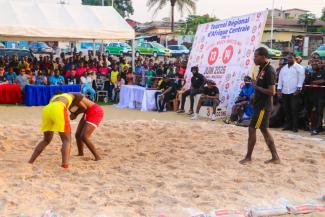
The programme concluded with the Regional Tournament, followed by the Beach Wrestling Regional Tournament, giving participants the opportunity to apply lessons learned during the educational phase directly into competition conditions.

The programme specifically prioritised youth development, with participating athletes largely drawn from the U17 age group and encouraging the involvement of emerging coaches across Central Africa. Support mechanisms jointly delivered by UWW and Olympic Solidarity helped facilitate participation through travel, accommodation, training access and tournament organisation.

Africa REDT

More than just a standalone event, Brazzaville demonstrated the long-term vision behind Road to Dakar 2026 by building stronger national structures, expanding participation and creating sustainable development opportunities well before the final qualification stages for the Youth Olympic Games.