CORALVILLE, IOWA, United States (May 8) -- Nathali GRIMAN (VEN), 34, made her Pan-American debut in 2013, finishing fifth at 59kg in Panama City. 13 years later and wrestling at her 11th Pan-American Championships on Friday, Griman finally won the elusive gold medal.
At the Xtream Arena, Coralville, Griman's gold also spoiled what could have been a perfect day for the United States as it won the remaining five golds in Women's Wrestling.

Greco-Roman also closed out with the remaining two weight classes on Friday at the Pan-American Championships as the United States won the team title with 216 points. Cuba finished second with 115 points and Brazil was third with 99 points.
The one Greco gold for the U.S. on Friday was won by Benjamin PEAK (USA) at 72kg while Olympic bronze medalist Gabriel ROSILLO (CUB) gave Cuba its third Greco gold of the tournament by reigning supreme at 97kg.
In the final at 62kg, Griman was up against former U20 world champion Jasmine ROBINSON (USA), who had dominated her way to the final, winning four bouts 11-1, 12-1, 10-0 and 11-0, and was clearly the favorite.
Robinson opened the final with a takedown for two points, tripping Griman at the edge of the zone. Griman was put on the activity clock soon after and as she failed to score, Robinson got a point and led 3-0 at the break. However, Griman used over-under set-up to throw Robinson and score four points 23 seconds into the second period.
Robinson scored a reversal and then a gut-wrench to quickly reclaim the lead 6-4 with 2:16 remaining in the final. Griman remained unfazed and hit a double-leg attack, lifted Robinson before slamming her on the mat for two points and a 6-6 criteria lead, thanks to her superior scoring sequence of four points earlier in the mat.
After a longish medical timeout, Robinson returned to the center but was not able to break the defense of Griman who held on and ended her wait for the gold medal.
Griman has six other medals in the tournament's history -- two silvers won in 2025 and 2023 and four bronze medals won in 2014, 2015, 2017 and 2019. It was also the first time ever that Griman won a gold medal at a United World Wrestling championships.
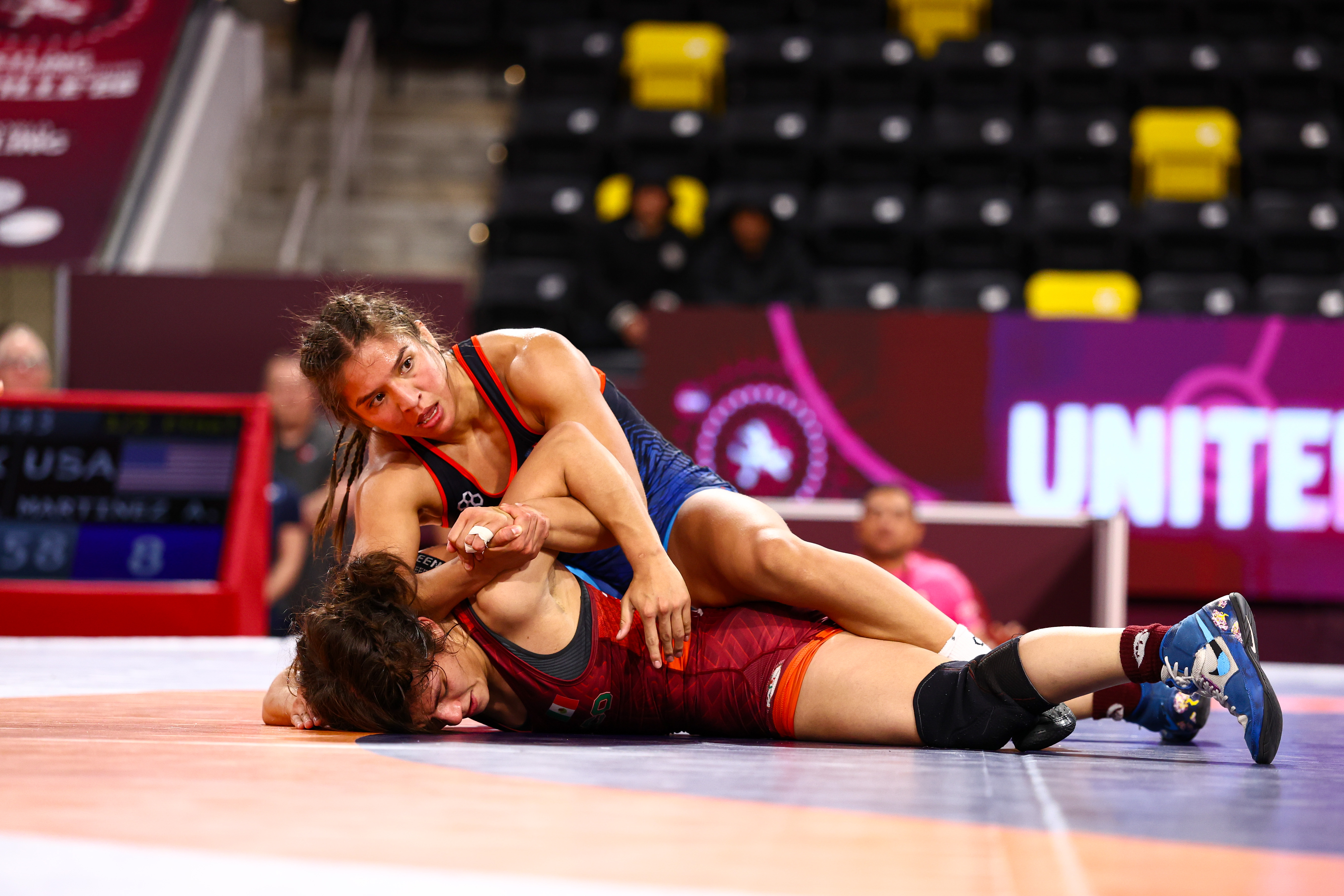 Amanda MARTINEZ (USA) won the 57kg gold medal to be one of the five champions for the U.S. on Friday. (Photo: United World Wrestling / Jake Kirkman)
The five gold-medal run for the U.S. began at 50kg as Katie GOMEZ (USA) won the final against Jacqueline MOLLOCANA (ECU), 5-3. The two were in a tangle and rolled through with both wrestlers getting two points each and Mollocana leading 2-2 on criteria.
But the Ecuador wrestler was put on activity clock in the second period and Gomez picked up a takedown during that period to lead 5-2. Mollocana kept the pressure and managed a stepout with 16 seconds remaining but could not get a takedown to win the bout.
At 55kg, U20 world champion Everest LEYDECKER (USA) won her first Pan-Am title in just 52 seconds. With only three wrestlers in the bracket, Leydecker won both her bouts with ease. She used a takedown against Josefina RAMIREZ (MEX) and then transitioned into a lace, finishing the bout.
Amanda MARTINEZ (USA) added the third gold for the U.S. by beating Luisa VALVERDE (ECU), 6-1, in the 57kg final. She scored a stepout to open the scoring and then doubled her lead with another. Valverde scored a stepout of her own just before the break, making the score 2-1.
Valverde was put on the activity clock in the second period and Martinez managed another stepout, though it was Valverde who just backpedaled out of bounds. Leading 4-1, Martinez countered a leg-attack from Valverde and scored a takedown to confirm her winning score with more than a minute left in the final.
In a low scoring final at 62kg, Adaugo NWACHUKWU (USA) held off Melanie JIMENEZ (MEX), 3-1, to claim the fourth gold of the night for the U.S. Nwachukwu was the first to go on the activity clock and she did not score in the 30-second window, giving a point to Jimenez. But the scores reversed in the second period when Jimenez was put on the activity clock and Nwachukwu also scored a stepout to lead 2-1 with 1:58 remaining.
Jimenez challenged at the end for Nwachukwu's fleeing but it was not confirmed on review, adding another point to the U.S. wrestler's score.
Precious BELL (USA) won both her bouts at 72kg via technical superiority to claim the gold medal in the three-wrestler bracket. She first defeated Michelle OLEA (MEX) and then Ellise DAYNES (CAN), winning the fifth gold for the host nation.
Rosillo Wins 3rd Pan-Am Title
In the two Greco-Roman weight categories that were competed on Friday, former world champion Rosillo defended his Pan-Am gold medal at 97kg while Peak gave the U.S. its seventh Greco gold of the tournament.
The 97kg final went on for only 2:15 but it was an action-packed bout with Rosillo securing a fall over Paris Olympian Kevin MEJIA (HON) to win the gold medal. Rosillo got the par terre position in the first period and turned Mejia to lead 3-0.
As he was trying another gut-wrench, Mejia blocked him and scored two points for exposure. He then lifted Rosillo to set up a big throw but the Cuban turned to face Mejia who, instead of a suplex, managed a bodylock throw.
Rosillo fell on top of Mejia and then held him on the mat to secure the fall with 3:45 remaining in the final. Rosillo joined Kevin DE ARMAS (CUB) at 60kg and Luis ORTA (CUB) at 67kg as Pan-Am champions for Cuba.
Peak at 72kg was in a three-wrestler bracket and won both his bouts to claim the gold medal, seventh for U.S. Greco team in Coralville. He first defeated Mauri VICENTE (BRA), 8-0, and then held on to a 4-2 win over Emerson FELIPE (GUA) to secure the title.

RESULTS
Greco-Roman
72kg
GOLD: Benjamin PEAK (USA)
SILVER: Emerson FELIPE (GUA)
BRONZE: Mauri VICENTE (BRA)
97kg
GOLD: Gabriel ROSILLO (CUB) df. Kevin MEJIA (HON), via fall (6-2)
BRONZE: Carlos ADAMES (DOM) df. Ricardo GOMEZ (ARG), 12-11
BRONZE: Timothy YOUNG (USA) df. Jhonny ARIAS (COL), 7-2
Women's Wrestling
50kg
GOLD: Katie GOMEZ (USA) df. Jacqueline MOLLOCANA (ECU), 5-3
BRONZE: Thalia OLIVEIRA (BRA) df. Nohalis LOYO (VEN), 7-6
BRONZE: Madison PARKS (CAN) df. Nathaly HERRERA (PER), 8-0
55kg
GOLD: Everest LEYDECKER (USA)
SILVER: Josefina RAMIREZ (MEX)
BRONZE: Amber WIEBE (CAN)
57kg
GOLD: Amanda MARTINEZ (USA) df. Luisa VALVERDE (ECU), 6-1
BRONZE: Bertha ROJAS (MEX) df. Yocleidy RAMIREZ (DOM), 5-2
BRONZE: Yaynelis SANZ (CUB) df. Giullia PENALBER (BRA), 4-0
62kg
GOLD: Adaugo NWACHUKWU (USA) df. Melanie JIMENEZ (MEX), 3-1
BRONZE: Astrid MONTERO (VEN) df. Lais NUNES (BRA), 2-1
68kg
GOLD: Nathali GRIMAN (VEN) df. Jasmine ROBINSON (USA), 6-6
BRONZE: Virginia JIMENEZ (CHI) df. Maria CEBALLOS (COL), 9-0
72kg
GOLD: Precious BELL (USA)
SILVER: Ellise DAYNES (CAN)
BRONZE: Michelle OLEA (MEX)




Share your thoughts.
Comments