

#WrestleTokyo

#WrestleTokyo Olympic Games Preview: 68kg

By Ken Marantz

TOKYO, Japan (July 23) -- Many athletes might cringe at the near-monastic life awaiting them under the harsh pandemic protocols at the Olympics. Tamyra MENSAH-STOCK (USA) can't wait. 

"I'm going to be fine," Mensah-Stock told the Japanese press at the U.S. team's pre-Olympic camp in central Japan. "I'm a homebody. I play video games, I karaoke, I literally stay at home when I'm in the States. This is what I love. This is perfect."

That only spells more trouble for the others in the women's 68kg weight class, where the 28-year-old Mensah-Stock heads into her Olympic debut in Tokyo as the reigning world champion and the No. 1 seed, and on quite a roll. 

Mensah-Stock's main competition looks to come from unseeded opponents -- the two fifth-place finishers at the 2019 World Championships, Alla CHERKASOVA (UKR) and 2016 Rio Olympic champion Sara DOSHO (JPN), as well as Asian qualifier Feng ZHOU (CHN) and two-time former world champion Battsetseg SORONZONBOLD (MGL), a bronze medalist at the 2012 London Olympics.

Since her triumph at the 2019 worlds in Nur-Sultan, Mensah-Stock has lost just one match in international competition. 

After winning all three of her matches at the 2019 World Cup, she finished second at 2020 Matteo Pellicone tournament. In Rome, Mensah-Stock defeated both Blessing OBORUDUDU (NGR) and Koumba LARROQUE (FRA) -- who are the Nos. 2 and 3 seeds in Tokyo, respectively -- en route to the final, where she dropped a 8-8 decision to China's Zhou after leading 8-0 with two minutes to go. 

The American rebounded from that setback with titles at the 2020 and 2021 Pan American Championships, which sandwiched golds at the Grand Prix de France and the Matteo Pellicone in 2021.

Although Mensah-Stock goes in as the favorite, she knows she can't take anything for granted. 

"I just have to stay tough and have a strong mindset," she said. "I wouldn't say I'm worried about all of them, but I've got to stay on my guard. Because at any point in time, something can happen." 

Asked what drives her to seek the gold medal, she replied, "I need to showcase what I have. God has given me so much talent, I have to go out there and showcase what he has given me, and I feel like he has given me enough talent to reach gold. So I've got to go and shine my light, just blind everybody with all my talent, if I can."

Naturally optimistic and outgoing, Mensah-Stock took the postponement of the Olympics in stride. 

"I was bummed, but I knew that it was only going to be postponed, I knew it wasn't going to be canceled," she said. "So I was actually kind of happy as well, because I got spend more time with my husband and my dogs, and see my family a lot more. So it was kind of a super-vacation."

Her main rival for the gold at Makuhari Messe will likely be Dosho, who seemed to be cruising toward a succession of global titles when she suffered a serious left shoulder injury during a victory over Danielle LAPPAGE (CAN) at the 2018 World Cup that required surgery.

That kept the 26-year-old Japanese from defending the world title she had won the previous year, and even when she came back at the Japan championships at the end of 2018, she was not the force she once was, being reticent to use her left arm. 

At the 2019 World Championships, Dosho hardly looked like an Olympic champion. She was completely overpowered by Mensah-Stock in a 10-1 drubbing in the quarterfinals, then squeaked by Oborududu in the repechage to make it to the bronze-medal match, where she lost 4-1 to Anna SCHELL (GER). 

She could have clinched the Olympic berth she earned for Japan at Nur-Sultan by winning the national title in 2019, but suffered a left knee injury just before the tournament, and was unceremoniously ousted 9-2 by Miwa MORIKAWA (JPN) in the semifinals.

Her Olympic fate hung on a playoff between her and Morikawa, held in March 2020, which Dosho managed to win 3-1. Dosho then became one of those athletes who benefitted from the postponement of the Tokyo Games, because it gave her time for all of her injuries to heal. 

"I was able to change my outlook, thinking this is a chance for my injuries to heal and to build up strength for the Olympics," Dosho told the Japan federation website. 

Now healthy and with an expanded repertoire beyond the quick double-leg tackle she learned at the kids wrestling club run by late father of Saori YOSHIDA (JPN), Dosho heads into the Tokyo Olympics with renewed confidence.

"The previous time [in Rio] was my first Olympics and I just rolled with the punches," Dosho said. "I had no problems and I was able to easily qualify. This time, it didn't go like that. I thought, 'This was really tough.' But through my losses, I was able to get a true feel for my weaknesses, and I could think about what I need to do to win the next time. I feel I've really grown."

Prior to her loss in Nur-Sultan, Dosho had not tasted defeat since the 2015 World Championships, where she lost in the quarterfinals to Zhou before taking the bronze medal. She avenged that loss in the semifinals at the 2017 Asian Championships en route to the gold, and again in the final at the 2019 Asian Championships. 

Asked to comment about a possible clash with Dosho, Mensah-Stock deferred. "Let's let the wrestling do all the talking," she said. "I don't really have any comments about any of my competitors. Let's just get out there, wrestle clean, wrestle hard, wrestle smart."

The 32-year-old Cherkasova, who will be appearing in her second Olympics, won the 2018 world title that Dosho missed, defeating Larroque in the final as Zhou and Mensah-Stock shared the bronze medals.

From 2017 up to the 2019 World Championships, Cherkasova medaled at 12 consecutive tournaments, but missed a bronze medal in Nur-Sultan when Soronzonbold scored a defensive takedown with 45 seconds left for a 2-2 win. 

She has had mediocre run-up to Tokyo, however, as all she has to show from four tournaments is a bronze medal at the 2020 European Championships. At the 2020 Matteo Pellicone tournament, she lost to Zhou in the quarterfinals and Lappage in the repechage. 

The 31-year-old Soronzonbold's better days appear to be behind her, but experience means she can never be fully discounted. Her world titles came back in 2010 and 2015, the latter with a win in the final over Risako KAWAI (JPN) who would go on to win the Olympic gold the following year. 

China's Feng, 27, qualified for her second Olympics by winning the Asian Olympic qualifying tournament in April, which she preceded with a gold at the 2019 World Military Games and her victory over Mensah-Stock in the 2020 Matteo Pellicone final. She has two world medals, a bronze in 2018 and a silver in 2015. 

Larroque, 22, is also a two-time world medalist. Having earned her ticket to Tokyo at the European Olympic qualifying tournament, she heads there on a bit of a roll, having won the European and Poland Open titles this year, the latter coming in a field that included eight entries at the Tokyo Olympics. 

68kg
No. 1 Tamyra Mariama STOCK MENSAH (USA)
No. 2 Blessing OBORUDUDU (NGR)
No. 3 Koumba Selene Fanta LARROQUE (FRA)
No. 4 Anna Carmen SCHELL (GER)
Agnieszka Jadwiga WIESZCZEK KORDUS (POL)
Battsetseg SORONZONBOLD (MGL)
Alla CHERKASOVA (UKR)
Sara DOSHO (JPN)
Enas Mostafa Youssef Khourshed AHMED (EGY)
Danielle Suzanne LAPPAGE (CAN)
Yudari SANCHEZ RODRIGUEZ (CUB)
Khanum VELIEVA (RUS)
Feng ZHOU (CHN)
Meerim ZHUMANAZAROVA (KGZ)
Mimi HRISTOVA (BUL)
Elis MANOLOVA (AZE)

#JapanWrestling

Kiyooka, Kusaka secure chance to add first world titles to Paris golds

By Ken Marantz

TOKYO (June 22) -- Kotaro KIYOOKA and Nao KUSAKA both lived up to their lofty status as Olympic champions. Now each will get a chance to add a first world title to their Paris gold.

Kiyooka and Kusaka, competing in their first major competition since triumphing at Paris 2024, both won titles on the final day of the Meiji Cup All-Japan Championships, then returned to mat to beat the same opponent in a playoff for this year's World Championships.

In one of the most anticipated duels of the tournament, Kiyooka, the Paris champion at freestyle 65kg, pulled off a double victory over former Nippon Sports Science University teammate and Asian champion Kaisei TANABE, whose chances were hampered by a knee injury in the playoff.

"It's my first time to be involved in a playoff and to face the same opponent twice on the same day," Kiyooka said. "It was a learning experience and a good opportunity."

Also Read: Motoki stuns Ozaki with last-second win in Japan's world team playoff

Kusaka, who has a 2023 world bronze to go along with his Paris gold at Greco 77kg, showed little effects of a recent back injury that curtailed his preparation in defeating Kodai SAKURABA to earn a ticket to the World Championships to be held Sept. 13-22 in Zagreb.

The four-day Meiji Cup at Tokyo Metropolitan Gym was serving as the second of two domestic qualifiers for the team to Zagreb, along with the Emperor's Cup All-Japan Championships in December. A victory at both tournaments earned an automatic spot, while a playoff was held at the end of each day to decide between separate winners.

Both Kiyooka and Kusaka had participated in the German Bundesliga in the autumn after the Paris Olympics, but otherwise had joined the vast majority of Japan's medalists who reaped the rewards of their new-found fame, attending special events and appearing on variety TV shows.

They, along with Sakura MOTOKI at women's 62kg, were the only ones among Japan's eight gold medalists who decided to return to the mat in earnest at the Meiji Cup.

Kotaro KIYOOKA (JPN)Kotaro KIYOOKA scores four with a unique throw in the freestyle 65kg playoff with Kaisei TANABE. (Photo: Takeo Yabuki / wrestling-spirits.jp)

For the 24-year-old Kiyooka, making it to his first World Championships gives him a chance to prove that his victory in Paris was no fluke and that he is no one-hit wonder.

"Before the Olympics, the word out there was that I wouldn't win, but I managed to turn that idea on its head," Kiyooka said. "Still, I'm a champion who came out of the blue, so I'm really not the established king. I want to take the world title so that people both at home and abroad recognize that Kotaro Kiyooka is the true champion."

He and Tanabe, who won his first career Emperor's Cup title in December, have often sparred together in practice, but had never faced each other in an official match.

In an entertaining final that featured a constant tangle of legs and arms amid wild scrambles, Tanabe struck first with a takedown, but Kiyooka responded with a takedown-gut wrench combination to go into the second period ahead 4-2.

Tanabe, the son of NSSU coach and 2004 Sydney Olympic bronze medalist Chikara TANABE, put the pressure on, but could only manage a late stepout as Kiyooka held on for a 4-3 victory.

Kotaro KIYOOKA (JPN)Kotaro KIYOOKA works for a takedown against Kaisei TANABE during the freestyle 65kg playoff. (Photo: Takeo Yabuki / wrestling-spirits.jp)
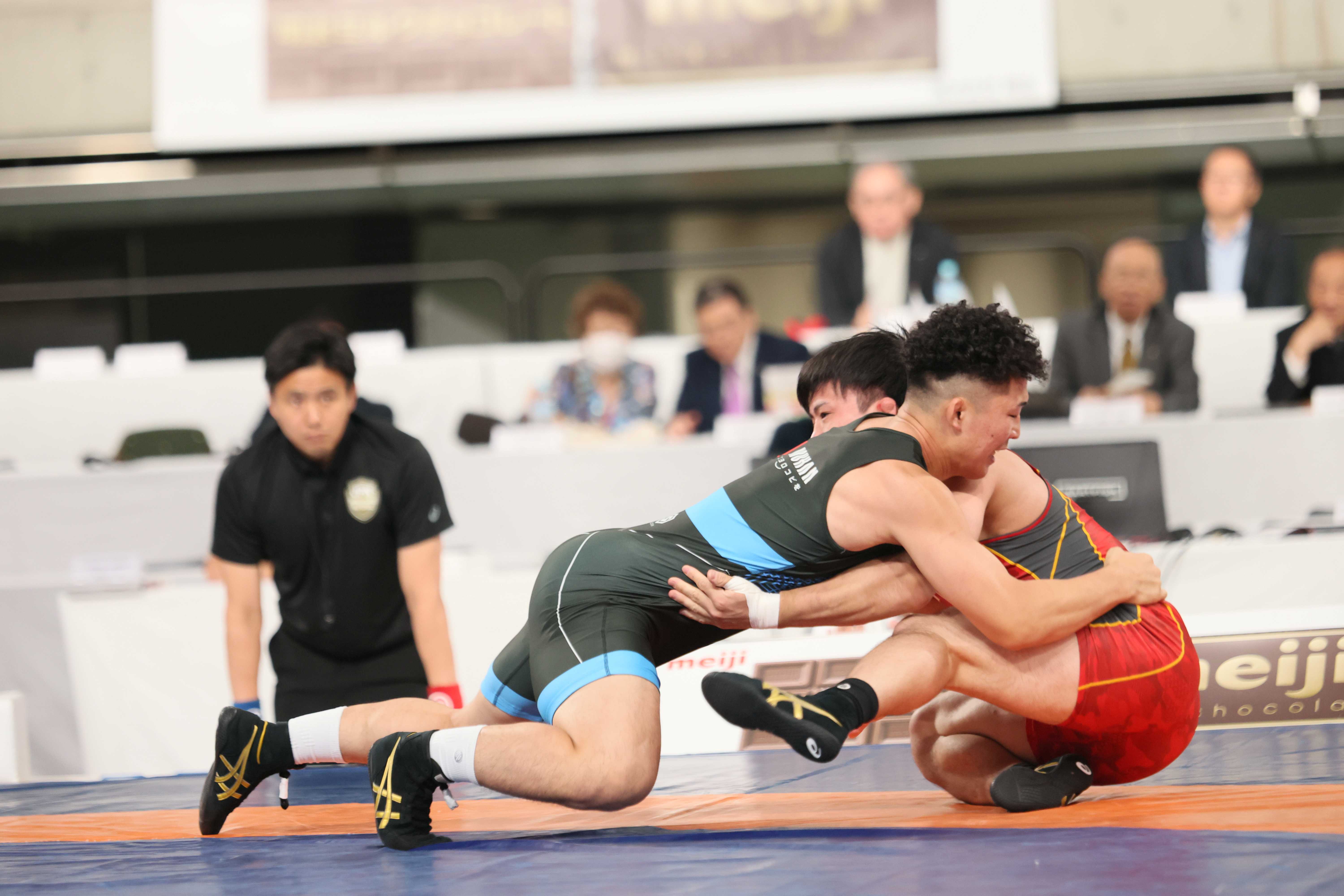
In the playoff, Kiyooka opened with a stepout off a scramble, then received an activity point. But when he scored a stepout late in the period, Tanabe was slow to get up and indicated he had suffered a knee injury.

Tanabe bravely forged on and scored 2 off a counter lift off a Kiyooka takedown attempt, but Kiyooka kept his leg hold and made it 7-2 with an intriguing 4-point move.

With Tanabe on his back, Kiyooka stood straight up, then moved to the edge, where he launched an aerial cartwheel that caused Tanabe to land flat on his back.

"I wanted to lift him up and get a big point," Kiyooka said. "But Tanabe is a competitor with a high level of talent and athleticism, and if I didn't do it right, he could be the one to get the points. I was glad that I gave it a try.

"To get a big score provides an advantage later on. From now, I'm going to need a move like that, because without it, I'll have to settle for one or two points, which makes it easier for the opponent to catch up. I'm going to add it to my regular practice."

Tanabe stayed down and took an injury timeout, and it was soon after that Kiyooka put the match away with a counter lift and two exposures to win 13-2 in 5:45.

"My opponent's condition wasn't very good in the final, and then his knee became painful in the playoff," Kiyooka said. "So he wasn't at his best, but I couldn't let that sway me and I had to fight to the end.

"At this tournament, the main thing was to win, as it was where I was making my return. I'm also also making a new start with a new company affiliation and wanted it to go right, so I'm glad I could win the title and make the team to the World Championships."

Kiyooka, whose younger sister Moe lost a playoff at women's 53kg on Saturday, said the extended layoff caused him some concern.

"There was some anxiety, but as long as I did what I needed to do, I thought it would lead to a result like this," Kiyooka said. "There are only so many days until the Los Angeles Olympics, and this have given me an idea of what I will need to work on to put it all together."

Nao KUSAKA (JPN)Nao KUSAKA bulls his way to a takedown in the Greco 77kg playoff with Kodai SAKURABA. (Photo: Takeo Yabuki / wrestling-spirits.jp)

Kusaka never seemed in danger in either of his matches against Emperor's Cup champion Sakuraba, nor did he show the dominance that led to Olympic gold.

In the Meiji Cup final, Kusaka came away with a 5-1 win in which he scored no technical points. In the first period, he received a passivity point, then when Sakuraba tried to escape from the bottom of par terre, he was hit with a 2-point penalty for a leg foul, and an unsuccessful challenge made it 4-0. Kusaka then received a second passivity point in the second period and that was it.

Kusaka was more productive in the playoff, bulling his way to a takedown in the first period and a stepout in the second in chalking up a 4-1 victory.

"I became more fatigued that I expected," Kusaka said. "It's been awhile since I went all out. No matter how much you build up in practice, you don't get the tension that you get in a match."

Kusaka revealed that his preparations were curtailed when he suffered a serious back strain while weight training in late May. He said the injury was so serious, it was first time he ever had to be transported on a stretcher.

"I had good luck when it came to the Olympics, but this time I had to go through that," he said. "For two weeks, I couldn't wrestle at all and I spent a week in bed."

Like Kiyooka, Kusaka wants to enhance his relatively slim resume with a world title.

"I've been wrestling 21, 22 years, and it's something I've always aspired to," Kusaka said. "I'm getting attention as an Olympic champion, but I want to be active around the world. The 2024 season went extremely well and I received the MVP award, which was great. But I don't want to be a one-hit wonder. I have to keep getting results."

Kyotaro SOGABE (JPN)Kyotaro SOGABE squares off with longtime rival Katsuaki ENDO in the Greco 67kg playoff. (Photo: Takeo Yabuki / wrestling-spirits.jp)

Another playoff of note occurred at Greco 67kg, where Paris Olympian Kyotaro SOGABE secured his latest triumph over longtime rival and fellow NSSU alum Katsuaki ENDO.

Endo won the Emperor's Cup in Sogabe's absence, but the latter set up the playoff with a 4-0 victory in the Meiji Cup final in which he twice received passivity points, scoring a gut wrench after his second chance at par terre. In the playoff, Sogabe never gave Endo an opening and rolled to a 9-0 victory.

Rin SAKAMOTO (JPN)Teenager Rin SAKAMOTO gestures after securing his ticket to the senior worlds at freestyle 57kg. (Photo: Takeo Yabuki / wrestling-spirits.jp)

Among the two men's weight classes that did not need to go to a playoff, teenager Rin SAKAMOTO secured his ticket to Zagreb at freestyle 57kg by crushing Kento YUMIYA 10-0 to complete the Emperor's Cup-Meiji Cup double.

The 19-year-old Sakamoto is a maverick among Japanese wrestlers, in that he decided to pursue a collegiate career in the United States, where he now competes for powerhouse Oklahoma State University.

He admittedly had trouble at the Emperor's Cup adjusting back to freestyle after practicing in the American folkstyle. But this time, with the U.S. collegiate season over, he was able to focus exclusively on the international style.

Sakamoto had a disappointing showing at the Asian Championships, where he lost in the bronze-medal match, but returned to Japan in April and won the qualifying tournament for the World U20 Championships.

Regarding making his first senior worlds, Sakamoto said, "I'm excited," citing the fact that he can match Tokyo Olympic champion Takuto OTOGURO, who was also 19 when he won the world title in 2018. Unfortunately, should Sakamoto triumph in Zagreb, he will fall one month short of Otoguro's record for Japan's youngest-ever male world champion.

At Greco 60kg, Emperor's Cup champion and two-time Asian medalist Kaito INABA defeated Yu SHIOTANI 5-2 in the final to earn his first trip to the World Championships.

Asian and world U23 champion Kodai TAKAHASHI will get another shot at the senior worlds after he defeated Emperor's Cup champion Hikaru TAKATA 3-0 in the freestyle 74kg playoff.

Takahashi, who missed the Emperor's Cup due to an injury suffered while competing at 79kg at last year's non-Olympic worlds, secured a place in the playoff by beating Takata in Saturday's semifinals. then topping Masaki SATO 3-1 in the Meiji Cup final.

Day 4 Results

Freestyle

57kg (11 entries)
GOLD: Rin SAKAMOTO df. Kento YUMIYA by TF, 10-0, 2:22

BRONZE: Rikuto NAGAI df. Kodai NAKAISHI by TF, 10-0, 5:59
BRONZE: . Rikuto ARAI df. Fuga SASAKI, 4-1

65kg (9 entries)
GOLD: Kotaro KIYOOKA df. Kaisei TANABE, 4-3

BRONZE: Shinnosuke SUWAMA df. Ryuto SAKAKI, 8-5
BRONZE: Yuto NISHIUCHI df. Takuma AKIYAMA by TF, 10-0, 5:45

World Team Playoff: Kiyooka df. Tanabe by TF, 10-0, 5:45

74kg (12 entries)
GOLD: Kota TAKAHASHI df. Masaki SATO, 3-1

BRONZE: Kanata YAMAGUCHI df. Hikaru TAKATA by Def.
BRONZE: Toki OGAWA df. Tenju HOSAKA, 2-1

World Team Playoff: Takahashi df. Takata, 3-0

Greco-Roman

60kg (8 entries)
GOLD: Kaito INABA df. Yu SHIOTANI, 5-2

BRONZE: Seima TOKUHARA df. Eiru TAKAYAMA, 5-2
BRONZE: Koto GOMI df. Maito KAWANA, 7-7

67kg (12 entries)
GOLD: Kyotaro SOGABE df. Katsuaki ENDO, 4-0

BRONZE: Kensuke SHIMIZU df. Chiezo MARUYAMA, 3-2
BRONZE: Haruto YABE df. Kojiro HASEGAWA, 8-5

World Team Playoff: Sogabe df. Endo by TF, 9-0, 5:50

77kg (10 entries)
GOLD: Nao KUSAKA df. Kodai SAKURABA, 5-1

BRONZE: Fuga MISAIZU df. Shu YAMADA by Def.
BRONZE: Isami HORIKITA df. Naoki KADODE, 5-3

World Team Playoff: Kusaka df. Sakuraba, 4-1