#WrestleTokyo

#WrestleTokyo Greco-Roman Previews

By United World Wrestling Press

Greco-Roman Previews

60kg
The last time the Olympics were held in Tokyo, Japan won two gold medals in Greco-Roman wrestling. 57 years later, Kenichiro FUMITA (JPN) will have a chance to repeat the feat the world champion at 60kg leads the country's hope for a Greco-Roman Olympic champion in 37 years.

FULL PREVIEW

67kg
Big challenges lie ahead of returning Olympic champion Ismael BORRERO MOLINA (CUB). The first is he is making his return in a new weight category, eight kilograms above the 59kg in which won a gold medal in the Rio Olympics.

Five world champions appear in the category which may throw a surprise Olympic champion given a mix of youth and veterans at this weight.

FULL PREVIEW

77kg
Two-time defending Olympic champion Roman VLASOV's (RUS) reign as the top wrestler will be over after nine years. The winner of the gold medal in 2012 and 2016 failed to win the spot on the Russian team, which means a new Olympic champion will be crowned at this weight.

FULL PREVIEW

87kg
Zhan BELENIUK (UKR) will look to improve on the Olympic silver medal he won at the 2016 Rio Games. He won gold at the 2019 World Championships in Nur-Sultan, which was his second world title after claiming gold in 2015. The 30-year-old Beleniuk has five world medals and four European gold medals. Earlier this year, Beleniuk won gold at the Grand Prix of Zagreb before getting a bronze at the European Championships in April. He enters the Tokyo Olympics as the No.2 seed at 87kg.

FULL PREVIEW

97kg
One of wrestling's greatest rivalries could be renewed in Tokyo if the seeds hold. Musa EVLOEV (RUS) and Artur ALEKSANYAN (ARM), two of Greco-Roman's biggest stars, enter Tokyo Games as the top two seeds at 97kg. They have combined to win every world or Olympic title in this weight category since 2014.

FULL PREVIEW

130kg
Mijain LOPEZ NUNEZ (CUB) will look to make history at the Tokyo Olympics. The Cuban wrestling legend, who enters unseeded, has a chance to become the first four-time Olympic champion in Greco-Roman and the second wrestler in any style to accomplish the feat. (At the 2016 Rio Olympics, Japan's Kaori ICHO became the first four-time Olympic champion wrestler in any style.) The 38-year-old Lopez is not only unbeaten at the Olympic Games since 2008, but he has won five world titles and three world silver medals. Two of his three losses in world championship competition have come to Riza KAYAALP (TUR), who enters the Tokyo Olympics as the top seed at 130kg.
FULL PREVIEW

#development

South Africa Advances National Wrestling System with DNSS Phase 2

By United World Wrestling Press

PRETORIA, South Africa (April 8) -- South Africa has reached a decisive milestone in its long-term wrestling development strategy with the successful implementation of Phase 2 of the Development of National Sport System (DNSS) programme, delivered in collaboration with United World Wrestling (UWW) and supported by Olympic Solidarity.

Following the diagnostic and mapping phase conducted earlier, Phase 2 marks a clear transition from analysis to structured implementation, laying the foundation for a sustainable and internationally aligned wrestling system.

Led by UWW Development Officer Vincent AKA, in close cooperation with the South African Wrestling Federation (SAWF), the National Head Coach, Markus DEKKER and Provincial Coordinators, the programme was deployed across multiple provinces through a structured 10-day intervention from March 2 to 13. 

Activities were conducted in key locations including:

· LPWA (Ion Bachu)
· CGWA (Ruiter)
· NGWA (Menlo Park Hall)
· Frank Joubert Tournament (Menlo Park Hall)

This nationwide approach ensured direct engagement with provincial structures, strengthening alignment between national leadership and local associations while promoting inclusive development across the country.

From Talent Identification to System Building

Unlike traditional training camps, DNSS Phase 2 focused on identifying talent and building long-term development systems. Wrestlers and coaches from all age categories -- U13, U15, U17, U20, and Senior -- were actively involved, ensuring a complete pathway approach.

Provincial visits and stakeholder meetings played a key role in assessing facilities and operational structures, strengthening coordination between SAWF and provinces, and identifying emerging wrestlers.

Building Athlete Pipeline

A training camp for different provinces brought together wrestler to consolidate talent identified during Phase 1 and introduce standardized training methodologies.

The training camp included technical sessions, physical conditioning, match simulations and wrestling. The initiative contributed to the creation of an updated national prospect and the foundation of a structured athlete monitoring system.

South Africa

Beach Wrestling Gains Momentum

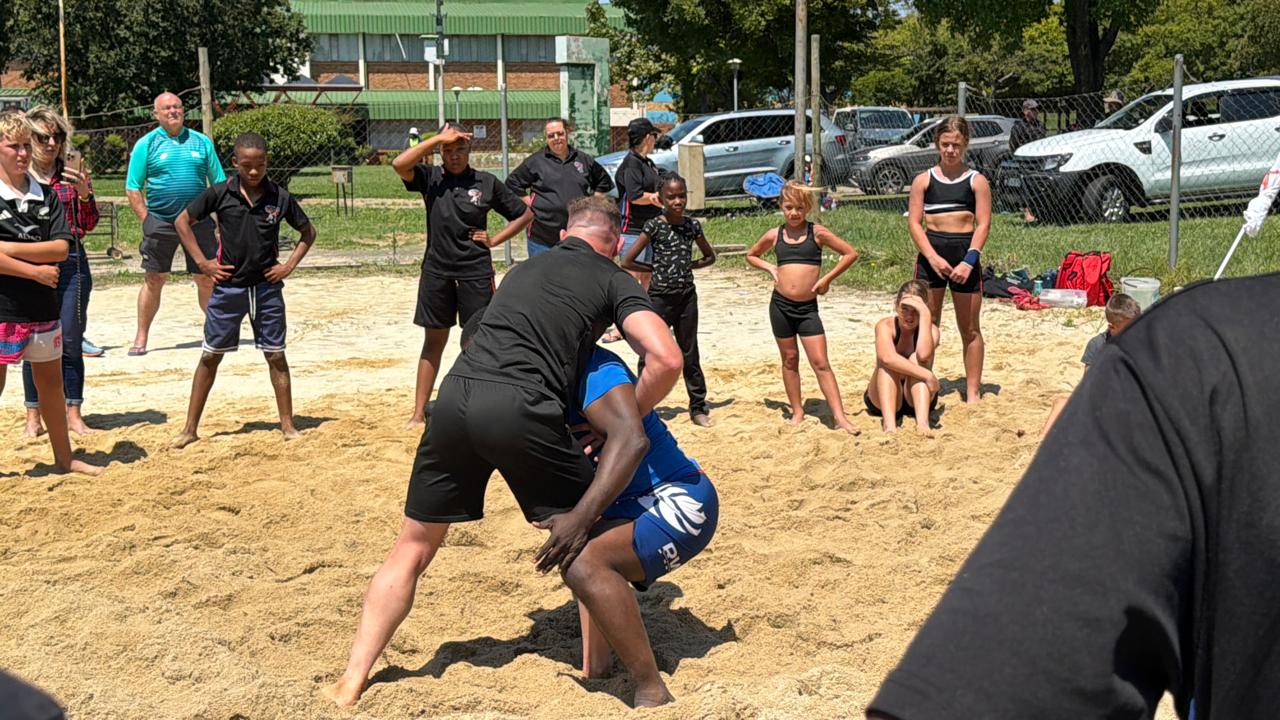
As part of the DNSS activities, a Beach Wrestling training session in Roodepoort highlighted the programme’s expanding impact.

During the visit, Aka led a specialized session, sharing advanced technical insights adapted to beach wrestling. It included stance and balance adjustments, grip and control techniques, and movement adaptation on sand.

The training programme comes at a crucial time, as South African athletes prepare for African Beach Wrestling Championships in Alexandria, Egypt and other international tournaments.