

#WrestleOslo: Taylor, Yazdani set up gold-medal showdown; USA puts 3 in finals
Saturday, October 2, 2021 - 18:47 By Ken Marantz

OSLO (October 3) -- Just two months after a victory that gave him an Olympic gold medal, David TAYLOR (USA) will meet nemesis Hassan YAZDANI (IRI) again, this time with the world championship on the line in the latest edition of one of wrestling's biggest rivalries.
Taylor was one of three Americans to advance to the finals in the four freestyle weight classes in action on the opening day Saturday of the World Championships in Oslo, storming into the 86kg gold-medal match with a victory by fall over Abubakr ABARAKOV (AZE) in the semifinals.
Meanwhile, Tokyo Olympic bronze medalist Kyle DAKE (USA) will get a chance to add the world 74kg title to the two he owns at 79kg, while Daton FIX (USA) rampaged through the rounds to make the final at 61kg at the Jordal Amfi arena.
At 125kg, rising star Amir ZARE (IRI) outlasted two-time former world champion Taha AKGUL (TUR) in a clash of Olympic bronze medalists to set up a gold-medal showdown with three-time defending champion Geno PETRIASHVILI (GEO).
Yazdani, aiming for his third career world title, advanced into Sunday night's 86kg final by defeating Artur NAIFONOV (RWF) 8-2 -- a virtual repeat of their semifinal clash at the Tokyo Olympics in August which Yazdani won 7-1.
 David TAYLOR (USA) advanced to the 86kg final. (Photo: UWW / Kadir Caliskan)
Taylor's victory in the Tokyo final over Yazdani was the third in three career meetings between the two, but he knows not to underestimate such a dangerous foe, given that he needed a late takedown to forge out a 4-3 win.
"You can't take this one for granted," Taylor said. "It was a very close match at the Olympics. So we'll see which guy prevails in this match. Either way, it's going to be very tough. I'm ready, I'm looking forward to it."
Yazdani, the 2016 Rio Olympic champion at 74kg, has similar sentiments, but thinks he is ready to turn the tide.
"It will be a beautiful wrestling bout," Yazdani said. "Based on my three times wrestling with him, I know him, I am getting better and I can do a good job so that I can avenge my Tokyo loss."
Taylor, who started the day with a technical fall and a fall, had a rare lapse in his semifinal against 2019 world U23 silver medalist Abarakov, who scored an early takedown with a shrug and go-behind.
But Taylor came back with a vengence, scoring a quick takedown and gut wrench. Then, harkening back to his American folkstyle roots, he used a chicken wing and arm bar to turn Abarakov over and secure the fall at 2:34.
"My background is folkstyle wrestling, I'm a dangerous freestyle wrestler, and I can score from so many positions." Taylor said, "It's about adapting, finding ways to make that stuff work...You get to the World Championships, where people really want to win and want to scramble a little longer, that kind of stuff opens up for me."
Taylor's high-pace attack has always been his strongpoint, helping him win his first and only world title in 2018. He is certainly showing none of the effects of the knee injury that kept him out of the 2019 worlds.
"People have been trying to slow me down since I was 10," Taylor said. "It hasn't changed, it's just a different level. They're not going to wrestle my pace, we know that.
"It's about making adjustments, getting a good game plan ready to go. He gets the first takedown, but now what, there's five minutes? Know that I'm coming for five. He was good, he was prepared. He's a good skilled guy."
Asked about the strong opening-day showing by the US, which includes all but one of its Olympic medalists, Taylor said he didn't really understand why some countries would opt to skip the tournament or send lower-level teams.
"We have a great team," he said. "A lot of countries chose to take this one off, but I think it's a big mistake. You only get so many healthy world championship opportunities, you got to show up. We showed up, we performed really well today, we got to keep it rolling. I hope we set the tone for the next couple of days."
 Tajmuraz SALKAZANOV (SVK) will wrestle Kyle DAKE (USA) in the 74kg final. (Photo: UWW / Martin Gabor)
Also getting the ball rolling was Dake, who rolled to a 9-1 victory over Azamat NURYKAU (BLR), which got a little testy at times, to advance to the 74kg final, where he will face Tajmuraz SALKAZANOV (SVK).
"I am excited to be back and to compete at a high level, whoever I face," Dake said.
Dake scored a single-leg takedown that he followed with a gut wrench and two tilts for a quick 8-0 lead. All that Nurykau could manage was a stepout in the second period, while a penalty point capped Dake's scoring.
Nurykau, who is competing in his seventh World Championships, will get yet another chance for a medal -- he wrestled for a bronze three times, in 2014, 2015 and 2017, and lost each time.
The Russian-born Salkazanov assured his adopted country of a fourth world medal in its history, and will look to become its first-ever gold medalist, after defeating 2018 world silver medalist Avtandil KENTCHADZE (GEO) 5-0.
"It would be a great honor for me to bring the gold medal of the World Championships for my country Slovakia, I would be unbelievably proud of it," Salkazanov said. "I will be happy if I can make it."
Salkazanov, this year's European champion and a 2019 world bronze medalist at 79kg, barely made it out of the quarterfinals, scoring a last-second stepout to stun Timur BIZHOEV (RWF) 2-2.
 Abasgadzhi MAGOMEDOV (RWF) will wrestle Daton FIX (USA) in the 61kg final. (Photo: UWW / Kadir Caliskan)
At 61kg, the final was set up between Fix and European champion Abasgadzhi MAGOMEDOV (RWF), as the two were equally dominant in opposite brackets.
Fix, a 2017 world junior champion, needed just 34 seconds to overwhelm two-time world junior bronze medalist Arsen HARUTYUNYAN (ARM) by 10-0 technical fall, giving him a shot at a gold medal in his second career World Championships.
"I wanna be a world champion," Fix said. "I am here, you know, the time is now. I am not gonna let another opportunity slip away from me....I feel good, I am wrestling well, and I am just gonna keep it rolling into the finals."
Magomedov, the 2018 world junior champion, had little trouble in also advancing with a 10-0 technical fall, ending his clash at 3:41 with 2018 world U23 champion Toshihiro HASEGAWA (JPN), who couldn't pull off another comeback after rallying in all three of his previous wins.
As the lone Russian Wrestling Federation wrestler in the first group of finals, Magomedov is also thinking of the importance of a victory in terms of the team race.
"I will be the first one to wrestle [in Sunday’s finals] and I’ll try to give it all I can with God's will to help my team get the team title," Magomedov said.
Fix chalked up three technical falls without giving up a point leading up to the semifinals, while Magomedov had a pair of first-period falls.
"It’s not my special tactic to pin the opponents," Magomedov said. "I see how it goes during the match. It’s better to pin the opponent and rest rather than wrestle for six minutes. If I feel it’s gonna work, I’ll pin. But it’s not something I’ve learned on purpose."
Fix recalled that he and Magomedov met once before, in the 54kg quarterfinals at the 2015 world cadets in Sarajevo. Magomedov won that encounter 3-2 (he went on to the final, but lost to Takuto OTOGURO (JPN), the Tokyo 2021 65kg champion).
"I’ll let him have that one, and I’ll get one here," Fix said.
The 125kg field is missing Olympic champion Gable STEVESON (USA), but the three other medalists are all here, and Akgul ended up being the odd-man out of the final.
 Amir ZARE (IRI) defeated Taha AKGUL (TUR) in the semifinal and will wrestle Geno PETRIASHVILI (GEO) in the 125kg final. (Photo: UWW / Kadir Caliskan)
Zare, the 2019 world U23 gold medalist, gained an activity point in each period, then scored a takedown countering a late attack by Akgul for a 4-0 victory and a chance to avenge a semifinal loss to Petriashvili from the Tokyo Olympics.
"After the Olympics and a short break, I joined the training camp," Zare said. "The coaches analyzed carefully and I am really ready for the [final] and I am eager for it. In the final, I will not repeat my mistakes as I did in Tokyo and I can win gold medal."
Petrashvili, who lost a 10-8 thriller to Steveson in the Olympic final, had little trouble scoring a 10-0 technical fall over Asian champion Oleg BOLTIN (KAZ). The Georgian scored three takedowns, adding a gut wrench after two of them to win in 4:50.
Boltin will get a chance for take home a bronze in likely his final competition. The 28-year-old, who won four Japan national collegiate titles at Yamanashi Gakuin University, will reportedly start a career with the New Japan Pro-Wrestling organization following the tournament.
Day 1 Results
61kg
Semifinal - Daton FIX (USA) df. Arsen HARUTYUNYAN (ARM) by TF, 10-0, :34
Semifinal - Abasgadzhi MAGOMEDOV (RWF) df. Toshihiro HASEGAWA (JPN) by TF, 10-0, 3:41
74kg
Semifinal - Kyle DAKE (USA) df. Azamat NURYKAU (BLR), 9-1
Semifinal - Tajmuraz SALKAZANOV (SVK) df. Avtandil KENTCHADZE (GEO), 5-0
86kg
Semifinal - David TAYLOR (USA) df. Abubakr ABARAKOV (AZE) by Fall, 2:34 (6-2)
Semifinal - Hassan YAZDANI (IRI) df. Artur NAIFONOV (RWF), 8-2
125kg
Semifinal Geno PETRIASHVILI (GEO) df. Oleg BOLTIN (KAZ) by TF, 10-0, 4:50
Semifinal - Amir ZARE (IRI) df. Taha AKGUL (TUR), 4-0
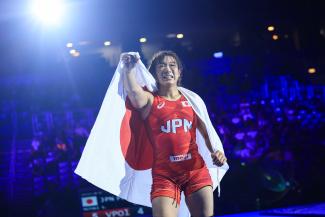
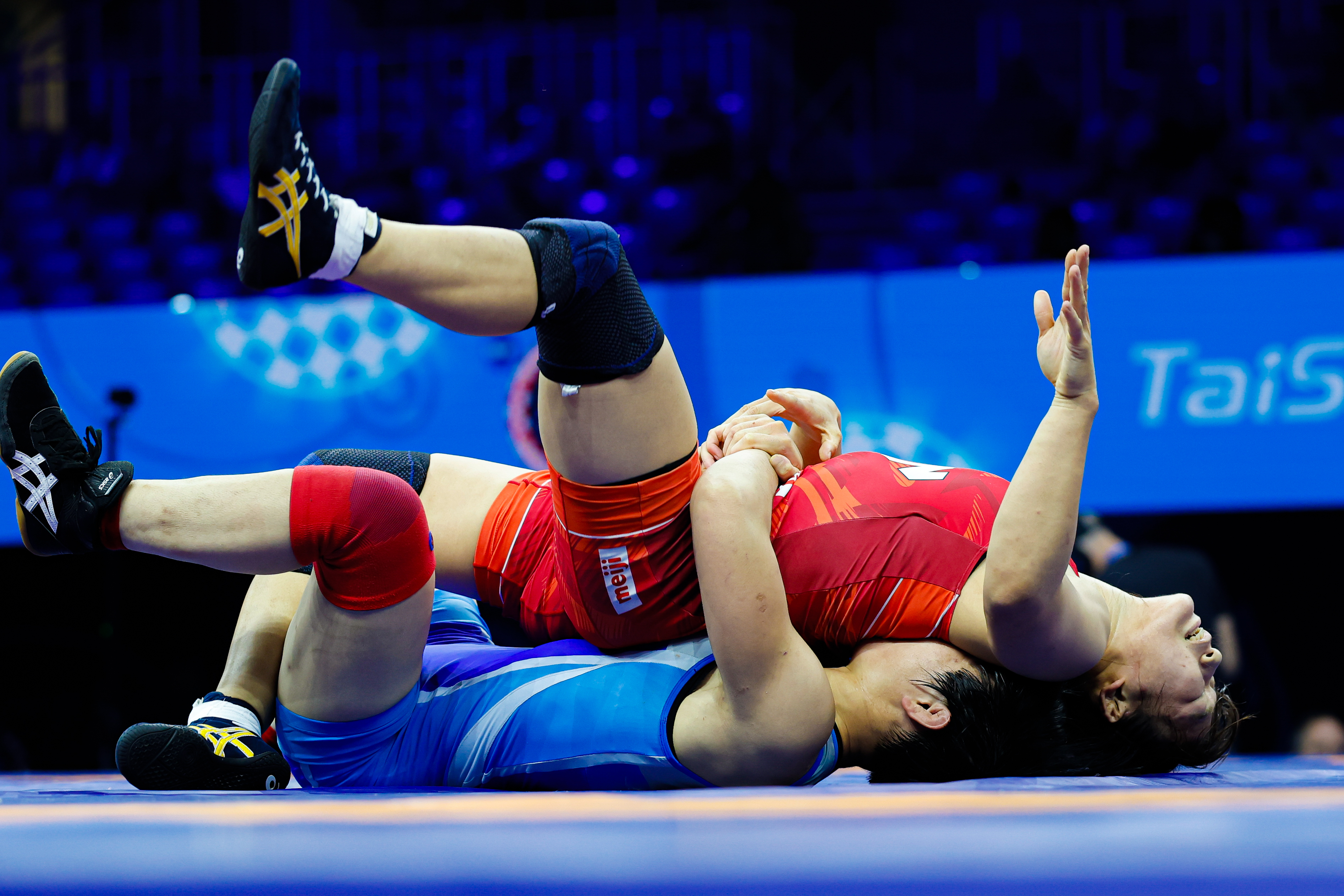 Ok Ju KIM (PRK) turns Sakura MOTOKI (JPN) to take a 4-3 lead in the 62kg final. (Photo: United World Wrestling / Kostadin Andonov)
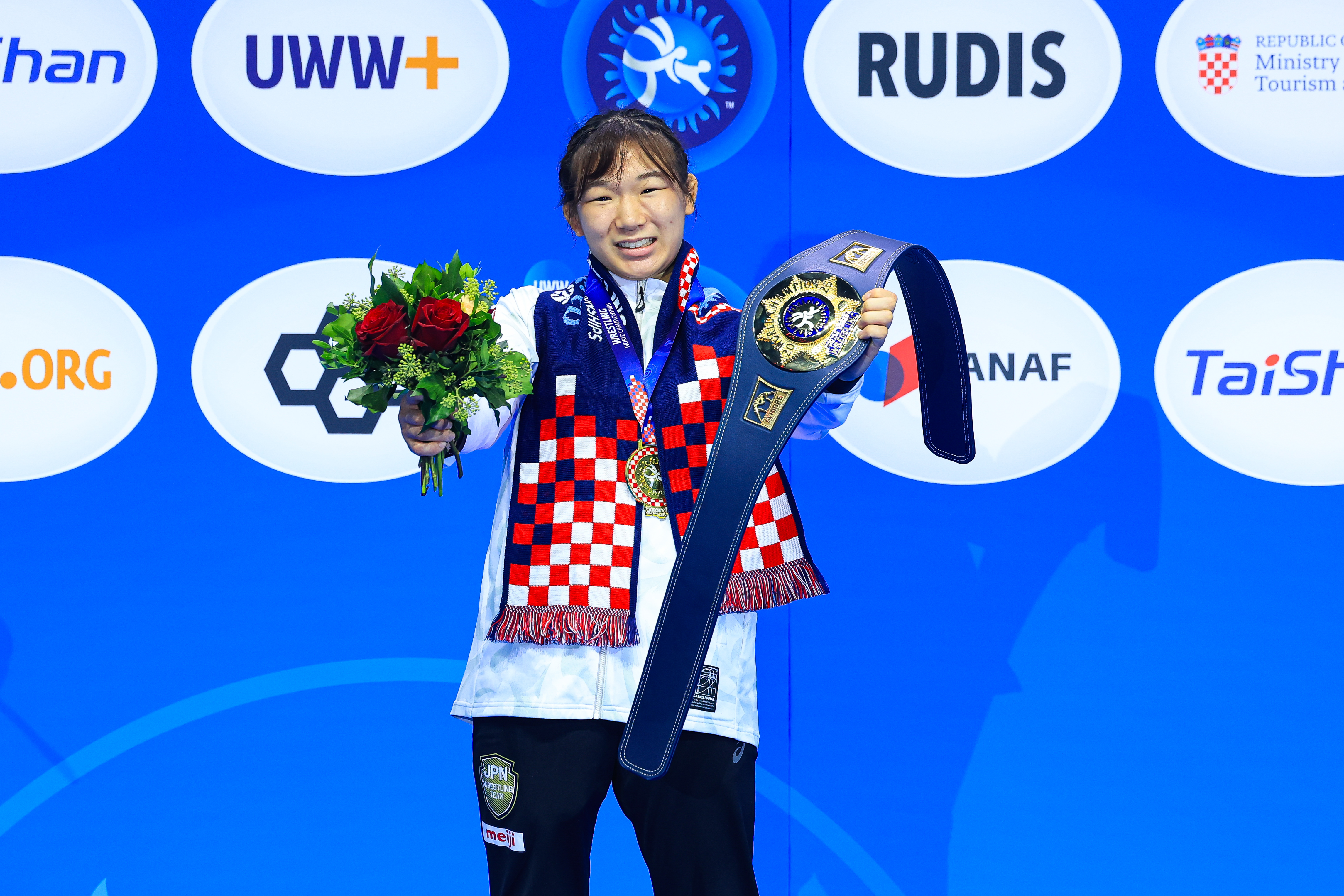 Sakura MOTOKI (JPN) won her first world gold medal in Zagreb. (Photo: United World Wrestling / Kadir Caliskan)
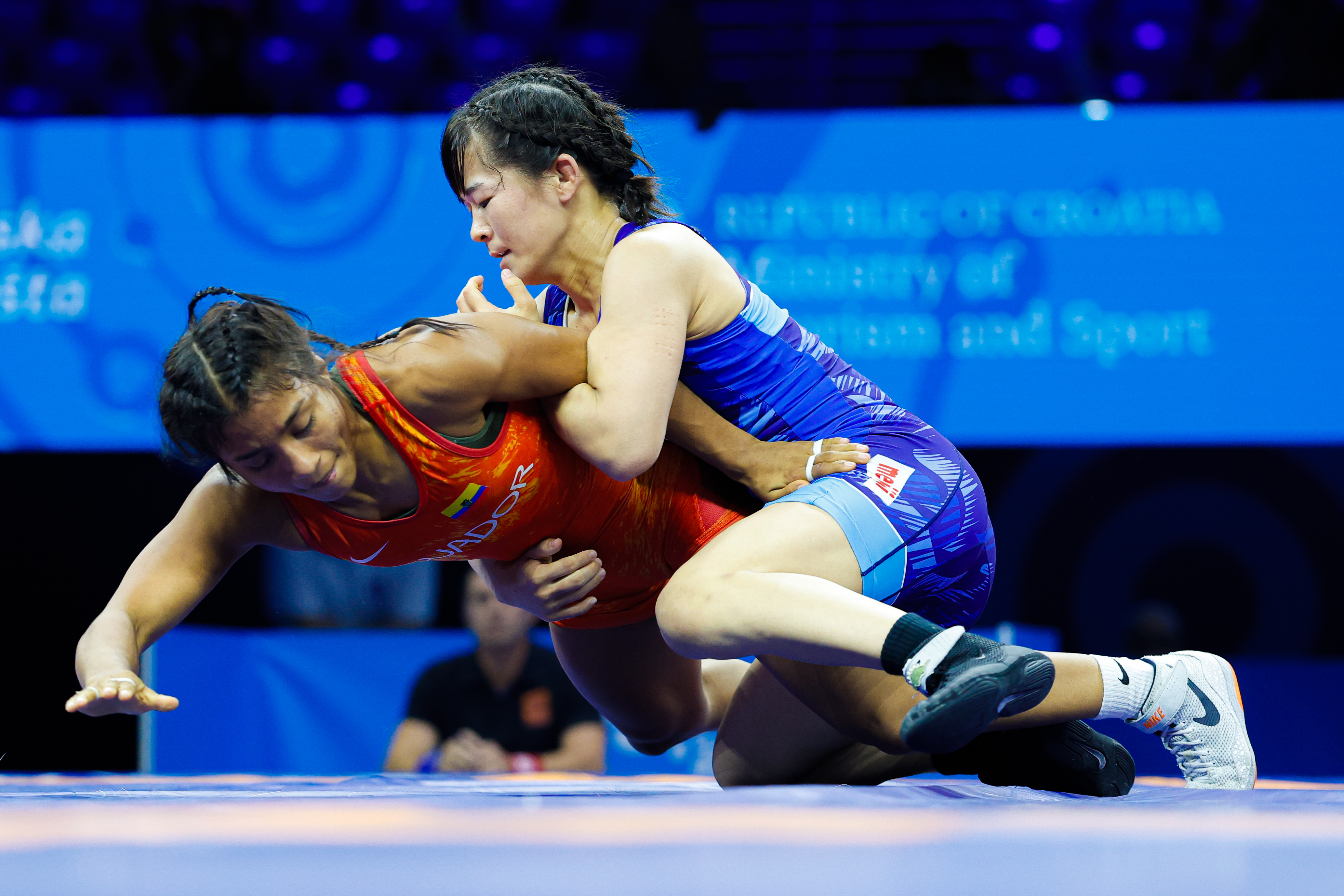 Haruna MURAYAMA (JPN) controls Lucia YEPEZ (ECU) during the 53kg final at the World Championships. (Photo: United World Wrestling / Kostadin Andonov)
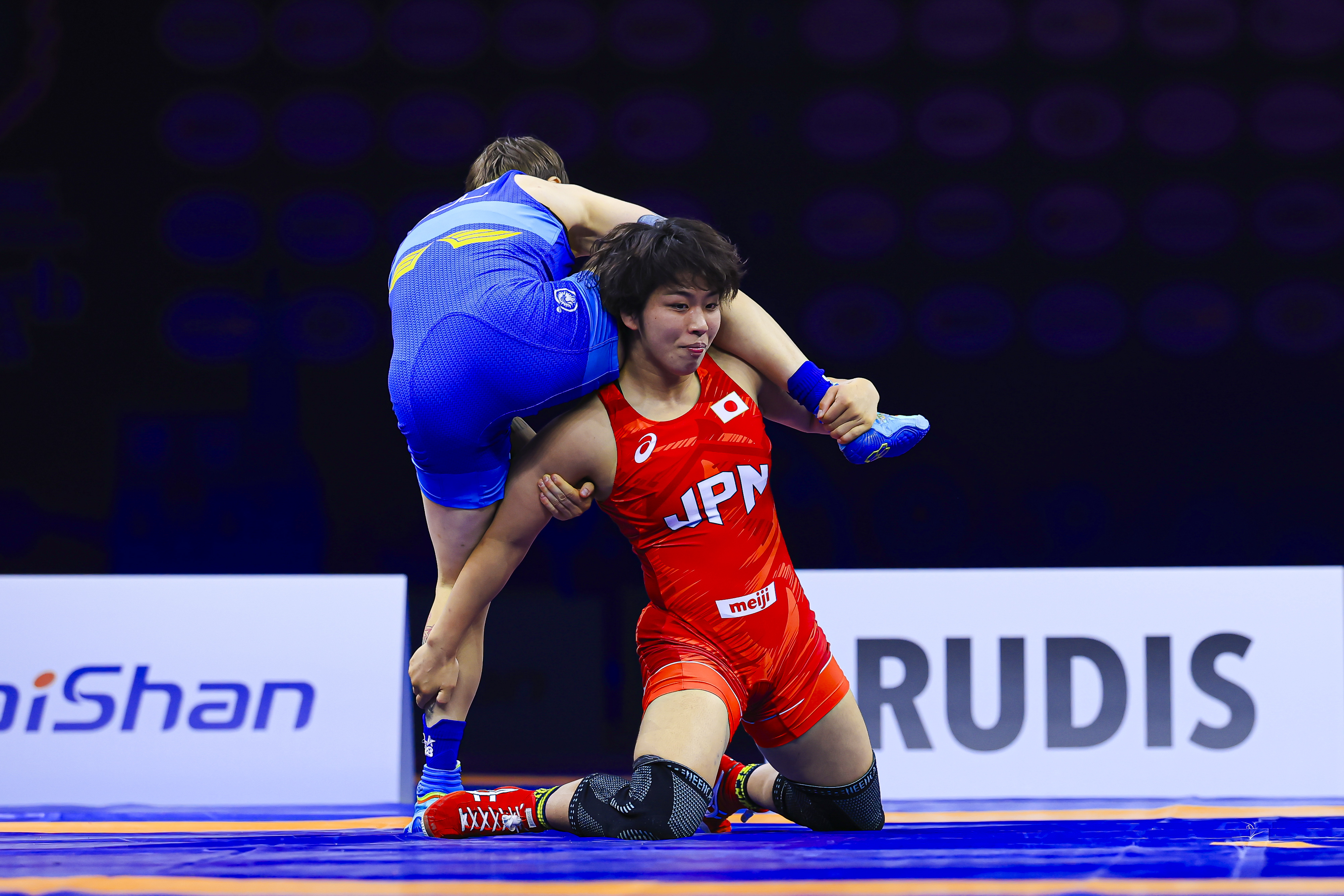 Ami ISHII (JPN) tries to score on Yuliana YANEVA (BUL) in the 68kg final. (Photo: United World Wrestling / Kadir Caliskan)
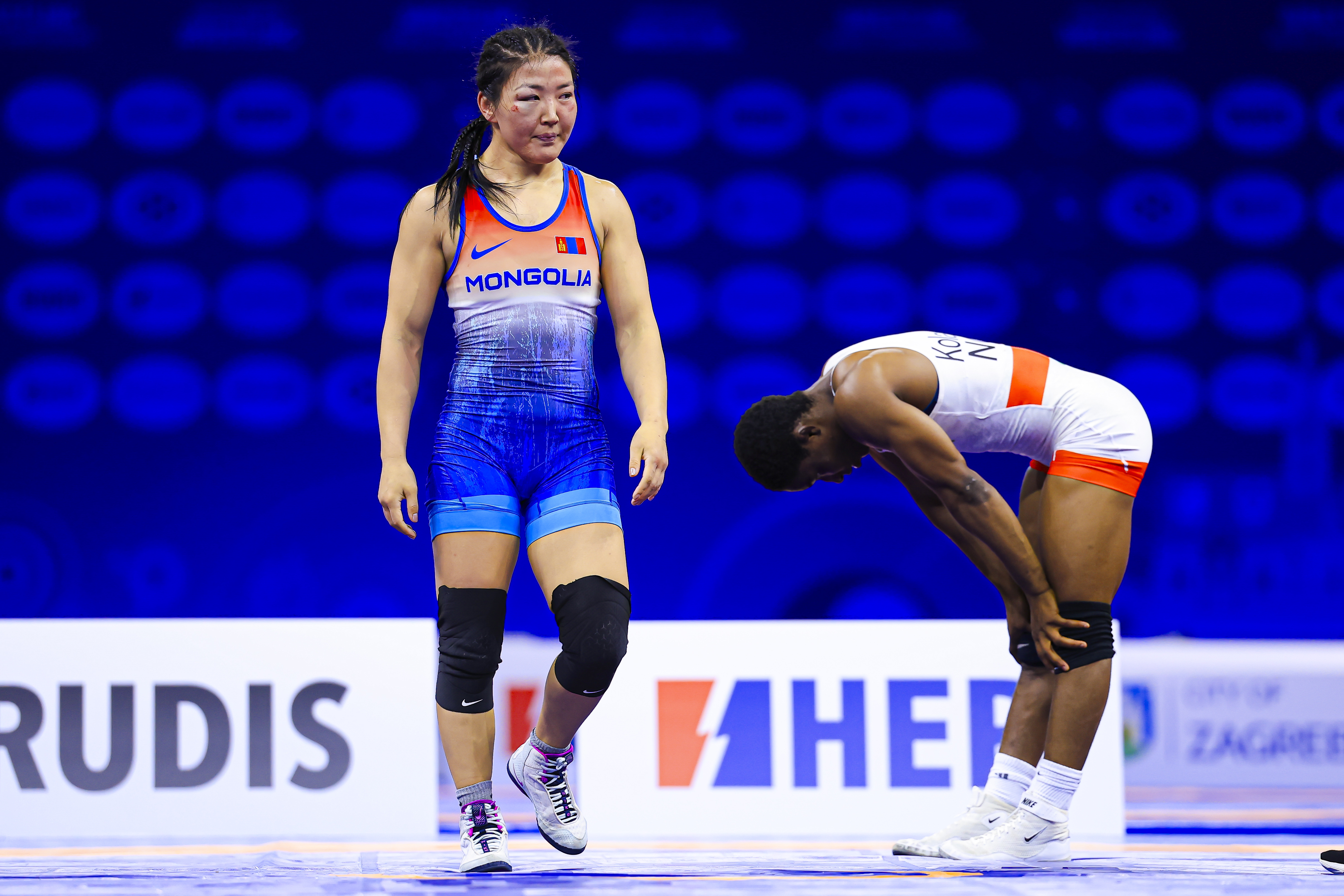 Orkhon PUREVDORJ (MGL) defeated Esther KOLAWOLE (NGR) to win bronze at 62kg. (Photo: United World Wrestling / Kadir Caliskan)
Share your thoughts.
Comments