

#WrestleIstanbul: Oborududu Wins 68kg Gold; Tynybekova stunned
Friday, February 25, 2022 - 16:12 By Vinay Siwach

ISTANBUL, Turkey (February 25) -- Blessing OBORUDUDU (NGR) clearly remembered her Olympic quarterfinal bout against Meerim ZHUMANAZAROVA (KGZ). She won that match, 3-2, but it wasn't as error-free as she wanted it to be. She earned two points for a takedown and a point for Zhumanazarova's inactivity but also surrendered a takedown and was on the verge of losing.
With lessons from that Tokyo bout, Oborududu stepped on the mat for her 68kg final against Zhumanazarova at the Hamit Kaplan Ranking Series in Istanbul, Turkey, with confidence.
"I wrestled her in the quarterfinals in Tokyo, but here, I knew it would be tougher," Oborududu said. "I had to keep myself from attacking too much. My coach told me to move before attacking. I can say it was easy."
Both wrestlers were cautious at the beginning of the match, and the referee warned Zhumanazarova for her inactivity. At the end of the first period, Oburududu led 1-0.
Zhumanazarova was dinged again for passivity at the start of the second period. She became desperate to score, but Oborududu defended her Kyrgyz opponent's shot attempts and gained the 2-0 lead.
"I was calculating a lot in my mind," she said. "I knew if she scored, then she would get two points. So I needed it to be 3-2."
With 40 seconds remaining, Oborududu managed to score a stepout, which proved crucial in the end. That also gave her a first Ranking Series gold after two silver and a bronze-medal finish.
Comparing the two bouts, the African champion felt that Zhumanazarov might have taken the Istanbul bout a little easy.
"She was a bit better in Tokyo than here because everyone prepares better for the Olympics," she said. "I needed to be careful to get gold. In Tokyo, I attacked to get two points and then one passivity to win, 3-2. That was difficult.
"I am so excited. Now I have African Championships in May and then the Commonwealth Games. I want to win a world medal in September."
 Tserenchimed SUKHEE (MGL) defeated Macey KILTY (USA) in the 62kg final. (Photo: UWW / Kadir Caliskan)
Pin to win
Tserenchimed SUKHEE (MGL) had an out-of-favor Olympic cycle before Tokyo. After winning the world title in 2014 and a silver medal in 2015, Mongolia hoped Sukhee would become their country's first Olympic champion.
Unfortunately, Sukhee failed to qualify for Rio, and after losing in the semifinals of the Asian Olympic Qualifiers in Almaty, she could not punch her ticket for the Tokyo Games.
"I was devasted after the loss in Almaty," Sukhee said. "I worked hard on my skill and techniques to improve. I have focused on my condition as well."
That was evident today, as she made her way to the final with three big wins. She pinned Tokyo bronze medalist Tabye YUSEIN (BUL), Rio bronze medalist Sakshi MALIK (IND) and beat Rio bronze Marwa AMRI (TUN), 11-0.
Furthermore, she did so in a bracket that featured two-time world champion Aisuluu TYNYBEKOVA (KGZ), who lost in the first bout.
She faced a familiar opponent in the finals. A month back, Sukhee and Macey KILTY (USA) were in the gold-medal bout at the Ivan Yarguin Grand Prix. The Mongolian had no trouble getting past Kilty, winning that match, 12-0. The two made their way back to the final at the Hamit Kaplan Ranking Series events in Istanbul Friday, with Kilty hoping to avenge that loss.
But that dream quickly faded Sukhee bombed three four-point throws inside the first period to win 12-0, a score that mirrored the Yargiun final.
"I have done many camps in the USA and trained with her," she said. "The final from January also helped me prepare for this, and it was easy for me."
 Lais NUNES DE OLIVEIRA (BRA) defeated two-time world champion Aisuluu TYNYBEKOVA (KGZ). (Photo: UWW / Kadir Caliskan)
Earlier, Lais NUNES DE OLIVEIRA (BRA) used her pace to score a pair of stepouts over Tnynbekova, then rallied to score three takedowns to beat the Tokyo silver medalist, 8-0.
Before that, the Brazilian recovered from 8-0 deficit to beat Anastasiia PAROKHINA (RWF), 11-8.
Evelina NIKOLOVA (BUL) was another wrestler who went on a pinning spree on Friday. She secured four wins via fall, including one in the 57kg final.
The Tokyo bronze medalist began with a quick pin over Ozge FINDIKCI (TUR). She followed that up with a similar pin over Aisha UALISHAN (KAZ) to reach the quarterfinal. It turned out to be a lot closer than she thought but ultimately prevailed over Esther KOLAWOLE (NGR), 10-6.
Tokyo silver medalist Iryna KURACHKINA (BLR) thought she had secured a win over Nikolova when she led 6-4 in the semifinal, but Nikolova once again brought out the cradle to secure the win.
Bolortuya KHURELKHUU (MGL) had also made her way to the 57kg final after three wins out of four via pin, setting up a finals matchup of big pinners.
The Mongolian was leading 6-0, and it seemed Nikolova might go home with a silver medal, but out of nowhere, she held Khurelkhuu on the back to get the gold.
"I practice the technique a lot, and it has been working," Nikolova said.
 Aiperi MEDET KYZY (KGZ) used two exposure to win over Martina KUENZ (AUT). (Photo: UWW / Kadir Caliskan)
The last gold medal of the day went to U23 world champion Aiperi MEDET KYZY (KGZ), who fell behind 4-2 in the finals against Martina KUENZ (AUT), but with 40 seconds remaining, hit two crotch lifts. That turned the bout on its head and gave the Kyrgyzstan wrestler a 6-4 win.
Turkey Wins GR Team Title
Turkey grabbed the Greco-Roman team title after three gold medals on the second day. Selcuk CAN (TUR) won the 72kg gold, Yunus BASAR (TUR) won at 77kg and Burhan AKBUDAK (TUR) claimed the gold at 82kg.
This was after two gold Thursday and Turkey finished on the top with 205 points. Kazakhstan finished second with 131 points, while Azerbaijan finished in third with 127 points.
At 77kg, Basar held off world silver medalist Sanan SULEYMANOV (AZE), 2-1. The two exchanged inactivity points, but Basar secured the one-point win with a late step out.
In the 82kg finals, Akbudak won with a similar scoreline, as he beat Mihail BRADU (MDA), 2-1.
More than the final, it was the semifinal that mattered more. In an anti-climatic rematch of Oslo's 82kg world final, Akbudak stunned Rafiq HUSEYNOV (AZE), 9-0, after rolling the Azeri with four exposures.
At 72kg, Can got a walkover after Kristupas SLEIVA (LTU) pulled out injured.
 Evelina NIKOLOVA (BUL) won the 57kg gold medal. (Photo: UWW / Kadir Caliskan)
GR RESULTS
72kg
GOLD: Selcuk CAN (TUR) df Kristupas SLEIVA (LAT), via injury default
BRONZE: Murat DAG (TUR) df Ensar KARABACAK (TUR), 8-5
BRONZE: Mateusz BERNATEK (POL) df Mikko PELTOKANGAS (FIN), 5-2
77kg
GOLD: Yunus BASAR (TUR) df Sanan SULEYMANOV (AZE), 2-1
BRONZE: Tamerlan SHADUKAYEV (KAZ) df Viktor NEMES (SRB), 1-1
BRONZE: Furkan BAYRAK (TUR) df Demeu ZHADRAYEV (KAZ), 6-5
82kg
GOLD: Burhan AKBUDAK (TUR) df Mihail BRADU (MDA), 2-1
BRONZE: Rafig HUSEYNOV (AZE) df Ilimdor SATAYEV (KAZ), 11-0
BRONZE: Tunjay VAZIRZADE (AZE) df Rakhmet SAPIYEV (KAZ), 7-1
WW RESULTS
57kg
GOLD: Evelina NIKOLOVA (BUL) df Bolortuya KHURELKHUU (MGL), via fall
BRONZE: Iryna KURACHKINA (BLR) df Esther KOLAWOLE (NGR), 8-3
BRONZE: Veronika CHUMIKOVA (RWF) df Anhelina LYSAK (POL) , 7-6
62kg
GOLD: Tserenchimed SUKHEE (MGL) df Macey KILTY (USA), 11-0
BRONZE: Marwa AMRI (TUN) df Taybe YUSEIN (BUL), 5-4
BRONZE: Svetlana LIPATOVA (RWF) df Veranika IVANOVA (BLR), 6-5
68kg
GOLD: Blessing OBORUDUDU (NGR) df Meerim ZHUMANAZAROVA (KGZ), 3-0
BRONZE: Khanum VELIEVA (RWF) df Tatiana SMOLIAK (RWF), 10-0
BRONZE: Adela HANZLICKOVA (CZE) df Albina KAIRGELDINOVA (KAZ), 11-0
76kg
GOLD: Aiperi MEDET KYZY (KGZ) df Martina KUENZ (AUT), 6-4
BRONZE: Gulmaral YERKEBAYEVA (KAZ) df Victoria FRANCIS (USA), 5-1
BRONZE: Francy RAEDELT (GER) df Ekaterina BUKINA (RWF), 13-11
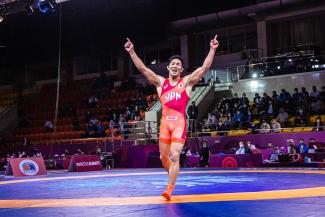
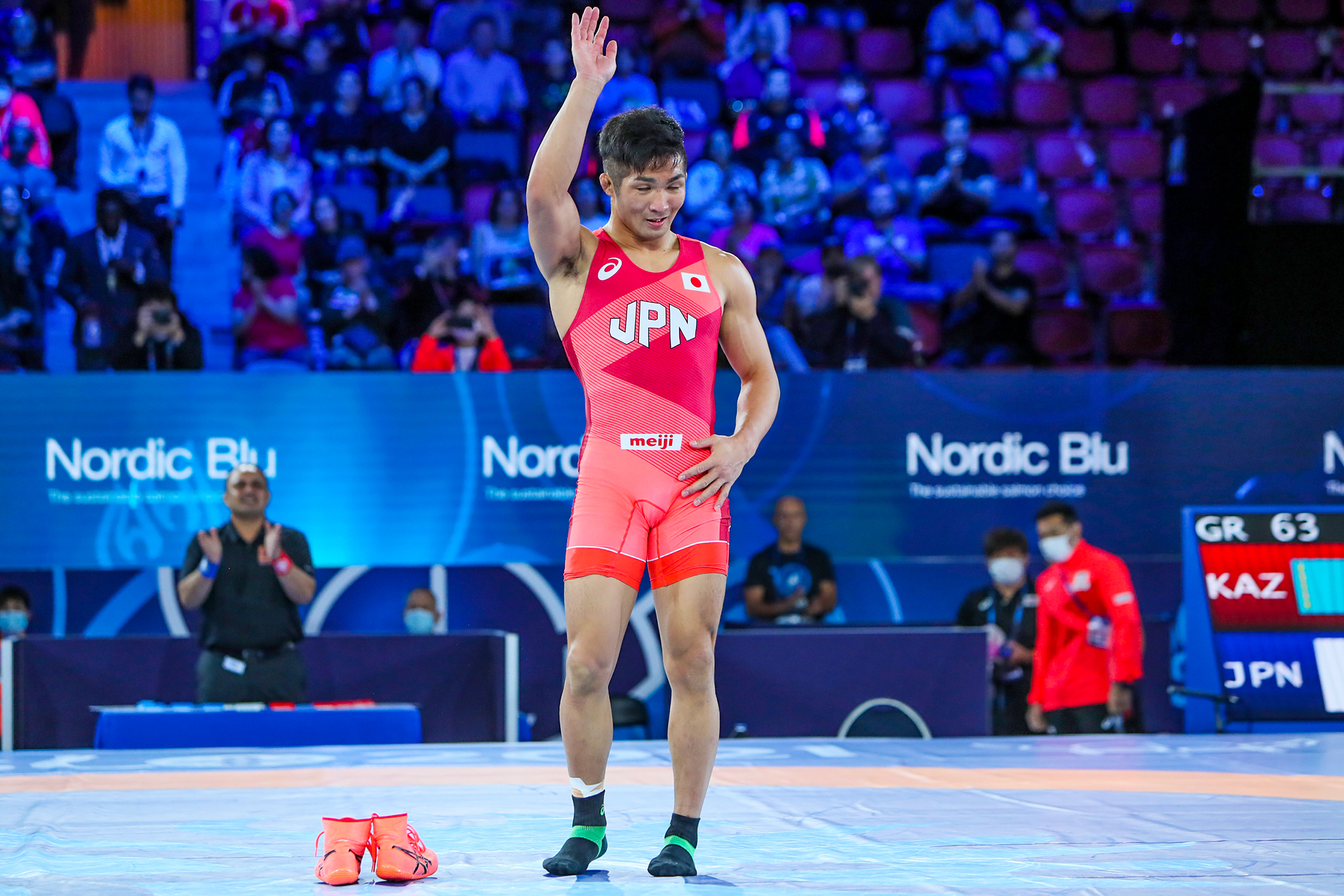 Tsuchika SHIMOYAMADA (AUS) had left his shoes on the mat during the 2021 World Championships to mark his retirement. (Photo: United World Wrestling / Martin Gabor)
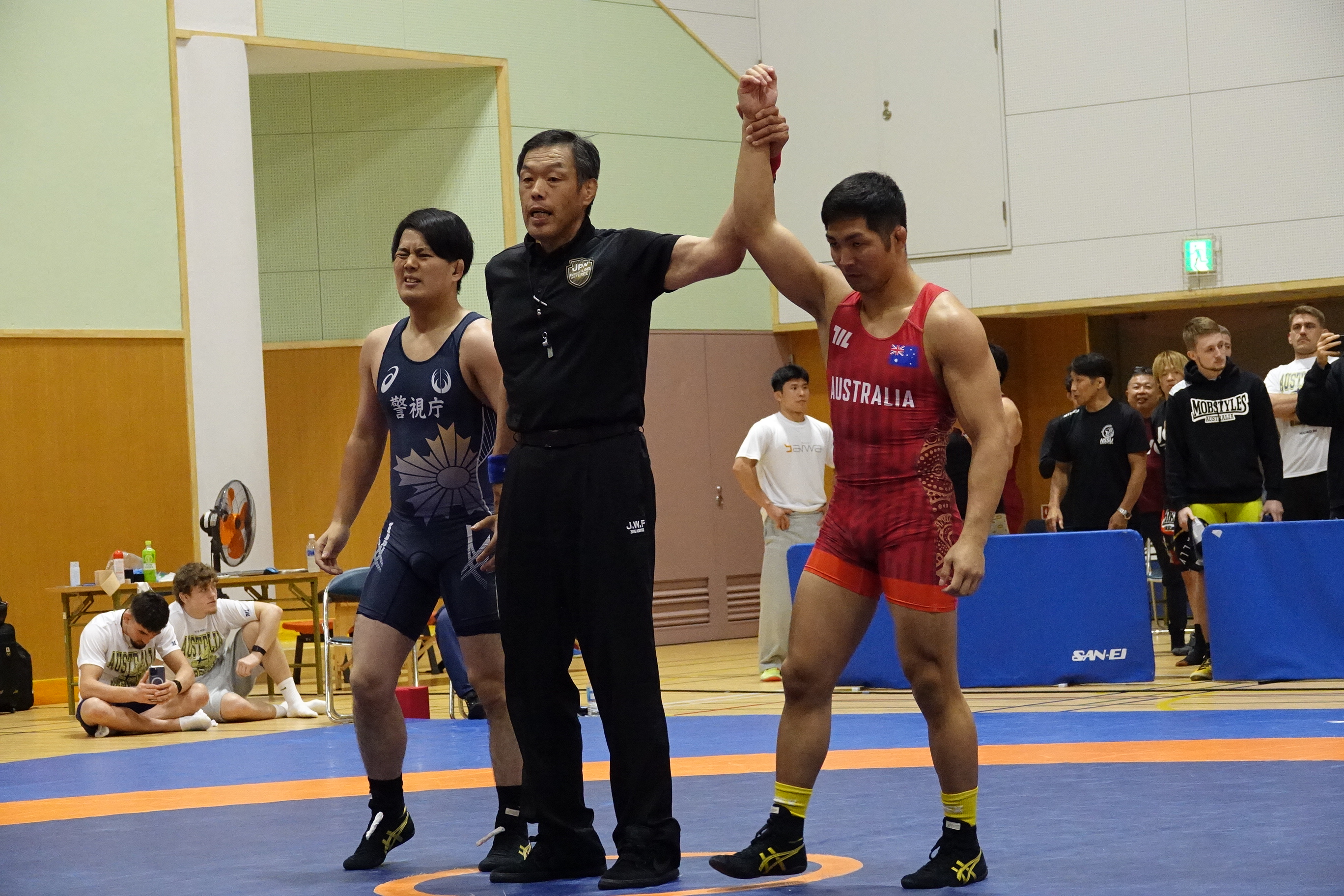 Tsuchika SHIMOYAMADA advances to the semifinals at the All-Japan Non-Student Championships in July with a 52-second win over Kokoro GOTO. (Photo: Koji Fuse / wrestling-spirits.jp)
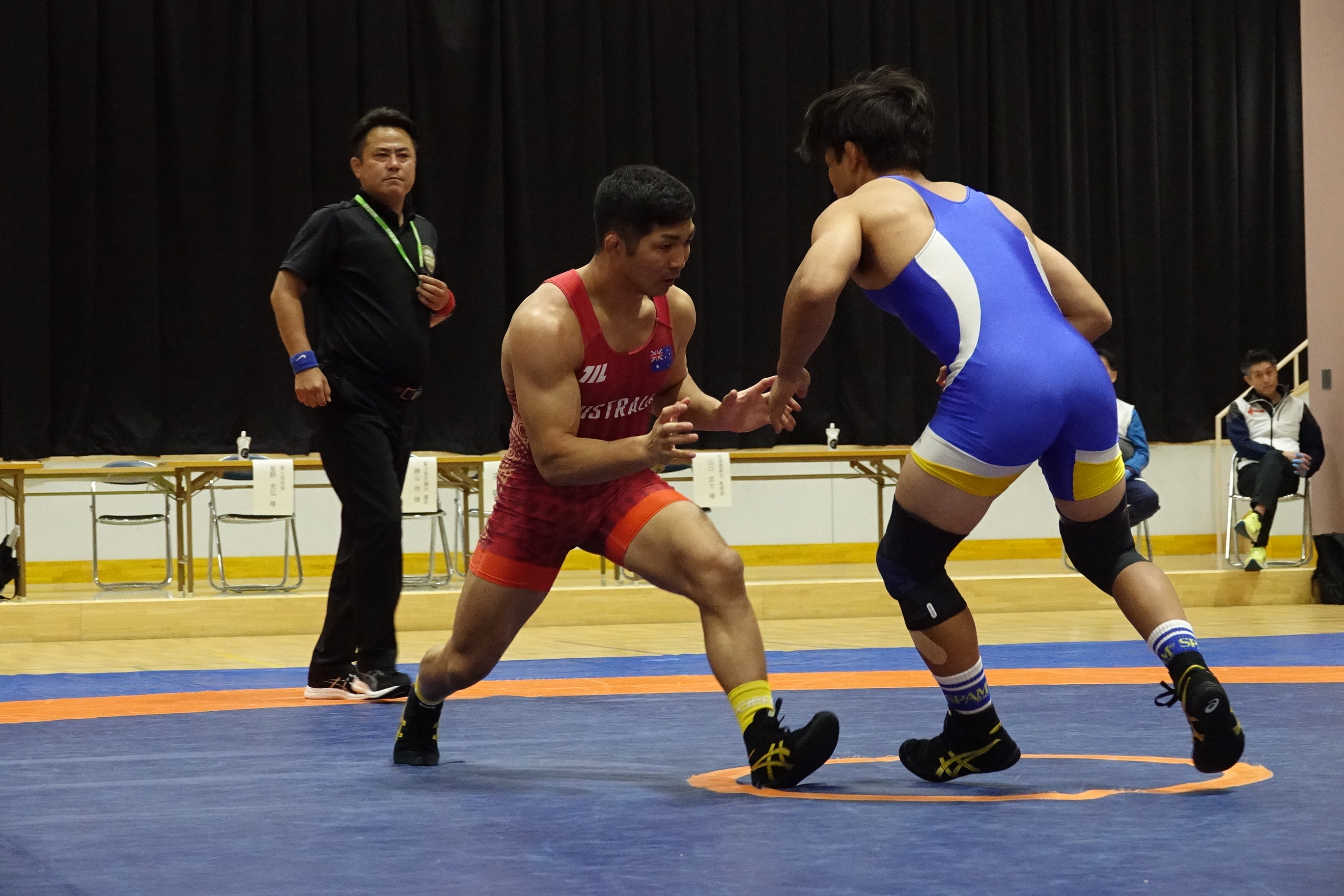 Tsuchika SHIMOYAMA faces Keitaro ONO in his opening match at the All-Japan Non-Student Championships in July. (Photo: Koji Fuse / wrestling-spirits.jp)
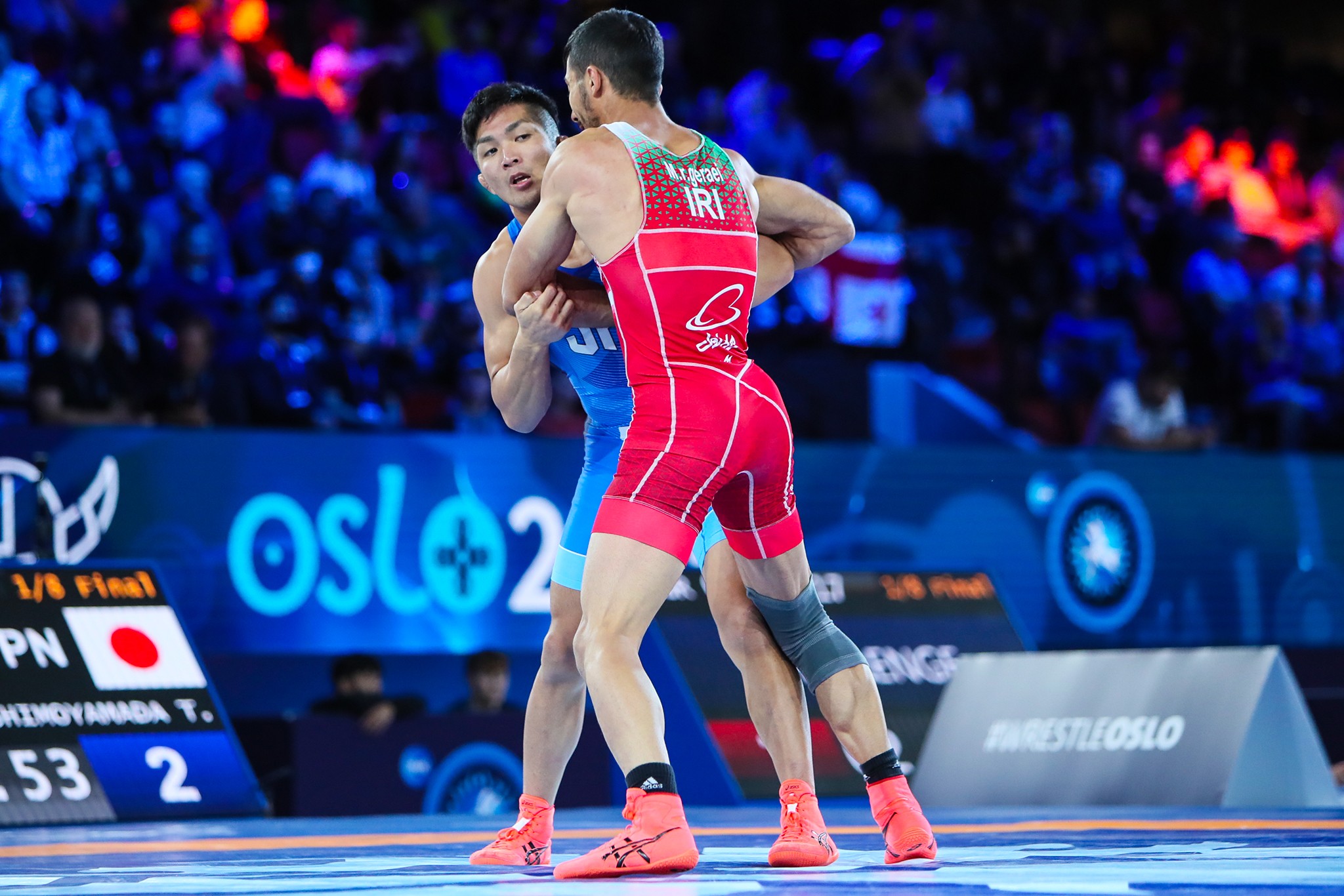 Tsuchika SHIMOYAMADA (AUS) was dominating Mohammadreza GERAEI (IRI) in their match at the 2021 World Championships before being pinned. (Photo: United World Wrestling / Martin Gabor)
Share your thoughts.
Comments