CORALVILLE, IOWA, United States (May 5) -- Eight years of dominance at the Pan-American Championships.
That is the standard the United States has set on the continental stage, winning team titles in freestyle, Greco-Roman, and women’s wrestling at every edition of the tournament since 2018.
There is little reason to expect 2026 to be any different.
A powerful U.S. squad will headline the home edition of the 2026 Pan-American Championships, which runs May 7-10 in Coralville, Iowa, United States.
DOWNLOAD FULL PREVIEW HERE | HOW TO WATCH | PAN-AM ENTRIES

World and defending champions Zahid VALENCIA (USA) at 86kg and Trent HIDLAY (USA) at 92kg will lead the 30-member squad that also features world silver medalist Levi HAINES (USA) at 79kg, Real WOODS (USA) at 65kg, and local star Stephen BUCHANAN (USA) at 97kg.
Valencia, who won the world gold in 2025, opened his season this year at the Zagreb Open Ranking Series, winning a bronze medal. He looks to return to the top of the podium in Coralville like did at his previous two Pan-Am Championships. Valencia has won six bouts overall without much trouble and outscored his opponents 32-0 last year.
He is likely to win the gold medal this year as well and extend his unbeaten run in the continent unless returning silver medalist Jorge LLANO (ARG) can avenge his loss from last year.
Past medalist Ethan RAMOS (PUR) will be returning to Pan-Ams after four years and has a good chance to finish on the podium. Kevin DE LEON TREVINO (MEX), bronze medalist last year, is also returning with an aim to change the color of his medal.
The 92kg bracket has only four wrestlers so Hidlay will have to win three bouts to retain his gold medal. Joining him are returning silver medalist Andrew JOHNSON (CAN), Brazil's rising star Lucas ALVAN (BRA) and last year's silver medalist at 79kg Shane JONES (PUR) who is not at 92kg.
Similarly at 79kg, it will be a round-robin bracket with Haines as the favorite. Haines, who won the world silver in Zagreb with some incredibly high-paced wrestling, can face some resistance from Patrik LEDER (CAN) in an otherwise smooth sail.
A rematch of the World Championships bronze-medal bout is on the cards at 65kg as world bronze medalist Woods and fifth-placer Peiman BIABANI (CAN) are entered. Woods defeated Biabani in Zagreb but the Canadian has the arsenal to counter Woods especially in a rematch.
At 125kg, Wyatt HENDRICKSON (USA) will be returning to defend his gold medal which he won in spectacular manner, using a five-point throw and a fall.
Paris Olympian Jonovan SMITH (PUR), youngster Jorawar DHINSA (CAN) and 37-year-old returning bronze medalist Jose DIAZ ROBERTTI (VEN) will be among the challengers for Hendrickson.
Buchanan, who grabbed wrestling headlines after beating Hassan YAZDANI (IRI) at the Zagreb Open, will start at 97kg. It will be only his second international competition. Returning silver medalist Arturo SILOT TORRES (CUB) will hope to win the gold medal over Buchanan in front of the American's home crowd.
Among other competitors are Nishan RANDHAWA (CAN), Edwin MORALES (PUR) and Cristian SARCO COLMENAREZ (VEN).
At 74kg, Geannis GARZON TAMAYO (CUB) will look to make amends after being disqualified last year for brutality. However, U20 Pan-Am champion Phillip WEBSTER (USA) stands in his way.
Adam THOMSON (CAN) has made steady improvements in his career and won bronze last year. The Canadian and former medalist Jonathan PARRILLA RAMOS (PUR) have a good chance of finishing on the podium.
Two of the three weight classes in which the U.S. did not win the gold medal last year were 57kg, and 70kg. (The third was 65kg).
But this year, 57kg is missing defending champ Roman BRAVO YOUNG (MEX), leaving the category wide open. The entries this year include returning bronze medalists Liam CRONIN (USA) and Edwin SEGURA GUERRA (GUA) and former silver medalists Darian CRUZ (PUR) and Pedro MEJIAS RODRIGUEZ (VEN).
At 70kg, with 2025 gold medalist Austin GOMEZ (MEX) retiring, a new champion will be crowned. The U.S. is sending Ridge LOVETT (USA) who finished eighth at the 2026 Muhamet Malo Ranking Series.
Other entries include former medalist Mauricio LOVERA (ARG), Michael ZALE (CAN), Francisco GONZALEZ TORRES (MEX) and youngster Victor SOTO RIVERA (PUR).
At 61kg, Austin DESANTO (USA) will fancy his chances of winning gold in a round-robin bracket. Desanto began his year with a gold medal at the Zagreb Open Ranking Series after winning the round-robin bracket in which he also pinned AMAN (IND).
He will be joined by Garette SAUNDERS (CAN), Peter HAMMER CUDE (CRC) and Caleb SMITH (PUR) in the bracket.
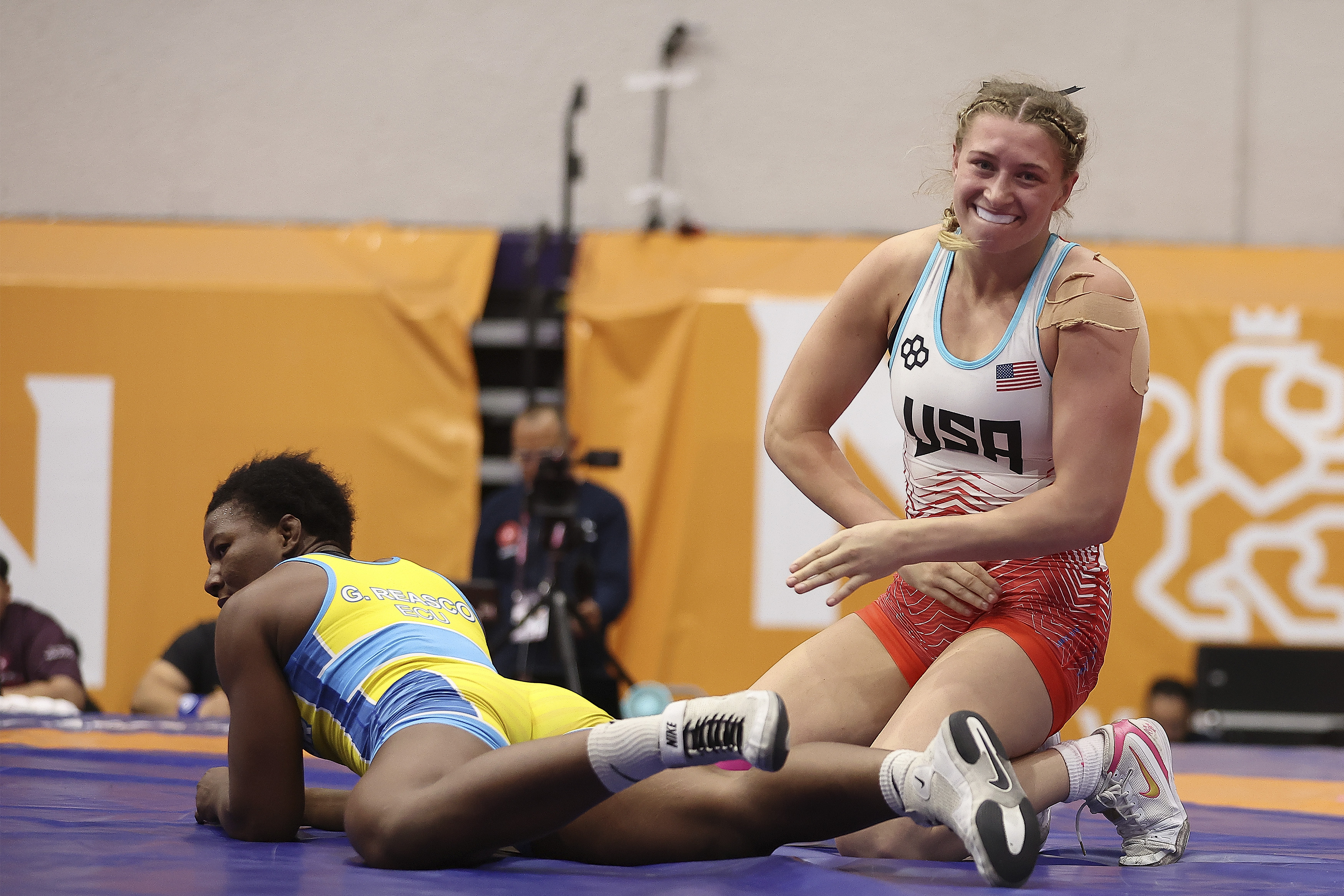 Defending champion Kylie WELKER (USA) and world champion Genesis REASCO (ECU) are expected to meet in the 76kg final. (Photo: United World Wrestling / Osvaldo Aguilar)
Women's Wrestling (DOWNLOAD FULL PREVIEW HERE)
The 76kg division has produced a different champion at each of the last six Pan-American Championships. Three of those title winners will compete again in Iowa. While several weight classes at the Pan-Ams appear predictable on paper, 76kg stands out as the division to watch.
Defending champion Kylie WELKER (USA) will likely have a face-off against world champion Genesis REASCO (ECU) who she defeated in the semifinals last year. The two can only meet in the final as both are seeded on opposite sides.
The Paris 2024 Olympic bronze medalists Tatiana RENTERIA (COL) and Milaimy MARIN (CUB) are also entered for the competition. Renteria has lost two Pan-Am finals and is returning to the tournament after two years. Marin, who won the 2023 title by beating Renteria in the final, will also be eyeing her second title.
Another Olympic medalist in action is Lucia YEPEZ GUZMAN (ECU) who has been a force at 53kg for some years, and she recently won silver at the World Championships.
The U.S. is sending former U20 world champion Cristelle RODRIGUEZ (USA) who has not had similar success at the senior level but is still a tough competitor. Former U23 world silver medalist Serena DI BENEDETTO (CAN) will also look to reach the podium and challenge Guzman and her bid for a fourth Pan-Am title.
At 57kg, defending champion Yaynelis SANZ (CUB) will return in a packed bracket featuring former champion Giullia PENALBER (BRA), veteran Luisa VALVERDE (ECU), Amanda MARTINEZ (USA), Bertha ROJAS CHAVEZ (MEX) and 55kg champion Karla GODINEZ (CAN) who is now at 57kg.
At 62kg, there will be a new champion as the 2025 gold medalist Ana GODINEZ (CAN) has decided to skip the tournament. Returning silver medalist Astrid MONTERO (VEN) will fancy her chances but the bracket has former champion Lais NUNES (BRA) and returning bronze medalist Melanie JIMENEZ (MEX) as well.
Adaugo NWACHUKWU (USA) will lead the U.S. challenge while Canada is sending Annika FINES (CAN).
The U.S. will hope that the 68kg gold stays with it despite last year's gold medalist Kennedy BLADES (USA) not part of the team. Former U20 world champion Jasmine ROBINSON (USA) will lead the charge in this weight class. Among the contenders are returning silver medalist Nathaly GRIMAN (VEN), returning bronze medalist Virginia JIMENEZ (CHI) along with Eduarda RODRIGUES (BRA) and Aleah NICKEL (CAN).
Former U17 world champion Katie GOMEZ (USA) has made a drastic but successful drop to 50kg as she earned a spot on the U.S. team last week. She will be looking for her first Pan-Am title in Coralville but adjusting to the weight will be a bigger challenge.
Returning silver medalist Madison PARKS (CAN) will definitely fancy her chances against Gomez and bronze medalist Nohalis LOYO (VEN) would like to change the color of her medal. Cuba is sending U23 Pan-Am champ Greili BENCOSME (CUB) who will hope for a podium finish.
In the non-Olympic weight classes, the U.S. has strong representation. U20 world champion and prodigious talent Everest LEYDECKER (USA) is the favorite at 55kg. She began the season with a gold medal at the Zagreb Open. She will be joined by Amber WIEBE (CAN) and Josefina RAMIREZ (MEX) in the bracket.
At 59kg, defending champion and world bronze medalist Laurence BEAUREGARD (CAN) will once again start as the favorite despite the presence of Daniela MARTINEZ (MEX), Abigail NETTE (USA) and Mayara RAMOS (BRA).
Former world silver medalist Kayla MIRACLE (USA) is back on the mat after a brief period in which she was out of action. She will have to win two bouts to confirm the gold medal at 65kg. Returning silver medalist Miki ROWBOTTOM (CAN) will try to find a way past Miracle and clinch the gold medal this year. They are joined by Alexis GOMEZ (MEX) in the bracket.
Ellise DAYNES (CAN), Michelle OLEA RUIZ (MEX) and Precious BELL (USA) complete the 72kg bracket for the Pan-Am Championships.
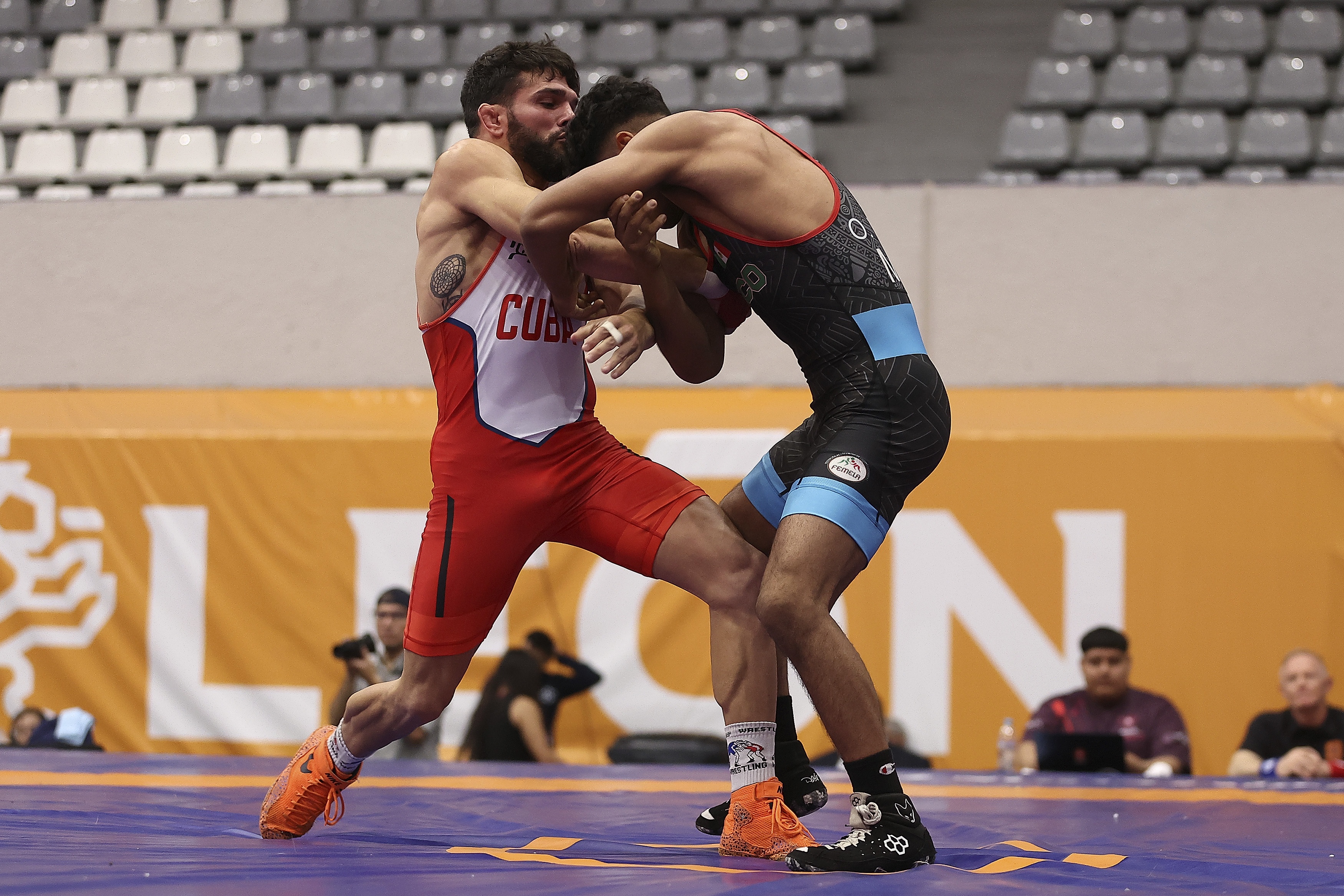 Luis ORTA (CUB) is a three-time Pan-American champion. (Photo: United World Wrestling / Osvaldo Aguilar)
Greco-Roman (DOWNLOAD FULL PREVIEW HERE)
Cuba has historically dominated Greco-Roman wrestling at the Pan-American Championships. Up until 2021, it routinely collected multiple gold medals, including clean sweeps of all weight categories in 1988, 1997 and 2005. However, following the COVID-19 pandemic in 2020 and 2021, the country struggled to maintain that level of dominance.
The dip was evident in 2020, when Cuba managed three golds. For any other country, that would be a successful campaign. However, for Cuba it was their worst performance since 2003. Since then, Cuba has not won more than three golds, hitting rock bottom in 2024 with just one gold.
Cuba is now hoping to reverse that trend. Led by Olympic and world champion Luis ORTA (CUB), Cuba will eye at least four golds in Coralville. Orta is among the three defending champs from Cuba returning along with Gabriel ROSILLO (CUB) and Oscar PINO (CUB).
Orta, a bronze medalist at the Paris 2024 Olympics, is a four-time Pan-American champion and remains unbeaten in the tournament. He will compete at 67kg in Coralville, where he is expected to extend that streak.
The weight also features returning silver medalist Nestor ALMAZA (CHI) and U23 world bronze medalist Otto BLACK (USA) making his Pan-Am debut. Other contenders include returning 72kg silver medalist Nilton SOTO (PER), 2023 bronze medalist Andres MONTANO (ECU) and Mauricio LOVERA (ARG), a former bronze medalist trying to do the Greco and Freestyle double again.
At 97kg, Rosillo enters as the defending champion and favorite. The 2023 world champion, who also won bronze in Paris, will look to add another continental title. His main rival remains Kevin MEJIA (HON), a three-time champion who defeated Rosillo in the 2024 final before finishing runner-up in 2025.
Returning bronze medalist Carlos ADAMES (DOM) and U23 Pan-Am champion Juan DIAZ (VEN), who is making his senior debut, add further depth to the field.
Pino is placed in a highly competitive 130kg category as he faces a tough challenge from Cohlton SCHULTZ (USA), last year’s silver medalist, and Paris 2024 Olympic silver medalist Yasmani ACOSTA (CHI), who returns after a two-year break.
Acosta defeated Pino in the 2024 final while Zagreb Open champion Schultz pushed him close in 2025. Gino AVILA (HON), who won bronze medals last year in both Freestyle and Greco-Roman, will be wrestling only Greco this year.
Cuba will hope for golds in other weight classes as well and the biggest hope will be four-time 87kg champion Daniel GREGORICH (CUB), who turns 30 on the first day of the competition.
However, 2025 82kg champion Beka MELELASHVILI (USA) will be the biggest hurdle as he brings the European style to the mat and Gregorich, away from international wrestling for two years, will have to adjust quickly.
Others in the bracket include returning silver medalist Luis AVENDANO (VEN) who also lost to Gregorich in the 2023 final, returning bronze medalist Jose VARGAS (MEX) and Johan BATISTA (DOM), a silver medalist from 2022 after losing to Gregorich in the final.
At 60kg, Paris Olympian Kevin DE ARMAS (CUB) makes his Pan-Ams debut and faces returning silver medalist Alexis RODRIGUEZ (MEX), 2023 champion Dalton ROBERTS (USA) and age-group Pan-Am champion Abel SANCHEZ (PER).
With no Cuban entry, the 77kg category is wide open. Former U17 world champion Joel ADAMS (USA) leads the U.S. challenge but will have experienced wrestlers like Joilson DE BRITO (BRA), a former silver medalist and returning to competition after two years, in the bracket.
Two age-group stars Dario CUBAS (PER) and Darfel PARADA (VEN) will make their senior debuts in Coralville and are medal threats.
Big-throwing Kamal BEY (USA) will be at 82kg and with Diego MACIAS (MEX) as the only other wrestler in the category, the two will face directly for gold.
Returning to international wrestling after four years, 36-year-old Max NOWRY (USA) will look to win his fourth Pan-Am title to go along with his golds in 2013, 2019 and 2020.
The other three in his 55kg bracket are at least 14 years younger to Nowry. Yan LANDIM (BRA), Moises PERALTA (ECU) and returning silver medalist Isaac MARIN (MEX) will be the ones challenging the veteran Nowry.
Returning 63kg champion Jeremy PERALTA (ECU) has 41-year-old Marat GARIPOV (BRA) in the same bracket along with U23 Pan-Am champion Angel SEGURA (MEX) and two senior debutants Derick MARTINEZ (PUR) and Landon DRURY (USA).
A round-robin will decide the champion at 72kg as Mauri VICENTE (BRA), Emerson FELIPE (GUA) and Benjamin PEAK (USA) complete the bracket.



Share your thoughts.
Comments