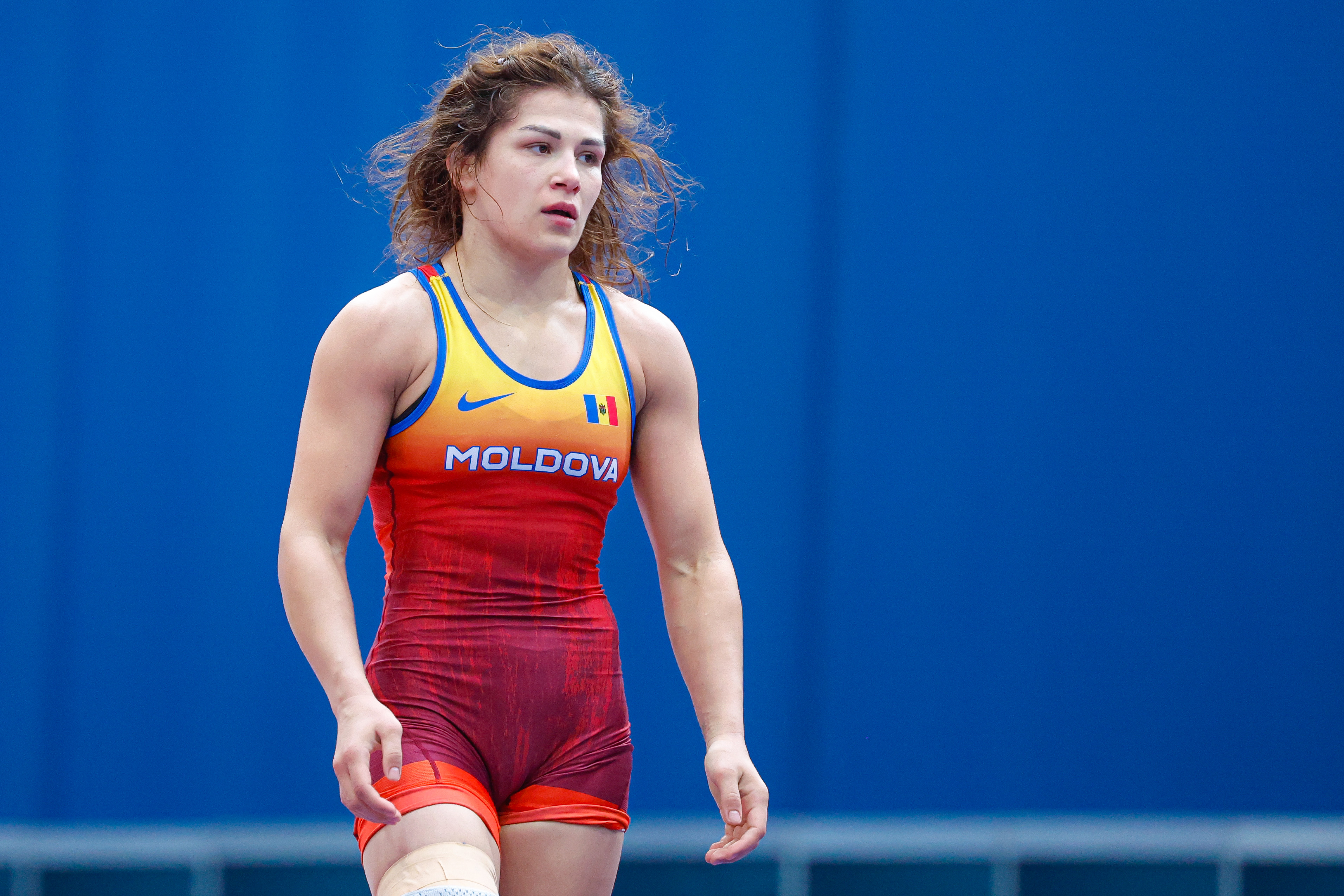
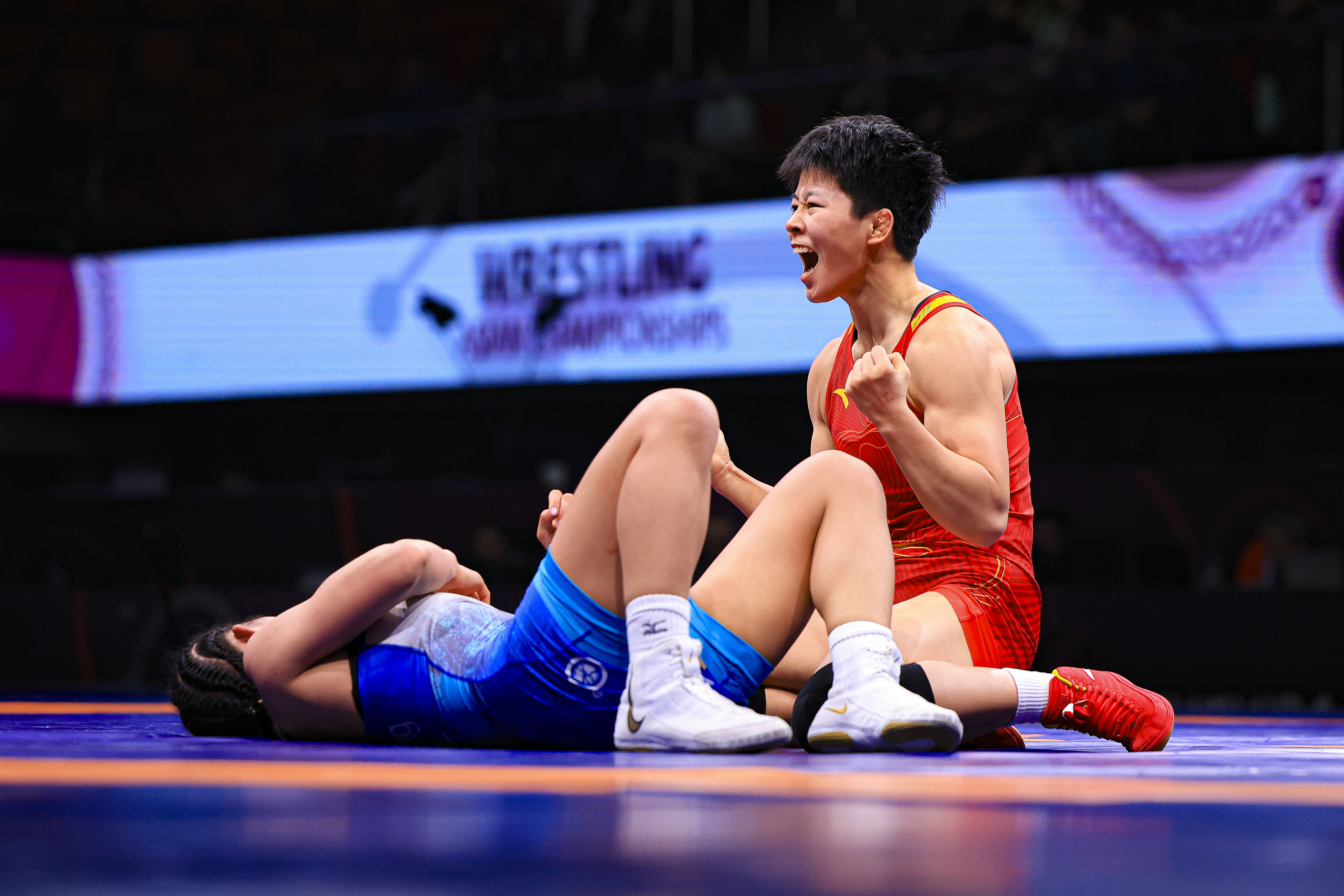
#WrestleParis

Women's Wrestling at Olympics: 20 years strong

By United World Wrestling Press

PARIS (July 8) -- Inside an academy located in the middle of a farm at a village in Haryana, the northern Indian state that’s the country’s wrestling capital, a bunch of teenage girls had scribbled the name of their hero on a wall – Helen MAROULIS (USA).

When women’s wrestling made its Olympic debut, some of these girls were not even born. There were no roads leading up to the academy where they trained until a few years ago — the best way to reach the academy was on foot from the nearest highway exit point roughly a couple of miles away. And internet connectivity was patchy at best.

Yet, the story of Maroulis’s dominance had traveled to this far-flung village and became a part of the folklore. Few stories illustrate better the impact and the reach of women’s wrestling.

In less than three weeks, the eyes of the entire sporting – and wider – world will be fixed on Paris when the Olympic Games get underway. On the mat at the Grand Palais Éphémère in Champ de Mars, more stories of inspiration will unfold, paving the way for many young wrestlers to follow in the footsteps of their heroes.

At the Paris Olympics, women's wrestling will celebrate its 20th year of being at the Games. Back in 2004, when it was included in Athens, there were only four categories. In Paris, as was the case in Tokyo, there will be six — the same as Freestyle and Greco-Roman.

The 2024 Games will also be significant for the officials. As many as 11 female referees will be part of the officials. Back in 1988, it was only one.

AthensWomen's Wrestling at the 2004 Athens Olympic Games. (Photo: United World Wrestling / Martin Gabor)

Wrestling at the Paris Olympics will also be a symbolic occasion given the key role France played in the evolution of the women’s game. It was at Pas-de-Calais where women’s wrestling took one of its first steps. A club in Calonne-Ricouart was the first to open its doors to women in 1971.

From this tiny space in a region roughly three hours from Paris, women’s wrestling spread in other parts of France before it became a popular activity in the rest of the world.

The seeds that were sown in France have blossomed in countries across the world. As women’s wrestling traveled to Beijing, London, Tokyo and now arrives in Paris – following the journey that began in Athens – it left behind immaculate footprints for young, aspiring children to follow.

Tayla FORD (NZL)Tayla FORD (NZL) is the first wrestler from New Zealand who will compete at the Olympics. (Photo: United World Wrestling / Amirreza Aliasgari)

Next month, when the competition gets underway in the French capital, history will be in the offing as Tayla FORD (NZL) will become the first female wrestler from her country to make it to the Olympics.

Ford’s story is one of sheer perseverance, not just hers but even of those around the wrestler. Her father, a high school wrestler, got Ford into wrestling after it was included in the Olympics programme. He had a mat installed in their garage and every day, the father and daughter trained.

In a way, Ford’s story is similar to the wrestlers from the Olympic women’s wrestling’s undisputed powerhouse, Japan.

The queen of wrestling, Saori YOSHIDA (JPN), began her journey in the same way. Before she went on to win every title there was to win – three Olympic gold medals, 13 World Championship titles, four Asian Games and Asian Championship gold medals each – Yoshida learnt the art at home.

Her father built a dojo at home where Yoshida, began to wrestle before she could even run properly. The rest, as they say, is history. The rise of Kaori ICHO (JPN), who went 13 years without a loss, followed a similar arc. And so do the stories of the other Japanese women, from Risako KAWAI to Yui SUSAKI.

Not to forget Icho, who won four gold medals at the Olympics, becoming the first Olympic athlete to win four golds in the same individual sport.

In Athens 20 years ago, Japan won only 2 gold medals. Since then, they have won 13. This level of dominance is rare to see in any sport. One of the few countries that’s consistently come close to challenging Japan’s dominance, and been a thorn in their flesh when it comes to a clean sweep of gold medals, is the USA.

Remarkably, the USA did not even compete at the World Championships until 1989, two years after the first edition for women took place. But once they landed on the scene, they took everyone by storm.

Afsoon JOHNSTON (USA) – who won a bronze medal – Asia DEWEESE (silver) and Leia KAWAII (silver) finished on the podium in 1989 and became sort of the pioneers of women’s wrestling in the US. Since then, there hasn’t been a time when the athletes from the Olympic powerhouse haven’t been among the medals.

The rise of women’s wrestling in the US is also a fascinating story, with nearly 50,000 girls competing in high school championships last year. Those young girls saw the wrestling stars from the country on television and decided to tread the same path they’d chosen.

A major reason for the surge in popularity in the US has been wrestlers like Maroulis. Her gold medal at the Rio Olympics in 2016 – the first American woman to achieve that feat – is seen as one of the big milestones that gave the sport a massive push.

Maroulis’s feat didn’t just inspire children in the US. The story traveled the world over, including a remote village in India. If anything, it showcased the sport’s transcending influence.

#WrestleZagreb

Zagreb Open: Ozaki, Morikawa Mark Golden Return to Olympic Weights

By Vinay Siwach

ZAGREB, Croatia (February 7) -- Just four months ago, Nonoka OZAKI (JPN) came to Zagreb as a training partner with Miwa MORIKAWA (JPN) at the World Championships.

While Morikawa won the gold medal, Ozaki cheered for her close friend, even writing messages for her on a small bandage that Morikawa put on her cheek.

Back then, Ozaki wished she could compete and become world champions together.

Not the World Championships, but Ozaki and Morikawa won gold medals at the Zagreb Open Ranking Series event on Friday. Ozaki completed a dominant run to win the 62kg title while Morikawa had a bumpy ride to the 68kg gold medal, a weight class above 65kg in which she won the world gold.

"We managed to win gold with the star of Physical Asia," Morikawa wrote on social media referring to a Netflix show in which Ozaki participated.

The two do not train at the same university in Japan but the closeness of their weight classes has allowed them to practice together whenever they get a chance, including being on international tours together.

They were two of the four Japanese wrestlers who won gold medals in Women's Wrestling, joining Sena NAGAMOTO (JPN) at 59kg and Nana IKEHATA (JPN) at 65kg.

Greco-Roman also kicked off at the Zagreb Open, the season-opening Ranking Series event, and the world champion at 63kg Aytjan KHALMAKHANOV (UZB) showed that he has adjusted to the Olympic weight class 67kg, winning gold.

Iran won gold at 63kg after Erfan JARKANI (IRI) defeated CHETAN (IND) in the final.

Ozaki began her day by securing a fall over Irina KUZNETSOVA (KAZ) after building a 12-2 lead, and then pinned Eniko ELEKES (HUN) in the second bout to book a spot in the semifinal.

It was in this bout that Ozaki faced her first struggles of the day against Macey KILTY (USA). Though she ultimately secured a 5-2 win, Ozaki gave up positions against the American wrestler. She would later admit that it was not easy to keep herself calm during the bout.

In the final against Johanna LINDBORG (SWE), a silver medalist from the European Championships, Ozaki scored four different takedowns and looked in complete control. With the 8-0 win, Ozaki won her first Ranking Series gold medal.

Ozaki won the world title at 65kg in 2023 but was a phenom at 62kg when she emerged on the international scene in 2022. But after a slump in form both in Japan and internationally, she missed out on making the Japan team for the 2023 World Championships at 62kg.

However, with Ami ISHII (JPN) qualifying Japan for the 2024 Paris Games without winning a medal opened a door for Ozaki to be at the Olympics.

Ozaki set out on a daunting task of moving to 68kg and not only did she defeat Ishii while being underweight, she managed to win a bronze medal at the Paris Olympics.

Soon after, she decided to move back to 62kg but suffered two back-to-back heartbreaking losses to Olympic champion Sakura MOTOKI (JPN) and failed to make the 2025 world team.

It turned around at the Emperor's Cup in December 2025 as Ozaki avenged her loss to Motoki and earned the right to participate in the Zagreb Open and Asian Championships in April.

Miwa MORIKAWA (JPN)Miwa MORIKAWA (JPN) scores a takedown on Nesrin BAS (TUR) during the 68kg final. (Photo: United World Wrestling / Amirreza Aliasgari)

Morikawa, who also moved to 68kg after winning gold at 65kg at the World Championships in 2025, had a hiccup in the final, but managed to get the gold medal against Nesrin BAS (TUR).

The two-time world champion captured her third Ranking Series gold medal and first since 2018 but not before having a tough time on the mat. She began with an 11-0 win over Kateryna ZELENYKH (ROU) and then a 10-0 technical superiority over Alina SHEVCHENKO (UWW).

While the fall over Aleah NICKEL (CAN) in the semifinals was dominant, Morikawa did show some signs of discomfort. That showed up in the final against Bas as Morikawa fell behind 2-0 in the first period. She managed to score a point before the break and cut the lead to 2-1.

Morikawa found a way to score two takedowns in the second period to take a 5-2 lead to capture the gold medal at 68kg.

Bas, who was at the Paris Olympics at 62kg but won world silver medal in 2025 at 72kg, was another wrestler trying to adjust to a new weight class. Her biggest test came in the semifinal against Olympic silver medalist Kennedy BLADES (USA).

Blades led 1-0 at the end of the first period but  Bas seemed unfazed. The American was put on the shot clock in the second period and after 30-second activity time exchanged, Bas took a 1-1 criteria lead. Bas also got a point for stepout to make it 2-1.


She then defended the lead until the end of the time to claim a victory over Blades and a spot in the final against Morikawa. Bas is likely to continue at the weight and the silver medal in Zagreb will be a huge boost for her going forward.

Khalmakhanov adjusts to 67kg

Another star wrestler shifting to an Olympic weight class was 63kg world champion Khalmakhanov and he performed strongly at 67kg. His first battle came in the semifinal when he faced Kyotaro SOGABE (JPN).

But an arm-throw and turn gave him a 6-0 lead against Sogabe who got a few stepouts in the bout. Khalmakhanov scored two correct throws to add four more points in the bout and got one point for a lost challenge to win 11-5.

From the other side of the bracket, Diego CHKHIKVADZE (GEO) made it to the final after beating Katsuaki ENDO (JPN), 11-3, in the semifinals.

For the gold medal, Khalmakhanov and Chkhikvadze were matched evenly. While the scoreline points to a low-scoring bout, both wrestlers left it all on the mat.

Chkhikvadze was the first to get par terre but he failed to score any more points from the position and led 1-0 at the break. Khalmakhanov also got a point for the par terre position in the second period but Chkhikvadze held criteria.

The Georgian managed to score a stepout to extend his lead to a clear 2-1 score. But as the bout grew in intensity, it was Chkhikvadze who suffered, giving up a stepout with less than 30 seconds left.

With the score at 2-2, Khalmakhanov held criteria for the last point scored. He managed to hold his lead and won the gold medal in Zagreb, thus making a smooth transition to the Olympic weight class, three months after winning bronze at the Islamic Solidarity Games at 67kg.

RESULTS

Women's Wrestling

59kg
GOLD: Sena NAGAMOTO (JPN) df. Alexis JANIAK (USA), 10-0

BRONZE: Elena BRUGGER (GER) df. Hiunai HURBANOVA (AZE), via fall (7-0)
BRONZE: Abigail NETTE (USA) df. Iris SLATKA (CRO), via fall (10-0)

62kg
GOLD: Nonoka OZAKI (JPN) df. Johanna LINDBORG (SWE), 8-0

BRONZE: Macey KILTY (USA) df. Eniko ELEKES (HUN), via fall
BRONZE: ANJLI (IND) df. Bhagyashree FAND (IND), 5-4

65kg
GOLD: Nana IKEHATA (JPN)
SILVER: PULKIT (IND)
BRONZE: Kriszta INCZE (ROU)

68kg
GOLD: Miwa MORIKAWA (JPN) df. Nesrin BAS (TUR), 5-2

BRONZE: NISHA (IND) df. Kennedy BLADES (USA), via inj. def. 
BRONZE: Alina SHEVCHENKO (UWW) df. Aleah NICKEL (CAN), 9-0

Greco-Roman

63kg
GOLD:  Erfan JARKANI (IRI) df. CHETAN (IND), 8-4

BRONZE: Vitalie ERIOMENCO (MDA) df. Khusniddin OLIMBOEV (UZB), 6-1
BRONZE: Meysam DALKHANI (IRI) df. Dastan ZARLYKHANOV (KAZ), 8-0

67kg
GOLD: Aytjan KHALMAKHANOV (UZB) df. Diego CHKHIKVADZE (GEO), 2-2

BRONZE: Kyotaro SOGABE (JPN) df. Valentin PETIC (MDA), 5-0
BRONZE: Katsuaki ENDO (JPN) df. Mahmoud KAMALI (IRI), 3-2