

Weekly FIVE! February 25, 2020
Tuesday, February 25, 2020 - 13:23 By Eric Olanowski

1. Otoguro Dominates in Rematch With Punia for 65kg Asian Gold
Former world champion Takuto OTOGURO (JPN) came out on top quite convincingly in the rematch on his rival’s home soil. Whether he can repeat it back in his own country—when it would matter most---is a matter for another time.
Otoguro effectively used a low-single attack to grind out a 10-2 victory over Bajrang PUNIA (IND) in the freestyle 65kg final at the Asian Championships on Saturday night in New Delhi.
The victory in the highly anticipated rematch of the final at the 2018 World Championships, in which Otoguro rambled to with a wild 16-9 win, gives the young Japanese a confidence boost heading toward the Tokyo Olympics—particularly taking into consideration his disappointing fifth-place finish at last year’s worlds in Nur-Sultan.
“Last year, I feel like I was only losing and I went through various experiences,” Otoguro said. “From now, this is an Olympic year, and I feel I’ve gained some momentum. But I still have room to improve. How strong I can get from here, I’m also looking forward to finding out.”
Punia, a bronze medalist in Nur-Sultan, was looking to defend the Asian title he won last year in Xi’an, China. But he had no answer for Otoguro’s attacks and counters, as the Japanese put the match away with seven unanswered points in the second period.
Asked about his low-single approach, Otoguro replied, “When I shot for the low single, his leg was sweaty, so I went for his shoe so I wouldn’t slip off.”
Punia was not immediately available for comment, but his personal coach, Shako Bentinidis, said people should not read into the loss too much.
“I am happy with the silver medal today,” Bentinidis said. “Sometimes it is possible for him to lose, but not at Olympics. I think this is no problem. Better to lose now before Olympics.”
Bentinidis issued a warning to the Indian media, saying, “We must stay relaxed, and not so much ‘Bajrang, Bajrang.’”
For the 21-year-old Otoguro, it was his first continental championship since winning the Asian cadet crown in 2014. He said that heading into the Tokyo Olympics, he is undecided if he will enter an overseas tournament, and is leaning toward attending a training camp abroad.
One thing he knows is that since winning the 2018 world title, which made him Japan’s youngest-ever world freestyle champion, his rivals are looking for holes in his game to exploit.
“Of course, I feel that others have been studying me,” he said. “I really felt it over the last year. Since then, I have been making adjustments looking ahead to the Olympics.”
Click HERE to read Ken Marantz’ Day Five Freestyle wrap
Click HERE to read Ken Marantz’ Day Six Freestyle wrap
Freestyle
57kg - Kumar RAVI (IND) df. Hikmatullo VOHIDOV (TJK), 10-0
61kg - Ulubek ZHOLDOSHBEKOV (KGZ) df. Muhammad IKROMOV (TJK), via fall
65kg - Takuto OTOGURO (JPN) df. Bajrang PUNIA (IND), 10-2
70kg - Ilyas BEKBULATOV (UZB) df. Amirhossein HOSSEINI (IRI), 10-6
74kg - Daniyar KAISANOV (KAZ) df. Jitender JITENDER (IND), 3-1
79kg - Arsalan BUDAZHAPOV (KGZ) df. Baliyan GOURAV (IND), 7-5
86kg - Shutaro YAMADA (JPN) df. Ahmad BAZRIGHALEH (IRI), 10-10
92kg - Mohammadjavad EBRAHIMIZIVLAEI (IRI) df. Takuma OTSU (JPN), 11-0
97kg - Mojtaba GOLEIJ (IRI) df. Salywart KADIAN (IND), 10-0
125kg - Yusup BATIRMURZAEV (KAZ) df. Khuderbulga DORJKHAND (MGL),10-0
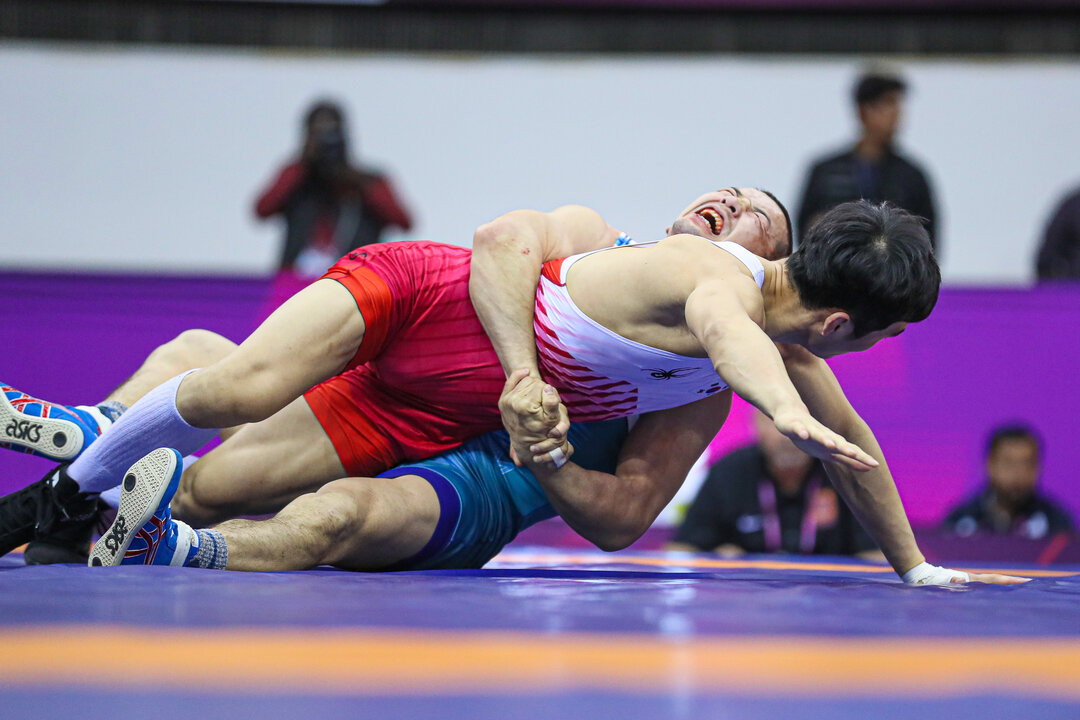 Elmurat TASMURADOV (UZB) turns SONG Jinseub (KOR) in the 63kg finals of the Asian Championships. (Photo: Kadir Caliskan)
2. Tasmuradov Puts Aside Pain, Korean Opponent to Chalk up 5th Asian Gold
How tough is Olympic bronze medalist Elmurat TASMURADOV (UZB)? He just won a fifth gold medal at the Asian Championships two weeks after breaking a rib.
“It’s still healing,” Tasmuradov said after demolishing SONG Jinseub (KOR) in the Greco-Roman 63kg final on the opening day of this year’s continental tournament Tuesday in New Delhi. “I wanted to go for a fall so that I wouldn’t have to do the par terre.”
In regaining the Asian crown he last won in 2018, Tasmuradov wasn’t able to secure a fall, but got the next best thing, scoring a 9-0 technical fall in 1:33 that included a big 4-point lift and gave him an eighth career Asian medal overall.
Tasmuradov was back at his regular weight at 63kg, where he said he felt more “comfortable,” after qualifying for this year’s Tokyo Olympics at 60kg by placing fifth at last year’s World Championships in Nur-Sultan.
The 2018 world silver medalist said missing out on a medal in Nur-Sultan was irrelevant, given that he achieved what he had set out to do.
“I planned to go and just qualify for Tokyo,” he said. “I didn’t aim to take a medal, because I’m not a young wrestler. So I went to just qualify and I did it.”
Asked to comment on earning his fifth Asian gold in the Indian capital, site of his first title in 2013 with a last-second win over Abdol PAPI (IRI), he replied, “I don’t feel anything,” he said. “My mind is just on the Tokyo Olympics.”
Tasmuradov lost a shot at winning his fifth title last May in Xi’an, China, when he suffered a severe back injury and had to default in the final to TUO Erbatu (CHN). The fact that he continued to wrestle until the pain became so intense he had to be helped off the mat showed the tenacity that has made him so successful – and allows him to shrug off a mere broken rib.
Click HERE to read Ken Marantz’ Day One Greco-Roman wrap
Click HERE to read Ken Marantz’ Day Two Greco-Roman wrap
Greco-Roman
55kg - Pouya NASERPOUR (IRI) df. Jasurbek ORTIKBOEV (UZB), 8-0
60kg - Kenichiro FUMITA (JPN) df. Zholaman SHARSHENBEKOV (KGZ), 4-0
63kg - Elmurat TASMURADOV (UZB) df. SONG Jinseub (KOR), 9-0
67kg - RYU Hansu (KOR) df. Makhmud BAKHSHILLOEV (UZB), 4-1
72kg - Almin KAVIYANINEJAD (IRI) df. Ibragim MAGOMADOV (KAZ), 8-0
77kg - Tamerlan SHADUKAYEV (KAZ) df. Pejman POSHTAM (IRI), 10-1
82kg - Mahdi EBRAHIMI (IRI) df. CHOI Junhyeong (KOR), 3-1
87kg - Kumar SUNIL (IND) df. Azat SALIDINOV (KGZ), 5-0
97kg - Mohammadhadi SARAVI (IRI) df. LEE Seyeol (KOR), 5-2
130kg - Amin MIRZAZADEH (IRI) df. KIM Minseok (KOR), 9-0
3. Akhmetova Amanzhol Snatches Victory From Jaws of Defeat to Stun Mukaida for 53kg Title
Tatyana AKHMETOVA AMANZHOL (KAZ) has been around long enough to know anything can happen in wrestling. But the miracle victory she pulled off left her as stunned as anyone.
Akhmetova Amanzhol was on the verge of losing by technical fall in the women’s 53kg final against world silver medalist Mayu MUKAIDA (JPN) when, on what would have been a decisive gut wrench, she stepped over and instead snatched a victory by fall and the gold medal on Friday at the Asian Championships.
“Still now, I can’t believe it because I was losing 8-0 and I could make a fall, so I’m happy,” said Akhmetova Amanzhol, who won her fourth career Asian title and first since winning back-to-back golds in 2013 and 2014.
“It’s the same as in 2013, the final was here in New Delhi,” said the 34-year-old mother of two young boys. “And also in that final match I was losing and I used the same technique, but the opponent was Chinese.”
Akhmetova Amanzhol’s gold was one of two captured by Kazakhstan as the final five titles in women’s wrestling were decided.
For Mukaida, the loss added to a history of squandered opportunities in major events. She lost in the final seconds of the final at the 2017 World Championships in Paris, then again in the final at last year’s Asian Championships.
What makes this loss doubly disappointing is that the 2018 world 55kg champion was an absolute dynamo in ripping through the competition in New Delhi. But it all came apart with one sudden lapse that she can only look at as a lesson learned heading to the Tokyo 2020 Olympics.
“From my first match, I kept my feet moving, and I feel my mobility was really good this tournament,” Mukaida said. “Even in [the final], I felt I was moving like I want to. But in the end, I was lax in trying to finish off the roll and it ended up as a fall.”
Up to that moment, Akhmetova Amanzhol had no answer as Mukaida used her trademark low single to score a takedown, then added a roll for a 4-0 lead. She then repeated the process to put her within two points of a technical fall.
Mukaida was on the verge of wrapping it up when she launched a gut wrench. But midway through the roll, Akhmetova Amanzhol managed to loosen the grip and step over Mukaida, who was stopped firmly on her back. The Kazakh only needed to clamp down to end the match at 1:48.
“I couldn’t think about what to do,” Akhmetova Amanzhol said of what her thought process was at 8-0 down. “But it’s wrestling. In wrestling, anything can happen.”
Even more amazing is that Akhmetova Amanzhol was competing despite nursing a right knee injury. “I was wrestling carefully because of my knee,” she said. “It might be because of this that the score was 8-0.”
Akhmetova Amanzhol, who took time off over the years for childbirth, was motivated to return by the desire to get back to the Olympics. She appeared at the Beijing 2008 Olympics, placing fifth at 48kg, and will try to earn a spot at the Tokyo Olympics at the Asian Olympic qualifier next month in neighboring Kyrgyzstan.
“My motivation is to wrestle in the Olympic Games because once I was in it before,” she said. “The Tokyo Olympics is motivation for me to return to wrestling and win the gold medal for my family, and dedicate it to my children and country.”
Click HERE to read Ken Marantz’ Day Three women’s wrestling wrap
Click HERE to read Ken Marantz’ Day Four women’s wrestling wrap
Women’s Wrestling
50kg - Miho IGARASHI (JPN) df. Devi NIRMALA (IND), 3-2
53kg - Tatyana AKHMETOVA AMANZHOL (KAZ) df. Mayu MUKAIDA (JPN), via fall
55kg - Pinki PINKI (IND) df. Dulguun BOLORMAA (MGL), 2-1
57kg - Risako KAWAI (JPN) df. Davaachimeg ERKHEMBAYAR (MGL), 10-0
59kg - Sarita SARITA (IND) df. Battsetseng ALTANTSETSEG (MGL), 3-2
62kg - Yukako KAWAI (JPN) df. Ayaulym KASSYMOVA (KAZ), 5-1
65kg - Naomi RUIKE (JPN) df. Sakshi MALIK (IND), 2-0
68kg - Divya KAKRAN (IND) df. Naruha MATSUYUKI (JPN), via fall
72kg - Zhamila BAKBERGENOVA (KAZ) df. Mei SHINDO (JPN), 2-1
76kg - Hiroe MINAGAWA (JPN) df. Aiperi MEDET KYZY (KGZ), 4-1
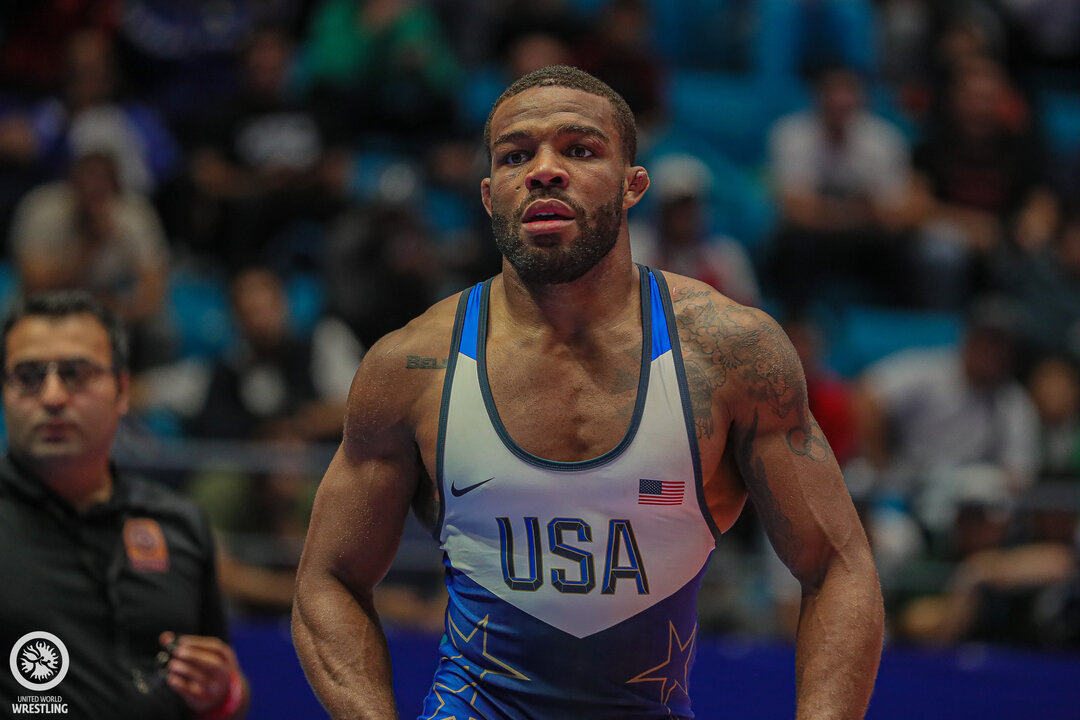 Jordan BURROUGHS (USA) is one of three returning champions entered into the Pan-American Championships. (Photo: Kadir Caliskan)
4. Pan-American Championships Closeout Continental Championship Season
After a full slate of continental championships in February, the party rolls on into March. The Pan-American Championships kick off March 6-9 in Ottawa, Canada, and will feature 192 athletes from 19 different nations wrestling -- including 16 returning gold medalists.
Olympic champion Ismael BORRERO MOLINA (CUB) leads a list of eight returning Greco-Roman champions into Ottawa.
America’s pair of reigning world champions Tamyra MENSAH (USA) and Adeline GRAY (USA) are two of the five 2019 gold medalists that highlight the women’s wrestling part of the competition.
And In freestyle, Anthony James ASHNAULT (USA), Jordan BURROUGHS (USA) and Kyle Frederick SNYDER (USA) return to the Pan-American championships looking to retain the titles they claimed a year ago.
SCHEDULE
Thursday (March 5)
17:00 - Draw GR – All weight categories
Friday (March 6)
08:30 - Medical examination & weigh-in GR – 55-60-63-67-72-97-130kg
10:30 - Qualification rounds & repechage GR – 55-60-63-67-72-97-130kg
14:00 - Technical conference – all WW teams
16:00 - Opening Ceremony
17:00 - Finals / Finales GR – 55-60-63-67-72-97-130kg Award ceremonies
Saturday (March 7)
8:30 - Medical examination & weigh-in GR – 77-82-87kg & WW – 55-59-65-72kg
10:30-13:30 Qualification rounds & repechage GR – 77-82-87kg & WW – 55-59-65-72kg
13:30 - Technical conference – all FS teams
17:00 - Finals - 77-82-87kg & WW – 55-59-65-72kg Award ceremonies
Sunday (March 8)
08:30 - Medical examination & weigh-in WW – 50-53-57-62-68-76kg & FS – 79-92kg
10:30 - Qualification rounds & repechage WW – 50-53-57-62-68-76kg & FS – 79-92kg
17:00 - Finals / Finales WW – 50-53-57-62-68-76kg & FS – 79-92kg Award ceremonies
Monday (March 9)
08:30 - Medical examination & weigh-in FS – 57-61-65-70-74-86-97-125kg
10:30 - Qualification rounds & repechage FS – 57-61-65-70-74-86-97-125kg
17:00 - Finals / Finales FS – 57-61-65-70-74-86-97-125kg Award ceremonies
5. Cox Claims Cerro Pelado Gold in Debut at 97kg
A week after making his highly publicized announcement about moving up to 97kg, J’den COX (USA) debuted at his new Olympic weight for the first time at the Cerro Pelado International in Havana, Cuba. The two-time world champion went 3-0 in the round-robin competition, defeating two Cuban opponents and a fellow American en route to winning the gold medal.
Cox's win came days after announcing he’s moving up from the non-Olympic weight of 92kg to 97kg, where he’ll look to improve on his Rio Olympic bronze medal. “I have to make the decision between 86kg and 97kg. Where I am in my career right now, I need a fight; I need a test," said Cox. "This fight that I’m looking for, this drive, this test that I need is also why I have decided to go 97kg for the 2020 Olympics.”
Cox passed his first test at the weight, defeating Jacob KASPER (USA) and U23 world bronze medalist Yonger BASTIDA (CUB), but his biggest win of the weekend came against the three-time world medalist, Reineris SALAS PEREZ (CUB). He edged his Rio Olympic bronze-medal match opponent, 5-3.
Cox won't compete at the Pan-American Championships but will return to the mat April 4-5 at the Olympic Trials, where he'll look to dethrone reigning Olympic champion, Kyle SNYDER (USA), for USA’s Tokyo Olympic spot.
Weekly Five In Social Media!
1. Big Move Monday -- Winchester J. @jacarra016(USA) -- Senior Worlds 2019
2. #WrestleNewDelhi Top Performer: Kumar RAVI (IND)
3. Happy Jordan Burroughs Day! (2/22)
4. Otoguro (JPN) Takes the GOLD!
5. Fumita (JPN) gets GOLD

Share your thoughts.
Comments