

Weekly FIVE!

Weekly FIVE! December 24, 2018

By Eric Olanowski

Reviewing the new Ranking Series point structure and tournament locations. Also taking a look at Icho's win over Kawai, the #UWWAwards, and the 2018 Greco-Roman World Clubs Cup. 

1. Wrestling Revamps Ranking Series System, Names 2019 Host Locations
The United World Wrestling Bureau has approved new regulations for the 2019 Ranking Series. The recommendations were brought forward by the Technical Commission at a meeting last week in Belgrade.

The most important changes to the 2019 Ranking Series centered around the allocation of points at world championships, continental championships, and Ranking Series events. The points were rebalanced to emphasize participation, and success, at the world and continental championships.

New worldwide rankings have been updated on the United World Wrestling website. The 2018 World Championships results are the basis of the rankings, as each year the world championships results will be the first points for the following year.

The seeding process for the World Championships and Olympic Games will now also include a field of the top four wrestlers in each weight category with lower seeded athletes bumping up, should one of the top four not participate in the world championships. The previous version of the world championships did not replace top seeds when they were absent of the competition.

Click HERE to see locations for the freestyle, Greco-Roman, and women's wrestling Ranking Series events. 


2. Icho Pulls Off Dramatic Win over Kawai to Move Step Closer to Shot at Olympic 5-peat
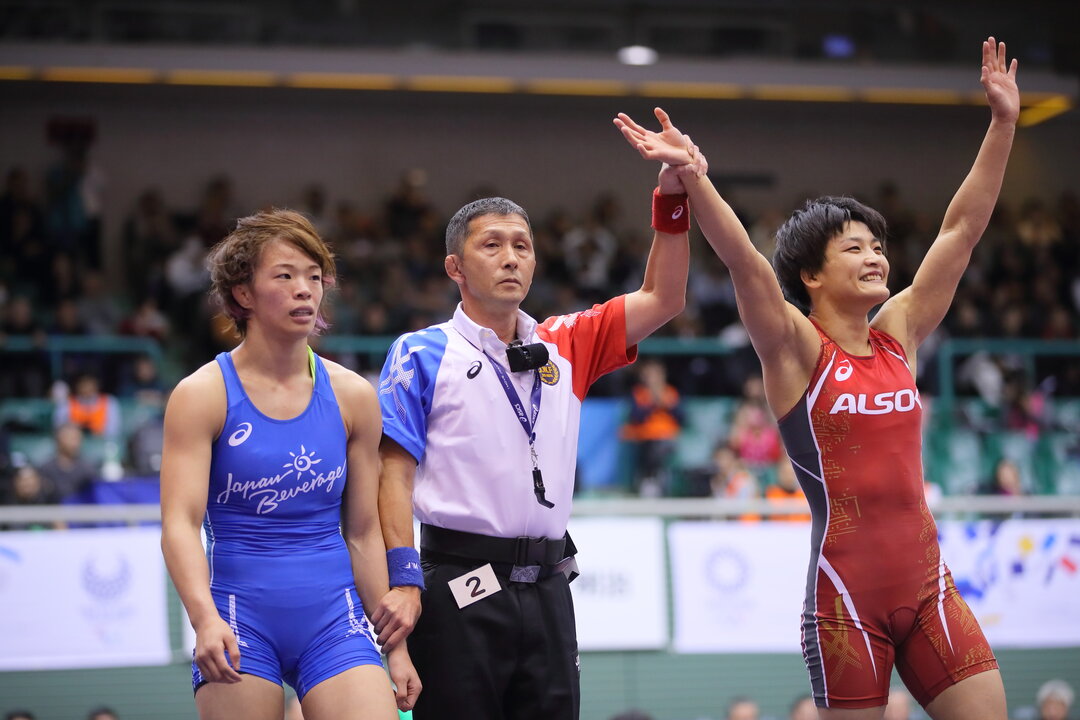
Adding another chapter to her bulging legend, Kaori ICHO pulled off a dramatic last-second victory over the new titan on the block, and moved a step closer to gaining a shot at winning a historic fifth Olympic gold medal in her home country.

Icho scored a takedown with 10 seconds left to clinch a 3-2 victory over fellow Rio 2016 Olympic champion Risako KAWAI in a nationally televised women’s 57kg final that brought a close to the All-Japan Championships in Tokyo.

Icho’s stunning victory came a day after Kawai, this year’s world champion at 59kg, edged the four-time Olympic champion 2-1 in a preliminary round-robin group match, handing Icho her first loss to a Japanese opponent since 2001.

I knew it was going to be a tough match, but I’m happy I could pull it off,” said Icho, who let out a short scream of joy and clenched her fists after the victory. “It’s been awhile since I’ve felt this nervousness, so I thought to just try and stay relaxed.”

The 34-year-old Icho won her first national title since 2015 and 13th overall dating back to 2002, despite spending more than two years away from the mat after winning the gold in Rio, which made her the first woman in Olympic history to win four straight titles in a single event.

She returned to competition in September as a prelude for the All-Japan Championships, also referred to as the Emperor’s Cup and which was serving as the first stage in the qualifying process for the Tokyo 2020 Olympics.

Click HERE to read the full recap of the final day of wrestling at the Emperor’s Cup. 
Day One: Emperor's Cup Wrap 
Day Two: Emperor's Cup Wrap 
Day Three: Emperor's Cup Wrap 

3. Bonne, Bacsi and Gray Named Comeback Athletes of the Year

United World Wrestling named Yowls BONNE-RODRIGUEZ (CUB), Peter BACSI (HUN), and Adeline GRAY (USA) the 2018 Comeback Athletes of the Year.

In freestyle, Cuba’s Yowls Bonne-Rodriguez won his first world title just days before his 35th birthday. Bonne finally obtained the elusive world gold medal after three previous attempts, scoring come-from-behind wins in the quarterfinals and finals.

In the quarterfinals, Bonne trailed Iran’s Mohammadbagher YAKHKESHI by two points with five seconds left when he hit a four-point inside trip and stole the match, 10-8.

Then, in the finals, Bonne trailed Russia’s Gadzhimurad RASHIDOV  2-0 before scoring a massive five-point move, which ultimately catapulted him to the top of the podium with a 5-5 criteria win.

This was Bonne's third world medal, previously finishing up the 2014 and 2017 World Championships with bronze medals.

Peter Bacsi, the 35-year-old Hungarian, won his first world championship since 2014 earning himself this year's Greco-Roman Comeback Athlete of the Year.

Basci trailed Turkey’s Emrah KUS 3-0 in the 82kg gold medal bout but scored four unanswered points to give the host nation their first and only gold medal of the Budapest World Championships.

The 2018 World Championships were rumored to be Bacsi’s last, but after his surprise victory he didn't rule out the 2019 Astana World Championships, though he did confirm he will not be making a run for Hungary’s 2020 Tokyo Olympic team.

Adeline Gray (USA) was named the women’s wrestling Comeback Athlete of the Year after returning from a year absence to win her fourth world title.

The American’s impressive road to her fourth world title went through reigning Olympic champion Erica WIEBE (CAN), and reigning world champion, Yasmin ADAR (TUR).

In the semifinals, Gray edged Wiebe, 3-1, and wrapped up the gold-medal bout early with a 13-1 win over Adar, winning the gold medal in a weight class that featured eight previous world champions.

4. Burroughs and Chamizo, Snyder and Sadulaev Headline Biggest Rivalries of the Year

United World Wrestling has named four of the Biggest Rivalries of the Year. There were two in freestyle, and one in Greco-Roman and women's wrestling.

The freestyle season saw more than one top-level rivalry, so a pair were selected for this category. The first freestyle rivalry selected was the 74kg showdown between Jordan BURROUGHS (USA) and Frank CHAMIZO (ITA), and the second was Abdulrashid SADULAEV (RUS) and Kyle SNYDER (USA).

Perhaps no weight category was more competitive in 2018 than women’s wrestling’s 76kg. Lead by reigning world champion, Yasmin ADAR (TUR), four-time world champion, Adeline GRAY (USA), and Rio Olympic champion, Erica WIEBE (CAN). It was the American Adeline Gray who prevailed and won her fourth world title.

In Greco-Roman, Kyrgyzstan’s Akzhol MAKHMUDOV (KGZ) was looking for redemption coming into the Junior World Championships the American Kamal Ameer BEY (USA) was victorious in the 2017 junior world finals. Makhmudov dominated the bronze-medal bout at the Junior World Championships and picked up the 8-1 win.

5.  Iran Team Wins GR World Clubs Cup, Azizli & Kayaalp Remain Undefeated
Iran's Team Bimeh Razi Ardabil defeated Team Russia to capture 2018 Greco-Roman World Clubs Cup title in Ardabil city of Iran. 

The Iranian team, lifted by Eldaniz AZIZLI and Sergey SEMENOV, the pair of reigning world 2018 world champions, defeated Russia, 8-2 to claim the 2018 Greco-Roman World Clubs Cup team title. 

Azerbaijan’s 55kg world champion Eldaniz Azizli gave Bimeh Razi their first win of the finals with a technical fall victory over Vitalii Kabaloev (RUS). 

Bimeh Razi added wins from Mehrdad MARDANI and Saman ABDEVALI (Bimeh) and took a three match lead into the 67kg matchup between Maksim SURKOV (RUS) df. Mohammad ELYASI (Bimeh). Surkov put Russia on the board with a 1-1 criteria win, and closed the scored to 3-1. Denis MURTAZIN (RUS) gave Russia their second and final win of the night with a 10-8 win over Boroumand ASLAN. 

Bimeh Razi closed out the gold-medal bout on a five match win steak, including two 5-0 shutout wins at 82kg and 87kg, and a fall from Russia’s reigning 130kg world champion, Sergey Semenov, who was competing for the Iranian side. 

In the bronze medal match, Iran’s Sina Sanat Izeh narrowly defated Turkey, 6-4. 

In the fifth-place match, Georgia defeated Iran’s Shohadaye Modafe Haram, 6-4, while Ukraine beat Serbia, 8-2 in the seventh-place bout. 

Click HERE for full results of the final day of the 2018 Greco-Roman World Clubs Cup.

Day One: Greco-Roman World Clubs Cup Wrap 

Weekly FIVE! In Social Media 

1. REPOST: @usawrestling you don’t wanna miss this one! ???@btslosangeles#wrestlelikeagirl
2. Over the next two weeks @unitedworldwrestling will share our most popular videos and photos from 2018. 
#FrankChamizo VS  #JordanBurroughs
@beatthestreets 
В течении следующих двух недель мы будем делиться с вами лучшими публикациями 2018 года. 
#ФрэнкЧамизо VS  #ДжорданБарроуз
#thebestof2018
#лучшееиз2018
3. Over the next two weeks @unitedworldwrestling will share our most popular videos and photos from 2018. 
#DavidTaylor ? @kadircaliskan
В течении следующих двух недель мы будем делиться с вами лучшими публикациями 2018 года. 
#ДэвидТэйлор
#thebestof2018
#лучшееиз2018
4. Best photos of 2018 GR World Clubs Cup in Iran, Ardabil city.

Phtos by @alireza_akbari_62 
بهترین تصاویر از مسابقات کشتی فرنگی باشگاه های جهان در اردبیل
5. Check out the 2019 Ranking Series events! Link in stories!

#JapanWrestling

Ex-Olympic medalist Ota continues mission of opening wrestling mat to those with Down syndrome

By Ikuo Higuchi

(Editor's Note: The following is an edited version of a two-part series that appeared on the Japan Wrestling Federation website on Jan. 18 with excerpts from previous stories. It has been translated and published by permission.)

"Through wrestling, society can be changed. Those with Down syndrome can be given courage by wrestling."

On the second floor of a non-descript building near Tokyo Dome in the heart of the city, the club members gathered in a small martial arts gym with a wall-to-wall mat to resume activities that, for some, date back to the start of the club in 2005.

Unavoidably suspended during the pandemic, the Waku-waku Wrestling Club -- specifically for those with Down syndrome -- was restarted in mid-January to central Tokyo, continuing the mission of its founder of enabling people with Down syndrome to become sharper physically and emotionally, and give them hope in life.

The club ("waku-waku" is an onomatopoeic expression of the feeling of excitement) is the lifework of Takuya OTA, the 1996 Atlanta Olympic bronze medalist at freestyle 74kg.  "It has become a part of my life," says the 53-year-old  Ota,  who, following a long stint as coach at Waseda University, is currently the head coach at Chuo University. "I get my power to go on from these kids."

The flame of Ota's interest in helping those with Down syndrome was ignited after being deeply moved by the book "Tatta Hitotsu no Takaramono (The One and Only Treasure)," a mother's account of raising a son with the disorder published in 2004. The book by Hiromi Kato was made into a TV drama, titled "The One and Only," which won the Asian Television Award for drama in 2005.

When Ota started the project, he was already working full-time coaching world-class competitors at Waseda, Japan's longest-running team. He had also launched the Waseda Club for kids, fueled by his determination to spread the word about the wonders of wrestling to as many people as possible.

According to the Mayo Clinic website, Down syndrome is a "genetic disorder" caused by abnormal cell division during gestation, with the resulting extra genetic material causing "the developmental changes and physical features of Down syndrome."

It affects 1 in 1,000 newborns and varies in severity. The website notes: "Better understanding of Down syndrome and early interventions can greatly increase the quality of life for children and adults with this disorder and help them live fulfilling lives."

After reading Kato's book, Ota began to think to himself, "How would it be if I had them try wrestling?" For those who are often neglected or ignored by society and suffer from uninformed biases, could not wrestling be a means to help give them more worth to their lives?

In July 2005, he started the first wrestling club specifically for this purpose, taking under his wing an inaugural group of six kids.

That's not to say there were no initial concerns. Children with Down syndrome are not on the same physical level as their healthy peers, and there were some whose spines might not hold up to the rigors of wrestling. Was wrestling something they could do? But there was no way to know until they tried, and Ota wanted to give them the chance.

And given the chance, they showed that they were able to move around just like the others. Not so much at first, but as they got used to it, they gained strength and confidence. They began to understand the rules and learned the techniques as Ota put priority on safety and stopped any potentially dangerous action.

Ota
Just like any wrestling practice anywhere in Japan, Coach Takuya Ota addresses the wrestlers before the start as the Waku-Waku Wrestling Club resumed in January for the first time since the start of the pandemic. (Photo: Japanese Wrestling Federation)

Getting big names involved

Perhaps no observers were more surprised, and overjoyed, by the success of the project than the parents. They could see their children who had mostly been kept out of sports getting exercise, having fun and, most importantly, building their self-esteem.

In 2017, reigning world champion and future Olympic gold medalist Yui SUSAKI was in her freshman year at Waseda when she offered her time to the Waku-waku Wrestling Club.

"I became aware Waku-waku Wrestling from the federation website and other sources," Susaki said. "I thought that after entering college, I wanted to be involved, so I participated joined the practices once a month as a coach. Everyone in Waku-waku has a pure love for wrestling, and each time it stimulated me as well," she added with a glisten in her eyes.

Yui SUSAKI (JPN)Future Olympic champion Yui SUSAKI and Beijing Olympic silver medalist Kenichi YUMOTO pose with two proud participants at the 2017 Waku-waku Waseda Cup. (Photo: Japan Wrestling Federation)

Also coming on board to help out was Kenichi YUMOTO, the 60kg freestyle silver medalist at the 2008 Beijing Olympics with deep connections to Ota -- they are both natives of Wakayama Prefecture and alumni of Nippon Sports Science University. Yumoto made his presence felt at practices, patiently teaching techniques.

The club continued unabated until the coronavirus pandemic hit the world in 2020, leaving no sport unaffected. Ota's contract had just ended at Waseda and he made the move to Chuo University, which is located in the western Tokyo suburb of Hachioji. That left the club without the wrestling room at Waseda, and combined with the pandemic, caused a halt to the operations.

The recent easing of pandemic restrictions in Japan allowed the club to restart, and Ota was fortunate to make arrangements for use of the martial arts gym near Tokyo Dome in Bunkyo Ward.  It was a special moment for everyone involved.

"People with Down syndrome are fundamentally averse to combative sports," he said. "But when they continue doing it, I find that their fighting spirit come out. I hear from parents, 'He's no longer timid' or 'He's become able to do things on his own.' I feel that the parents also sense that by wrestling, they have unlimited potential for personal growth."

While there were only five participants on that first day of restarting the club, the room was filled with a positive energy, from the smiles on their faces as they practiced moves to the way they proudly raised their hands when asked for sparring partners.

Among those taking the mat was 24-year-old Aruban Kubota, who was one of the original members of the club in 2005 as an elementary school first-grader. Kubota, whose first name is derived from his father's native country of Albania, is currently employed in a public welfare center.

"At first, he would always sit off to the side at practice," recalls his mother, Rimiko. "But before we knew it, he starting joining the group and would decide things by himself. He started acting on his own."

Rimiko says the wait for the club to restart seemed interminable. "I am so grateful to Coach Ota," she says.

In July 2009 , Ota, looking to give the members a chance to put their new-found skills to the same test as all wrestlers, organized the "1st Waseda Cup." Other clubs for Down syndrome kids had cropped up, mostly at the urging of Ota through his wrestling connections, and the tournament drew 29 entries from three clubs.

The tournament, which would later be renamed the "Waku-waku Waseda Cup" and gain sponsorship from a company employing former Waseda wrestlers, has drawn entries from children to adults in their 20s. The level continues to improve and, unlike in the early years when it was difficult for the participants to control their emotions, matches are no longer halted and can proceed smoothly.

"At first, our main objective was to just get them to be able to go out onto the mat by themselves," Ota said in an interview after the 2016 tournament. "Now, they understand the rules and can have what we would consider a regular match."

All participants receive a medal, but the highlight of the award ceremony is the selection of  the MVP and Fighting Spirit Award which come with a trophy. As Ota holds the microphone before making the announcement, the winners (who are eligible for MVP) watch him as if in prayer while the whole venue takes on a atmosphere of smiles.

Ota2A club member does a double-leg takedown drill as the others watch. (Photo: Japanese Wrestling Federation)

Aiming for the Special Olympics

As could be seen by the enthusiasm at the 2021 Tokyo Paralympics, sports is not the exclusive dominion of the able-bodied. People with Down syndrome or other intellectual disabilities are also making strides toward participating in sports.

In October 2020, an athletics competition solely for those with Down syndrome was held in Miyazaki in southern Japan, and earlier this year, a division for Down syndrome entrants was set up for the first time at a swimming meet in Chiba, east of Tokyo.

On an international scale, Virtus, an organization established for the development of elite sport worldwide for athletes with intellectual impairments, had judo on the program at the 1st Oceania/Asian Games held in November last year in Australia. Japan athletes took part, widening the scope of opportunities for those with Down syndrome.

Ota is also looking beyond Japan's shores. Ota's next goal is to get wrestling into the Special Olympics, which has a history of over 50 years and differs from the Paralympics in that it is specifically for those with intellectual disabilities. Currently, there are over 20 sports in the Special Olympics, including judo.

Ota has visited the headquarters in Washington, D.C., where he was told that for wrestling to be included, it was necessary for the sport to expand in Japan and for more countries around the world to start programs. As it is still evolving and not well-known in Japan, it marks a high hurdle to be cleared.

But he is undaunted. "Even if you have a disability, as long as there is a sport providing a stage to shine, one can have a big presence in society," Ota said.

--Translation and editing by Ken Marantz