

Weekly FIVE!

Weekly FIVE! December 10, 2018

By Eric Olanowski

Reviewing Russia's Ivan Yarygin qualification process. Also reviewing results from the Alans and Haparanda Cup.  

1. Dzambolat Tedeev Clarifies 2019 Ivan Yarygin Qualification Process
Dzambolat Tedeev, the head freestyle wrestling coach for the Russian Federation, clarified the qualification process for January’s Ivan Yarygin, which takes place in Krasnoyarsk, Russia. Only three Russian wrestlers will qualify for the "Toughest Tournament in the World." Each of the 2018 world team members, along with the Alans and Mindiashvili winners will each punch their ticket to the Ivan Yarygin. 

In an interview with WRESTRUS.RU’s correspondent, Tigran Avanian, Tedeev said, “The first members of the Russian national team, mainly those who wrestled in Budapest, can still compete in the Alans. They already have an admission to Yarygin, but only in the weight in which they wrestled in Budapest.” Meaning the below world team members have qualified at the following weights.

57kg - Zaur UGUEV
61kg - Gadzhimurad RASHIDOV 
65kg - Akhmed CHAKAEV 
70kg - Magomedrasul GAZIMAGOMEDOV 
74kg - Zaurbek SIDAKOV 
79kg - Ahmed GADZHIMAGOMEDOV 
86kg - Dauren KURUGLIEV
92kg-  Batyrbek TSAKULOV
97kg - Abdulrashid SADULAEV 
125kg -  Anzor HIZRIEV

In order to provide further clarification, coach Tedeev  continued by saying, “If an athlete decides to change his weight category, he needs to establish himself in the new weight, which means he’ll have to win either the Alans or the Mindiashvili tournament, and only then he will be able to wrestle in Krasnoyarsk."
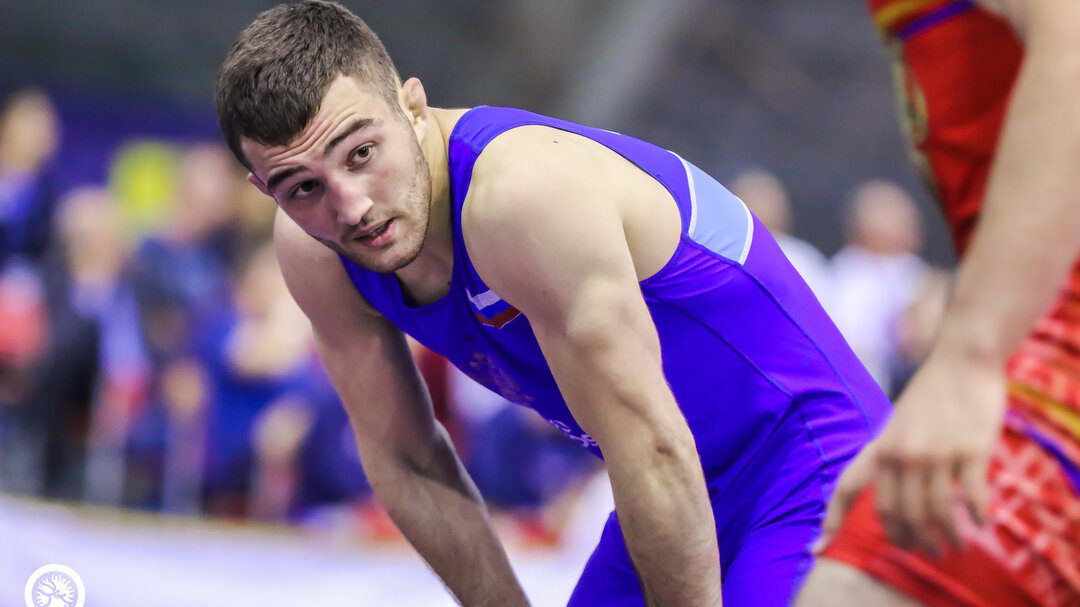

70kg Alans champion, David BAEV (RUS) Photo by Marion Stein. 

2. Vladikavkaz Hosts Yarygin Qualification Tournament, the Alans 
Loads of fans showed up to the sold-out Sports Center Arena in Vladikavkaz, North Ossetia-Alania, Russia, for one of the country’s most important tournaments, the Alans. As mentioned above, the Alans served as a qualification for the January’s Ivan Yarygin in Krasnoyarsk, Russia. 

Arguably, the most impressive gold medal winner was the 70kg champion, David BAEV (RUS). Baev, the two-time age-level world champion, and 2018 U23 world runner-up knocked off back-to-back- world medalists on his run to the top of the podium. In the semifinals, Baev defeated two-time world medalist, James GREEN (USA), 8-6. He followed that up with a 5-3 finals win over 2016 world champion, Magomed KURBANALIEV (RUS). 

Azerbaijan, Georgia, and the United State each had wrestlers medal, but it was the Russian Federation who won nine of ten possible gold medals. The lone non-Russian champion was reigning two-time world champion, Geno PETRIASHVILI (GEO) who won the 125kg gold medal over Iran's Jaber SADEGHZADEH. 

RESULTS 
57kg
GOLD - Abasgadzhi MAGOMEDOV (RUS)
SILVER - Khuresh Ool DONDUK OOL (RUS) 
BRONZE - Ramiz AMZATOV (RUS)
BRONZE - Ibragim ABDURAKHMANOV (RUS) 

61kg 
GOLD - Ramazan FERZALIEV (RUS) 
SILVER - Beka LOMTADZE (GEO) 
BRONZE - Iulian GERGENOV (RUS)
BRONZE - Aleksandr BOGOMOEV (RUS) 

65kg 
GOLD - Muslim SAIDULAEV (RUS)
SILVER - Kurban SHIRAEV (RUS)
BRONZE – Nachyn KUULAR (RUS)
BRONZE – Alan GOGAEV (RUS)

70kg 
GOLD - David BAEV (RUS) 
SILVER - Magomed KURBANALIEV (RUS)
BRONZE - James Malcolm GREEN (USA) 
BRONZE - Razambek ZHAMALOV (RUS) 

74kg 
GOLD - Timur BIZHOEV (RUS) 
SILVER - Avtandil KENTCHADZE (GEO) 
BRONZE - Akhmed USMANOV (RUS)
BRONZE - Kakhaber KHUBEZHTY (RUS) 

79kg 
GOLD - Gadzhi NABIEV (RUS) 
SILVER - Atsamaz SANAKOEV (RUS)
BRONZE - Alan ZASEEV (RUS)
BRONZE - Khalil AMINOV (RUS)

86kg 
GOLD - Vladislav VALIEV (RUS)
SILVER - Magomedsharif BIIAKAEV (RUS)
BRONZE - Slavik NANIEV (RUS)
BRONZE - Soslan KTSOEV (RUS)

92kg
GOLD - Anzor URISHEV (RUS)
SILVER - Magomed KURBANOV (RUS)
BRONZE - Alikhan ZHABRAILOV (RUS)
BRONZE - Sharif SHARIFOV (AZE) 

97kg
GOLD - Vladislav BAITCAEV (RUS)
SILVER - Shamil MUSAEV (RUS)
BRONZE - Zaynulla KURBANOV (RUS)
BRONZE - Igor OVSIANNIKOV (RUS)

125kg 
GOLD - Geno PETRIASHVILI (GEO) 
SILVER - Jaber Taghi SADEGHZADEH (IRI) 
Mukhamagazi MAGOMEDOV (RUS)
Vitalii GOLOEV (RUS)

3. Tehran to Host 2018 World Wrestling Clubs Cup 

Tehran, Iran is set to host the fifth annual World Wrestling Clubs Cup on December 13-14. 

Last year, 16 World and Olympic medalists took part in the two-day competition, but it was Iran's Easy Pipe Kashan who edged defending champions from the United States, Titan Mercury, 6-4, while Setaregan Sari (IRI) downed Khimori (MGL) in the third-place dual.

One interesting note regarding this year's World Wrestling Clubs Cup, the United State's will not be sending a team to Tehran. Due to the World Championships being pushed back to October, the United States decided to rest their athletes and not send them to Iran. 

2017 Finals Results 
57kg - Reza ATARI (Easy Pipe) df. Thomas GILMAN (TMWC), 6-4 
61kg- Vladimir KHINCHEGASHVILI (Easy Pipe) df. Alan WATERS (TMWC), 7-0
65kg- Farzad AMOUZAD KHALILI df. (Easy Pipe) Bernard FUTRELL (TMWC), 6-3
70kg- Mohammad NADERI (Easy Pipe) df. Franklin GOMEZ (TMWC), 2-2
74kg- Nazariy KULCHYTSKYY (TMWC) df. Hossein ELYASI (Easy Pipe), 5-4 
79kg- Kyle DAKE (TMWC) TF. Reza AFZALI (Easy Pipe), 12-0
86kg- David TAYLOR (TMWC) df. Alireza KARIMI (Easy Pipe), 3-1 
92kg- Hossein SHAHBAZI (Easy Pipe) df. Nickolas HEFLIN (Titan), 4-2
97kg- Kyle SNYDER (TMWC) TF. Vladislav BAITSAEV (Easy Pipe), 11-0
125kg - Geno PETRIASHVILI (Easy Pipe) df. Nick GWIAZDOWSKI (Titan), 6-5
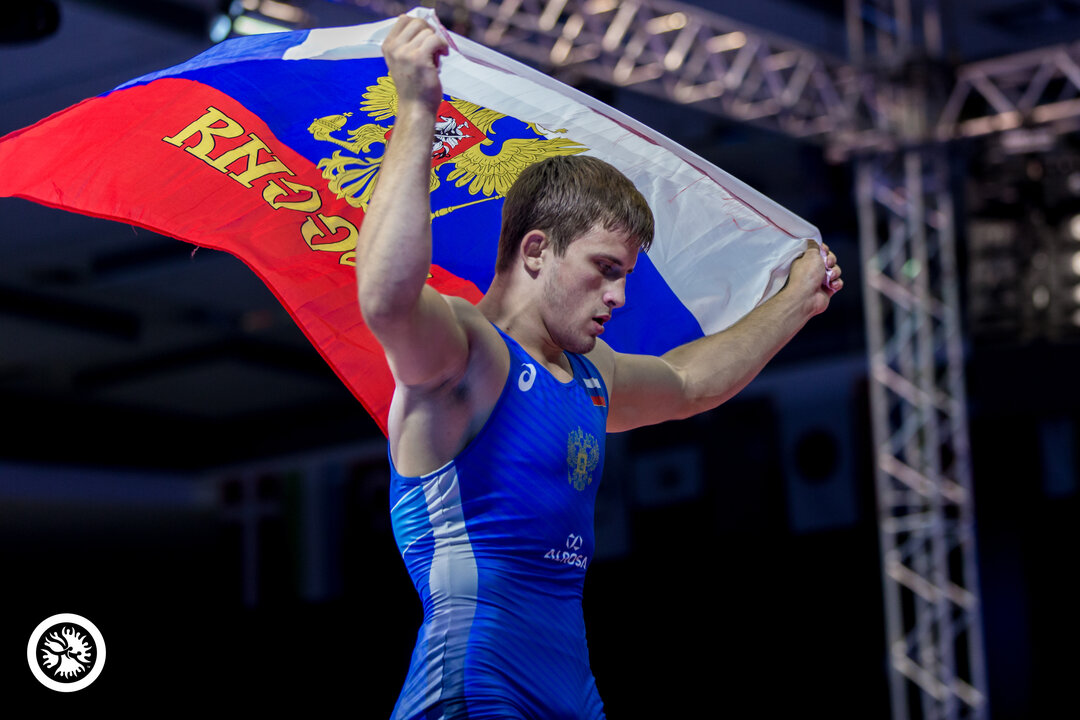

Aleksander KOMAROV (RUS), 82kg Haparanda Cup champion. (Photo by Max Rose-Fyne) 

4. Russia Wins Quartet of Golds at 2018 Haparanda Cup
Over 60 wrestlers made the trip to Haparanda, Sweden to compete in the annual Haparanda Cup. Per usual, the Russian Federation was locked and loaded, winning four of the nine overall Haparanda Cup gold medals. 

The most notably gold medal came at 82kg where the Russian youngster Aleksander KOMAROV (RUS) competed in his first tournament since September when he captured the 2018 junior world title in Tampere, Finland. This was Komarov’s second junior world title, but his fourth overall age-level world title. He also won back-to-back cadet world titles in 2015 and 2016. 

Without a doubt, Komarov has the most impressive Greco-Roman resumes in recent memory. Since stepping on the international scene back in 2015, he’s entered 13 tournaments and has yet to face defeat at any of those 13 tournaments. 

In addition to his four age-level world and European titles, Komarov also has five senior-level tournament gold medals to his name. 

Russia also had a trio of other gold medalists. They were Yuri DENISOV (RUS), Ivan CHERNOV (RUS), and Maxim SAYARYAN (RUS). Russia was the only country to win more than one gold medal. Finland, Norway Sweden, Ukraine, and the United States were the remaining five nations who won a solo gold medal. 

RESULTS 
60 kg   
GOLD - Maksym LIU (UKR)
SILVER - Christoffer SVENSSON (SWE)
BRONZE - Roope MIETTUNEN (FIN)

63kg 
GOLD - Alexander BICA (SWE)
SILVER - Colton RUSHE (USA)

BRONZE - Raffaele MASI (USA)

67kg  
GOLD - Håvard JORGENSEN (NOR) 
SILVER - Jamel JOHNSON (USA)
BRONZE - Denis BOLUNOV (EST)
BRONZE - Serhii HRUSHYN (UKR)

72kg  
GOLD - Yuri DENISOV (RUS) 
SILVER - Akseli  KISALIJAT (FIN)
BRONZE - Ihor BYCHKOV (UKR)
BRONZE - Vladyslav KRAVCHENKO (UKR)

77kg  
GOLD - Ivan CHERNOV (RUS)
SILVER - Sakke PUROLAINEN (FIN) 
BRONZE - Pat SMITH (USA)
BRONZE - Roni PUROLAINEN (FIN)

82kg   
GOLD - Aleksander KOMAROV (RUS)
SILVER - Dmytro GARDUBEI (UKR)
BRONZE - John STEFANOWICZ (USA) 
BRONZE - Vitalii ANDRILOVYCH  (UKR)

87kg
GOLD - Rami HIETANIEMI (FIN) 
SILVER - Joe RAU (USA) 

BRONZE - Duguchiev MOVSAR (RUS)
BRONZE - Valentyn SHKLIARENKO (UKR) 

97kg 
GOLD – Maxim SAYARYAN (RUS)
SILVER - Billy RAAF (SWE)

BRONZE - Daniel MILLER (USA) 
BRONZE - Kalle PERSSON (SWE)

130kg 
GOLD - Trent OSNES (USA) 

5. United World Wrestling Yearly Awards to be Released Over Next Few Weeks 
As the 2018 calendar year comes to a close, it leaves an opportunity for the wrestling world to reflect on successes over the previous twelve months. In the next few weeks, United World Wrestling will be releasing their annual year-end awards. Like past year’s awards, this year’s awards will look at some of the best matches, athletes, and performances from 2018. 

If you have a favorite moment, match, or wrestler that you think should be included in our annual awards; please share your thoughts on Facebook, Instagram or Twitter

Weekly FIVE! In Social Media 

1.Big Move Monday! 
2.  Flipping into the week like. 
3. Black and white photos from #BudaWrestle2018 
4. Steam coming off a young Indian wrestler 
5. Matcharshvili outscored his opponents 40-0 to win the 97kg U23 world title.

Trained in Japan and USA, Yoneoka hopes to coach Norway to global success

By Ken Marantz

TOKYO, Japan (July 20) -- Yurie YONEOKA has taken her share of knocks along her lifelong path in wrestling, but she always seems to land on her feet. This time it has planted her onto a second different continent.

Yoneoka, a Japanese who competed collegiately in the United States before becoming a coach there, has been hired as head coach of the Norwegian national women’s team, which hopes some of the success of her home country can rub off after decades of slim results.

Norway, which was among the top nations in women’s wrestling in the early 1990s, has not produced a women’s world champion since Gudren HOELE won the last of her five world golds in 1998 at 56kg, and its last world medal of any kind was a bronze in 2005 by Lene AANES at 59kg.

The 29-year-old Yoneoka was hired on an initial two-year contract, but with eyes on producing results at the 2028 Los Angeles Olympics. That’s a tall task in itself, as Norway has only had one woman qualify in wrestling for the Olympics in its history when Signe Marie STORE made the field at 69kg at the 2016 Rio Games but finished 18th.

YoneokaYurie YONEOKA talks with the press during a recent trip back to Japan. (Photo: Japan Wrestling Federation)

“We have a six-year goal which is Los Angeles [2028],” Yoneoka said during an interview in Tokyo earlier this month when she returned to attend a wedding. “But we have to take baby steps. So the first thing is to medal at the European Championships at the senior level, and the junior [U20] level as well.

“We will hopefully get a World Championships medal. That's the closest way to get to the Olympics,” she said, referring to the direct Olympic qualifying places available at the World Championships.

Yoneoka, who ultimately would like to land an executive position at United World Wrestling so she can advance the standing of women and Japan, found out about the Norway opening from a notice on the UWW website. She immediately applied and, after an extended interview process, was hired in June.

"At the time I was coaching at the university in the United States and I was looking to take a step up for a more high-level coaching job,” she says. “My [ultimate] goal in my life is working at United World Wrestling. So I was thinking what are the good steps to reach my goal, and I was thinking higher-level coaching would be a very good opportunity.”

YoneokaYurie YONEOKA addresses members of the Norwegian national team for the first time during a brief visit last month. (Photo courtesy of Yurie Yoneoka)

Norway has a current senior star in two-time European champion Grace BULLEN, but she has yet to meet expectations in terms of world medals and Olympic qualifying. Yoneoka said her focus will be more on developing the next generation of wrestlers.

“My main focus, which the federation asked me, is mostly on U20,” she says. “But I will do a lot of camps to collect the girls and bond together regardless of age. For U17 and U15, I will probably still coach and go to the competition if I am available, but not super-focused, more like support.”

Yoneoka is looking to centralize the national team operations in Oslo and has already set up a training camp for September. She has only briefly met team members and is still waiting for a work visa and a place to live.

Having been exposed to the sport both in Japan and the United States, Yoneoka feels she brings a broad perspective to Norway and can allow team members to find the style that best suits them.

“While making the most of each individual’s own style, I believe it is vital to add to what they do well, rather than completely change their wrestling,” Yoneoka said in an earlier interview on the JWF website. “Six years will go by before you know it. If there is even the slightest feeling of hesitation, the goal will get further away.”

Looking at the differences, “Japanese style is very focused on basics, and they have high technique. Very good conditioning,” Yoneoka says. “The American style is very powerful, with big dynamic movement. They love to show stuff. And they have a lack of conditioning. Of course, they haven't done a lot of freestyle, so that's probably one point. The European style is very mixed, which I would say is very balanced between Japanese style and American style.”

YoneokaYurie YONEOKA, center on right, poses with University of Providence teammates after placing sixth at the 2019 U.S. national collegiate championships. (Photo courtesy of Yurie Yoneoka)

Coming to America

Although Yoneoka never competed at a World or Asian Championships on any level herself, she was a better-than-average high school wrestler, placing third at the national high school championships in an era that would produce several future Olympic champions.

But later disillusionment with her college program in Japan set in motion a journey that would bring her to one of the most rural and off-the-beaten-path parts of America.

As with the Norway job, Yoneoka’s interest in a jump across the Pacific was sparked by an online notice, this one on the Japan Wrestling Federation website in 2013. There was a call out for Japanese wrestlers interested in competing collegiately in the U.S.

Behind the project was Tadaaki HATTA, a former NCAA champion and U.S. national team coach who has long served as a link between the two countries.

In the past, a few Japanese males like Hatta have gone over to U.S. universities, most notably Yojiro UETAKE, who went undefeated at Oklahoma State in the 1960s and became a two-time Olympic champion, and Sanshiro ABE, who won an NCAA title at Penn State in 1996 and competed at that year's Atlanta Olympics.

But Yoneoka still remains the only woman to take the plunge. And it was not easy getting there. Yoneoka first had to pass the Test of English as a Foreign Language (TOEFL), a formidable hurdle given that “[English] was the subject I always got the worst grade at school. I was always at the bottom in the class. So I literally started from the ‘This is a pen’ level."

Talk about perseverance. Yoneoka failed the test 14 times -- 14 times! -- over a four-year period before finally earning a passing score. During that time, she worked part-time jobs as a receptionist at a dry cleaning shop and as a staff member at Costco.

Yoneoka had been recruited to attend Jamestown University in North Dakota, and the school patiently waited for her to pass the TOEFL test. "We kept in touch and [the school] was always supportive of what I was doing," she said.

Unfortunately, after she finally to Jamestown, she was unable to compete in her first year for reasons she still doesn't understand. The next year, coach Tony DEAND took a new job at the University of Providence in Great Falls, Montana, and took Yoneoka with him. And once again, she was declared ineligible to compete for a season. When Deand left after just one season, Yoneoka remained at Providence.

While going abroad to study afforded her more freedom than she had back in Japan, Yoneoka became too busy as a student-athlete to get caught up in the social scene. "I didn't party a lot at all," she says. "I had to make money, too, because I didn't get a full grant. I had to work on campus at the Starbucks, for only like two or three shifts [a week]."

She described her routine as "morning practice, go to class, work and practice. That was it."

In the end, her junior year was the only one in which she had a full competitive season. She won titles at the Spokane Open and the Battle of the Rockies, then finished sixth at the 2019 Women’s Collegiate Wrestling Association Championships at 116 pounds (52.6kg). She was ranked third in the nation at 109 (49.5 kg) in her senior year, only to have the 2020 championships canceled due to the pandemic.

After graduating with a degree in sociology, she was hired as an assistant coach at Providence, making her the first-ever Japanese woman to coach on the collegiate level in the United States.

She says it was difficult to leave Providence and the team to take the job with the Norwegian team, but says the response was positive. "It was pretty hard, especially for girls who I built a really good relationship with," she says. "They were very sad, but they were happy for me that I got the job."

YoneokaYurie YONEOKA, second from right, stands on the medal podium after placing third at the 2010 Junior Queens Cup. To her right is champion Risako KAWAI, now a two-time Olympic gold medalist. (Photo courtesy of Yurie Yoneoka)

Sweet bribe launches career

Yoneoka’s entry into the wrestling world was basically the result of a bribe. The culprit: Her father. The enticement: Chocolate.

Born in Tokyo, Yoneoka’s family moved to nearby Kashiwa, Chiba Prefecture, while she was a toddler. Her father, who was a dedicated amateur handball player, was looking for a sport for his four-year-old daughter when he spotted a poster at the local civic sports center. It was for a local kids wrestling club.

“He was like, 'This is it,’” Yoneoka recalls. “But I was a very, very shy girl and he was like, 'Do you want to go because I will buy you chocolate.' And I love chocolate. So chocolate is the only reason I went into wrestling.”

She still remembers her first day in the sport. "It was a very hard practice. [My father] threw me into the practice, and I had to do the whole practice on the first day. I almost cried."

But with a mix of determination and stubbornness that would get her through trying times later in life, Yoneoka stuck with it and showed potential. She developed a love for the sport and continued until being forced to stop briefly because of one of Japan's main social problems -- bullying, which she suffered in junior high school.

"I got bullied heavily and I couldn't go to school for awhile," she says. "So I had to stop wrestling as well because the wrestling team was practicing at that junior high. A few months later, I just changed schools."

Determined to get back into the sport, she passed the entrance exams for Saitama Sakae High School in neighboring Saitama Prefecture. It is among the top schools for wrestling in the Kanto region, which includes Tokyo and the surrounding prefectures, but also one that is also academically oriented.

"I wanted to be the best wrestler that I could ever be, and my dream was to go to the Olympics, too," Yoneoka says. "[I thought], where can I go to achieve that goal? There were only a few selective schools in the Kanto area because [women's] wrestling was still developing.

"Sakae was a very good school which has a pretty good academic program, too. My parents only wanted me to put my best [effort] into both academics and athletics. [They said] if you go in the advanced program of study, you can keep wrestling. I studied and got into the school."

Aside from the curriculum, going to Sakae meant enduring another hardship -- a two-hour train commute from her home in Kashiwa. "Those three years were probably one of the hardest times in my life," she says. "Practice started at 7 [a.m.], so I had to wake up before 5 and hop on the train for two hours."

YoneokaYurie YONEOKA poses with members of Norway's U15 team. (Photo courtesy of Yurie Yoneoka)

In 2010, Yoneoka placed third in the U17 division of the Junior Queens Cup at 49kg, a weight class won by future two-time Olympic champion Risako KAWAI. The next year, she won a bronze medal at the National High School Championships in that weight class, which was won by Nanami IRIE, a future world silver medalist.

To get an idea of how competitive the 2011 high school nationals were, the champions of three other weight classes would go on to become Olympic champions --Kawai, Eri TOSAKA and Sara DOSHO. Yoneoka met Tosaka at a wrestling camp during junior high school and they remain friends to this day.

"That was really tough," Yoneoka said of the competition. "I was actually very insecure about my wrestling. It [gave] me the power to push through, that I had to be better every day. But I was insecure that I could make it."

While the Big Three would all eventually go on to collegiate powerhouse Shigakkan University, Yoneoka was pressed by her coach to stay in the Kanto region and attend Toyo University. She never fully fit into the program and, after an undistinguished three years, dropped out during her senior year after the opportunity to go to the States came up.

"The wrestling community is pretty tight, and my high school coach pushed me to go to Toyo University," she says. "I liked it as a university, but the team situation was not what I had imagined or what I desired. It wasn't the best situation for me as an athlete.

"I didn't regret quitting the team, but I had a strong feeling that I shouldn't quit wrestling itself. I was feeling devastated about wrestling. I was like, what should I do with my life? All I had done with my life was wrestling. In very, very good timing I saw the advertisement by Tadaaki Hatta."

Having seen their daughter spend the last six years or so in the United States, what did her parents think about her career path now taking her to Norway?

"My parents were first of all surprised," she says. "But they know even if they say something, I will still do whatever I want to. For my parents, it was like, 'Alright go ahead.'

"My friends were like, 'Norway? I thought you were living in the U.S. forever.'"

Yoneoka looks forward to that first time one of her Norwegian wrestlers faces a Japanese opponent on the mat.

"I feel like I will be proud of the Norwegian to be competing against a Japanese because obviously, the Japanese wrestlers are the best," she says. "But I think that will be good for me to learn some things as well, and I have so much respect for the Japanese wrestling federation and wrestlers. It will be a little bit nostalgic, but it will be a good feeling."

Looking at the big picture, it is also about gaining acceptance for women in the sport.

"In the States, there are still issues that women's wrestling gets really disrespected by men's wrestlers or even just men," she says. "It's a big issue and I feel like girls have to stand up for themselves still, which is pretty sad.

"In Norway, there is a big equality system, like men and women have to be equal. I think it's good, but still, in the wrestling community, it's a tough fight. Of course, I will stand up for myself and for my girls as well as for my future as a woman. That's one of my goals."