

Uzbekistan dominates first day with 3 Greco golds, all at Iran's expense
Tuesday, March 25, 2025 - 20:02 By Ken Marantz

AMMAN, Jordan (March 25) -- While the ageless wonder Rustam ASSAKALOV (UZB) no longer wreaks havoc on the mat, his influence was strongly felt off it on the opening day of the Asian Championships on Tuesday.
With Assakalov offering encouragement and inspiration from the coach's corner, Uzbekistan came away with three of the five Greco-Roman golds on offer -- all with victories over Iranian opponents -- with teenager Aytjan KHALMAKHANOV (UZB) joining veterans Aram VARDANYAN (UZB) and Jalgasbay BERDIMURATOV (UZB) on the top of the podium.
"Generally speaking, we’ve been working hard for this," said Assakalov, a three-time Asian champion who retired after placing fifth at the 2024 Paris Olympics three weeks after his 40th birthday. "We were aiming to wrestle in at least four finals. Our 130kg wrestler is still a bit weak, but we will work on it and improve."
Fardin HEDAYATI (IRI) kept Iran from being shut out of the gold medals by keeping the 130kg title safely in Iranian hands, while Japan picked up the other title when collegian Kohei YAMAGIWA (JPN) triumphed at 55kg.
 Aytjan KHALMAKHANOV (UZB) won the 63kg final against Mohammad KESHTKAR (IRI), 13-4, in Amman. (Photo: United World Wrestling / Kadir Caliskan)
Khalmakhanov started the gold rush for Uzbekistan in dramatic fashion, coming back from a four-point deficit to stun Mohammad KESHTKAR (IRI) with a 13-4 win in the 63kg final that included a pair of 4-point throws.
Keshtkar, among a number of young, unproven wrestlers being given a chance by Iran, jumped out to a 4-0 lead with a takedown and 2-point throw. Khalmakhanov responded with a stepout and 2-point arm throw to cut the gap to 4-3 at the break.
In the second period, Khalmakhanov got the first chance at par terre and he took advantage, launching a 4-point throw to take the lead. He then brought an abrupt end to the match with a 4-point hip throw at 4:16.
The victory avenged a 5-4 loss in the quarterfinals at the Zagreb Ranking Series, where Kashtkar finished second and Khalmakhanov, the 2022 world U17 champion, took a bronze medal.
"Khalmakhanov was the first to set the bar high," Assakalov said. "This guy is only 18 years old, which is why all the others followed his example."
In the 77kg final, Vardanyan also needed a comeback to defeat two-time reigning world U20 champion Alireza ABDEVALI (IRI), and he couldn't have cut it any closer, scoring a takedown with one second left on the clock for a dramatic 4-2 victory.
Vardanyan, who placed fifth at the 2024 Paris Olympics following an extended drought of results in major competitions, gave up a first-period takedown and trailed 2-1 with the clock ticking down in the second period.
But he managed to drive in low and secure a body lock, then forced Abdevali backward to the mat for the winning takedown as time expired. An Iran challenge was unsuccessful, tacking on an additional point.
The 29-year-old Vardanyan had failed to make a major podium since winning a world silver medal at 72kg in 2019. His best previous finishes at the Asian Championships were a pair of bronzes back in 2016 and 2017.
 Jalgasbay BERDIMURATOV (UZB) won his second career Asian Championships gold medal. (Photo: United World Wrestling / Amirreza Aliasgari)
Unlike his compatriots, two-time world medalist Berdimuratov never had to play catch-up in defeating Yasin YAZDI (IRI) 7-2 to take the 87kg gold for his fifth Asian medal overall.
Berdimuratov stormed to a 7-0 lead in the first period with a 4-point throw and 2-point roll from par terre, then held on after giving up a passivity point and a penalty point for grabbing fingers in the second period.
Berdimuratov, the 2023 Asian Games champion, had previously won an Asian gold at 82kg in 2021. He also has a silver and two bronzes in his collection.
"We are on our way to becoming the best team in the world," Assakalov said. "It doesn’t matter if we’re competing against the national teams of Iran, Russia -- every one of our guys gave it their all and wrestled until the very end. Thank God, we showed a good result today."
At 130kg, Hedayati established himself as a rising force in Iran's packed heavyweight corps by cruising to a 7-0 victory over three-time Asian medalist Alimkhan SYZDYKOV (KAZ).
"It was a good competition and at a relatively high level," Hedayati said. "I managed to wrestle four matches and become the champion without losing a single point."
Hedayati, last year's world U23 champion and the 2023 world U20 gold medalist, combined two stepouts, an arm-throw takedown and a passivity point for a 5-0 lead in the first period. In the second, he got behind for a takedown while completely neutralizing an attacks by Syzdykov.
Hedayati's victory gave Iran the 130kg gold for the fourth straight year and ninth time in 10 years. The only year in that span that Iran missed out was 2020 -- the winner? Syzdykov.
"I’m grateful to everyone who supported me along the way," Hedayati said. "I hope to keep progressing so I can win the most beautiful medal at the World Championships and the Olympics."
 Kohei YAMAGIWA (JPN) won his first-ever Asian Championships on debut. (Photo: United World Wrestling / Amirreza Aliasgari)
Yamagiwa won the first gold of the tournament when he nailed a 4-point back suplex to clinch a 7-1 victory over Iranian-born Sajjad ALBIDHAN (IRQ) in the 55kg final.
Yamagiwa scored his first points from the bottom of par terre in the first period, when he stopped a roll with a headlock for a 2-1 lead.
A scramble that would have put him up 5-3 was wiped out by a challenge that ruled the original move a slipped throw, but Yamagiwa came back by locking up the head and an arm, then tossing Albidhan to his back for 4 with just under a minute left. The Japanese added a late stepout for his final point.
"He suppressed my wrestling and I didn't get a chance in par terre," Yamagiwa said. "To be honest, I have to wonder if I really did enough to win. But I gave it everything I had at the end and scored a 4-point move and I'm glad I was able to win."
Yamagiwa got over his biggest hurdle in the semifinals, when he won an action-packed battle with defending champion Yu Chol RO (PRK) 11-9 in which the lead changed hands several times.
"He was the champion last year, and if I beat him I could see a championship for me," Yamagiwa said. "It was a back-and-forth match, but I came out as the winner."
In winning the Asian gold, Yamagiwa emulated two of his predecessors and role models at powerhouse Nippon Sports Science University, Shinobu OTA (JPN) and Kenichiro FUMITA (JPN), who both won senior Asian golds. The latter, who is still active, is among his training partners.
Now he hopes he can follow in their footsteps to Olympic glory -- Ota was a silver medalist at Rio 2016, while Fumita was the Tokyo 2021 silver medalist before winning the gold at Paris 2024.
Host Jordan denied first medal since 2013
In the bronze-medal matches, Ibragim MAGOMADOV (KAZ) completed the collection of Asian medals while denying the host country its first hardware since 2013, making the most of his chance at par terre to storm to an 11-3 victory at 77kg over Amro SADEH (JOR).
Sadeh had raised hopes of becoming the third Asian medalist in Jordanian history when he scored a roll from par terre for a 3-0 first period lead. But in the second period, he had no answer from the bottom as Magomadov ripped of five rolls this way and that to end the match in 4:21.
Magomadov's previous medals had come at 72kg, taking the silver in 2020 in New Delhi and the gold two years ago at home in Astana.
Yryskeldi MAKSATBEK UULU (KGZ), winner at this year's Zagreb Ranking Series, needed little time to grab the other 77kg bronze, taking down Lai Hsing YAO (TPE) to his back and securing a fall in 1:28.
At 55kg, the DPR Korea's Ro wasn't able to successfully defend his title, but he won't leave Amman empty-handed after muscling to a 5-0 victory over Yun LU (CHN) for a bronze.
Ro secured an underhook, dropped down and pancaked Lu to his back for a quick 4, then added a passivity point. Lu did a good job to keep from getting turned in par terre, but in a scoreless second period, Ro kept the enough pressure and never had to go on bottom.
Ikhtiyor BOTIROV (UZB) picked up the other bronze at 55kg and the second of his career with an 8-4 come-from-behind victory over 2023 Asian U23 champion Yerbol KAMALIYEV (KAZ).
Botirov had scored a gut wrench from par terre in the first period, only to fall behind in the second when Kamaliyev returned the favor using a front body lock. But Botirov rolled through and reversed Kamaliyev to his back, then added a gut wrench for good measure.
At 63kg, Hanjae CHUNG (KOR) really earned his third Asian bronze and fourth medal overall, scoring three takedowns in the second period for a 6-3 victory over Godai MITANI (JPN), who was making his international debut in Amman.
Chung trailed 3-0 in the second period when he countered a throw attempt for a takedown, then went ahead with a hip throw that, on challenge, was degraded from 4 points to 2 because Mitani skillfully avoided landing on his back. A third takedown clinched the win for the Korean.
Chan KIM (PRK) won his second straight Asian bronze with a dominant 7-0 win over 2021 Asian champion Sultan ASSETULY (KAZ). Kim ripped off two rolls from par terre in the first period, then added an arm spin in the second for a takedown to ice the victory.
At 87kg, Russian-born Shamil OZHAEV (KAZ), a former world U23 bronze medalist, unleashed a 4-point throw from par terre and was never really challenged the rest of way in posting a 5-1 victory over Sanghyeok PARK (KOR).
It was the same scoreline in the other match at 87kg, as Sunil KUMAR (IND) captured his fifth Asian medal by defeating Jiaxin HUANG (CHN) 5-1. Sunil, the 2020 gold medalist, piled up the points with a pair of rolls from par terre.
At 130kg, Ali AL SHARUEE (IRQ) prevented Temurbek NASIMOV (UZB) from joining the Uzbek parade to the medal podium, rebounding after giving up a 4-point move to triumph 6-4.
After scoring a stepout, Al Sharuee gave up a 4-point arm throw, but reversed Nasimov and added a 2-point exposure to trail 4-4 on criteria. He rectified that by scoring a stepout in the final second of the first period to take a 5-4 lead. An unsuccessful challenge gave the Iraqi his lone point of the second period as he went on to capture Iraq's second medal of the night.
Yuta NARA (JPN) won the other 130kg bronze in spectacular fashion, scoring a 4-point amplitude throw with :05 left to stun Erlan MANATBEKOV (KGZ) 7-3 and deny him a second straight bronze medal.
Nara, a 2023 bronze medalist at 97kg who moved up to the heaviest weight last year, appeared to go ahead with a gut wrench from par terre, but Manatbekov managed to stop the Japanese in mid-roll for 2 and a 3-3 lead on last-point criteria.

Day 1 Results
Greco-Roman
55kg
GOLD: Kohei YAMAGIWA (JPN) df. Sajjad ALBIDHAN (IRQ), 7-1
BRONZE: Yu Chol RO (PRK) df. Yun LU (CHN), 5-0
BRONZE: Ikhtiyor BOTIROV (UZB) df. Yerbol KAMALIYEV (KAZ), 8-4
63kg
GOLD: Aytjan KHALMAKHANOV (UZB) df. Mohammad KESHTKAR (IRI) by TF, 13-4, 4:16
BRONZE: Hanjae CHUNG (KOR) df. Godai MITANI (JPN), 6-3
BRONZE: Chan KIM (PRK) df. Sultan ASSETULY (KAZ), 7-0
77kg
GOLD: Aram VARDANYAN (UZB) df. Alireza ABDEVALI (IRI), 4-2
BRONZE: Ibragim MAGOMADOV (KAZ) df. Amro SADEH (JOR) by TF, 11-3, 4:21
BRONZE: Yryskeldi MAKSATBEK UULU (KGZ) df. Lai Hsing YAO (TPE) by Fall, 1:28 (2-0)
87kg
GOLD: Jalgasbay BERDIMURATOV (UZB) df. Yasin YAZDI (IRI), 7-2
BRONZE: Shamil OZHAEV (KAZ) df. Sanghyeok PARK (KOR), 5-1
BRONZE: Kumar SUNIL (IND) df. Jiaxin HUANG (CHN), 5-1
130kg
GOLD: Fardin HEDAYATI (IRI) df. Alimkhan SYZDYKOV (KAZ), 7-0
BRONZE: Ali AL SHARUEE (IRQ) df. Temurbek NASIMOV (UZB), 6-4
BRONZE: Yuta NARA (JPN) df. Erlan MANATBEKOV (KGZ), 7-3
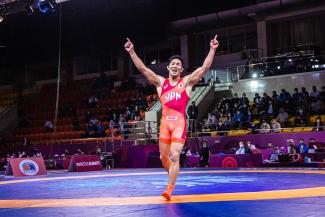
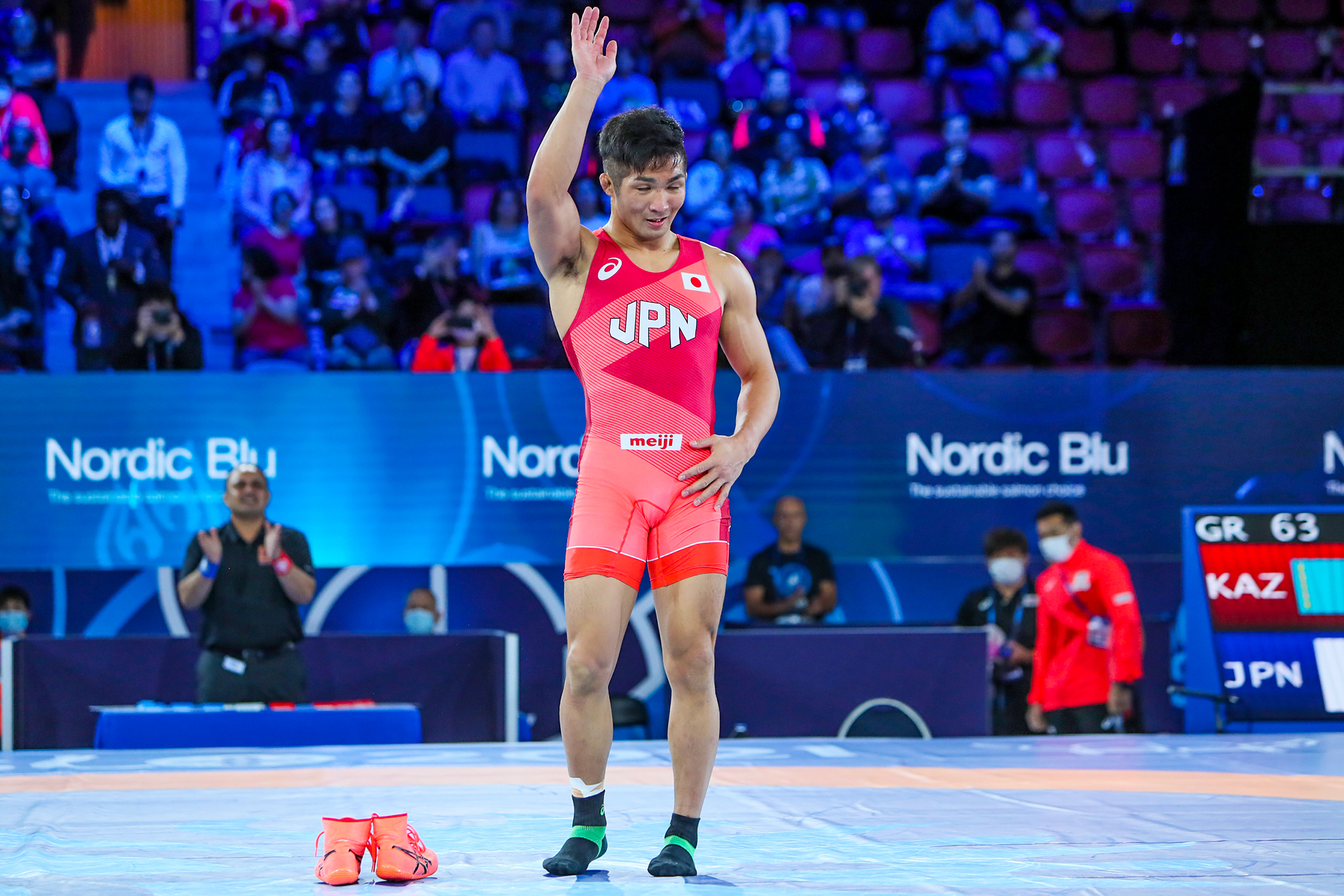 Tsuchika SHIMOYAMADA (AUS) had left his shoes on the mat during the 2021 World Championships to mark his retirement. (Photo: United World Wrestling / Martin Gabor)
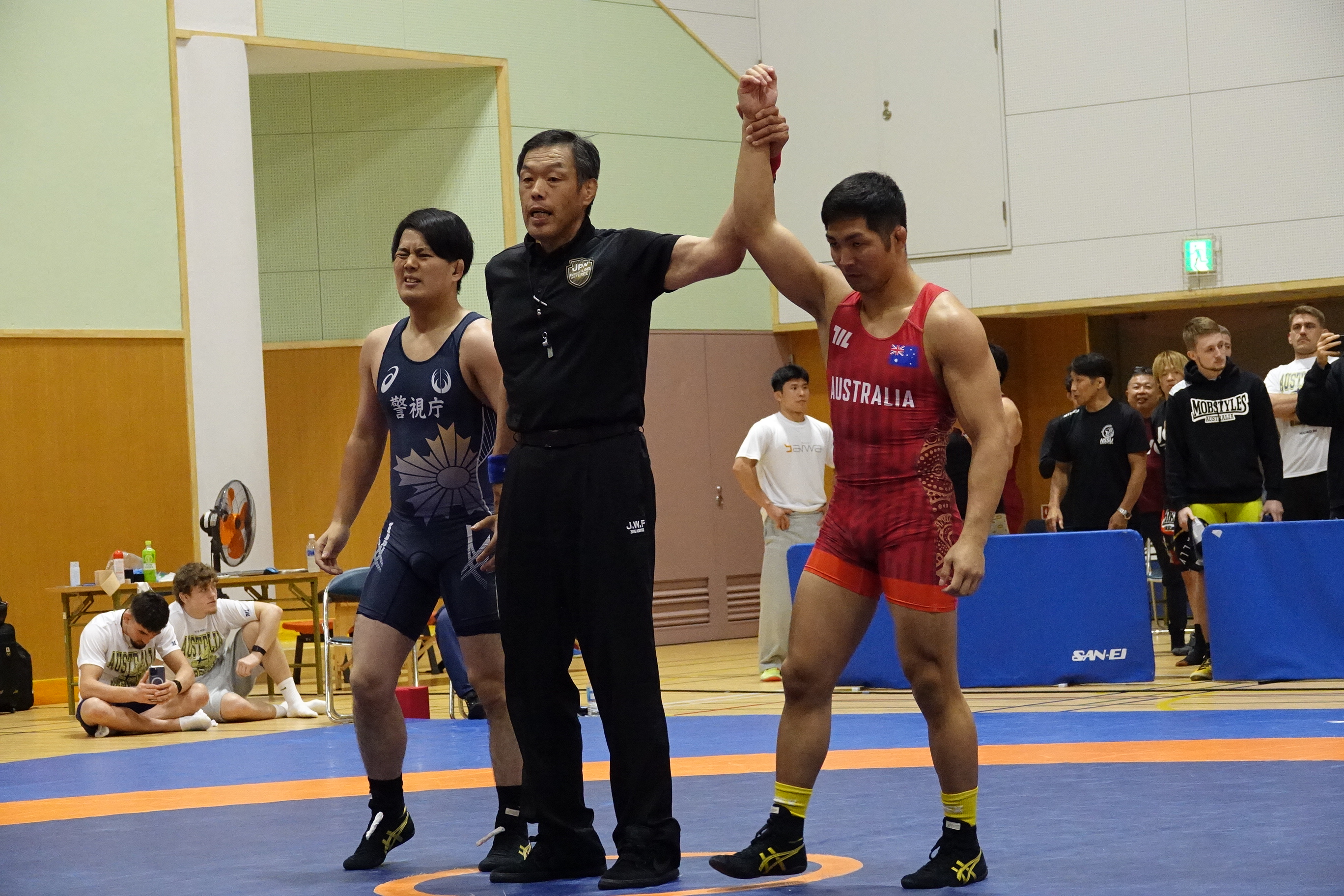 Tsuchika SHIMOYAMADA advances to the semifinals at the All-Japan Non-Student Championships in July with a 52-second win over Kokoro GOTO. (Photo: Koji Fuse / wrestling-spirits.jp)
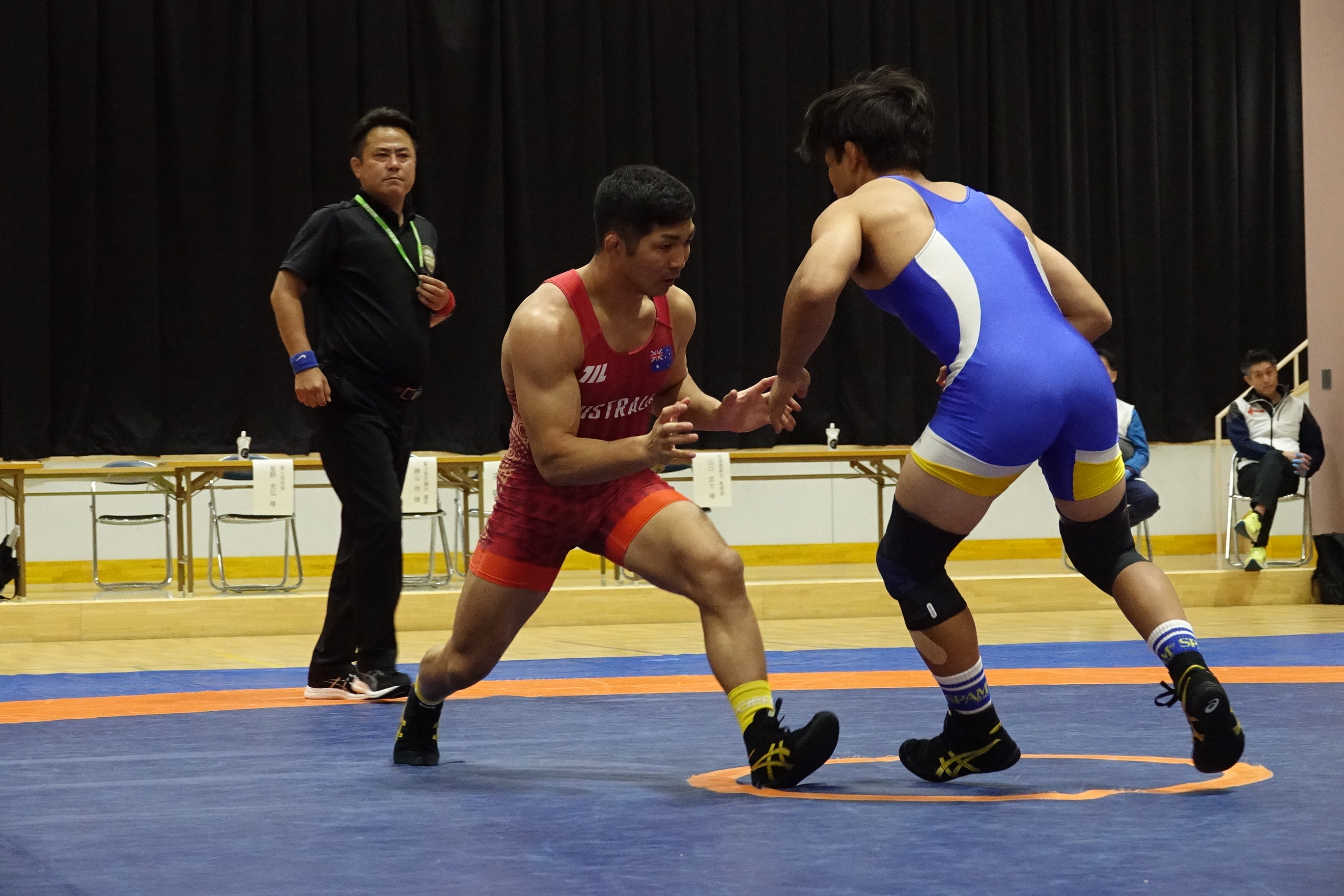 Tsuchika SHIMOYAMA faces Keitaro ONO in his opening match at the All-Japan Non-Student Championships in July. (Photo: Koji Fuse / wrestling-spirits.jp)
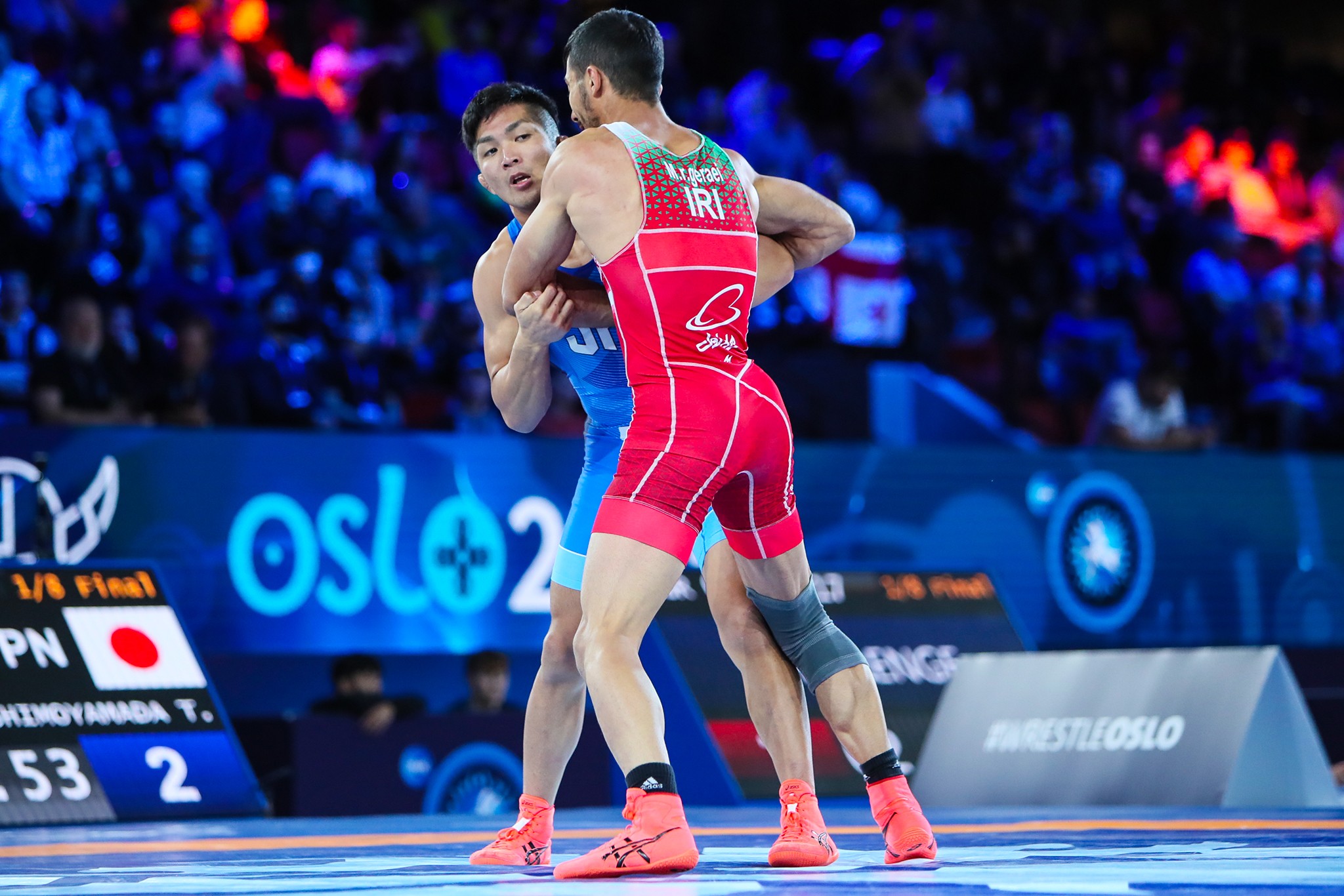 Tsuchika SHIMOYAMADA (AUS) was dominating Mohammadreza GERAEI (IRI) in their match at the 2021 World Championships before being pinned. (Photo: United World Wrestling / Martin Gabor)
Share your thoughts.
Comments