TOKYO (December 4) -- After winning both the U20 and senior world titles at freestyle 61kg within a two-month span in the autumn of 2024, Masanosuke ONO all but disappeared from the Japanese wrestling scene.
That culminated with his announcement in March this year that, having left Yamanashi Gakuin University, he had committed to wrestle at U.S. collegiate powerhouse Penn State. He has not been seen on the mats of Japan since.
Ono will compete once again in his home country, dropping down from 61kg to 57kg for the upcoming Emperor's Cup All-Japan Championships at Tokyo's Komazawa Gym, according to the entry list announced Thursday by the Japan Wrestling Federation.
The tournament, to be held December 18-21, will also serve as the domestic qualifier for next year's Asian Championships, and the first of two qualifiers for the Asian Games and World Championships in 2026.
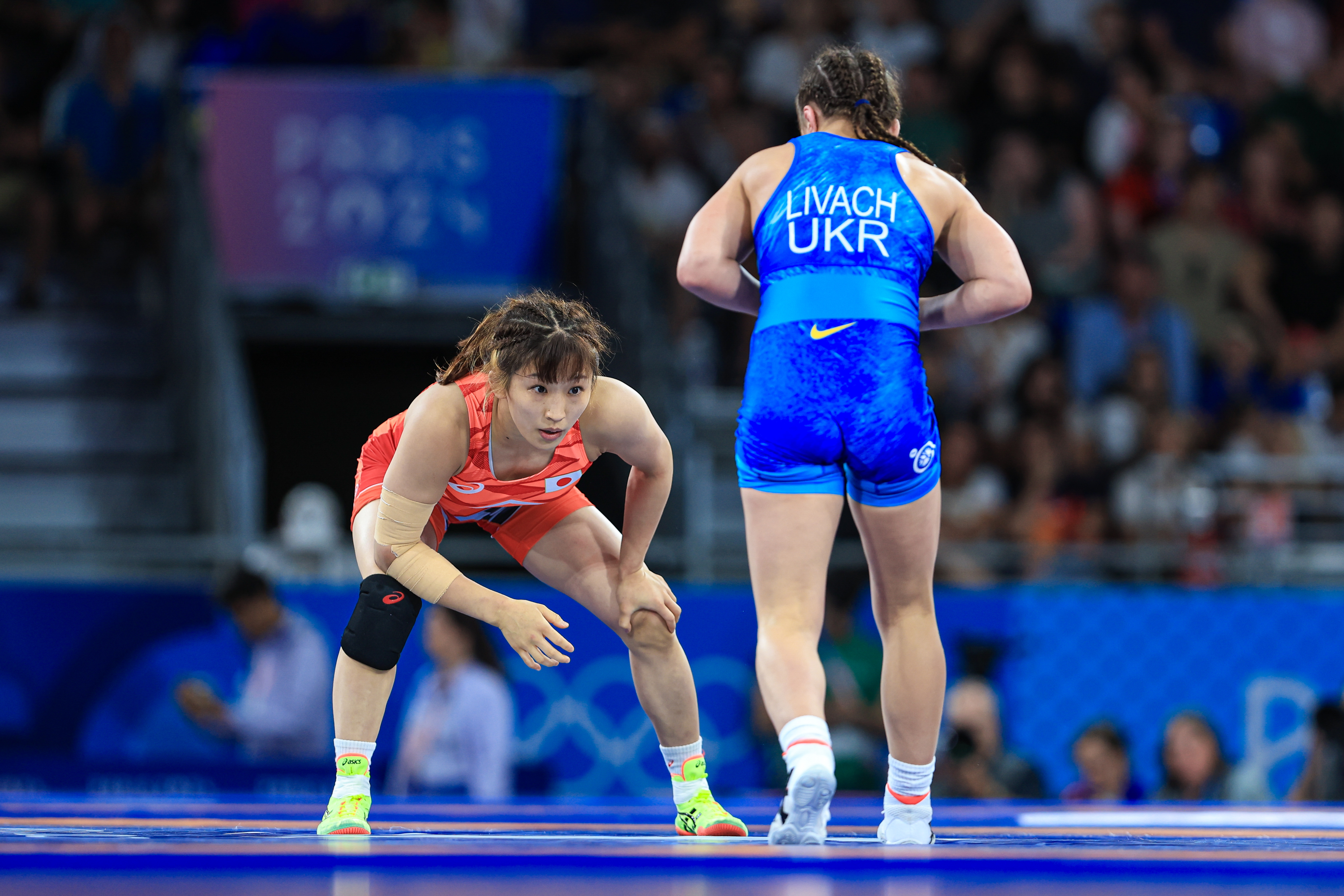 Yui SUSAKI (JPN) will compete at 50kg at the Emperor's Cup. (Photo: United World Wrestling / Amirreza Aliasgari)
Among other notable recent absentees appearing on the entry list is Yui SUSAKI, the 2021 Tokyo Olympic champion at 50kg who had to settle for a bronze at the 2024 Paris Olympics. She will compete at 50kg, putting to bed speculation that she might move up to the 53kg division.
"This will be a tournament to start me anew on the road to the Los Angeles Olympics," Susaki said in an online press conference with the Japanese media, as reported by Wrestling-Spirits.jp.
"In order to reclaim the gold medal at the Los Angeles Olympics, as a challenger starting from scratch, I want to win in a Yui Susaki-esque way of wrestling."
The 21-year-old Ono had been a question mark with the tournament falling in the middle of the Penn State season. But the decision to redshirt Ono -- the system of allowing him to train with the team while withholding him from competition to maintain an extra year of eligibility -- opened the door for him to make the trip back to Japan.
Assuming he does not have trouble making weight, he should be the class of the 57kg field, with his toughest competition most likely coming from two-time Asian bronze medalist Rikuto ARAI.
One opponent he won't have to contend with is Paris Olympic champion Rei HIGUCHI, who decided to continue delaying his return to action. Also missing is defending champion Rin SAKAMOTO, who was injured at the World Championships. With Sakamoto also across the Pacific at Oklahoma State University, it prevents a rare clash of U.S.-based wrestlers.
Susaki only returned to action in September, and both of her forays were at 53kg. That, and the well-publicized move up to 57kg by Akari FUJINAMI, the 53kg champion in Paris, fueled conjecture that Susaki might also move up.
Susaki started at the National Sports Festival, where she competed at 53kg if for no other reason that it was one of only two women's weight classes in the competition. She lost a defensive-oriented 2-1 decision to 2024 world 55kg champion Moe KIYOOKA in the quarterfinals, marking her first loss to a Japanese opponent in six years.
"Losing at the National Sports Festival gave me the chance to look inside myself," Susaki said. "The result was really disappointing, but I'm glad I took part and was grateful for the opportunity."
Now 26, the four-time world champion is firmly determined to regain the Olympic gold that eluded her in Paris with a heart-breaking last-second loss to Vinesh PHOGAT (IND) in the opening round.
"I truly was shown just how difficult and challenging it was to win at the Paris Olympics. It also gave me a chance to reflect on the preparation process leading up to the competition and what was needed mentally for the Olympics. I will work hard to use that experience to make sure I win the gold medal at the Los Angeles Olympics."
Susaki's top challengers at the Emperor's Cup appear to be world U23 bronze medalist Umi ITO and Haruna MORIKAWA, the world U23 champion at 53kg.
Meanwhile the presence of Fujinami, who added the world U23 title in October to her burgeoning resume, has been immediately felt at 57kg. Despite being an Olympic weight class, the division drew just nine others who will look to end the 21-year-old superstar's 147-match winning streak.
Her most potentially dangerous opponent could be Asian champion Sara NATAMI. At the National Sports Festival, she was losing 8-1 at 62kg to world 59kg champion Sakura ONISHI when she countered a takedown attempt by slamming her to her back for a fall.
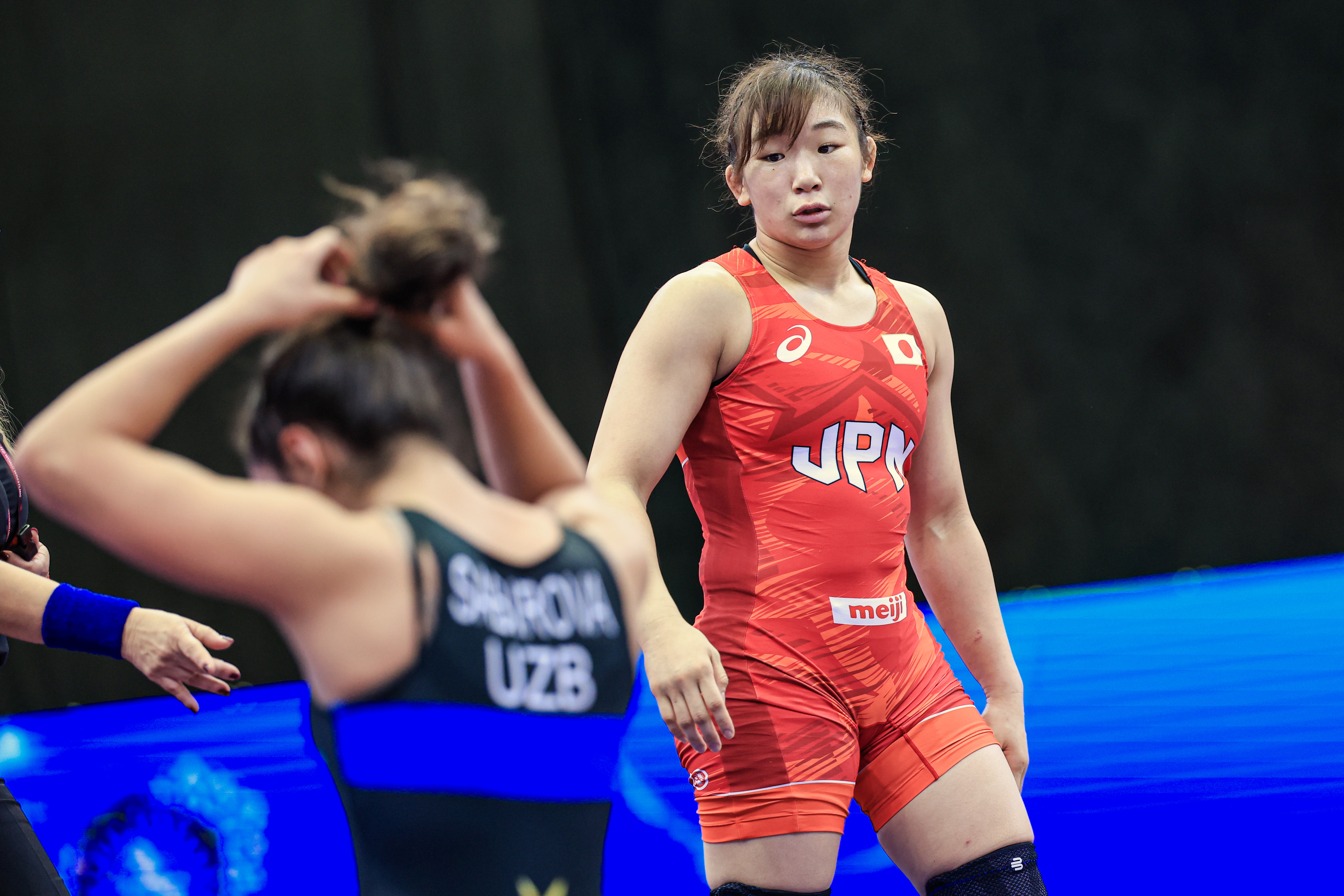 Paris Olympic and 2025 world champion Sakura MOTOKI (JPN). (Photo: United World Wrestling / Amirreza Aliasgari)
Golden trio at women's 62kg; returns of Paris champs Fumita, Kagami
As with any Japan competition that has world or Olympic berths at stake, a number of weight classes could see clashes between multiple wrestlers with global successes as they jockey for position in the run-up to the 2028 Los Angeles Olympics.
And in one case, there are three at once, while two other weight classes could have direct clashes of champions from this year's worlds in Zagreb, Croatia.
At women's 62kg, Paris and 2025 world gold medalist Sakura MOTOKI will renew her rivalry with two-time former world champion Nonoka OZAKI, while Onishi moves up from 59kg to join the mix and can't be overlooked.
At women’s 68kg, reigning world champion Ami ISHII could lock horns with Miwa MORIKAWA, the gold medalist at 65kg, while at freestyle 74kg, we could see a battle between Zagreb winner Kota TAKAHASHI and 70kg titlist Yoshinosuke AOYAGI.
Like Susaki, all of Japan's large group of Paris medalists took some time off to bask in the spotlight before gradually returning to the mat over the past two years.
Two of the remaining gold medalist holdouts -- Kenichiro FUMITA and Yuka KAGAMI -- will both take the mat for the first time since their Paris victories at the Emperor's Cup.
Fumita, who won an elusive gold medal in Paris at Greco 60kg after taking the silver at Tokyo 2021, is entered at 63kg, where he will aim for a fifth national title and first since 2022. Kagami is entered at her gold medal-winning weight of women's 76kg. Their own rustiness may be more of a factor then the opponents.
While away from competition, Fumita spent the ensuing time experimenting with different methods as he looks to expand his reportoire.
"I have some anxiety, but I'm also looking forward to it," Fumita told Wrestling-Spirits.jp. "I achieved my goal in Paris, and on top of that, I've been taking a good look at wrestling. it. It was a year and four months full of new experiences. This will be a battlefield to reveal my new wrestling. I want to show wrestling that is free and unrestrained."
Fumita said he observed the nerves shown by fellow Paris gold medalists Nao KUSAKA (Greco 77kg) and Kotaro KIYOOKA (freestyle 65kg) when they returned to mat ahead of him at the Meiji Cup All-Japan Invitational Championships last spring.
"Before their matches, both of them looked pale," Fumita said. "I want to focus on fighting without putting too much pressure on myself. For better or worse, I want to fight thinking of myself as a different person than I was in Paris."
Other intriguing weight classes include freestyle 65kg, where Kiyooka may have to contend with Asian champion Kaisei TANABE, Asian 61kg champion Takara SUDA and two-time world U20 champion Yuto NISHIUCHI.
Two gold medalists from Tokyo who took time off for marriage and childbirth are back, with Mayu SHIDOCHI (nee MUKAIDA) challenging Moe Kiyooka at women's 55kg and Yukako INAMURA (nee KAWAI) entered at 59kg.
In Greco, rising star Taizo YOSHIDA, a bronze medalist at both the U20 and senior worlds this year at 82kg, has moved up to 87kg, where he will challenge two-time defending champion So SAKABE.




Share your thoughts.
Comments