

UWW Five-Year Strategic Plan: Enhance Women's Wrestling, Transform Digitally
Wednesday, November 10, 2021 - 08:38 By Eric Olanowski

CORSIER-SUR-VEVEY, Switzerland (November 10) -- As United World Wrestling moves into another Olympic cycle after completing a successful Tokyo Olympics, it is keen on taking the next big step.
At the bi-annual Congress, held on the eve of the U23 World Championships in Belgrade, Serbia, UWW revealed its extensive five-year plan to enhance the sport. It has identified five key areas of focus over the next five years.
The areas identified following a comprehensive outreach program are women's wrestling, digital transformation, youth engagement, associated styles and the image of wrestling.
The five areas will be the priority at every competition through 2022-'26. The organization will implement a system to track the progress. United World Wrestling will provide national federations with roadmaps and resources that aim to help move forward together.
 UWW Congress was held in Belgrade, Serbia. (Photo: UWW / Kadir Caliskan)
Enhance and Empower Women's Wrestling
In line with the International Olympic Committee's focus on gender equality, UWW aims to create an optimal inclusive environment to achieve gender equality. Women's wrestling and its growth are a significant part of that program.
With the objective to communicate the potential of women's wrestling and create inclusivity at the sporting and organizational level, UWW will analyze the areas that can boost women's wrestling growth.
UWW's top priority before Paris Olympics is to identify the blockers in the growth of women's wrestling and the potential drivers that can provide that boost. It also plans to share inspiring case studies and launch women's achievement awards.
On the sporting front, the technical committee will review and adapt training methods and techniques, develop more female coaches, analyze rules for WW and review event presentation and delivery for all women competitions.
 UWW is keen on a digital-first approach. (Photo: UWW / Kadir Caliskan)
Embrace and Foster Digital Transformation
With a digital-first approach, UWW has achieved a pathbreaking system aiming to transform the sport and organization using digital tools.
Moving forward, it will create a roadmap by analyzing the current landscape and identifying the challenges that may arise, given the complex nature of the sport.
The inclusion of all stakeholders is essential to achieve a digital transformation with national federations, commissions, and even wrestlers. Therefore, UWW will build a universal understanding of the digital-first approach.
An internal team will be formed, where they'll be responsible for setting goals and preparing the stakeholders. They will also be responsible for reinforcing the technology adaptation at all levels.
It will be a huge step in fostering a digital culture, and with the support of national federations, training will be provided. By monitoring the trends, UWW can analyze the areas in which more work is needed.
UWW is also in the works to create a digital transformation dashboard to measure the global status and progress it makes with these changes.

Elevate and Inspire Youth Engagement
As the future of the sport lies in the hands of youth, UWW has made it a priority to reach out and engage youth for the future of our sport. The objectives outlined by UWW are to develop entry pathways for youth, connect and enhance youth competitions.
For that, UWW will encourage more schools to have wrestling programs, inspire more girls to wrestle, and even prepare programs between countries. It also aims to connect via demonstrating shared values, promoting youth wrestling stories and creating youth awards.
UWW will analyze industry best practices, test new event activation ideas at competitions of all styles and age categories, and evaluate the impact to enhance youth competitions.
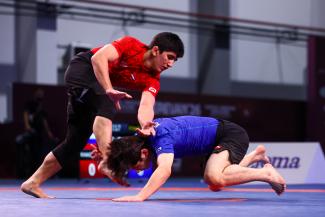
 Grappling is one of UWW's most important Associated Styles. (Photo: UWW / Max Rose-Fyne)
Support and Connect Associated Styles
Given the history of the sport, UWW embraces many different wrestling styles and aims to grow all styles under one umbrella.
For the best results in associated styles, UWW will clarify the objectives by capturing the current landscape of the different styles around the world and gathering input on the priorities and objectives.
It also aims to establish better connections by creating a global UWW Summit for all styles and fostering knowledge and best practices. Connecting all styles remains a priority for the organization, and it will keep testing new approaches for that.
UWW will review the competition system and increase cross-promotion by facilitating education about different styles to create synergy and a win-win situation for every style.
Revamp and Reinforce Image of Wrestling
UWW has done it before and now it is time to take it to the next level. In a need to be better at showcasing the strengths of both wrestling and UWW, it will showcase the unique and attractive image of wrestling to audiences worldwide.
At the first step, UWW will clarify the image gap and revamp it. The organization then plans to reinforce and multiply the message about the sport and how it's run.
It is undoubtedly a process, but to determine how it wants to be looked at, UWW will analyze how it is seen in the current scenario. Clarifying the image gap will also need to the gap internally and externally.
By identifying the intangible strength of wrestling, UWW aims to produce new and attractive material and have new activities to showcase its image.
A huge part in promotion is played by the national federations, and UWW will support them and seek to develop new partnerships to amplify the new image. It will also create awards to share positive stories.
While UWW will not lag in these initiatives, only a united effort will be needed to support and activate activities at the regional and national levels. It has invited all national federations to send regular feedback and even share ideas to make wrestling a better sport.
Share your thoughts.
Comments