

USA push three into Tuesday's U20 world finals
Monday, August 15, 2022 - 19:24 By Vinay Siwach

SOFIA, Bulgaria (August 15) -- Perhaps it is the James GREEN effect. The USA, which won the freestyle team title at the U17 World Championships two weeks ago, continued its dream run under coach Green and emerged as the best team on day one of the U20 World Championships on Monday.
Green took over the coach just a month ago and is aiming to win the second team title in as many World Championships.
After entering four wrestlers in the semifinals, the USA managed to send three wrestlers to Tuesday's gold medal bouts. Azerbaijan was the next best team with two finalists. Kazakhstan, Uzbekistan, Armenia and Turkey were the five other countries that managed to have a wrestler each in the final.
All three of the USA wrestlers used their high-paced wrestling to win after trailing initially in the semifinal.
 Jore VOLK (USA) reached the 57kg final after beating Luka GVINJILIA (GEO) 13-6. (Photo: UWW / Kostadin Andonov)
At 57kg, Jore VOLK (USA) had to do it more than once. Wrestling Ahmad JAVAN (IRI) in the opening bout, Volk led 3-3 on criteria at the break and added another takedown to lead 5-3. But Javan, who was one win away from making the Iran senior World Championships team, took the criteria lead with 36 seconds left on the clock. He then tried defending it but Volk managed to put Javan's on the mat just before the final whistle to win 7-5.
In the semifinals, Luka GVINJILIA (GEO) opened with exposure but Volk with a takedown to lead 2-2 on criteria at the break. He upped the pace in the second and began with a takedown and Gvijilia was cautioned for fleeing. The bout restarted in par terre from which Volk made it 13-4. But it was too late for Gvijilia as he lost 13-6.
Volk will now wrestle U20 Asian champion Merey BAZARBAYEV (KAZ) as he defeated Heorhii KAZANZHY (UKR), 6-4, in a back-and-forth semifinal. Kazanzhy opened up a 4-0 lead with two exposures when Bazarbayev was trying to chest wrap Kazanzhy.
But the Kazakhstan wrestler, who defeated Abhishek DHAKA (IND) 5-1 in the quarterfinal, scored a takedown and a lace to lead 4-4. With the time running out, Bazarbayev continued his attacks and ultimately got the single leg to lead 6-4. He defended it for the final 47 seconds.
In another USA-Georgia semifinal, Benjamin KUETER (USA) made the gold medal bout after a 31-point slugfest against Luka KHUTCHUA (GEO) at 97kg.
Kueter came back from an 8-0 deficit after Khutchua scored a go-behind and rolled him thrice. He answered with a go-behind and then an arm-trap exposure to cut the lead to 8-4. The bout tilted in Kueter's favor when he managed to take a 9-9 criteria lead at the break against a tiring Khutchua.
The second period saw Kueter more attacks and he made it 15-10 before Khutchua managed a takedown and gut. While going for the second gut, Khutchua lost the grip and Kueter held in danger for the final 35 seconds to win 17-14.
 Rifat GIDAK (TUR) put on a defensive masterclass to beat Amirali AZARPIRA (IRI) in the 97kg semifinal. (Photo: UWW / Kostadin Andonov)
He will now have the rising star and '21 U17 world champion Rifat GIDAK (TUR) who stunned U20 Asian champion Amirali AZARPIRA (IRI), 6-4 in the semifinal.
After a slow start to the bout, Gidak opened the second period with a duck under to lead 2-1. A stepout and caution against Azarpira extended his lead to 4-1. Azarpira found it difficult to remain at the same pace as Gidak and conceded a counter takedown.
Though he got hold of Gidak on a couple of occasions, Azarpira could not convert them into takedowns. It was only late in the bout that he scored two stepouts but it was too little too late.
The third USA wrestler to reach the final was Mitchell MESENBRINK (USA) as he defeated Hayk PAPIKYAN (ARM), 6-3, in the semifinal after being down 3-0. As the second period began, he strung together three takedowns and ended the bout 6-3.
 Kanan HEYBATOV (AZE) come back from 3-0 deficit to beat Mulaym YADAV (IND) 5-3 in the 70kg semifinal. (Photo: UWW / Kadir Caliskan)
The other semifinal followed a similar script with Kanan HEYBATOV (AZE) winning it 5-3 against Mulaym YADAV (IND) after being behind 3-0 at the break.
Heybatov got a single leg to score a takedown at the edge after Azerbaijan challenged the neutral call. With just 18 seconds left, Heybatov managed to get a stepout and the lead.
Yadav almost scored a takedown over Heybatov but referees called it neutral as both wrestlers were grounded when going out of the zone. India challenged the call and on review, Heybatov was awarded a stepout and one more point for the lost challenge.
 U20 Asian champion Sobhan YARI (IRI) reached the 79kg final in Sofia. (Photo: UWW / Kadir Caliskan)
Iran and Armenia clash for the 79kg gold after Sobhan YARI (IRI) and Mushegh MKRTCHYAN (ARM) made it to the final.
Yari ended the hopes of a finalist for Georgia as he defeated Otari ADEISHVILI (GEO), 9-6, in a close encounter. He led 5-4 at the break but Adeishvili scored a takedown to lead 6-4. But Yari got the better of Adeishvili as the Georgian began to feel the heat of Yari's attack.
Mushegh MKRTCHYAN (ARM) will try to spot Yari from winning the gold after he made the final with a narrow 2-2 win over Mukhammad ABDULLAEV (KGZ).
The match was all but over with Abdullaev leading 2-0 with 20 seconds remaining. But Mkrtchyan found a final boost of energy and scored a takedown with 15 seconds remaining to win.
 Ziraddin BAYRAMOV (AZE) defeated Sujeet KALKAL (IND) to reach his second straight U20 Worlds final. (Photo: UWW / Kostadin Andonov)
At 65kg, returning silver medalist Ziraddin BAYRAMOV (AZE) will try to upgrade his medal from Ufa after he handed Sujeet KALKAL (IND) his first international defeat in the semifinal.
Bayramov seemed to have studied Kalkal's style of wrestling with underhooks and snapdowns and did not engage in any scrambles. Instead of allowing Kalkal to control the bout, Bayramov countered with single-leg attacks.
He scored the first two via steptous before blasting a double-leg for another takedown and lead 6-0. He went into a defensive mode in the second period but still managed to keep Kalkal from attacking. A late takedown gave the Indian two consolation points.
Bayramov will have to come up with another top performance if he wants to win the final against former U17 world champion Umidjon JALOLOV (UZB).
Jalolov will be looking to make amends from last year's World Championships in which he finished 10th after suffering a 6-6 loss to Abulfaz NASIROV (AZE) in his opening bout.
But in Sofia, he outscored his opponents 30-2 in the three bouts before the semifinal in which he faced Robert CORNELLA (USA) who reached the last four after scoring a final second takedown against Mohammad Reza SHAKERI (IRI) to win 6-5.
Jalolov was up 2-0 after two passivity calls against Cornella and he then scored a cradle exposure with an ankle pick to lead 4-0 and win the bout.
The remaining five freestyle weight classes will be in action on Tuesday along with the medal bouts of Monday's weights.

RESULTS
57kg
GOLD: Jore VOLK (USA) vs. Merey BAZARBAYEV (KAZ)
SF 1: Jore VOLK (USA) df. Luka GVINJILIA (GEO), 13-6
SF 2: Merey BAZARBAYEV (KAZ) df. Heorhii KAZANZHY (UKR), 6-4
65kg
GOLD: Umidjon JALOLOV (UZB) vs. Ziraddin BAYRAMOV (AZE)
SF 1: Umidjon JALOLOV (UZB) df. Robert CORNELLA (USA), 4-0
SF 2: Ziraddin BAYRAMOV (AZE) df. SUJEET (IND), 6-2
70kg
GOLD: Mitchell MESENBRINK (USA) vs Kanan HEYBATOV (AZE)
SF 1: Mitchell MESENBRINK (USA) df. Hayk PAPIKYAN (ARM), 6-3
SF 2: Kanan HEYBATOV (AZE) df. Mulaym YADAV (IND), 5-3
79kg
GOLD: Sobhan YARI (IRI) vs. Mushegh MKRTCHYAN (ARM)
SF 1: Sobhan YARI (IRI) df. Otari ADEISHVILI (GEO), 9-6
SF 2: Mushegh MKRTCHYAN (ARM) df. Mukhammad ABDULLAEV (KGZ), 2-2
97kg
GOLD: Benjamin KUETER (USA) vs. Rifat GIDAK (TUR)
SF 1: Benjamin KUETER (USA) df. Luka KHUTCHUA (GEO), 17-14
SF 2: Rifat GIDAK (TUR) df. Amirali AZARPIRA (IRI), 6-4
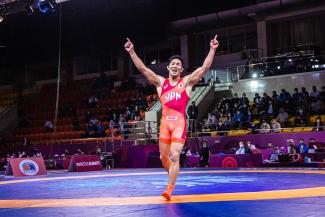
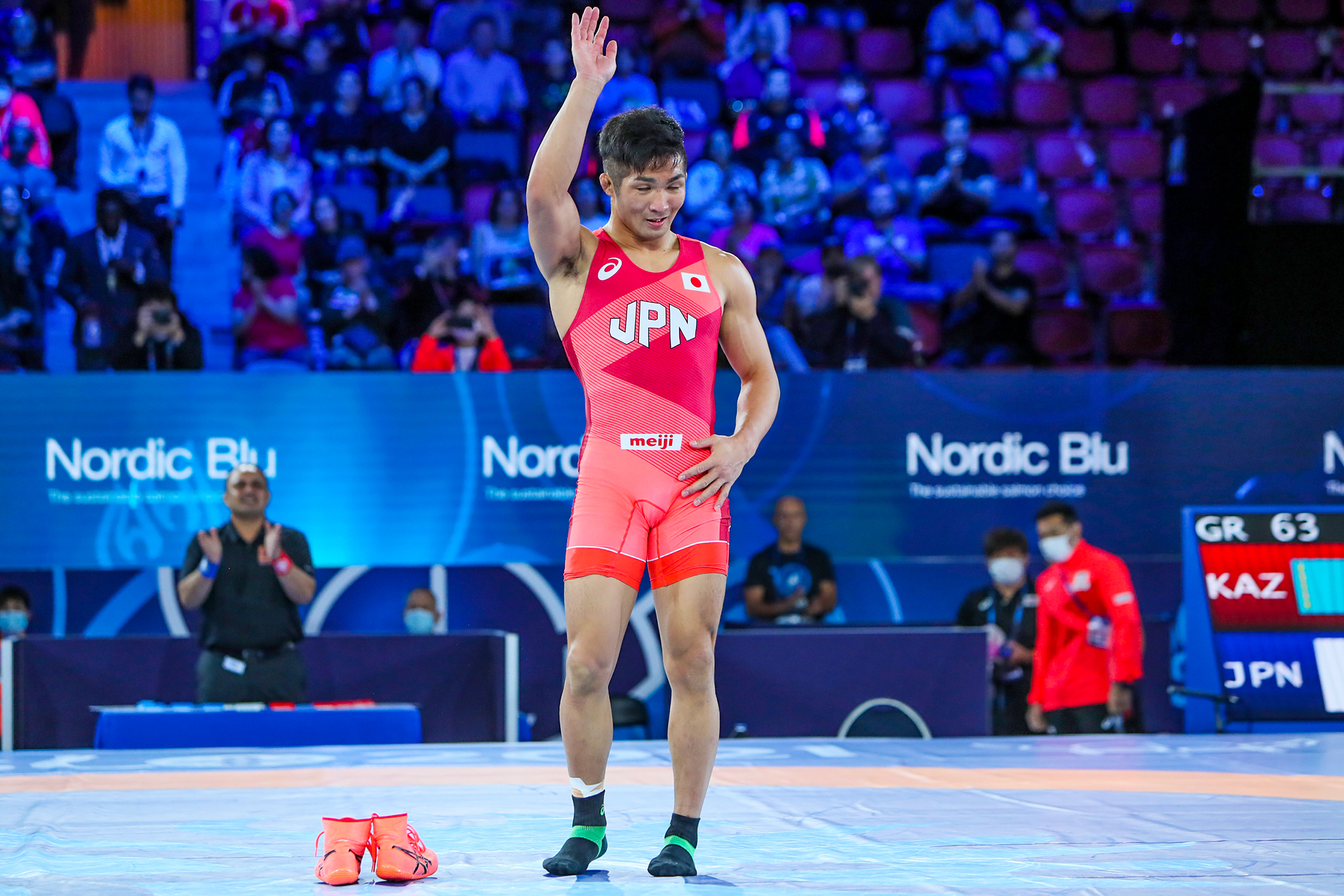 Tsuchika SHIMOYAMADA (AUS) had left his shoes on the mat during the 2021 World Championships to mark his retirement. (Photo: United World Wrestling / Martin Gabor)
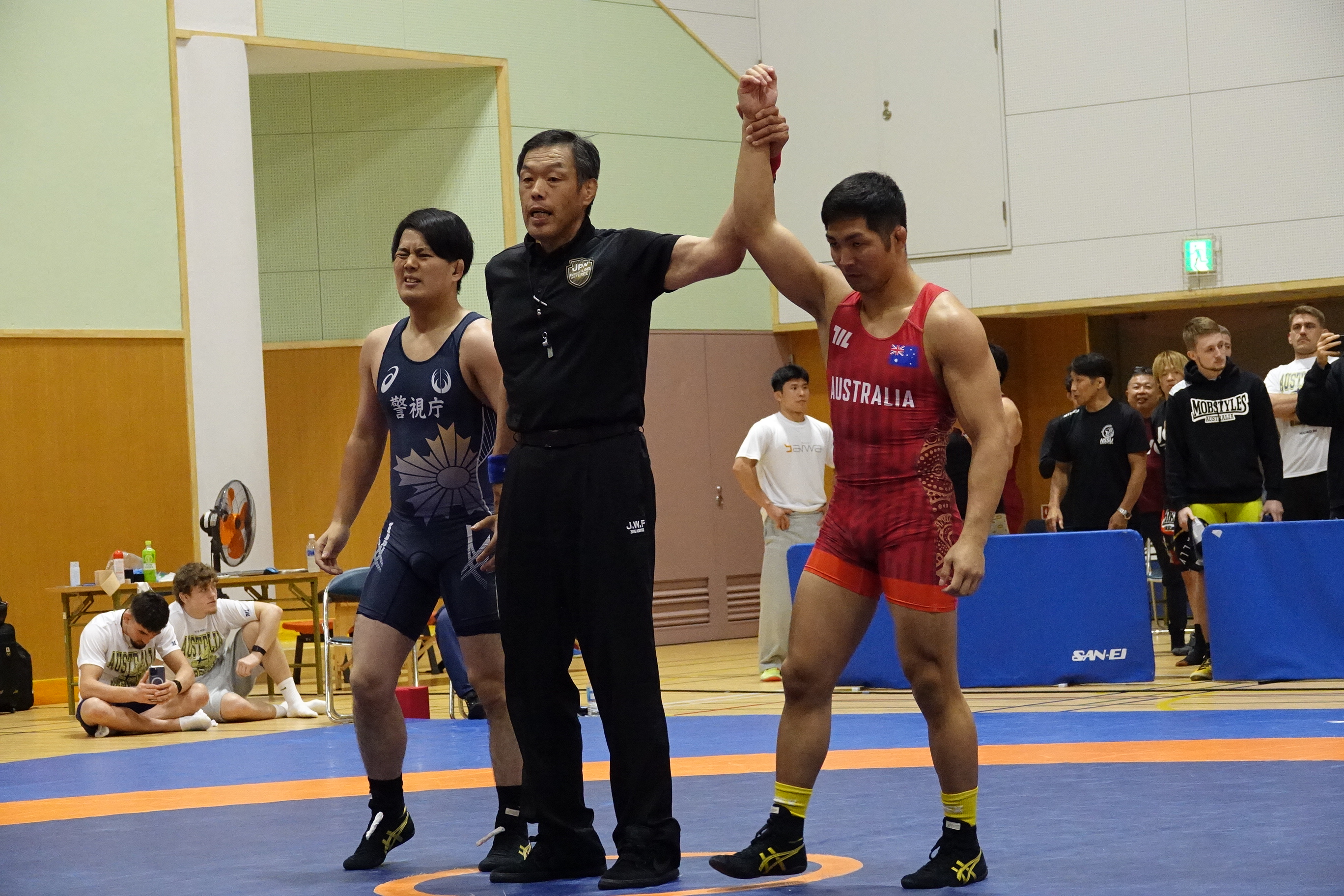 Tsuchika SHIMOYAMADA advances to the semifinals at the All-Japan Non-Student Championships in July with a 52-second win over Kokoro GOTO. (Photo: Koji Fuse / wrestling-spirits.jp)
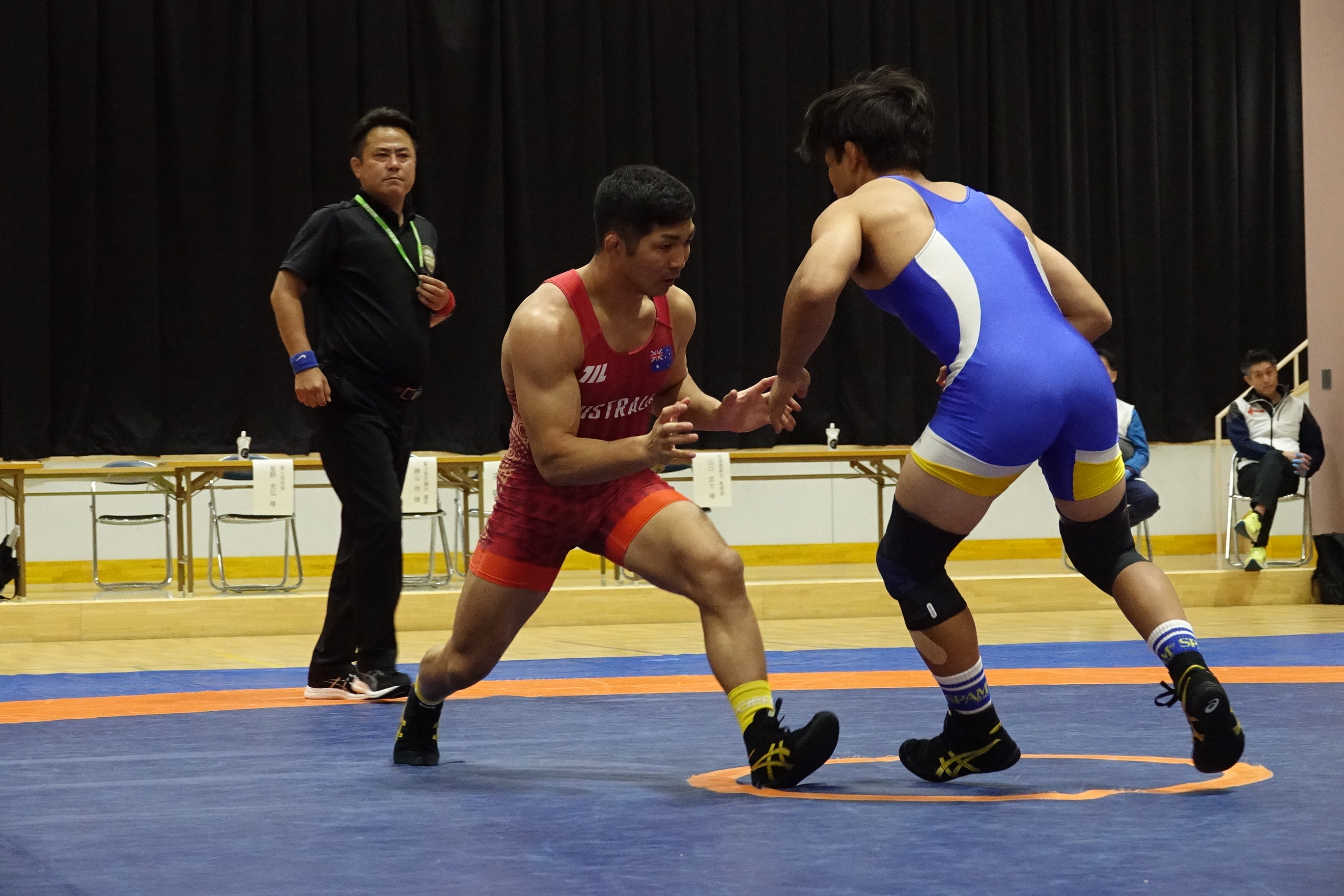 Tsuchika SHIMOYAMA faces Keitaro ONO in his opening match at the All-Japan Non-Student Championships in July. (Photo: Koji Fuse / wrestling-spirits.jp)
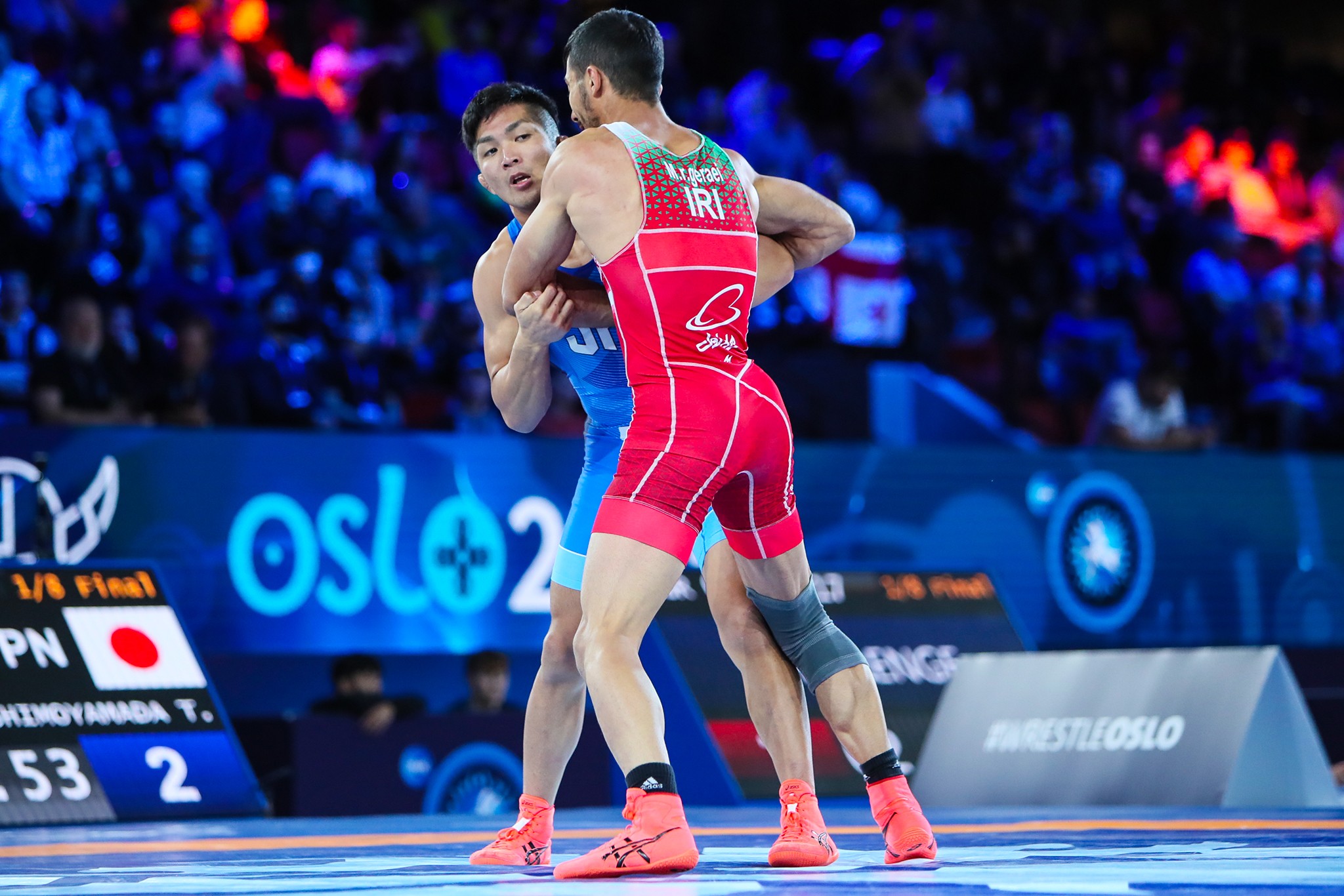 Tsuchika SHIMOYAMADA (AUS) was dominating Mohammadreza GERAEI (IRI) in their match at the 2021 World Championships before being pinned. (Photo: United World Wrestling / Martin Gabor)
Share your thoughts.
Comments