

Tynybekova continues dominance of Motoki for 6th Asian gold; Feng stuns Sakurai
Sunday, April 14, 2024 - 17:01 By Ken Marantz

BISHKEK, Kyrgyzstan (April 14) -- Throughout a sparkling career that has made her a hero in her homeland, Aisuluu TYNYBEKOVA (KGZ) has had a fierce rivalry with a number of Japanese wrestlers. The latest in the line has yet to find a way to break through and beat her.
Tynybekova continued her dominance of Sakura MOTOKI (JPN), using her counterattack style to maximum effect in a 9-6 victory in the women's 62kg final at the Asian Championships on Sunday in Bishkek, giving her a second straight gold and sixth of her career in front of an adoring home crowd.
"Throughout my career, I never got the chance to compete in Kyrgyzstan," Tynybekova said. "This year, when I found out the Asian Championships would be in Kyrgyzstan, I really wanted to compete in front of the home crowd. I am so happy that despite my physical condition, I could win the gold."
In the biggest upset of the tournament, Yongxin FENG (CHN) shocked three-time world champion Tsugumi SAKURAI (JPN) at 57kg as China came away with two of the four other golds at stake on the fourth day of competition at Bishkek Arena with Qian JIANG (CHN) prevailing at 72kg.
Ji Hyang KIM (PRK) gave DPR Korea its first gold medal in its return to the Asian Championships after a five-year absence with an impressive victory at 53kg, while Mahiro YOSHITAKE (JPN) triumphed at 65kg to ensure that the Japanese anthem would be played at least once on the night.
Japan, with four golds overall, barely won the team title for the third straight year with 173 points, just one point ahead of China and its three champions. Mongolia finished third with 138, three points ahead of India.
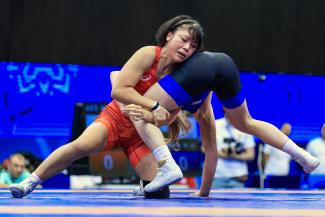
 Aisuluu TYNYBEKOVA (KGZ) uses a couter lift against Sakura MOTOKI (JPN) in the 62kg final during the Asian Championships. (Photo: United World Wrestling / Amirreza Aliasgari)
Tynybekova revealed that she got seriously ill after winning the title at last month's Yasar Dogu tournament in Antalya, Turkey, and even considered pulling out of the Asian Championships, where she now has 11 total medals.
"Two weeks before this continental championships, my coach Nurbek Izabekov proposed not to wrestle here because I didn’t fully recover," the three-time world champion said. "I spent two weeks lying in bed. Despite all this, I am so happy to be able to compete successfully."
Tynybekova, who made Kyrgyz history when she became the nation's first-ever wrestling world champion in 2019, has had her share of wins and losses contending with Japanese opponents through the years. First, there was Yukako KAWAI (JPN), who defeated her in the Tokyo Olympics final, then along came Nonoka OZAKI (JPN), who beat her in the 2022 Asian final.
Motoki, the 2022 world bronze medalist at 59kg, became the next in line when she moved up to 62kg and beat out Ozaki and Kawai in qualifying for the Paris Olympics. But Sunday's loss to Tynybekova was her third loss in three meetings over a seven-month span, and this was not as close as the first two.
"I would like to say that there are no easy or tough opponents," Tynybekova said. "It all depends on my physical condition on that exact day. That’s why me and my coaches will prepare to wrestle every single wrestler in my weight class."
In their first clash, Tynybekova pulled off a late 4-1 victory in the final at last year's World Championships in Belgrade. They met again in the semifinals at the Zagreb Open in January, where Tynybekova eked out a 3-3 win on criteria.
On Sunday, it was Tynybekova who took the early lead, gaining an activity point and then scoring a takedown after throwing Motoki off balance with a snap-down to go ahead 3-0.
In the second period, Motoki had no choice but to press for a takedown, but that was walking right into Tynybekova's trap. In a typical Tynybekova scramble, she initiated a counter lift from which she would score six points while conceding two to Motoki to go up 9-2.
Motoki managed a pair of consolation takedowns in the final 15 seconds, but could not gain additional exposures.
"I lost at the World Championships, then again in Croatia, and this time I wanted to get revenge," said a sobbing Motoki, whose father appeared in the 2000 Sydney Olympics. "I got various advice from a lot of people, and I came to this tournament with confidence. But my opponent was a level better than me today."
 Yongxin FENG (CHN) celebrates after beating world champion Tsugumi SAKURAI (JPN) in the 57kg final during the Asian Championships. (Photo: United World Wrestling / Kostadin Andonov)
Just as Yui SUSAKI (JPN) experienced the night before, Sakurai was dealt a wake-up call at a tournament that she was using as her final competition before the Paris Olympics. The difference is that Susaki held on to win the 50kg title, while Sakurai was dealt her first defeat in an international tournament in five years when she fell 5-2 to Feng.
Feng, a bronze medalist at the Zagreb Open this year, wrestled a strategically perfect match, grabbing an early lead and then all but neutralizing Sakurai's 2-on-1 attack. It would not be until the end of the match that Sakurai could get close to creating a scoring chance.
"First of all, I believed in my skills, and secondly, in terms of all aspects of my skills and physical condition, I am better than her, so I am more confident," Feng said.
Feng seemed to catch Sakurai flat-footed when she took a shot right off the opening whistle, scoring a takedown with a low single. Before Sakurai realized what had hit her, Feng added two more points with a gut wrench for a 4-0 lead.
"After I scored points in the first period, it made me more confident," Feng said. "Then in the second, I didn't try for many points because of my [earlier] points. I was thinking about being defensive. But I didn't think about defense throughout the whole process. I still want to score more points if I have the opportunity so that I can win for sure."
It would not be until the final minute that Sakurai finally got a clear shot and was able to get in on a double-leg takedown. As Feng reached over for a counter lift, Sakurai pressed ahead for a 2-point expoure.
But time ran out before she could add to the tally, and an unsuccessful challenge looking for a second exposure gave Feng her final point.
"The performance of the Chinese team has been very good," Feng said. "In terms of training, we train so hard, should we have such results? Yeah. I will train hard next and keep doing it. When I get off the podium, everything will be zero. I will continue to work hard."
Sakurai, last October's Asian Games champion and who had won the senior Asian title in her only other appearance in 2022, acknowledged that her opponents are doing their homework, and she will have to come up with a new strategy.
"I think everyone knows my style of wrestling," the 22-year-old Sakurai said. "I have to train so that even if I get stopped, I can still find a way to score points."
Sakurai won her first world title at 55kg in 2021, then moved up to the Olympic weight of 57kg and won back-to-back world golds. Just to get to last year's World Championships, where she secured her ticket to the Paris Olympics, she had to win out in a stacked domestic field that included two-time Olympic champion Risako KINJO (JPN). Her down-to-the-wire battles with Sae NANJO (JPN) were epic.
Now she needs to rebound from the shock of her first international defeat since losing 3-2 to Batbaatar ENKHTSETSEG (MGL) at the 2019 Asian U20 Championships.
"No matter the tournament, my objective is always to win the title," Sakurai said. "When you lose, there has to be a reason for the loss. I will look at this as I'm glad it wasn't the Olympics, and I will practice hard up to August."
 Mahiro YOSHITAKE (JPN) won the 65kg final via fall. (Photo: United World Wrestling / Kostadin Andonov)
In the 65kg final, Yoshitake beat Enkhjin TUVSHINJARGAL (MGL) at her own game, winning by fall to improve on her silver medal from a year ago in Astana.
After gaining an activity point, Yoshitake was under pressure from Tuvshinjargal, but she used it to unleash a headlock throw late in the first period to go ahead 3-0.
In the second period, Tuvshinjargal shot in on the legs, and Yoshitake slipped in underhooks, then pancaked the Mongolian to her back for the fall in 3:05.
Yoshitake, a winner in Antalya last month, became the third wrestler from Nippon Sports Science University to win a gold in Bishkek, following Kento YUMIYA (JPN) and Kota TAKAHASHI (JPN) in freestyle.
 Ji Hyang KIM (PRK) celebrates after beating ANJU (IND) in the 53kg final at the Asian Championships. (Photo: United World Wrestling / Amirreza Aliasgari)
At 53kg, Kim capped a day of dominance with a quick 10-0 victory in the final over ANJU (IND), adding the senior gold to her Asian cadet title from 2019.
Kim shot right off the whistle for a low single which she converted into a takedown, then added an exposure. Back on their feet, she made it 8-0 with a shrug-by takedown and exposure, then finished the match with another shrug-by, all in just over a minute.
Kim won all four of her matches by either fall or technical fall in a weight class that was supposed to feature reigning world champion Akari FUJINAMI (JPN), but who withdrew due to an elbow injury. The DPR Korea has entered a different wrestler in the Asian Olympic Qualifier that follows this event on April 19-21 in the same venue.
 Qian JIANG (CHN) defeated HARSHITA (IND) in the 76kg final. (Photo: United World Wrestling / Amirreza Aliasgari)
In the final bout of the night and the women's competition, China's Jiang, the 2019 Asian U20 champion at 76kg, scored a takedown in each period in defeating world U20 bronze medalist HARSHITA (IND) 5-2 for the 72kg gold.
Jiang took a 3-0 lead in the first period with a stepout and a snap-down takedown. In the second period, Harshita gained a 2-point exposure countering a takedown attempt. But Jiang came back with a spin-behind takedown to clinch the victory.
Mongolia claims 3 bronzes amid fall-fest
Of the 10 bronze-medal matches, only one went the distance, and Mongolia came away with three via falls by Otgontuya CHINBOLD (MGL) at 53kg, Tserenchimed SUKHEE (MGL) at 62kg and Bolortungalag ZORIGT (MGL) at 72kg, while India and Kazakhstan had two each.
Not everything went the Mongolians' way -- Gantuya ENKHBAT (MGL) was on the losing end of a technical fall at 57kg.
Chinbold, the silver medalist last year at 55kg, used a hip throw to send Thi My Trang NGUYEN (VIE) directly to her back and finish her off with a fall in 1:42.
Sukhee, a 2015 world silver medalist, took home her fourth Asian bronze and first in five years when, after a second takedown against Subeen JO (KOR), she trapped her opponent's leg against her chest, then pressed down from above for a pin in 2:42.
Zorigt took the longest of three, pancaking Nurzat NURTAEVA (KGZ), the Asian Games silver medalist at 68kg, in the second period to end the match in 3:49 with a 7-0 lead.
In the only match that went the full six minutes, Chun LEI (CHN) denied Sri Lanka its first-ever senior Asian medal when she scored a first-period takedown off a fireman's carry, then held on for a 2-0 victory over impressive teenager Nethmi AHINSA (SRI) at 53kg.
Ahinsa was the first-ever Sri Lankan woman to make it to a bronze-medal match, and just the third wrestler overall. Lei was the 2018 champion at 50kg.
India's bronzes came from MANISHA (IND), who recorded a fall in 1:30 at 62kg over Arian CARPIO (PHI) after a 4-point takedown, and ANTIM (IND) by forfeit from Soobin KIM (KOR), who suffered a knee injury in her opening match at 65kg in the afternoon session.
For Kazakhstan, Laura ALMAGANBETOVA (KAZ) needed just 55 seconds to throw Sezim ZHUMANAZAROVA (KGZ) to her back with a 4-point takedown and won by fall at 57kg, while Anastassiya PANASSOVICH (KAZ) scored five takedowns in a 10-0 technical fall over Ozoda ZARIPBOEVA (UZB).
Yaru WU (CHN) won China's second bronze of the night by pinning Irina KAZYULINA (KAZ) at 65kg. Wu had an 8-0 lead after a takedown and three tilts when Kazyulina came back with a takedown. But Kazyulina got careless trying for a reverse cradle, and Wu clamped down for a fall at 1:49.
Hyon Ju YUN (PRK) won the other bronze at 57kg when she broke open a close match with Mongolia's Enkhbat by scoring 10 points in the second period for a 12-1 win with five seconds left in the match.

Day 4 Results
Women's Wrestling
53kg (15 entries)
GOLD: Ji Hyang KIM (PRK) df. ANJU (IND) by TF, 10-0, 1:06
BRONZE: Otgontuya CHINBOLD (MGL) df. Thi My Trang NGUYEN (VIE) by Fall, 1:42 (4-0)
BRONZE: Chun LEI (CHN) df. Nethmi PORUTHOTAGE (SRI), 2-0
57kg (9 entries)
GOLD: Yongxin FENG (CHN) df. Tsugumi SAKURAI (JPN), 5-2
BRONZE: Laura ALMAGANBETOVA (KAZ) df. Sezim ZHUMANAZAROVA (KGZ) by Fall, :55 (4-0)
BRONZE: Hyon Ju YUN (PRK) df. Gantuya ENKHBAT (MGL) by TF, 12-1, 5:55
62kg (10 entries)
GOLD: Aisuluu TYNYBEKOVA (KGZ) df. Sakura MOTOKI (JPN), 9-6
BRONZE: Tserenchimed SUKHEE (MGL) df. Subeen JO (KOR) by Fall, 2:42 (4-0)
BRONZE: MANISHA (IND) df. Arian CARPIO (PHI) df. by Fall, 1:30 (5-0)
65kg (9 entries)
GOLD: Mahiro YOSHITAKE (JPN) df. Enkhjin TUVSHINJARGAL (MGL) by Fall, 4:03 (7-0)
BRONZE: ANTIM (IND) df. Soobin KIM (KOR) by inj. def.
BRONZE: Yaru WU (CHN) df. Irina KAZYULINA (KAZ) by Fall, 1:49 (10-2)
72kg (9 entries)
GOLD: Qian JIANG (CHN) df. HARSHITA (IND), 5-2
BRONZE: Bolortungalag ZORIGT (MGL) df. Nurzat NURTAEVA (KGZ) by Fall, 3:49 (7-0)
BRONZE: Anastassiya PANASSOVICH (KAZ) df. Ozoda ZARIPBOEVA (UZB) by TF, 10-0, 4:51
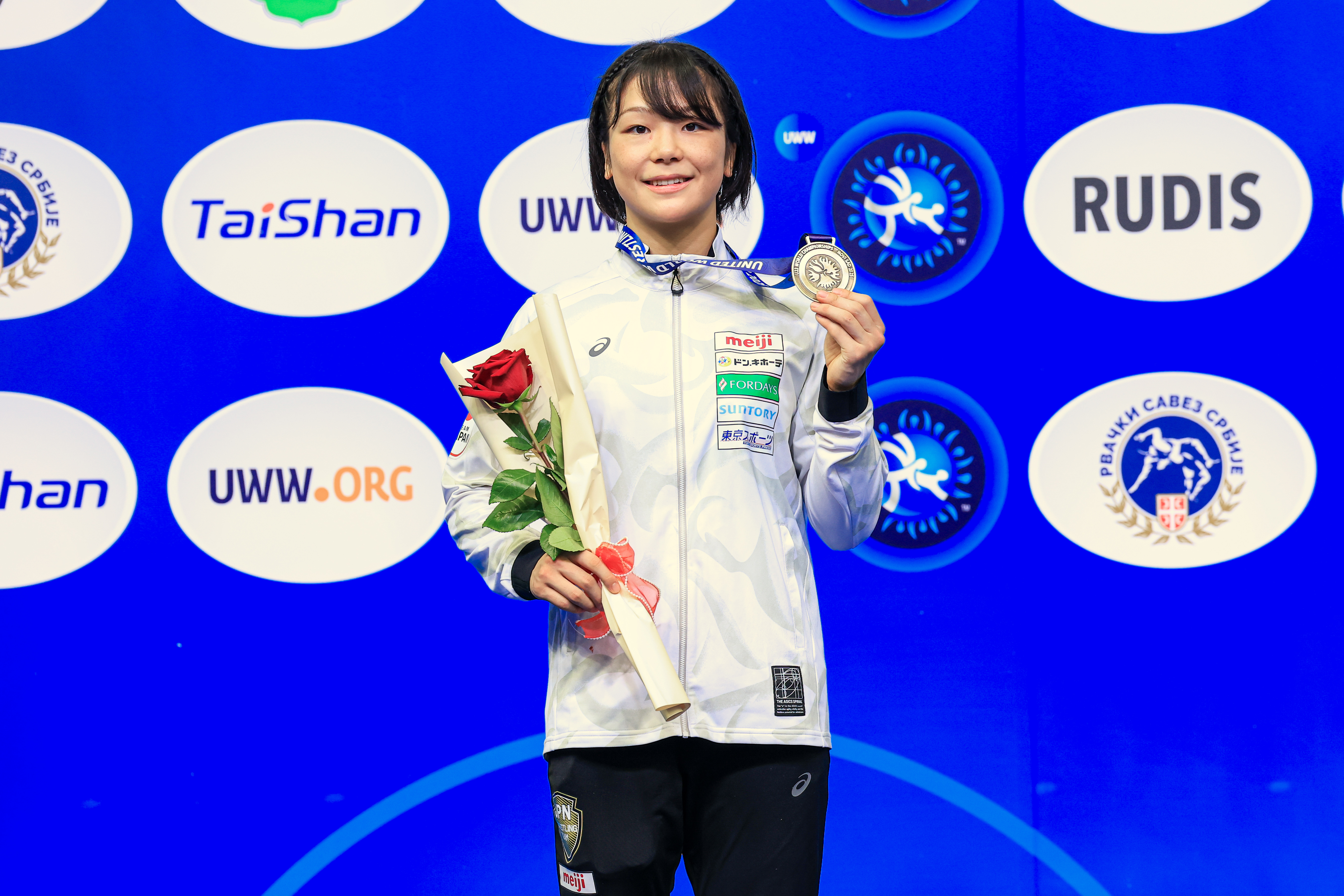 Akari FUJINAMI (JPN) won the gold medal at 57kg at the U23 World Championships. (Photo: United World Wrestling / Amirreza Aliasgari)
Share your thoughts.
Comments