

Tumur Ochir's 'god's gift' lands Asian Games gold
Friday, October 6, 2023 - 18:43 By Vinay Siwach

LIN'AN, Hangzhou, China (October 6) -- Tulga TUMUR OCHIR (MGL) flips the medal a few times before claiming it as the "best medal and God gift."
The Mongolian has his Asian Games gold medal around his neck. He can't stop staring at it before finally agreeing to speak for the interview.
There is one more thing that he calls a God's gift to him -- underhook, the deadly move he has mastered to win wrestling bouts.
It's a move that needs timing, accuracy, and perfect execution, combined with power to be perfect. Tumur Ochir has performed the move numerous times in his career and won. But what he did on Friday in the Lin'an Sports Culture and Exhibition Center was perfection. An underhook that brought down Asian champion Rahman AMOUZAD (IRI) in the 65kg gold-medal bout was so clean that even Amouzad, who is equally good at it if not better, failed to defend himself.
Once he got the four points, Tumur Ochir continued to punish Amouzad for weak defense from par terre, getting three gut wrenches to win the 65kg gold medal 11-1. This is Tumur Ochir's first gold at a championship or Games at the senior level.
The activity point for Amouzad was the only point that Tumur Ochir gave up in five bouts in Hangzhou, winning other bouts by blanking his opponents. He won three of those 10-0 and the semifinal against Kwang Jin KIM (PRK) via fall.
"God gave me this [move]," Tumur Ochir said. "My body is for wrestling. This is the most important thing for me."
The final in Hangzhou was a rematch of the Asian Championships final from Astan which Amouzad won 3-1. While Tumur Ochir failed to break Amouzad's defense in Astana, he worked it out on Friday.
Once he got the underhook, Tumur Ochir positioned his left arm on Amouzad's biceps. A little adjustment and he launched the throw, using a little pull of Amouzad's left arm. He then transitioned it into a gut wrench and effortlessly turned Amouzad three times.
"In the second round, Amouzad was slowly getting tired and that is when I thought that I could perform this move. It was my chance to score," he said.
 Tulga TUMUR OCHIR (MGL) scores against Rahman AMOUZAD (IRI) in the 65kg final. (Photo: UWW / Sachiko Hotaka)
Amouzad's conditioning was also in question at the World Championships in Belgrade where he was the defending champion. He finished fifth after suffering a loss to eventual champion Iszmail MUSZUKAJEV (HUN) and Shami MAMMEDOV (AIN).
In Hangzhou, Amouzad's first bout against Abbos RAKHMONOV (UZB) made it more evident that the weight loss could be hampering his performance on the mat. Amouzad fell behind against Rakhmonov thrice before putting up a 12-6 win using counters. Kaiki YAMAGUCHI (JPN) then pushed him to the brink but he held on for a 2-1 win and booked a spot in the semifinal against BAJRANG. The underhook defense worked perfectly against Bajrang who was returning to international competition for the first time in 13 months. Amouzad got a huge four and then added a double-leg lift for another four to win 8-1 to enter the final.
The World Championships were disappointing for Tumur Ochir as well. He was the returning bronze medalist but finished 19th this year after suffering a close loss to Haji ALIYEV (AZE). The loss impacted Tumur Ochir significantly but he recovered from it to push himself at the Asian Games.
"At the World Championships, I lost and it made me feel very bad for a long time," he said. "But in the 10 days after that, I recovered from everything and I got the gold medal and I am really happy. I felt extremely disheartened after the World Championships."
As he failed to win a medal or finish in the top five at the World Championships, Tumur Ochir will have to try an Olympic quota for Mongolia at the Asian Olympic Qualifiers in Bishkek next year. With no Asian country qualifying at the World Championships barring Iran, it would be a tough ask.
"I will train hard and try my best," he said. "I will need to prepare for the Asian Qualifiers in Bishkek. I am researching about everyone who will be there."
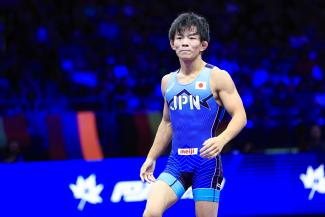
 Toshihiro HASEGAWA (JPN) won the gold at 57kg, Japan's first in Freestyle. (Photo: UWW / Sachiko Hotaka)
The second Freestyle gold medal at the Asian Games on Friday was won by former U23 world champion Toshihiro HASEGAWA (JPN) as he defeated Chongsong HAN (PRK) in the final. The gold medal ended Japan's 13-year wait for an Asian Games champion in Freestyle. Tatsuhiro YONEMITSU (JPN) was the last Asian Games champion in 2010.
Yonemitsu, who was in Hasegawa's corner in Hangzhou, himself had ended Japan's 16-year-long wait for a gold medal in the Asian Games after the 1994 edition.
Hasegawa, 27, was in control of the final from the opening whistle and mostly kept Han under check in the 7-3 win. Han was close to scoring on a few occasions but Hasegawa managed to defend the attacks.
"At the end, there were many times I nearly gave up points," he said. "At that time, I panicked a bit. I could hear [my coach]. I'm the type who listens to the coach, when I hear him, it calms me down. [Hearing to the coach] is not the biggest reason [for the win], but it was a big plus for me."
However, Hasegawa remained unsatisfied with his performance despite winning the gold medal.
"I'm not really that happy," Hasegawa said. "My feeling is that if it weren't for the great deal of support I received, I wouldn't have been here at all. Every time coach {Kenichi] Yumoto is in my corner I can wrestle relaxed. He told me to stay calm. When things get tough, he would shout advice, like the opponent is getting tired, or give it all to the end. I could clearly hear him and that spurred me on."
 Toshihiro HASEGAWA (JPN) defeated Asian champion AMAN 12-10 in the 57kg semifinal. (Photo: UWW / Sachiko Hotaka)
Yumoto's advice came in handy in the semifinal against Asian champion AMAN as Hasegawa won 12-10 despite building a 6-1 lead at the break.
Aman stormed back with a takedown and increased the pace of the bout which challenged Hasegawa. But the Japanese was up for the challenge and countered Aman's single-leg attacks with takedowns.
He had earlier beaten Minghu LIU (CHN) and Nodirjon SAFAROV (UZB) 7-0 and 10-0 in the opening bout and quarterfinals.
A product of the Nippon Sports Science University, Hasegawa is employed by San-Ei Transportation along with the World Championships bronze medalist in Greco-Roman 77kg Nao KUSAKA (JPN). Both train full-time at the NSSU campus despite being employed.
"Kusaka got the ball rolling by taking third at the World Championships," Hasegawa said. "Unlike other companies, they really watch out for us. The president is always available and people are calling us. I think I'm really blessed."
In the bronze medal bouts, Asian champion Aman scored a 11-0 technical superiority win over Minghu LIU (CHN) to claim his first Asian Games medal at just 19 years of age. The second bronze medal was won by Nasanbuyan NARMANDAKH (MGL) as he defeated Bekzat ALMAZ UULU (KGZ), 8-2.
At 65kg, Kaiki YAMAGUCHI (JPN) put up an impressive display against defending champion and four-time world medalist BAJRANG to win 10-0. The blanking meant that Bajrang will finish without a medal at an international tournament for the first time since 2017.
Kwang Jin KIM (PRK) claimed the other gold medal as he broke Sanzhar MUKHTAR (KAZ) to win 11-6.
 The 65kg medalists at the Asian Games in Hangzhou. (Photo: UWW / Sachiko Hotaka)
RESULTS
57kg
GOLD: Toshihiro HASEGAWA (JPN) df. Chongsong HAN (PRK), 7-3
BRONZE: AMAN df. Minghu LIU (CHN), 11-0
BRONZE: Nasanbuyan NARMANDAKH (MGL) df. Bekzat ALMAZ UULU (KGZ), 8-2
65kg
GOLD: Tulga TUMUR OCHIR (MGL) df. Rahman AMOUZAD (IRI), 11-1
BRONZE: Kaiki YAMAGUCHI (JPN) df. BAJRANG, 10-0
BRONZE: Kwang Jin KIM (PRK) df. Sanzhar MUKHTAR (KAZ), 11-6

Share your thoughts.
Comments