ATHENS, Greece (July 29) -- "There are very few wrestlers as gifted and talented as he is."
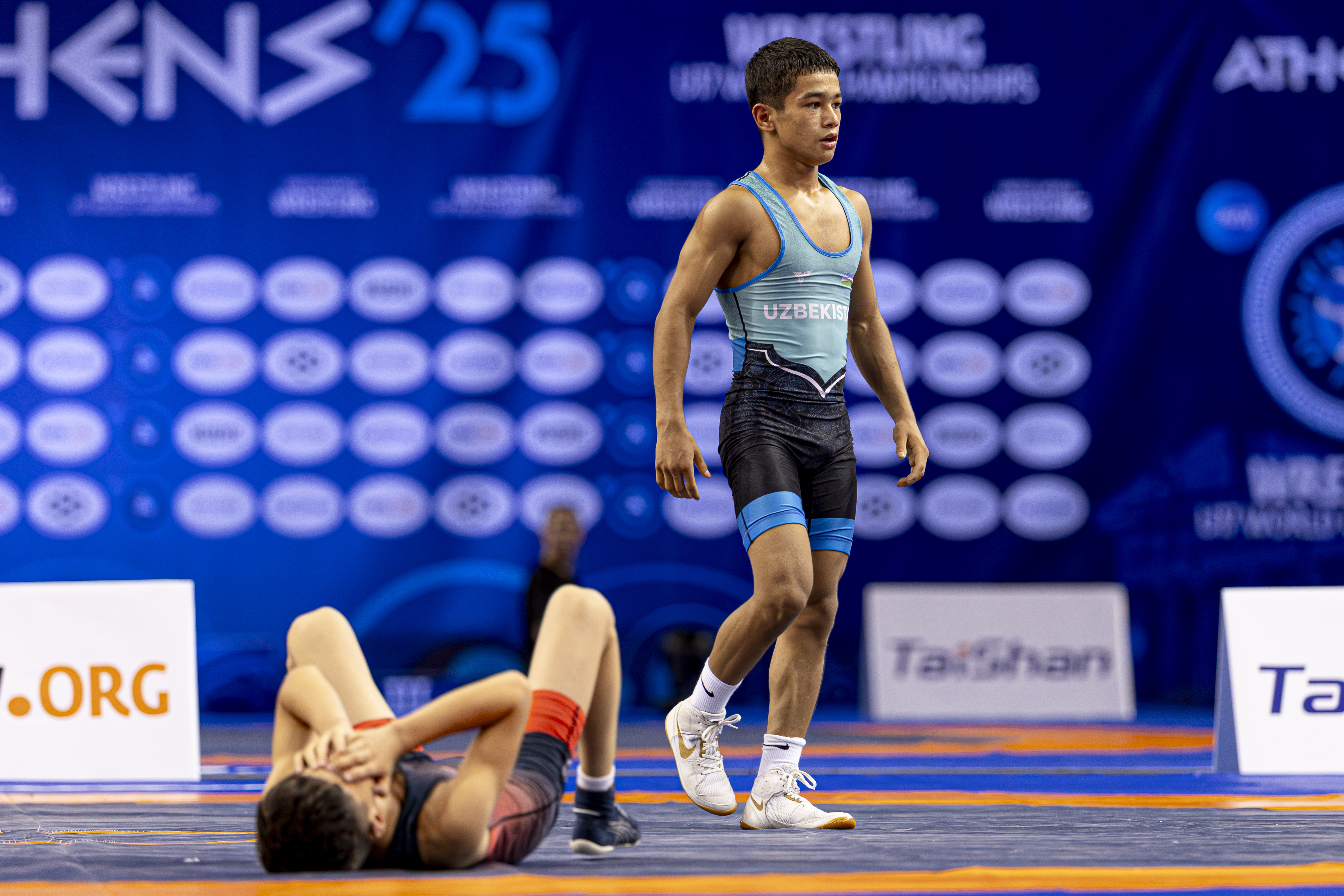
Uzbekistan coach Alim KURBANOV was full of praise of his newly-minted world champion ward Bunyod HASANOV (UZB) in Athens on Tuesday.
Hasanov left little doubt about his skills, as he tore through his competition at 48kg and won Uzbekistan's first world title in three year at this level.
A country which has won team titles at Asian U17 level two years in a row is now threatening to win the team title at the World U17 Championships.
Though it has to continue its good show on Wednesday as well as Uzbekistan is currently third in the team race with 58 points, it has two more finalists and two in repechage in Wednesday. If most of the results go its way, Uzbekistan can easily overtake first-place Kazakhstan [61 points] and second-placed Iran [60 points].
Read More: Greece gets Greco finalist at U17 Worlds; Uzbekistan, Kyrgyzstan keep up
Hasanov defeated Asian U17 champion Nurdaulet KUMARULY (KAZ) 10-1 in the final in a show of some skillful defense and powerful gut-wrench.
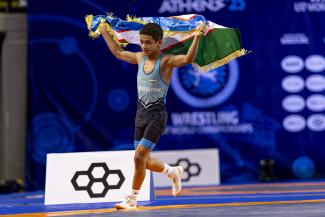
 Bunyod HASANOV (UZB) celebrates after winning the final at 48kg. (Photo: United World Wrestling / Kadir Caliskan)
Kumaruly opened the scoring when he got the par terre position in the first period but Hasanov managed to defend the attempts for gut-wrenches from the Kazakhstan wrestler. In the second period, Hasanov first scored a stepout and then got the par terre position. Out came the deadly gut-wrench as he rolled Kumaruly four times to lead 8-1.
The final finished when Hasanov threw Kumaruly off him and it was scored a takedown. The 10-1 win made Hasanov the first Uzbekistan wrestler to win gold at World U17 in three years.
"I have been wrestling for six years now," Hasanov said. "It was my grandfather’s dream to make me wrestle. He enrolled me in wrestling and dreamt that I would become a national champion and then a world champion. He himself did not wrestle, he just really loves this sport."
The second gold medal for Uzbekistan came from Abdulaziz KHOLMIRZAEV (UZB) who held off Luka MARTIASHVILI (GEO), 14-7, in a high-scoring final at 80kg.
Martiashvili got the first par terre and as he tried turning Kholmirzaev, he was blocked and the Uzbekistan got two points. A stepout for Martiashvili made it 2-2 but he was down on criteria.
In the second period, Kholmirzaev's attempted arm-throw was blocked by Martiashvili who got two points but the favored was returned by Kholmirzaev who added a four-point suplex in the same sequence to lead 8-4. Martiashvili reversed the position and scored a turn when the referee blew the whistle to review the challenge asked by Georgia.
The score was 8-6 for Kholmirzaev but after review, it was 8-7 and the bout restarted in par terre. As Martiashvili tried turning Kholmirzaev again, he was blocked, giving two more points to the Uzbekistan.
A desperate attempt for a throw and win from Martiashvili saw him land on his back, giving Kholmirzaev four points and a fall for the gold medal.
Georgia had more disappointment in store on Tuesday. Just two months ago, Erekle TAVBERIDZE (GEO) won the European U17 gold medal by destroying Janes NAZARYAN (ARM) 9-0 in the final in Skopje. As both wrestlers made it to the World U17 Championships final on Tuesday in Athens, Nazaryan was under pressure to reverse the result from Skopje.
It seemed that Tavberidze would take the gold once again over Nazaryan, a stroke of luck and persistence from Nazaryan saw him score a takedown and take a 5-4 lead for the win in the gold medal-bout.
Nazaryan was off the blocks with a passivity point and then he turned Tavberidze for two more points. The Georgian cut one point with a stepout just before the break to make it 3-1.
Tavberidze kept his composure in the second period and when he got the par terre position, he managed to turn Nazaryan and lead 4-3 with 50 seconds remaining. As both wrestlers battled it out in the center, Tavberidze turned his back in one of the escapes but Nazaryan pounced on him and managed to complete a takedown.
That was all he needed and kept his 5-4 lead and won the world title and managed to equal his head-to-head record against Tavberidze 2-2 in four bouts.
"I faced my opponent from the final for the fourth time," Nazaryan said. "He [Tavberidze] is my friend both on and off the mat. He gives me the motivation to train even harder so that I can beat him."
Born in Vagharshapat, Nazaryan trains at the Vagharshapat club as well as at the Norayr Musheghyan Sports School. While he shares the second name with the legendary two-time Olympic champion Armen NAZARYAN, Janes said he always looked up to Armen.
"He is my idol," he said. "I have watched a lot of videos of his wrestling, and he motivates me greatly. He is my idol, and I want to win even a few more medals than Armen Nazaryan."
Kyrgyzstan's gold medal came at 55kg as Asian U17 champion Alkham ABDIRASULOV (KGZ) won 3-1 against Nurali ASKAR (KAZ) in the final. A foul from Askar saw Abdirasulov get two points and the par terre points became neutral after that.
India won its fourth gold medal in World U17 Championships history as HARDEEP (IND) overcame the Iranian challenge of Yazdan DELROUZ (IRI) at 110kg.
This is the heaviest weight class India has ever won a gold medal in at the World U17 level. Earlier, Vinod KUMAR (IND) won at 45kg in 1980, Pappu YADAV (IND) won at 51kg in 1992 and SURAJ (IND) won at 55kg in 2022.
Hardeep fell behind 3-0 at the break as Delrouz scored two stepouts and one point for passivity. But Hardeep began the second period with a takedown and then got a point for passivity. In a surprising move, the Asian U17 champion asked for a standing restart instead of par terre as he was aware that Delrouz won't be able to sustain the pace of his wrestling.

RESULTS
48kg
GOLD: Bunyod HASANOV (UZB) df. Nurdaulet KUMARULY (KAZ), 10-1
BRONZE: Michael RUNDELL (USA) df. Kaisei YAMAMOTO (JPN), 12-6
BRONZE: Amirmohammad HAJIVAND (IRI) df. Baris SOYLU (TUR), 12-3
55kg
GOLD: Alkham ABDIRASULOV (KGZ) df. Nurali ASKAR (KAZ), 3-1
BRONZE: Amirreza TAHMASBPOUR (IRI) df. Aditya GUPTA (IND), via fall (10-1)
BRONZE: Makhdi BAROTOV (TJK) df. Nihat BAHMANOV (AZE), 8-5
65kg
GOLD: Janes NAZARYAN (ARM) df. Erekle TAVBERIDZE (GEO), via fall (5-4)
BRONZE: Dosbol SHAMIL (KAZ) df. ANUJ (IND), 5-4
BRONZE: Arseni KIKINIOU (USA) df. Yehor TARASENKO (UKR), 5-1
80kg
GOLD: Abdulaziz KHOLMIRZAEV (UZB) df. Luka MARTIASHVILI (GEO), via fall (14-7)
BRONZE: Ismail BEREKET (TUR) df. Nijat YEYLAGALIYEV (AZE), 9-0
BRONZE: Nurislam OSKONBAEV (KGZ) df. Taha NOURI (IRI), 3-1
110kg
GOLD: HARDEEP (IND) df. Yazdan DELROUZ (IRI), 3-3
BRONZE: Temuri SIMSIVE (GEO) df. Hu Anshi NUERLEBIEKE (CHN), 1-1
BRONZE: Anatolii NOVACHENKO (UKR) df. Emrullah CAPKAN (TUR), 5-1


Share your thoughts.
Comments