

#Trnava2018

Three Reigning Greco-Roman Junior World Champions Registered for #Trnava2018

By Eric Olanowski

TRNAVA, Slovakia (August 31) - The 2018 Junior World Championships kick off September 17-23 and each participating nation has summited their final entries to United World Wrestling. Nearly 265 Greco-Roman wrestlers from 43 nations will make the journey to Trnava, Slovakia with hopes of becoming a Junior World Champion. 

Three reigning champions in Kamal BEY (USA), Kerem KAMAL (TUR) and Amin KAVIYANINEJAD (IRI) are registered to defend their titles from last years Tampere Junior World Championships. 

Aleksander KOMAROV (RUS), the three-time age-level world champion and most dominant age-level wrestler in the world was expected to compete for Russia at 82kg but is not registered for the Junior World Championships. Instead, Russia has entered Shamil OZHAEV (RUS) at GR 82kg.

Greco-Roman wrestling begins on September 17 and will be wrestled through September 19. 

ROSTERS
ALG 
60kg - Mourtada NAANAA    

72kg - Amar MOUMENE        

ARM
55kg - Tigran MINASYAN       
60kg - Ararat MANUCHARYAN         
63kg - Hrachya POGHOSYAN
67kg - Malkhas AMOYAN      
77kg - Vahe POGHOSYAN     
82kg - Erik ELOYAN    
87kg - Hakob BAGHDASARYAN        
97kg - Razmik KHACHATRYAN          
130kg - David OVASAPYAN     

AUT 
97kg - Markus RAGGINGER  

AZE 
55kg - Zulfigar ALIYEV           
60kg -  Hasan MAMMADLI     
63kg - Elnur MUSAYEV          
67kg - Mahammadali HASANOV      
72kg - Ulvu GANIZADE          
77kg - Nasir HASANOV          
82kg - Nazarshah FATULLAYEV         
130kg - Sarkhan MAMMADOV            

BLR
55kg - Aliaksandr NIAHODA  
60kg - Ihar DROZD     
63kg - Maksim NEHODA       
67kg - Aliaksandr LIAVONCHYK         
72kg - Martun BADALIAN      
77kg - Yauheni YUROU          
82kg - Kiryl MASKEVICH        
87kg - Ihar YARASHEVICH     
97kg - Uladzislau PUSTASHYLAU      
130kg - Ilya YUDCHYTS            

BRA 
67kg - Joilson DE BRITO RAMOS JUNIOR      

BUL
60kg - Ivo ILIEV    
63kg - Nikalas SULEV
67kg - Krasimir DORMUSHEV       
72kg - Krasimir KRUMOV
77kg - Zahari ZASHEV         
82kg - Svetoslav NIKOLOV  
97kg -Delian ALISHAHI       
130kg - Ignat MILENOV          

CHI
130kg - Diego ALMENDRAS RODRIQUEZ           
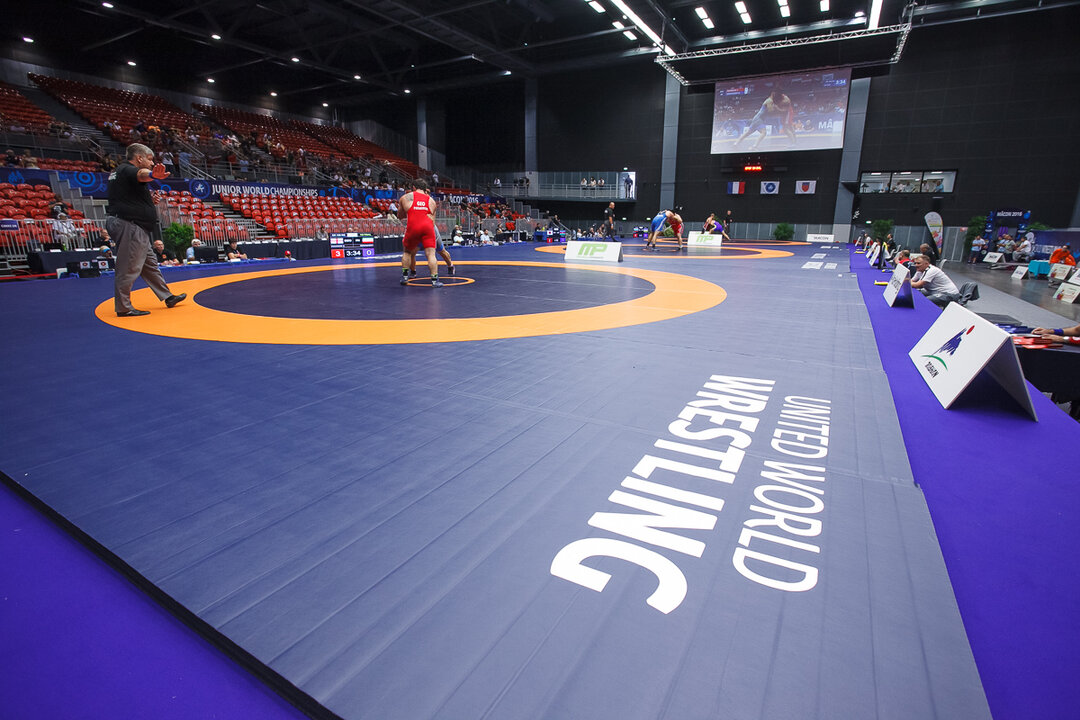
2016 Junior World Championship arena shot. Photo by Justin Hoch.

CHN
55kg - Liguo CAO       
60kg - Libin DING       
63kg - Delin WANG   
67kg - Xin HUANG     
72kg - Chuan ZHANG
77kg - Yilana YILANA
82kg - Wentao SU     
87kg - Maimaiti KAISAIER     
97kg - Yiming LI         
130kg - Lingzhe MENG            

CRO
72kg - Pavel PUKLAVEC         
82kg - Karlo KODRIC  
87kg - Filip SMETKO  
130kg - Ante MILKOVIC           

CZE
67kg - Denis MERTL   
72kg - Jakub BIELESZ
77kg - David PRUSA / Daniel VARGA
87kg - Jakub KROCAK
130kg - Ondrej DADAK
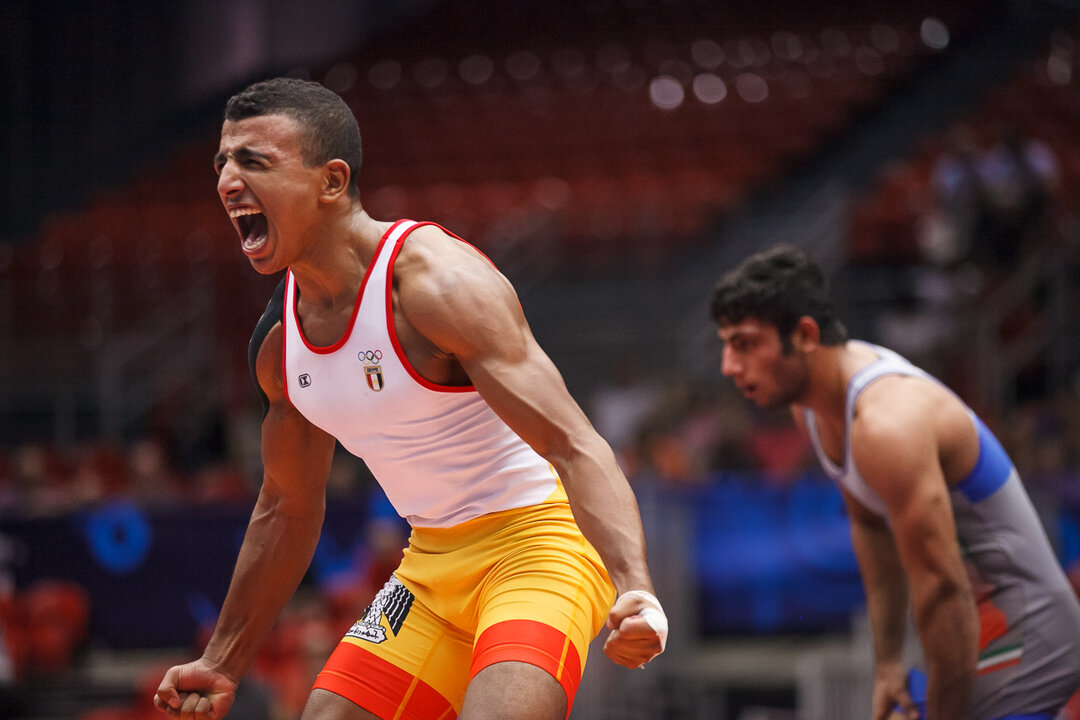
Mohamed ELSAYED, 2016 Cadet World Champion. Photo by Justin Hoch.

EGY
63kg - Hassan MOHAMED     
67kg - Mohamed ELSAYED    
72kg - Gamal MARZOUK       
130kg - Youssef ISSA   

EST
63kg - Denis BOLUNOV         
67kg - Kristo VIIDAS   
72kg - Andris PENT    
77kg - Hans Uku LEITHAM     
82kg - Ranet KALJOLA            
87kg - Ardo PAJUR    
97kg - Hendrik KALME           

FIN
67kg - Elmer Joakim MATTILA           
72kg - Akseli Elias YLI HANNUKSELA
77kg - Waltteri Harri Kristian LATVALA         
97kg - Arvi Martin SAVOLAINEN       

GEO
55kg - Ramaz SILAGAVA       
60kg- Irakli DZIMISTARISHVILI         
63kg - Leri ABULADZE           
67kg - Joni KHETSURIANI      
72kg - Nikoloz TCHIKAIDZE    
77kg - Beka GURULI  
82kg - Aivengo RIKADZE        
87kg - Temuri TCHKUASELIDZE         
97kg - Nika LOMIDZE
130kg - Beka MAKARIDZE        

GER
60kg - Andrej GINC    
63kg - Chlovelle Van MEIER  
72kg - Anthony Ezra SANDERS          
87kg - Nikolaos PAPADOPOULOS      
130kg - Franz RICHTER            

HUN
60kg - Tamas TOEROEK         
63kg - Krisztian Istvan VANCZA         
67kg - Tibor Sandor GYUERKY           
72kg - Gergely BAK    
77kg - Moric KISMONI           
82kg - Istvan TAKACSHUN
87kg - Alex SZOKE     
97kg - Balint VATZI    
130kg - Roland VATZI  
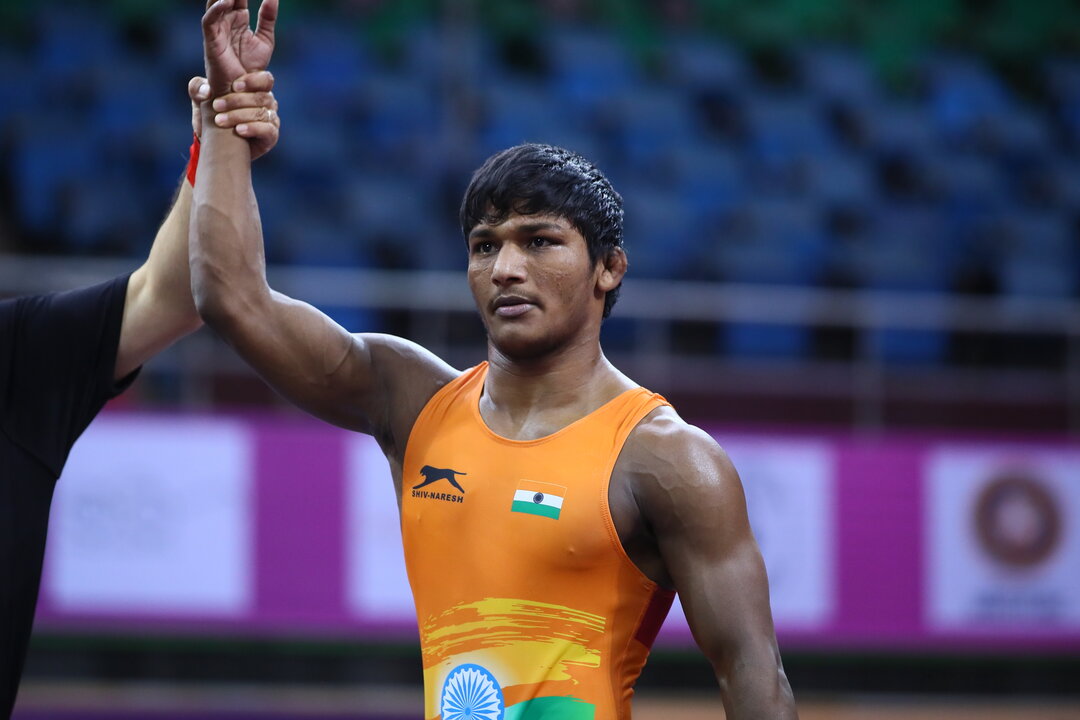
Vijay VIJAY (IND), 2018 Junior Asian Championship runner-up. Photo by Sachiko Hotaka.

IND
55kg - Vijay VIJAY      
60kg - Sachin RANA   
63kg - Manjeet MANJEET      
67kg - Malkit HOODA
72kg - Kuldeep MALIK           
77kg - Sajan SAJAN    
82kg - Sanjeet SANJEET         
87kg - Kumar SUNIL  
97kg - Viresh KUNDU
130kg - Aryan PANWAR          

IRI
55kg - Pouya NASERPOUR    
60kg - Ali NEJATI        
63kg - Bahram MAROUFKHANI IMCHEH      
67kg - Yousef HOSSEINVAND FATHI
72kg - Amin KAVIYANINEJAD
77kg - Shayan AFIFI   
82kg - Hosein FOROUZANDEH GHOJEHBEIGLOU    
87kg - Mohammadhadi SARAVI        
97kg - Vahid DADKHAH GHASEM ABADI      
130kg - Amin MIRZAZADEH    

ISR
67kg - Shamil ALAEV

ITA
55kg - Giovanni FRENI           
60kg - Jacopo SANDRON       
67kg - Ignazio SANFILIPPO    
77kg - Mirco MINGUZZI        
97kg - Luca SVAICARIITA

JPN
55kg - Shota OGAWA            
60kg - Kazuki YABE    
63kg - Harushi SHIMAYA       
67kg - Taishi HORIE   
72kg - Minto MAEDA
77kg- Rai HAYASHI   
82kg - Yudai SASAKI / Masao TANAKA          
87kg - Ryohta NASUKAWA    
97kg - Akira YAMANAKA / Naoki MATSUMOTO   
130kg - Sota OKUMURA          
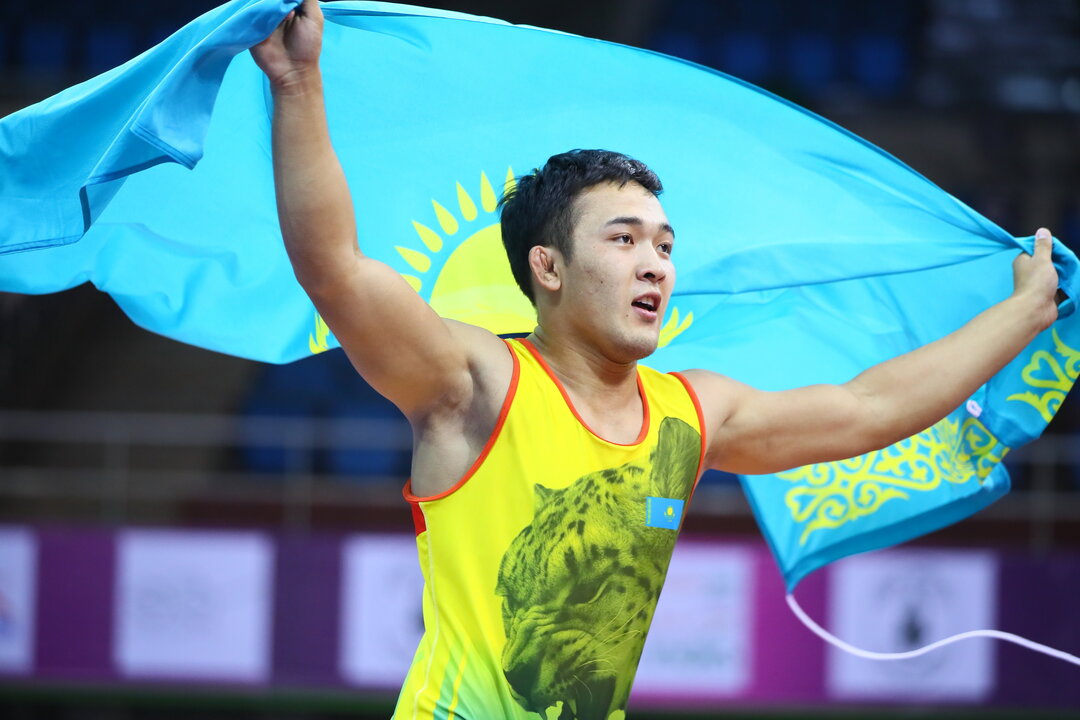
Merey BEKENOV (KAZ), 2018 Junior Asian Champion. Photo by Sachiko Hotaka. 

KAZ
55kg - Alpamys DASTANBEK
60kg- Galym KABDUNASSAROV      
63kg - Madiyar MALTEKBAYEV         
67kg - Merey BEKENOV        
72kg - Daulet LARIONOV       
77kg - Temirlan YESPENBET  
82kg - Stanislav RYLSKIY        
87kg - Sanzhar TEMIRBEK     
97kg - Islam UMAYEV            
130kg - Anton SAVENKO         

KGZ
55kg - Nurtazin KERIMBERDI UULU  
60kg - Dastan KADYROV        
63kg - Erbol BAKIROV            
67kg - Khalmurat IBRAGIMOV          
72kg - Ilim BILIMOV   
77kg - Akzhol MAKHMUDOV
82kg - Ilgiz BILIMOV  
87kg - Amankeldi TALANTBEK UULU

KOR
55kg - Doohoon KIM  
60kg - Seongmin KIM
63kg - Kyoungsub KIM           
67kg - Unho HAN       
72kg - Jueun JEONG  
77kg - Boseong KANG           
82kg - Inseob KIM      
87kg - Junyeop PARK
97kg - Jeongbin KWON          
130kg - Taeho YIM       

KSA
55kg - Tuorki Ali M HAZOAZI
60kg - Hassan M WADDAN    

LTU
60kg - Gytis KULEVICIUS        
77kg - Titas KERSEVICIUS      
97kg - Arnoldas BARANOVAS            

MDA
67kg - Valentin PETIC             
72kg - Anatolie POPOV          

NOR
67kg - Haavard JOERGENSEN
77kg - Per Anders KURE        

POL
60kg - Sebastian NOWICKI         
63kg - Mateusz SZEWCZUK          
67kg - Filip PETRONCZAK         
72kg - Gracjan GLOGIEWICZ
82kg - Piotr DUK            
87kg - Michal DYBKA            
97kg - Gerard KURNICZAK   
130kg - Patryk KAMINSKI  

POR
55kg - Andre CARDOSO OLIVEIRA SILVA       
63kg - Daniel DE MATOS OLIVEIRA DE MORAIS CA  

ROU
55kg - Florin TITA      
60kg - Razvan ARNAUT         
82kg - Nicu Samuel OJOG     
130kg - Lenard Istvan BEREI    
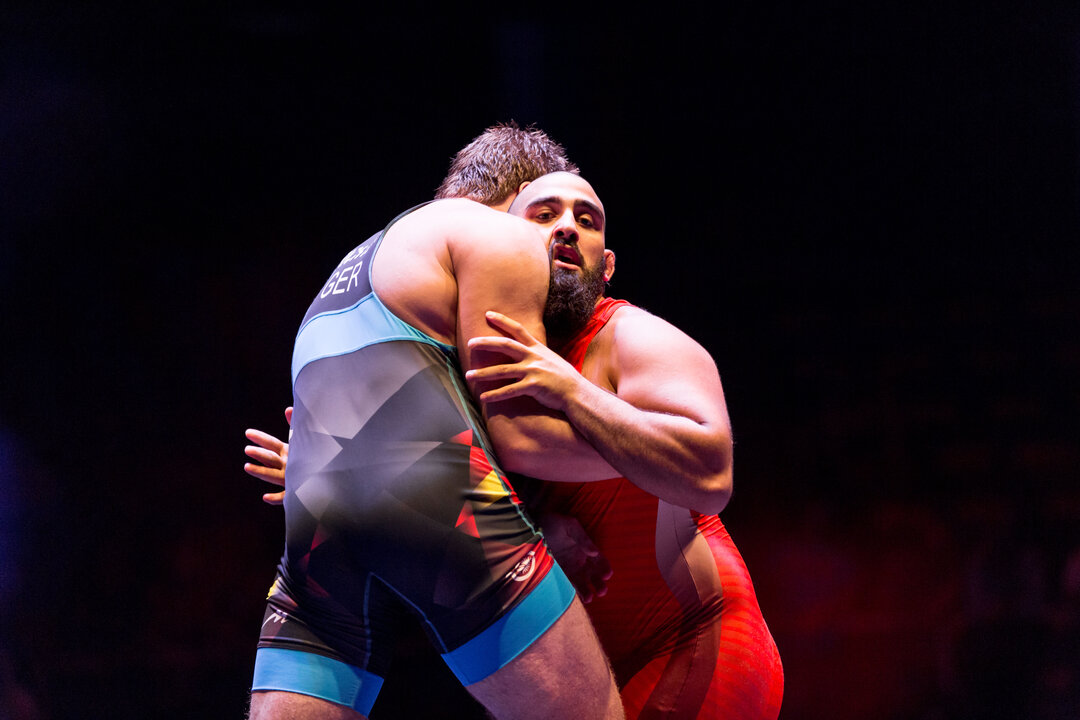
Oleg AGAKHANOV, 2018 Junior European Champion. Photo by Max Rose-Fyne. 

RUS
55kg - Emin SEFERSHAEV     
60kg- Abu AMAEV   
63kg - Azamat KAIROV          
67kg - Miakhdi IAKHIAEV      
72kg - Sergei STEPANOV       
77kg - Islam OPIEV    
82kg - Shamil OZHAEV          
87kg - Ilia ERMOLENKO         
97kg - Artur SARGSIAN         
130kg - Oleg AGAKHANOV      

SRB
55kg - Sebastian KOLOMPAR
67kg - Adam KATONA            
72kg - Sava MIJOKOVIC         
77kg - Andrija Luka MALETIN
82kg - Branko KOVACEVIC     

SUI
55kg - Dimitar SANDOV        
87kg - Ramon BETSCHART     
97kg - Damian VON EUW      

SVK
63kg - Istvan SLUKA   
67kg - Nikolas HULMAN        
72kg - Gergely BUERSOELY   
77kg - Bence HOLOCSI          
82kg - Zoltan MEGALY           

SWE
67kg - Elias ANDERSSON      
72kg - Mats AHLGREN      
77kg - Per OLOFSSON  
82kg - Anders OLSSON    
130kg - Jacob LOGAARD        

TJK
67kg - Faridun AKHMEDOV   
72kg - Bakhtovar KHASANOV            
77kg - Daler REZA ZADE        
130kg - Azmuddin VAKHOBOV           

TKM
63kg - Seydylla TAZAYEV       

TUR
55kg - Cihat Ahmet LIMAN    
60kg - Kerem KAMAL
63kg - Abdullah TOPRAK       
67kg - Ismail GUN     
72kg - Erkan ERGEN  
77kg - Alper Murat ERDURAN           
82kg - Muhutdin SARICICEK  
87kg - Bedirhan TAN
97kg - Beytullah KAYISDAG   
130kg - Fatih BOZKURT           

UKR
55kg - Vladyslav KUZKO         
60kg- Ihor KUROCHKIN        
63kg - Oleksandr HRUSHYN  
67kg - Parviz NASIBOV          
72kg - Ihor BYCHKOV
77kg - Dmytro GARDUBEI
82kg - Vitalii ANDRIIOVYCH
87kg - Dmytro KIIASHOK
97kg - Oleksandr YEVDOKIMOV
130kg - Vladyslav KOVALENKO            
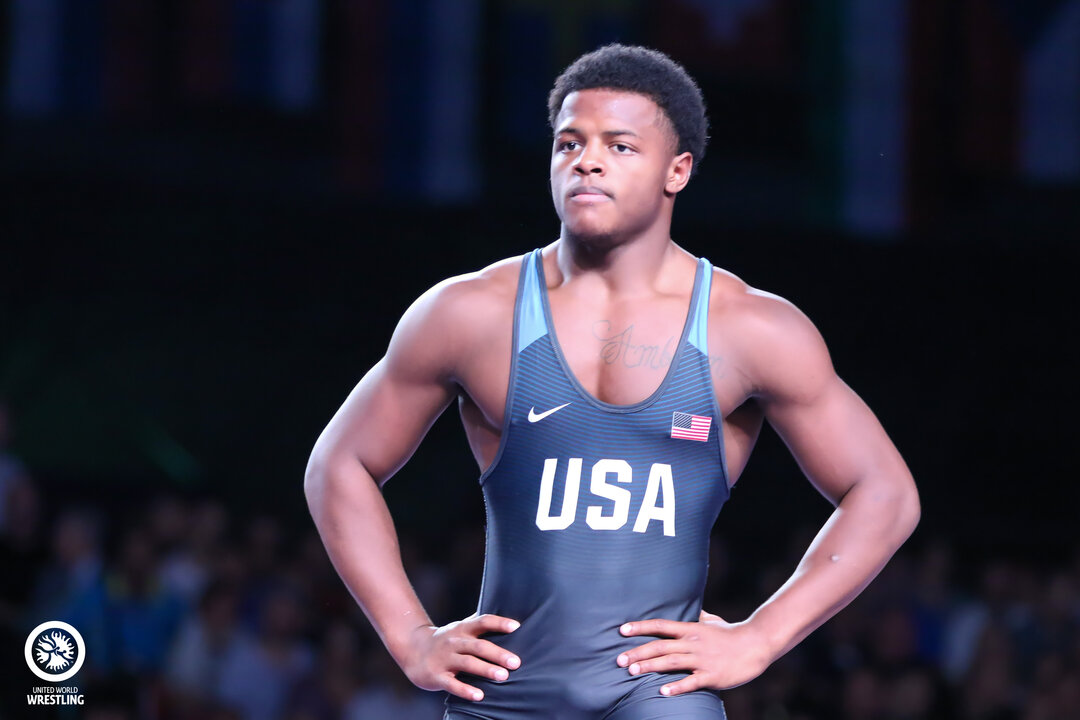
Kamal BEY (USA), 2017 Junior World Champion. Photo by Marion Stein. 

USA
55kg - Brady KOONTZ            
60kg - Taylor LA MONT         
63kg - Alston NUTTER           
67kg - Peyton OMANIA         
72kg - Tyler DOW      
77kg - Kamal BEY       
82kg - Andrew BERREYESA   
87kg - Barret HUGHES          
97kg - Chad PORTER  
130kg - Cohlton SCHULTZ       

UZB
63kg - Turabek TIRKASHEV   
67kg - Kamol KUZIEV
72kg - Makhmud BAKHSHILLOEV     
82kg - Alijon KHUSEYNOV     
97kg - Abubakr ALIMOV        
130kg - Temur Mirzo MAMAJANOV   

#JapanWrestling

Olympic champ Higuchi on fact-finding mission to get grasp on American folkstyle

By Ken Marantz

TOKYO (March 6) -- The conventional wisdom is that domestic folkstyle hampers American wrestlers trying to make the transition to the international stage. Paris Olympic champion Rei HIGUCHI (JPN), however, finds the opposite to be true, saying his toughest matches have come against opponents with such a background.

And the Japanese star has been on a fact-finding mission to find out why. Higuchi has been spending the winter learning American folkstyle while training at Lehigh University in the eastern U.S. in an attempt to find out what makes that version of the sport tick, and how he might be able to integrate its techniques into his own reportoire.

"When I face opponents who had done American style, I always have a hard time," Higuchi said in an interview last year prior to departing on his journey.

Higuchi, the freestyle 57kg gold medalist in Paris, cites the difficulty he had in the final with Spencer LEE (USA), the American sparkplug whom he defeated 4-2 with a late takedown off a scramble -- the aspect of the sport that Higuchi notes Americans are particularly adept at.

"It was the same with Seth GROSS [USA]," he added, referring to his opponent in a wild 15-7 semifinal victory en route to the 61kg world title in 2022. "It's a different culture, isn't it? The difference in styles, what makes them strong, that's something I haven't yet figured out. By not knowing, I feel I still have room for growth and that's exciting."

Rei HIGUCHI (JPN)Rei HIGUCHI (JPN) wrestling at the Lehigh University. (Photo: Courtesy of Lehigh University)

The biggest difference between American folkstyle and the freestyle used around the globe is the emphasis on control in the former. Takedowns are generally the same, but what comes after that is how the two styles greatly differ.

In a loose equivalent of par terre, there is no returning the wrestlers to their feet after an allotted time for gaining exposure points, and the bottom wrestler is obligated to be on the move and try to escape or reverse. And there are no points for just exposing the back; the opponent must be held down on the mat for a certain count for points to be given.

"In college style, on the ground, they don't use the body lock, so their forearms are incredibly strong," Higuchi noted. "Maybe it was just Spencer Lee, but I feel like I have to train harder to get that strength in my forearms.

"Instead of a body lock, I think I can raise my level by learning how to maintain control [on top], how to get takedowns and how to use my body. I want to practice a lot."

Regarding his first impression of the differences, Higuchi said in a message earlier this winter, "I feel that in folkstyle, there are a lot of scramble situations. In freestyle, you wrestle trying to keep your legs from getting touched. But these guys don't seem to care if someone gets in on a tackle.

"From the time the leg is touched, they are thinking about how to get control of the opponent. In that way, the American wrestlers are far superior in scrambles then those from other countries."

Lehigh UniversityLehigh University wrestling training room.

Lehigh comes calling

While it was Higuchi who would go off in search of enlightenment, it was actually Lehigh that came to him and proferred an invitation to practice with the team in the middle of the U.S. collegiate wrestling season.

The 29-year-old Higuchi, who defeated Lehigh alumnus Darian CRUZ (PUR) in the quarterfinals in Paris, said he was approached in September after the Olympics. He needed little persuasion.

"For them to think so highly of me, I was really happy," said Higuchi, who was allowed to bring his wife and baby daughter. "I want to help them produce NCAA champions."

The final arrangements were made by Sanshiro ABE (JPN), a former NCAA champ at Penn State currently living in Pennsylvania where Lehigh is located, via Shingo MATSUMOTO (JPN), the head coach at Nippon Sports Science University, Higuchi's alma mater where he continues to train.

From the start, Lehigh coach Pat SANTORO (USA), along with Kerry MCCOY (USA), the head coach of the Lehigh Valley Wrestling Club, were on board with Higuchi's coming.

"When Kerry McCoy and I were approached we were obviously very excited," Santoro said in an interview by email. "Kerry spent some time in Japan last year with Darian Cruz and learned so much. I have been a huge fan of Rei's for many years, so it was an easy decision."

Lehigh's timing was just right, because soon after other teams came calling for Higuchi. But he said he had already made a commitment and would stick to it.

"Actually, from [Tadaaki] HATTA I heard that Oklahoma [State] definitely wanted me to come," Higuchi said. "But I had already decided to accept Lehigh's offer, so I thought maybe I could go after that had finished. Oklahoma [State], Penn State, Iowa. Well, Iowa, I'm not sure, with the connection with Spencer Lee," he said with a grin.

Lehigh, which has a traditionally strong wrestling program, is an academically select private university with an enrollment of 5,800 located in the town of Bethlehem, about 90 kilometers north of Philadelphia and 130 kilometers west of New York City.

Higuchi is one of a number of top Japanese who have taken "sabbaticals" at U.S. universities this winter, after the country's wrestlers suddenly became hot commodities when they came away from Paris with a stunning haul of eight gold medals, a silver and two bronzes.

Reigning world 61kg champion Masanosuke ONO has been training at No. 1-ranked Penn State, while Paris 74kg silver medalist Daichi TAKATANI and Tokyo Olympic 65kg champion Takuto OTOGURO mixed it up at Ohio State.

But unlike Higuchi, the others went for exposure to American training methods, not to learn folkstyle. "I think it can be applied to freestyle," Higuchi said. "When we tied up, Seth was really strong in that position. His ability to be in control is higher than in freestyle now. I want to be able to do that part of it."

Higuchi said he knew going into the venture that, while his aim was to learn the American style, his hosts were not going to let the opportunity to pick the brain of an Olympic champion go to waste. As such, it natually evolved into a mutually beneficial arrangement for both sides, one in which Higuchi has already participated in a clinic for local wrestlers.

"I want to share the techniques I have with the Lehigh students, and conversely, I want to learn and absorb much from the Lehigh students that I can take back with me," Higuchi said. "I want it to be a fruitful three months."

Said coach Santoro: "Our staff and team ask a lot of questions about his training, learning new techniques and his mindset.

"I believe that freestyle and folkstyle are very similar and making a few minor adjustments will allow you to adapt to each style. At the end of the day, wrestling is wrestling and fundamentals are what wins at the highest level."

Higuchi said one thing he has he noticed is that American training sessions feature more live wrestling, while Japan's lean toward a more drill-oriented approach. "It's not a matter of which way is better, but the difference in culture seems to come out in the wrestling styles."

Rei HIGUCHI (JPN)Rei HIGUCHI (JPN) with wife Yuki and daughter Nagi at the airport before flying to the United States. (Photo: Rei Higuchi / X)

Longest stay abroad

Aside from international tournaments and overseas training camps, it marks the longest time Higuchi has spent overseas. "The longest up to now has been about three weeks," he said.

"I've been on extended practice tours to Russia, Mongolia and other places. But the max has been three weeks."

Ever since he attended the 2017 NCAA Championships in the midwestern city of St. Louis in 2017 ("They had massive crowds. Everyone eats popcorn as they watch," he recalls), Higuchi has been enamored with the fervor that Americans show for the sport.

He plans to stay through this year's NCAA Championships, to be held in nearby Philadelphia on March 20-22, and might consider a future stay in the States if the opportunity arises.

Rei HIGUCHI (JPN)Posing with Jordan BURROUGHS (USA) and others at the 2017 NCAA Championships in St. Louis. (Photo courtesy of Rei Higuchi)

"I've always wanted to go [to America]," Higuchi said. "But it was dependent on my putting up good results...In the future, I may be a coach in Japan, or perhaps a coach of a wrestler in America. I don't know how many years I will continue as an athlete.

"But I want to find a future work place that values the skills I have acquired, the passion I have for wrestling and my way of thinking."

In Japan, Higuchi has earned a reputation for being professional, polite and, for a Japanese athlete, outgoing in his own way. Coach Santoro said that that description fits the wrestler who has shown up in the wrestling room.

"Rei is extremely polite and friendly, what I noticed right away is how much he really enjoys wrestling," Santoro said. "He works extremely hard, but he often is smiling or laughing after a great scramble.

"His technique is some of the best I've seen in the world, he is fundamentally sound in so many positions. He is also very good at explaining his thought process of positional wrestling and technique."

Rei HIGUCHI (JPN)Playing the role of the typical tourist at the Statue of Liberty in New York in February. (Photo courtesy of Rei Higuchi)

Higuchi preceded his Lehigh adventure with a short stay at Cornell University, the alma mater of four-time world champion and two-time Olympic bronze medalist Kyle DAKE (USA) in upstate New York.

He arrived at Lehigh in December, but returned to Japan in early January to attend the wedding ceremony of fellow Olympic gold medalist and Nippon Sports Science alumnus Kenichiro FUMITA (JPN). When he returned to Lehigh, he was accompanied by his wife Yuki and daughter Nagi, who turned 1 in February.

The family, which took a sightseeing trip to New York City last month, has been staying at the home of Lehigh junior Ryan CROOKHAM (USA), who finished third at last year's NCAAs at 133lbs (60.3kg). Crookham is a local star from Hellertown, a neighboring town of Bethlehem.

"Our team loves having Rei around, they understand how elite he is and all of his accomplishments," Santoro said. "Seeing how well he prepares and how his mind works is very valuable for our guys. Some of the wrestlers on our team aspire to be World and Olympic champions, too."

Overcoming setbacks

Higuchi's determination enabled him to bounce back stronger from several devastating setbacks and ascend to the apex of the sport, the Olympic gold.

A native of Osaka in central Japan, Higuchi was pushed into the sport at age 3 by his mother, who was concerned he would be bullied because of his small size. His own stubbornness soured him on team sports, but was a good fit for an individual sport like wrestling.

"I was the type who would say, 'We lost because that guy stinks,'" Higuchi said in a 2019 interview with The Japan News. "In that way, wrestling is great. Everything depends on you. If you lose, it's you own fault. I think that is way it suits me."

His first setback came as an elementary school first-grader in 2002, when he lost in the final of that age group at the national championships. It's a loss that left a lifetime impression on him and solidified a distaste for losing that continued throughout his career. He went on to win his age group for the next five years.

He won his first senior national title in 2015 and qualified for the 2016 Rio Olympics, where he was dealt his second big disappointment. In the 57kg final, he suffered a heart-breaking and frustrating 3-3 criteria loss to Vladimir KHINCHEGASHVILI (GEO) in a match he had led 3-0.

Higuchi's bid to make amends for that loss led to perhaps the most devastating calamity of his career. After an unsuccessful bid to qualify for the 2020 Tokyo Olympics at 65kg, he moved back down to 57kg, only to infamously fail to make weight at the Asian Qualifying Tournament. He then lost a playoff for the Japan team spot to Yuki TAKAHASHI (JPN).

Getting married -- his wife was a former national high school champion, and they had a long-distance relationship starting as high schoolers -- helped add structure to his life, and enabled him to better manage his nutrition and weight control. From there, there was no stopping him as he stormed to the gold in Paris.

The path ahead

So, what lies ahead for Higuchi? Like the vast majority of Japan's Paris medalists, he has not seen action since the Olympics, spending the time recovering and taking advantage of invitations to take part in TV variety shows and other frivolities.

Higuchi had toyed with the idea of entering the Meiji Cup All-Japan Invitational Championships in June, which will serve as the second of two qualifiers for this year's World Championships, but has indicated he will give that a pass.

His more immediate aim is to make the team to the 2026 Asian Games, a tournament that he has yet to compete in and which Japan will host in the fall of that year. He would likely have to begin the qualifying process for that at the Emperor's Cup All-Japan Championships in December.

"The next objective is to win a tournament that I haven't won before, which is the Asian Games," Higuchi said. "That's what I'm shooting for."

Beyond that, including defending his Olympic title, remains undecided. "As an athlete, I think I'll want to keep going up to Los Angeles," he said. "I still don't know about that."