

Takahashi Aims to Make Most of Renewed Shot at Olympic Qualifying
Monday, May 3, 2021 - 12:19 By Ken Marantz

TOKYO --- For the second time, a former world champion in Japan whose dream of making it to the Tokyo Olympics had all but crushed, found it suddenly revived through a twist of fate over which they had no control.
Yuki TAKAHASHI (JPN) will get a chance that he never thought would come to qualify Japan for the Tokyo Olympics at freestyle 57kg when he takes the mat at the Final World Olympic Qualifying Tournament on May 6-9 in Sofia, Bulgaria.
The opportunity arose when Rio 2016 Olympic silver medalist Rei HIGUCHI (JPN) surprisingly failed to make weight at the Asian Olympic qualifier held in early April in Almaty. The Japan federation decided soon after to dispatch Takahashi to Sofia.
"Honestly speaking, as an athlete I was happy that the chance came my way," the 27-year-old Takahashi said during a recent online press conference with the Japanese media. "Up to now, the coronavirus pushed everything back and it was difficult for me to keep going. At times I thought, 'What am I doing this for?'"
Takahashi, who had figured his fate would be decided at the time that Higuchi either made the final in Almaty or didn't, instead got the news much earlier. He said he was eating lunch with his wife when he was informed that Higuchi had been disqualified.
"It was like a dream," the 2017 world champion said. "It was a Sunday and I had the day off. I was relaxing and eating when the news came. But I can't suddenly rush into things and change gears. I need to go at my own pace and start preparing."
Takahashi faces a substantially higher hurdle to overcome than the one cleared by Yui SUSAKI (JPN), the former two-time world champion who secured a Tokyo berth in the women's 50kg division at Almaty.
For one thing, Susaki had just four other entrants in the Asian qualifier from which the top two earned tickets to Tokyo; Takahashi could have as many as 26 rivals in Sofia, based on the preliminary entry list, for the same number of spots.
On top of that, even if he finishes in the top two, Takahashi will then have to face Higuchi in a playoff for the Tokyo Olympics ticket later in May. But it's a situation that he has accepted.
"I'm the [original] loser, so even if I win [in Sofia], it doesn't decide things yet," Takahashi said. "It can't be helped, that's the rule. It's quite clear."
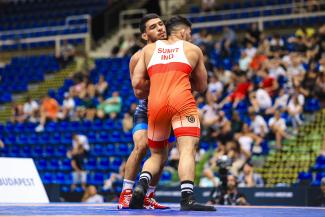
Takahashi lost out to Higuchi for a place on the team to the Rio Olympics, but came back later that year to win his first national title. In 2017, he made his mark globally, triumphing at the Asian Championships before winning the gold at the World Championships in Paris. He followed that with a bronze medal at the 2018 World Championships in Budapest.
But Takahashi's Olympic hopes went awry at the 2019 World Championships in Nursultan, where a medal would have clinched a place for Japan and himself at the Tokyo Olympics. Instead, a fourth-round loss left him in 10th place and empty-handed on all counts.
Meanwhile, Higuchi had dropped back to 57kg after going up a weight class after Rio and then making an unsuccessful run at qualifying for Tokyo at 65kg (although he won the world U-23 gold in that weight class along the way).
With the right to fight for the Olympic place in the Asian qualifier on the line, Higuchi defeated Takahashi in the final of the All-Japan Championships in December 2019.
Even with year delay, the odds were certainly in Higuchi's favor --- three Asian nations had earned 57kg berths in Nursultan, and there were just nine entries. But not even making it to the mat was a development nobody had foreseen.
Higuchi's misfortune became a gift for Takahashi, who had started a new job as a coach at his alma mater Yamanashi Gakuin University in April after leaving the wrestling team at security company ALSOK.
Up to then, Takahashi had found it difficult to remain motivated, although the competitive juices flowed again at the All-Japan Championships in December last year, where a victory put him first in line if Higuchi faltered in Almaty.
"While I was practicing, I never knew if I would be able to take part [in the qualifiers]," Takahashi said. "It was not so much that I gave up hope as my heart just wasn't in it. I went though the usual routine in practice, but I didn't care.
"I got back into it at the All-Japan Championships because it was competition again. I think it was important to have that change of heart."
Takahashi acknowledged that the Olympics were always in the back of his mind as he toiled away over the past year, helplessly waiting for the door to either reopen or be permanently closed.
"Of course I kept it in mind," he said. "Nobody could say there was zero possibility. In sports, you don't know what will happen. I kept going with the notion to never give up to the end."
While he has had to take a circuitous and uncertain path to keep his Olympic dream alive, Takahashi feels the setbacks along the way have made him stronger.
"I hit rock bottom," he said. "Aside from someone dying, there can't be a more painful experience in a lifetime. But it's become a strong point for me. I've never thought of myself as unlucky. In life there are good times and bad, and if I go to the Tokyo Olympics and I am successful, that will be good."
To get there, he will need to defeat some equally determined opponents. Among those on the preliminary list, the one who stands out is Reineri ANDREU ORTEGA (CUB), a two-time World U-23 champion who placed third at the Pan American Olympic qualifying tournament.
Takahashi beat Andreu Ortega in two previous meetings, both in 2018 and both close matches. The Japanese came out on top 7-5 in a clash at that year's World Cup, then again 5-4 in the bronze-medal match at the World Championships.
Others expected to be in the running are 2018 European champion Giorgi EDISHERASHVILI (AZE), 2018 Asian Games gold medalist Bekhbayar ERDENEBAT (MGL) and Muhamad IKROMOV (TJK), the 2020 Asian silver medalist at 61kg who finished third in the Asian Olympic qualifier.
"Japan is traditionally strong in the lightweight classes and I've added a few medals myself," Takahashi said. "I will fight with a feeling of responsibility, and stay relaxed and do my style of wrestling. If I properly prepare, I can come out on top."
When the call came and the national team coach told Takahashi, "It's your turn," the main concern was whether a little more than three weeks was enough time to get ready. Even though he had been practicing all that time, it is different than working toward peaking at a tournament.
"I've never had this experience," Takahashi said. "But I knew it was possible. It's always been that if Higuchi didn't produce a result at the Asian qualifier, I could be going. It was only natural that I was preparing. There's no extra burden to getting in shape."
Asked how he would describe his current condition, he replied, "It's not bad, it's not great. It just as usual. Now that I've been selected to be sent to the tournament, I have put all my worries behind and can focus."
Takahashi said his new job as coach at Yamanashi Gakuin has given him a fresh perspective on the sport. Yamanashi Gakuin is one of Japan's collegiate powerhouses, and among its many decorated alumni is 2018 world champion Takuto OTOGURO, who has already qualified for the Tokyo Olympics at freestyle 65kg.
"For me, it's really a change," Takahashi said. "When I was at ALSOK, I could think only of myself. But when you become a coach, you must keep in contact with the students."
His new situation really hit home when the JOC Cup, a junior-level tournament that includes younger collegians, was recently canceled due a surge in the coronavirus that led to Tokyo declaring a state of emergency for the third time since the start of the pandemic.
"It was a qualifier for the world junior and Asian junior championships," he said. "As a wrestler, I would have been thinking, 'What am I doing this for?' But now, my thinking has to be, how should we proceed with wrestling? What kind of advice can I give them? It's really made me think."
As a active wrestler, Takahashi also keeps in mind the importance of leading by example.
"They see the position I am in now and the tough times that I had to go through," he said. "What I want to tell them is, if you don't give up, your chance will come. Not through words, but through your actions."
Coming home with an Olympic berth for his country would provide the perfect example of making the most of an opportunity.
Share your thoughts.
Comments