

Takacs shows Hungary the way with gold at Zagreb Open
Friday, February 3, 2023 - 23:18 By Vinay Siwach

ZAGREB, Croatia (February 3) -- With the European Championships just two months away, Hungary is facing the pleasant problem of plenty.
On Friday at the Zagreb Open, it entered three wrestlers in the 87kg weight class, with the hope of finding an answer to who will be the representative at the continental championships which, incidentally, will be held in Zagreb.
The first Ranking Series event of the year, which has two-kilogram weight tolerance, entered its day three with two Greco-Roman and four women's wrestling weight classes.
At 87kg, Hungary entered Erik SZILVASSY (HUN), David LOSONCZI (HUN) and Istvan TAKACS (HUN), aiming to finish at least two on the podium.
By the end of the day, it was only Takacs who managed to win a medal, gold, and laid his claim to the spot on the national team. The fact that he did after navigating through a tough bracket, makes his claim even stronger.
"It was a long and tiring day," Takacs said. "I was wrestling well but it was a very long day."
Takacs had to beat World Championships silver medalist Turpal BISULTANOV (DEN), Hamidreza BADKAN (IRI), U23 European champion Marcel STERKENBURG (NED), teammate and world bronze medalist David LOSONCZI (HUN) and Asian champion Naser ALIZADEH (IRI) to win the gold.
Going through a tough set of wrestlers made Takacs struggle for breath after the first bout against Bisultanov as both exchanged only passivity points but gave it all. This was Takacs fourth win over Bisultanov in as many meetings.
After winning against Badkan, Sterkenburg did trouble Takacs. However, the Hungarian managed to get a turn from par terre to win the quarterfinal.
Losonczi managed to give him a tough fight but Takacs had a four-pointer from par terre in the first period. Losonczi did manage four points in the second period but could not get two more to beat Takacs.
During all this, Szilvassy suffered a close 3-3 loss to World Championships 82kg silver medalist Jalgasbay BERDIMURATOV (UZB) in the pre-quarterfinal. Berdimuratov suffered a rather surprising loss to Alizadeh in the quarterfinal.
Alizadeh failed to repeat his heroics in the final as Takacs shut him out with ease.
Takacs, the U23 world champion, led 2-0 at the break, gave up a point for passivity but managed to score two stepouts in the remaining time to win 4-1.
"I had to wrestle some tough wrestlers," he said. "The final was also tough against Iran."
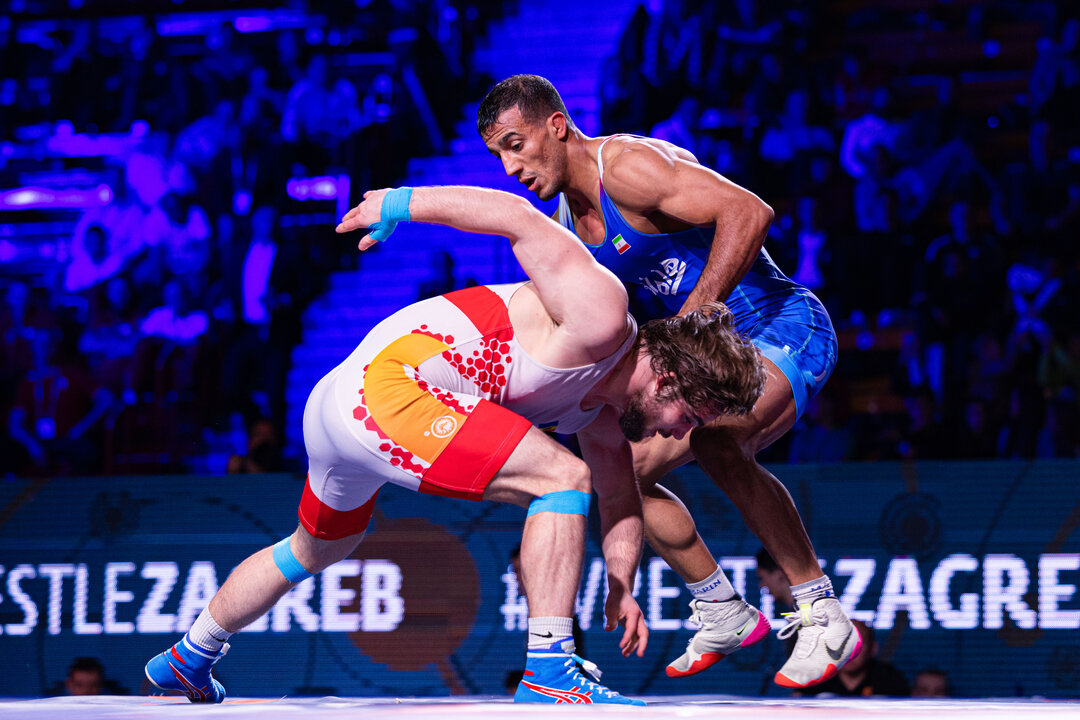 Mohammadali GERAEI (IRI) defeated Alexandrin GUTU (MDA) in the 77kg final. (Photo: UWW / Kadir Caliskan)
Mohammadali GERAEI (IRI) did reduce some of the disappointment for Iran by winning the 77kg over youngster Alexandrin GUTU (MDA).
While it was evident that Geraei was a shadow of his own self, he managed to reach the final after some hard-fought wins.
He opened the day with a 6-5 win over Juan AAK (NOR) as the score was 5-5 at the break. However, Geraei got the passivity point in the second period and managed to defend for the remaining time.
Aik MNATSAKANIAN (BUL) was cautioned out as he kept violating the par terre position. This gave Geraei a breather which he used to beat Per KURE (NOR) 11-0.
In the semifinal, Geraei managed to get the turn from par terre against Jonny BUR (FRA), who failed to do so and lost 3-1.
Gutu, on the other hand, dominated his run to the final with convincing wins over Mikko PELTOKANGAS (FIN), Paulius GALKINAS (LTU), Amin KAVIYANINEJAD (IRI) and Antonio KAMENJASEVIC (CRO) in semifinals.
He began the final on an aggressive note and got the par terre advantage. But as Geraei slipped out of it, Gutu tried to lock and hit a big throw. Geraei overpowered him and threw him instead for two points.
Gutu scored a stepout but the score was 2-2 in Geraei's favor and Gutu never found the final push to break the criteria.
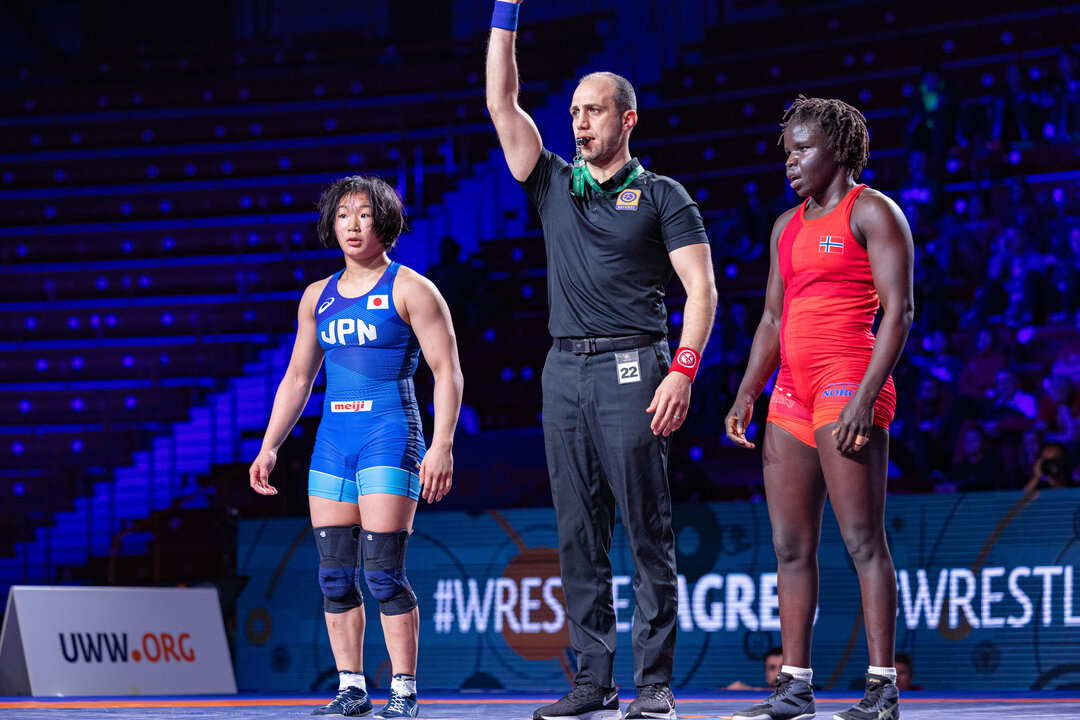 Sakura MOTOKI (JPN) won the 62kg gold medal. (Photo: UWW / Kostadin Andonov)
Motoki shows she belongs
Sakura MOTOKI (JPN) expressed her disappointment after failing to win the gold medal at 59kg at the World Championships in September.
Three months later, she had put that behind her and pulled two of the biggest wins of her career, beating Olympic champion Yukako KAWAI (JPN) and world champion Nonoka OZAKI (JPN) at the Emperor's Cup at 62kg.
Continuing from where she left in Tokyo, Motoki made her international debut at 62kg a memorable one, winning the gold medal with ease.
In the five bouts she wrestled to win the gold in Zagreb, Motoki scored 41 points and gave up only two points. She also had two falls and a victory via superiority.
The first to fall was Lauren LOUIVE (USA) before she pinned Viktoria VESSO (EST). Bilyana DUDOVA (BUL) did fight hard but failed to stop Motoki from winning 8-1. Motoki pinned Lias NUNES (BRA) in the semifinal.
From the other side, Grace BULLEN (NOR), the World Championships silver medalist at 59kg, made it to the other side and was dominating her bouts throughout the day.
After beating Eniko ELEKES (HUN) and Ariukhan JUMABAEVA (UZB), Bullen defeated Taybe YUSEIN (BUL) 11-0 before a nerve-wracking semifinal against Kayla MIRACLE (USA).
Miracle led 4-4 before a pushout along with caution gave Bullen a 6-4 lead. But she still had time to score and regain it. However, that hope was dashed when Bullen was awarded a stepout and Miracle challenged the call. The replays confirmed the scoring and Bullen led 8-4. A consolation takedown was not enough as Bullen secured a place against Motoki.
But the Japanese wrestler was having none of it, beating Bullen 7-0 for the gold medal.
Aisuluu TYNYBEVKOA (KGZ) lost in the opening round to Xiaojuan LUO (CHN) and failed to win a medal.
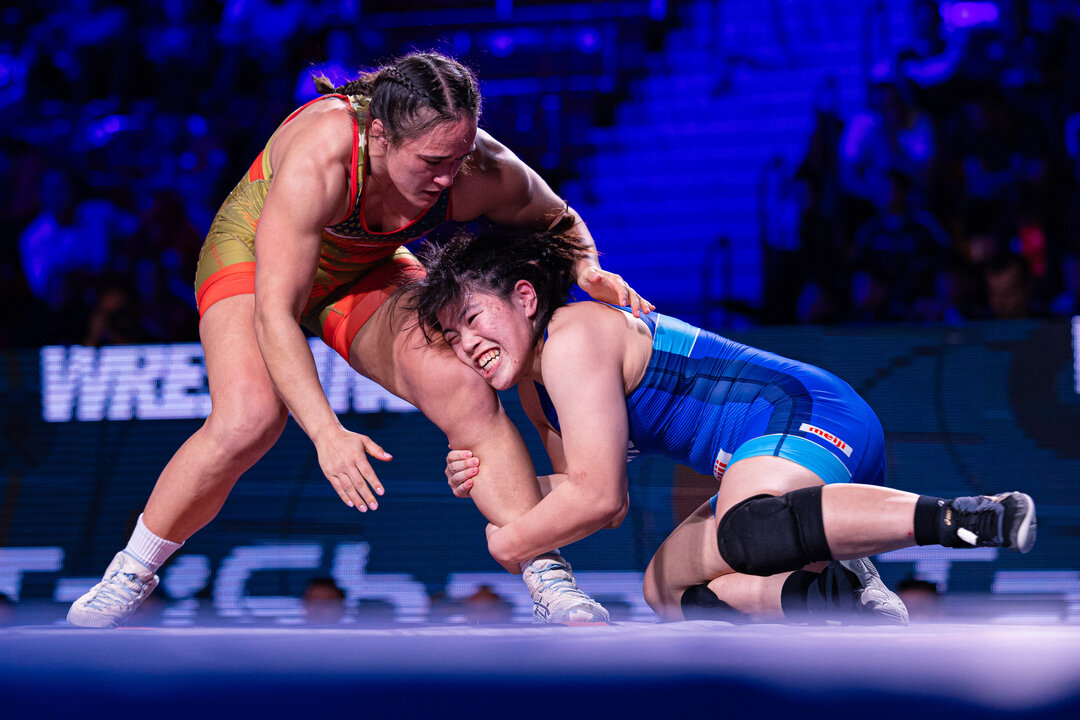 Mahiro YOSHITAKE (JPN) attempts a single-leg attack. (Photo: UWW / Kadir Caliskan)
The second gold for Japan came at 65kg as Mahiro YOSHITAKE (JPN) defeated Mallory VELTE (USA) 2-1 in the final.
In a format with two groups, Yoshitake was lucky to reach the semifinals despite losing to Emma BRUNTIL (USA). Yoshitake defeated Mallory VELTE (USA) in the opening bout who in turn beat Bruntil.
With all three wrestlers tied with one win and four classification points each, it was Velte and Yoshitake who moved into the semifinal as they had more technical points than Bruntil.
Velte defeated Iva GERIC (CRO) and Yoshitake beat BHATERI (IND) in the semifinals and set up the final which Yoshitake won.
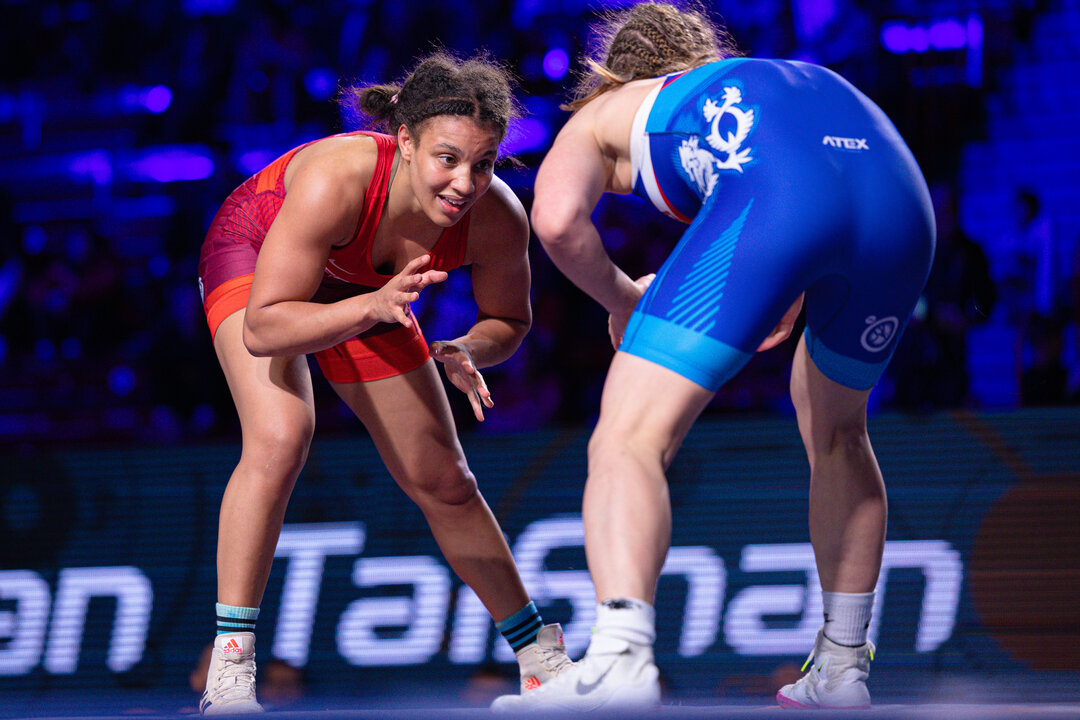 Koumba LARROQUE (FRA) won the 68kg gold at the Zagreb Open. (Photo: UWW / Kadir Caliskan)
At 68kg, Koumba LARROQUE (FRA) announced that she is ready for the World Championships and Olympics with the gold medal. She defeated Adela HANZLICKOVA (CZE) 5-0 in the final but it was the semifinal that proved to be a bigger test for Larroque.
World Championships bronze medalist Irina RINGACI (MDA) started as the favorite on paper and was even leading the bout. But she decided to sit on her 3-2 lead and paid the price. Larroque shot a double leg which Ringaci could not defend and gave up four points. A lost challenge added one more for a 7-3 win.
"I'm very happy to do this," Larroque said. "I haven't competed since last year because I had surgery. So I'm glad to wrestle against new girls I didn't know yet like Moldova."
Ringaci, who won the world title at 65kg in 2021, is one of the biggest threats at 68kg and Larroque is aware of the same.
"She was champion of Europe last year and champion of Europe in 2021," she said. "It was a match I have been waiting for a long time because I had never challenged her and I'm happy to have fought with her before [this year's] European Championships because I understood that I'm healthy and that I can win."
Larroque has been struggling with a knee injury for quite some time but her performance on Friday gave a peek into her recovery which is now on track.
"Last year was complicated," she said. "I did a lot of gym, muscle building, re-education and this allowed me to regain strength after the surgery and I'm sure I'm ready for the Olympics."
However, qualifying for the Olympics in Paris won't be easy for Larroque.
"It’s true that I lost a lot of weight but I am happy to be at 68kg," she said. "For now, the most important things are the European Championships because there is still a rivalry between me and Pauline [LECARPENTIER] and I really would like to be the champion and qualify for the Paris Olympic Games."
Larroque lost to Lecarpentier in a domestic trial at 68kg and had to wrestle at 65kg at the senior World Championships last year.
With her task cut out domestically, Larroque can draw inspiration from the fact that the Olympics will be in her hometown with the possibility of her family watching her win an Olympic medal.
"The whole family is excited because it's Paris," she said. "It's been 100 years since there have been [Olympics] Games in Paris and I am happy to fight in front of my family."
World champion Anastasia NICHITA (MDA) won the 59kg gold medal after winning all four of her round-robin bouts.
Only five wrestlers were entered at 59kg and Nichita outscored them 38-0. The only wrestler who stopped her from going for superiority was Yui SAKANO (JPN).
RESULTS
WW
59kg
GOLD: Anastasia NICHITA (MDA)
SILVER: Yui SAKANO (JPN)
BRONZE: Alyona KOLESNIK
62kg
GOLD: Sakura MOTOKI (JPN) df. Grace BULLEN (NOR), 7-0
BRONZE: Bilyana DUDOVA (BUL) df. Lais NUNES (BRA), 2-1
BRONZE: Kayla MIRACLE (USA) df. Taybe YUSEIN (BUL), 11-1
65kg
GOLD: Mahiro YOSHITAKE (JPN) df. Mallory VELTE (USA), 2-1
BRONZE: Iva GERIC (CRO) df. BHATERI (IND), 3-1
68kg
GOLD: Koumba LARROQUE 🇫🇷 df. Adela HANZLICKOVA 🇨🇿, 5-0
BRONZE: Irina RINGACI (MDA) df. Solin PIEARCY (USA), 6-0
BRONZE: Pauline LECARPENTIER (FRA) df. Wiktoria CHOLUJ (POL), 3-2
Greco-Roman
77kg
GOLD: Mohammadali GERAEI (IRI)df. Alexandrin GUTU 🇲🇩, 2-2
BRONZE: Aik MNATSAKANIAN (BUL) df. Johnny BUR (FRA), 3-0
BRONZE: Amin KAVIYANINEJAD (IRI) df. Antonio KAMENJASEVIC(CRO), 1-1
87kg
GOLD: Istvan TAKACS (HUN) df. Naser ALIZADEH (IRI), 4-1
BRONZE: Ivan HUKLEK (CRO) df. Jalgasbay BERDIMURATOV (UZB), 9-0
BRONZE: Turpal BISULTANOV (DEN) df. David LOSONCZI (HUN), 9-0

 Women's Wrestling at the 2004 Athens Olympic Games. (Photo: United World Wrestling / Martin Gabor)
 Tayla FORD (NZL) is the first wrestler from New Zealand who will compete at the Olympics. (Photo: United World Wrestling / Amirreza Aliasgari)
Share your thoughts.
Comments