

Special referee at national meet part of Japanese efforts to get more women to become officials
Tuesday, January 16, 2024 - 20:32 By Ikuo Higuchi

(Editor's Note: The following appeared on the Japan Wrestling Federation website on Jan. 1. It has been translated and published by permission.)
With its connection to the Paris Olympics, this year's Emperor's Cup All-Japan Championships drew a record field of 470 competitors. But history was also made regarding the third person on the mat. For the first time ever, a foreign referee was on the whistle, one specifically invited with the hope of producing long-term effects beyond the outcome of matches.
The Japan federation brought in Ji-Woo LEE, one of six Korean women holding international licenses, as part of its efforts to get more women interested in becoming referees. Lee is a holder of the UWW's highest Category IS License, which qualifies her to officiate at the Olympics and World Championships.
While Japan remains the dominant country in women’s wrestling, in the case of women referees, it can be regarded as “undeveloped.” Of Japan’s 19 international referees, only two are women, putting Japan far behind United World Wrestling’s objective of having equal numbers from both genders.
 Ji-Woo Lee holds the highest Category IS License. (photo by Japan Wrestling Federation)
"It was a big surprise, and wonderful," Lee said of being asked to officiate at the All-Japan Championships, which was held Dec. 21-24 in Tokyo and was serving as a qualifier for the Asian Olympic qualifying tournament in April. "It is really a joyful [moment] in my life. A big honor, also."
Lee said she was impressed by the large and enthusiastic crowd that packed into Yoyogi No. 2 Gym, saying it reminded her of the atmosphere at the big venues that stage the World Championships and European Championships.
 Lee faces Saori YOSHIDA at the 2004 Asian Championships in Tokyo. (photo by Takeo Yabuki / Japan Wrestling Federation)
Lee herself was no stranger to Japan. Long before she officiated at the 2021 Tokyo Olympics, she came on numerous trips during her career as a wrestler to train at the well-known Oka Wrestling Dojo in the mountains of Niigata Prefecture. Wrestling at 55kg and competing under the name LEE Na-Lae, she faced three-time Olympic champion Saori YOSHIDA three times, in the final at the 2002 Asian Games, and at both the 2004 and 2005 Asian Championships. Lee was the lone Korean woman to appear at the 2004 Athens Olympics.
While she knows a little Japanese, she basically operates in her native Korean or English. As for communicating on the mat at the All-Japan, she said, "I used very simple words. 'Fingers.' 'Open.' Maybe after a foul, I say, 'Next time caution.' Or 'One more time, the match is finished.'" Having Olympic experience both as a wrestler and a referee has given her the confidence to dish out warnings as she sees fit and remain in control on the mat.
 Lee made her Olympic refereeing debut at the Tokyo Games in 2021. (Photo by Japan Wrestling Federation)
Handling the big matches
After retiring as a wrestler, Lee went to the 2012 London Olympics as a national team coach, then changed course and embarked on a new path to become a referee, while also earning a doctorate and becoming a professor at Yong-In University. She obtained the Category IS License just before the 2019 World Championships, and was among the officiating crew at the 2021 Tokyo Olympics.
It was Isao OKIYAMA, head of the Japan Federation's refereeing commission, who suggested inviting Lee to the All-Japan. Okiyama's thinking took a two-pronged approach. In the big matches with so much at stake, the federation would get a neutral official completely free of any suspicions -- justified or not -- about college affiliations and other links that are so strong in Japanese wrestling.
And, by having a female Category IS official at Japan's highest-level tournament, it would bring national attention on the existence of female referees and further motivate more women to want to become one.
 Lee was on the whistle when Nonoka OZAKI defeated Ami ISHII in a vital 68kg match with Olympic implications. (photo by Takeo Yabuki / Japan Wrestling Federation)
At this year's All-Japan, three matches in particular stood out, each with global implications: 1) the first-round match at women's 68kg in which Nonoka OZAKI defeated Ami ISHII, who had needed to win the title to fill the Paris Olympic berth she secured for Japan at the World Championships; 2) the freestyle 65kg semifinal between Tokyo Olympic champion Takuto OTOGURO and collegian Kotaro KIYOOKA, which Otoguro lost to end his chances of a repeat in Paris; and 3) the 68kg final between Ozaki and Miwa MORIKAWA, which Ozaki won to advance to a future playoff with Ishii for the Paris ticket.
Lee was the mat official for all three. Asked if she was nervous, she replied, "I'm never nervous. I know this championships is very important for Japan, also in the world because the champions [can go to the Olympic qualifier]. More than being nervous, I was concerned with doing my best to make fair and clear decisions."
She admits she did feel jittery at her first major tournament at the 2019 World Championships in Nur-Sultan (now Astana). She particularly recalled a bronze-medal match between Iranian and Azerbaijan wrestlers where it seemed the entire crowd turned against her. "I was very nervous. One time [I made a] mistake, just a warning, and everyone goes, 'Boooooo,'"she recalled with a laugh.
 Lee poses with the three Japanese female referees at the All-Japan Championships, from right, Mariko SHIMIZU, Airi FURUSATO and Honoka SAITO. (photo courtesy of Airi FURUSATO)
Getting more women involved
At the All-Japan, there were only three other women referees, Airi FURUSATO, Mariko SHIMIZU and Honoka SAITO, putting them well in the minority. Only Furusato and Haruka WATANABE, currently on maternity leave, hold international licenses, and neither is at the Category IS level.
Of the 393 referees registered domestically in Japan, just 19 are women, or 4.8%. The percentage is even lower for those with a Class A license, which is required for officiating at the All-Japan — just seven out of 197, or 3.6%.
In its Global Gender Gap Report released in June last year by the World Economic Forum, Japan ranked 125th out of 146 countries in terms of achieving gender equality. While Japan is on top in women's wrestling, when it comes to women referees, it unfortunately aligns with the gender gap ranking.
 World champion Akari FUJINAMI tries her hand as a referee at a men's collegiate event last May. ((photo by Ikuo Higuchi / Japan Wrestling Federation)
Among recent moves to cultivate women referees was having world champions Akari FUJINAMI and Yuka KAGAMI serve as referees at the men's East Japan Collegiate League last May. Officials hope that seeing the female stars filling such roles will appeal to more women to consider becoming referees.
Lee said she hopes to see more Japanese women entering the referee ranks and believes that with the right training and support, they can become as much as factor as their wrestling sisters. In fact, it was Japan's Osamu SAITO, a former member of the UWW Refereeing Commission, who encouraged and mentored her and to whom she credits her advancement.
"I am waiting for the day when I can work with Japanese women referees," Lee said. "We are professionals with skills. I support the development of women referees."
--Translation and editing by Ken Marantz
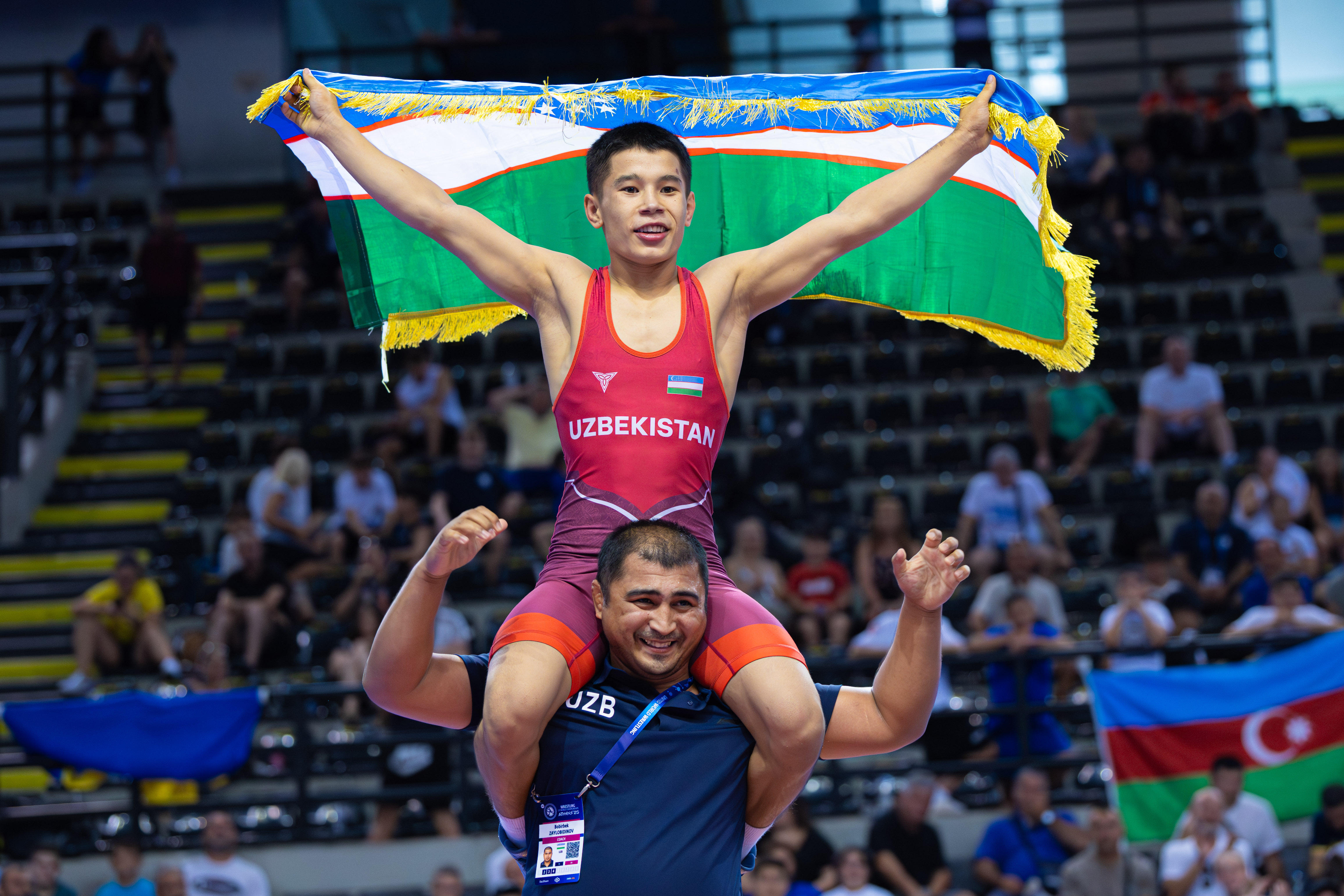 Otabek TURSUNOV (UZB) won the gold medal at 51kg in Athens. (Photo: United World Wrestling / Kostadin Andonov)
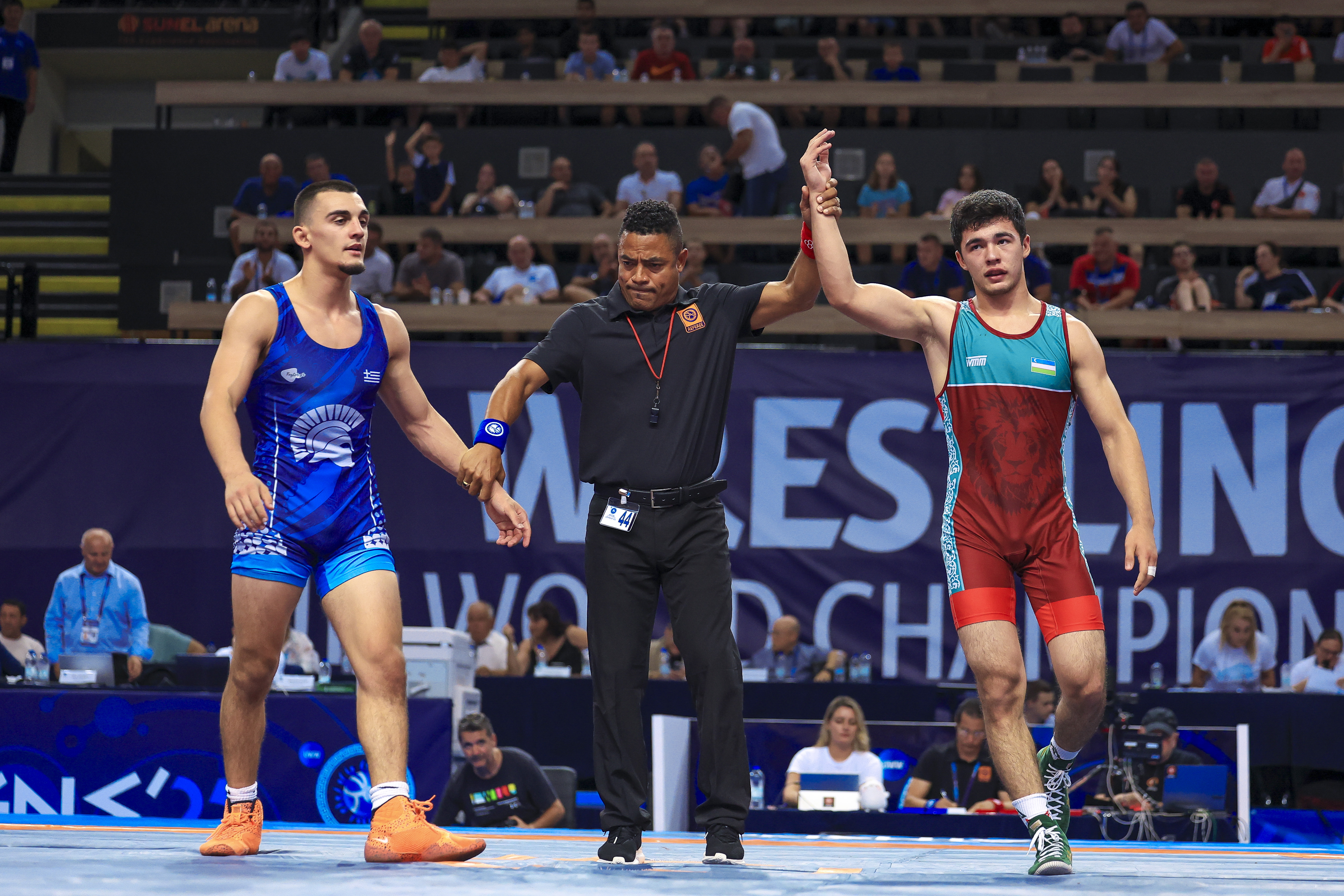 Behruzbek VALIEV (UZB) upgraded his bronze from 2024 to gold in 2025. (Photo: United World Wrestling / Amirreza Aliasgari)
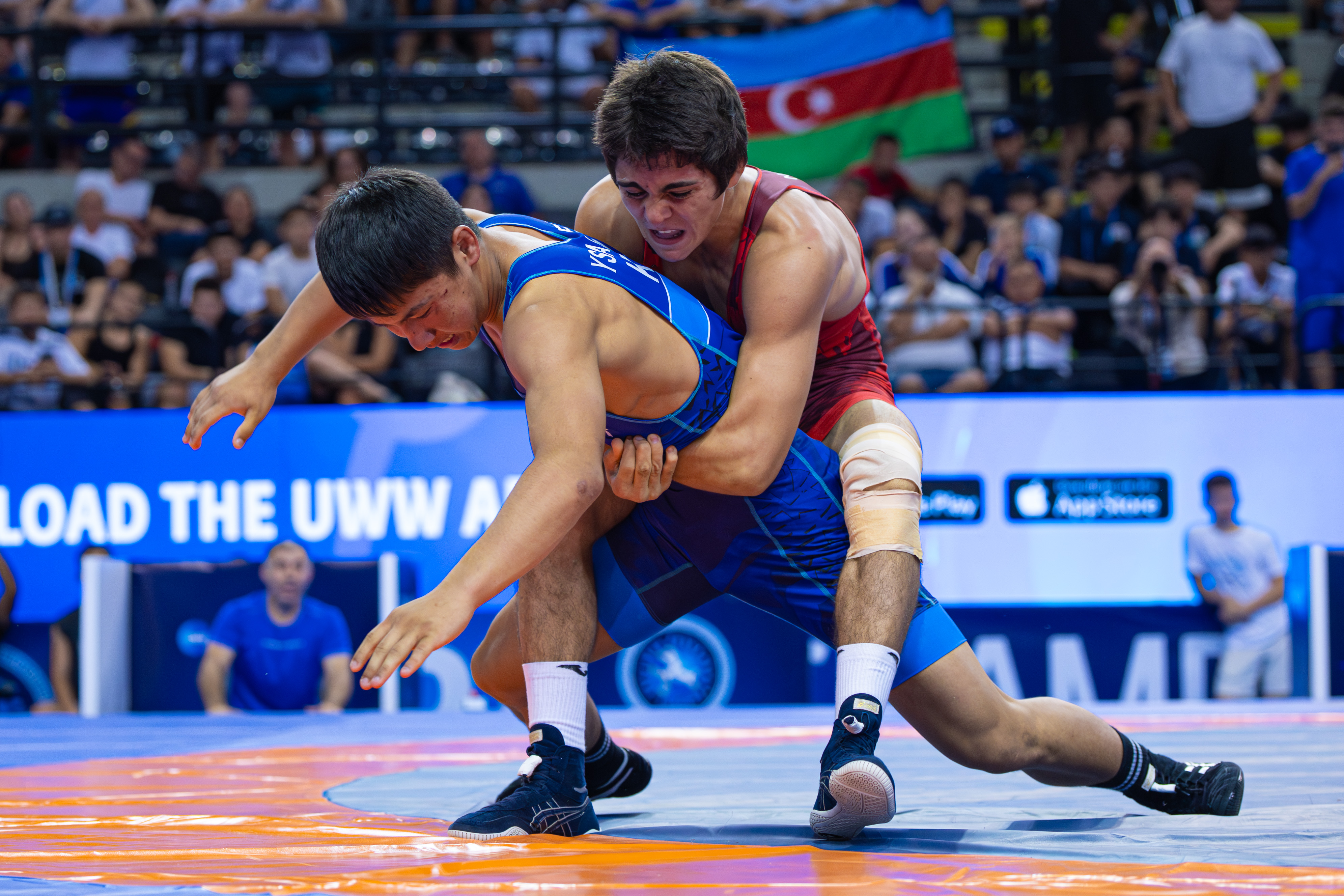 Ali NAZAROV (AZE) scored a 6-1 victory over Amangeldi YSAKBAEV (KGZ) in the 60kg final. (Photo: United World Wrestling / Kostadin Andonov)
Share your thoughts.
Comments