

Japan Wrestling

Shozo Sasahara, 1956 Olympic champion and former Japan federation president, dies at 93

By Ken Marantz

TOKYO (March 6) --- Hall of Famer Shozo SASAHARA, a gold medalist at the 1956 Melbourne Olympics who went on to become president of the Japan Wrestling Federation and an executive of FILA, the predecessor of UWW, has died of natural causes, the Japan federation announced on Monday. He was 93.

Sasahara, who had suffered a stroke in 2014, won the gold medal in the featherweight class (62kg) of freestyle at the Melbourne Games, where he  served as flag-bearer for Japan in the opening ceremony. Two years earlier, he had won the gold at the World Championships held in Tokyo.

Sasahara became renowned for his pioneering use of legs in what is today referred to as a grapevine, but was reverently termed by the English-speaking press in his prime as "Sasahara's Leg Scissors."

Those would be his lone international triumphs, as he was a late bloomer who only started wrestling after entering Chuo University in Tokyo, having previously competed in judo. He retired after the Melbourne Olympics and would have a long career in business and sports governing.

"He was always a leader in the sports world with ideas and actions that were ahead of the times," current JWF President Hideaki TOMIYAMA said in a statement. "As a wrestler, he was adored by many people from around the world as a pioneer of techniques. It is sad not only for wrestling, but the sports world. I would like to express my sincere condolences."

Sasahara was the national team performance enchancement director when Japan won five gold medals at the 1964 Tokyo Olympics and four at the 1968 Mexico City Olympics. He served as JWF president from 1989 to 2003, and was a director at FILA from 1972 to 1993, during which time he also served as a vice-president.

Sasahara also held the post of vice-president of the Japanese Olympic Committee, and was awarded the Olympic Silver Order by the International Olympic Committee in 1995.

Sasahara was born on July 28, 1929, in Yamagata, the capital city of Yamagata Prefecture in the cold-weather Tohoku region of northern Japan.

According to an account he penned himself in 2005 for a Japan Olympic Committee website series titled "Japanese Olympian Spirits," he said he was in the sixth year of elementary school when World War II broke out, and that inspired him to want a career in international trade, so he enrolled in Yamagata Commercial School for his junior and high school years.

His home was in the north part of the city and the school was four kilometers away in the south. In his third year, he started working at an aircraft factory, which was also four kilometers from his home, so every day for five years until graduation, he had an eight-kilometer round-trip walk. As he needed to learn English, he would carry flash cards and study them as he walked.

At school, judo, kendo (Japanese fencing), and swordsmanship were regular parts of the curriculum, and there was also military training, such as throwing grenades. After the war ended, he would visit a nearby U.S. military base, where he was able to practice his English on a native speaker for the first time, and eventually got a part-time job there.

While at school, Sasahara joined the town's judo club. There, an older teammate said that the university he went to did not have a judo club, so he had switched to wrestling. The friend said Sasahara was perfect for the sport and urged him to try it. Using money he saved from the job on the U.S. base -- and without telling his parents -- he went down to Tokyo to take the entrance exam for Chuo.

As a freshman in the spring of 1950, he started his wrestling career. His first impression of wrestling at Chuo was not good. Blood was splattered on the canvas mat and it smelled of sweat. The mat was hard and wrestlers would sometimes be knocked out. Anyone who skipped practice would be found and beaten. As he had not yet learned the techniques and wasn't physically strong, he thought many times of quitting.

But he didn't give up, and instead drove himself to become better and better. In his second year, he made the finals of several collegiate tournaments, which further encouraged him to  put his full energy into the sport. He would sneak into the other powerhouses of the day, Waseda and Meiji universities, to observe the practices and techniques, and read books written by U.S. coaches. Wrestling became a 24-hour-a-day obsession.

In 1953, he won his first title at the All-Japan Championships, as well as the national collegiate title. After graduating, he captured the world title in May 1954, beating 1952 Helsinki Olympic champion Bayram SIT (TUR), then successfully defended his All-Japan crown.

Sasahara went to Melbourne confident of victory. Japan had only been let back into the Olympics four years earlier in Helsinki, but FILA had been among the first of the individual sports organizations to readmit the nation, in 1949.

International exchanges resumed in 1951. Japanese wrestling was still in the developmental stage, but federation chief Ichiro HATTA saw the exchanges as the optimal path to getting stronger.  Among those who went on a wrestling tour to the United States was Shohachi ISHII, who became Japan's first-ever Olympic wrestling gold medalist in Helsinki. His success, and the speedy moves he brought back from America, served to inspire Sasahara and the others. "If he could do it, we can, too," Sasahara thought.

The team also did tours of the other wrestling powers -- Russia, Iran, Turkey, Bulgaria, Romania -- and Sasahara absorbed it all, which would pay off in gold in Melbourne.

After his triumph, Sasahara, then 27, decided to retire, as he felt he had reached his limit. He noted that it was also a clean way to go out -- from his first All-Japan title to that point, he had won exactly 200 straight matches. He pursued his career in international trade, spending time in America and later importing sporting goods. He was the first to import sports drinks into Japan.

He also got involved in sports organization. He put Japan wrestling's flop at the 1960 Rome Olympics down to poor training and nutrition, which would lead to him to help establish a government-back organization in 1976 to improve the general health and conditioning of athletes.

In one of his last public appearances, Sasahara donated his Olympic gold medal to his high school alma mater in October 2018.
#WrestleZagreb

World Championships 2025 Freestyle Preview

By Vinay Siwach

ZAGREB, Croatia (September 6) -- For nearly a decade, the 97kg Freestyle wrestling division was defined by two names: Abdulrashid SADULAEV (UWW) and Kyle SNYDER (USA). From 2015 to 2017, Snyder ruled the mat, winning Olympic and World titles.

Sadulaev then took over from 2018 to 2021, claiming every major gold. When Sadulaev missed the 2022 Worlds, Snyder reclaimed the top spot.

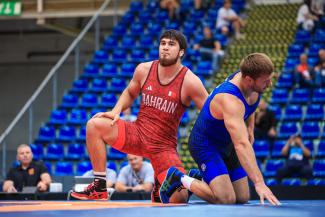
But in 2023, a new force emerged -- Akhmed TAZHUDINOV (BRN). He stunned the wrestling world by beating both Snyder and Sadulaev in Belgrade, claiming the world title. In 2024, he repeated his feat in Paris, solidifying his status as the man to beat at 97kg.

Now, Tazhudinov enters Zagreb as the wrestler to beat, but he’ll face stiff competition from veterans looking for redemption and rivals who came close to beating him.


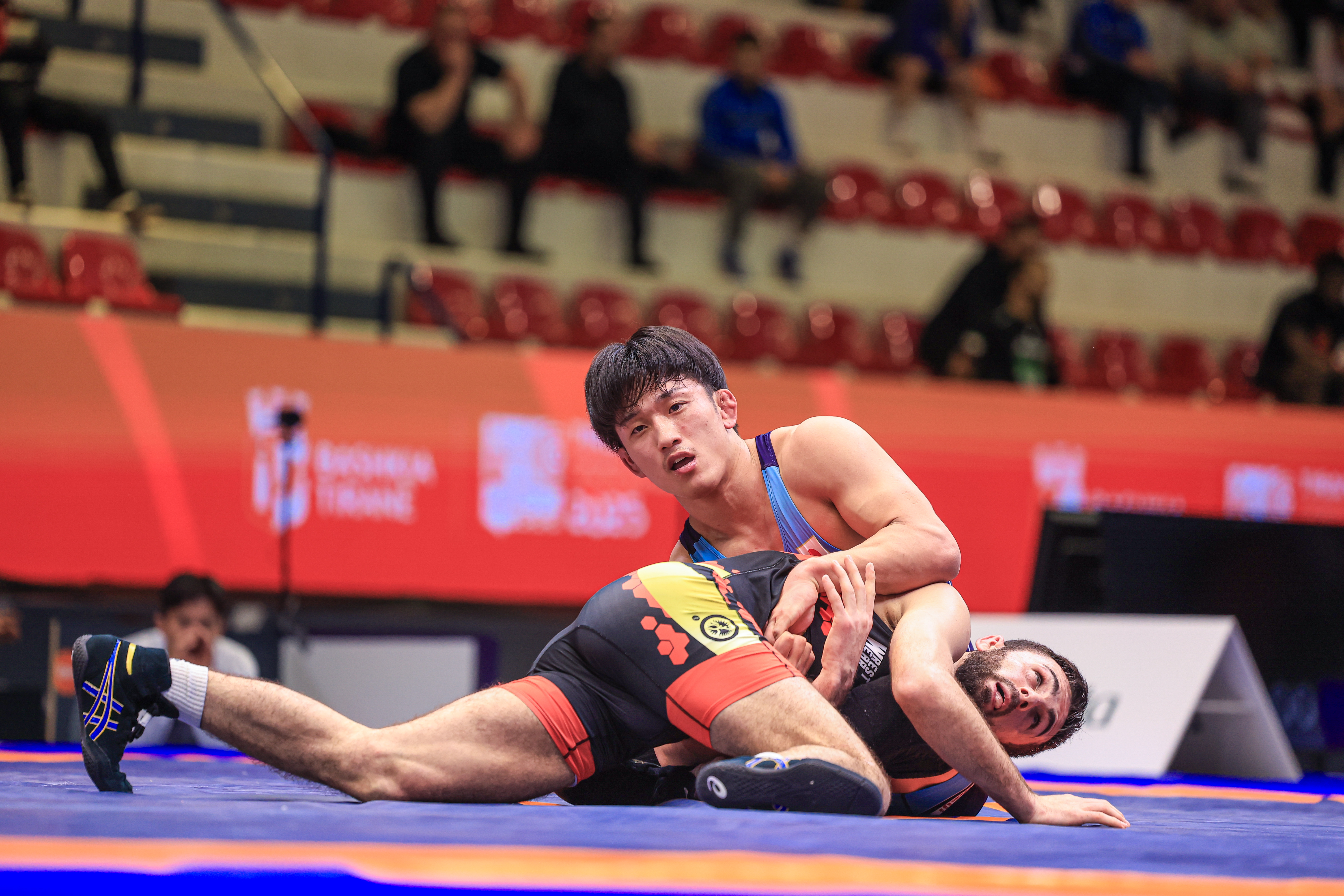
Snyder, who missed the podium in Paris, remains dangerous. He once pushed Sadulaev to the limit before the latter adjusted. Snyder also fell in Albania to Arash YOSHIDA (JPN), the current Asian champion. Yoshida, blends Iranian and Japanese techniques and has excellent underhook defense and is a serious medal contender.

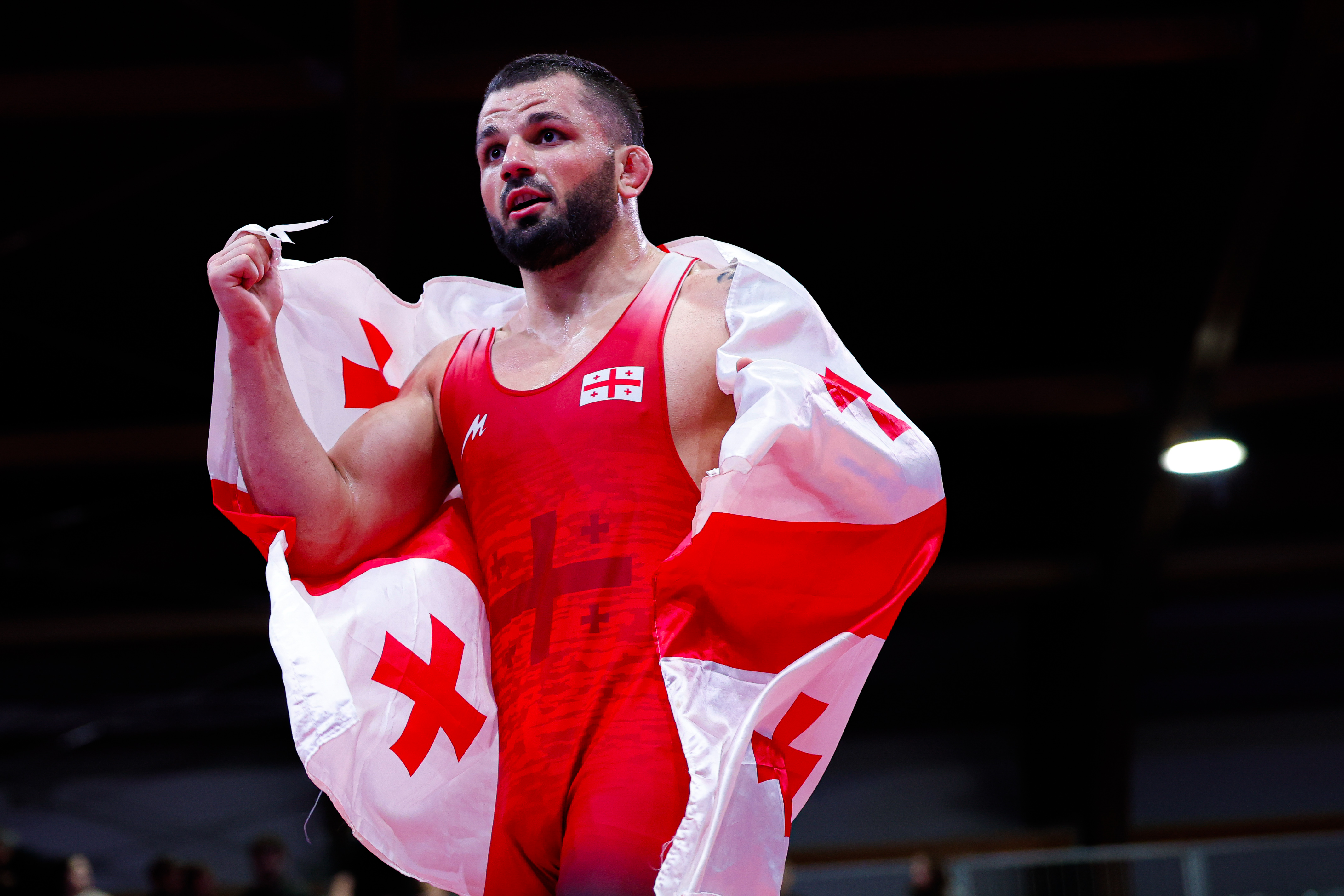
Givi MATCHARASHVILI (GEO)Givi MATCHARASHVILI (GEO) is a three-time European champion. (Photo: United World Wrestling / Kostadin Andonov)
European champion Givi MATCHARASHVILI (GEO) is another name to watch. He won Olympic silver in Paris but was pinned quickly by Tazhudinov. Still, as the number two seed, he avoids Tazhudinov until the final and must contend with Snyder, Yoshida, and possibly Sadulaev on his side of the bracket.

Amirali AZARPIRA (IRI), seeded number five, came closest to beating Tazhudinov in Paris, leading 3-0 before surrendering two late takedowns to lose 4-3. Back from injury, his fitness will be key if the two meet again in Zagreb.

Rizabek AITMUKHAN (KAZ), Kazakhstan’s first freestyle world champion, also pushed Tazhudinov hard at the Asian Championships but couldn’t close the match. He’s a strong bet for the podium. Magomedkhan MAGOMEDOV (AZE) returns after a bronze in Paris and a silver at the 2023 World Championships, remains a serious threat in one of the deepest brackets in the championships.

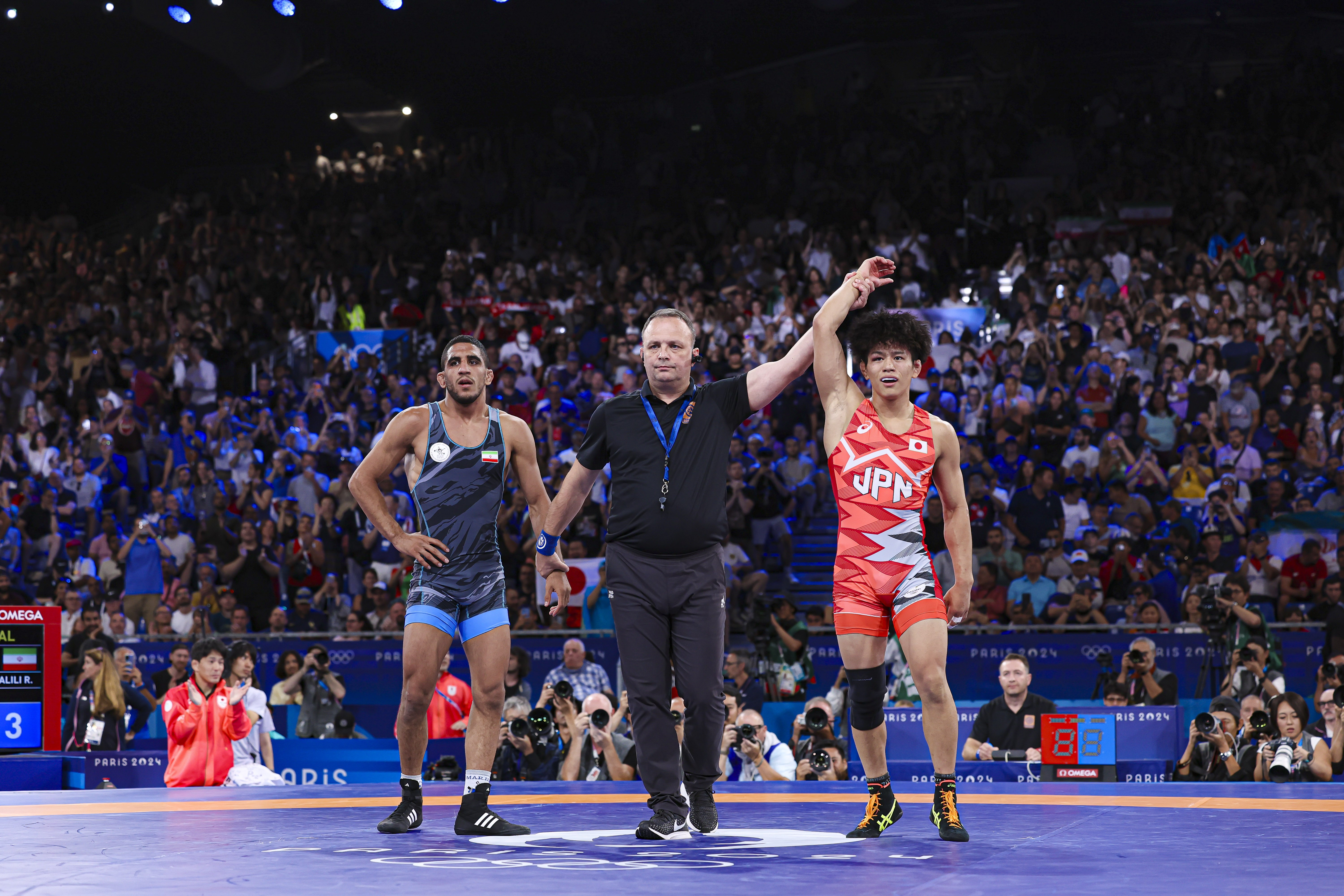
Kotaro KIYOOKA (JPN)Kotaro KIYOOKA (JPN) defeated Rahman AMOUZAD (IRI) in the 65kg Olympic final. (Photo: United World Wrestling / Kadir Caliskan)
Olympic final rematch on cards

Apart from Tazhudinov, Kotaro KIYOOKA (JPN) is the only other Freestyle Olympic champion in Zagreb. At 65kg, all four returning medalists from Paris are entered, though Islam DUDAEV (ALB) will wrestle at 70kg.

A repeat of the 2024 Olympic final is expected at 65kg, with Kiyooka and silver medalist Rahman AMOUZAD (IRI) on course to collide if seeding holds. Kiyooka has never wrestled at a World Championships and skipped the season after winning gold in Paris, but his resume includes wins over world-class opponents. He beat Tokyo Olympic champion Takuto OTOGURO (JPN) to earn Japan’s Paris spot, and then defeated Asian champion Kaisei TANABE (JPN) twice to make the team for Zagreb.

Amouzad will be his biggest threat, looking to avenge the Olympic final. Barring that loss, the Iranian has been a consistent force, using his under-over technique to catch opponents off guard. If he can limit Kiyooka's relentless attacks and keep the match low-scoring, he may have a chance.

European champion Ibragim IBRAGIMOV (UWW), the world U23 champion, brings a full arsenal to challenge both Kiyooka and Amouzad. He could be the biggest disruptor in the bracket.

Sebastian RIVERA (PUR), an Olympic bronze and world silver medalist, could medal again despite not competing since Paris. Vazgen TEVANYAN (ARM) and SUJEET (IND) are also aiming for podium finishes.

Gold drought for Uguev

Beyond Kiyooka and Yoshida, other Japanese medal hopefuls include Asian champion Takara SUDA (JPN) at 61kg, world silver medalist Yoshinosuke AOYAGI (JPN) at 70kg, Kota TAKAHASHI (JPN) at 74kg, and the Ishiguro brothers at 86kg and 92kg.

Suda will have big shoes to fill as his Yamanashi Gakuin University teammate Masanosuke ONO (JPN) rose to become the world champ last year. Suda faces an equally tough field with Zavur UGUEV (UWW), Zelimkhan ABAKAROV (ALB), and UDIT (IND) among others.

Takara SUDA (JPN)Takara SUDA (JPN) is the Asian champion at 61kg. (Photo: United World Wrestling / Amirreza Aliasgari)
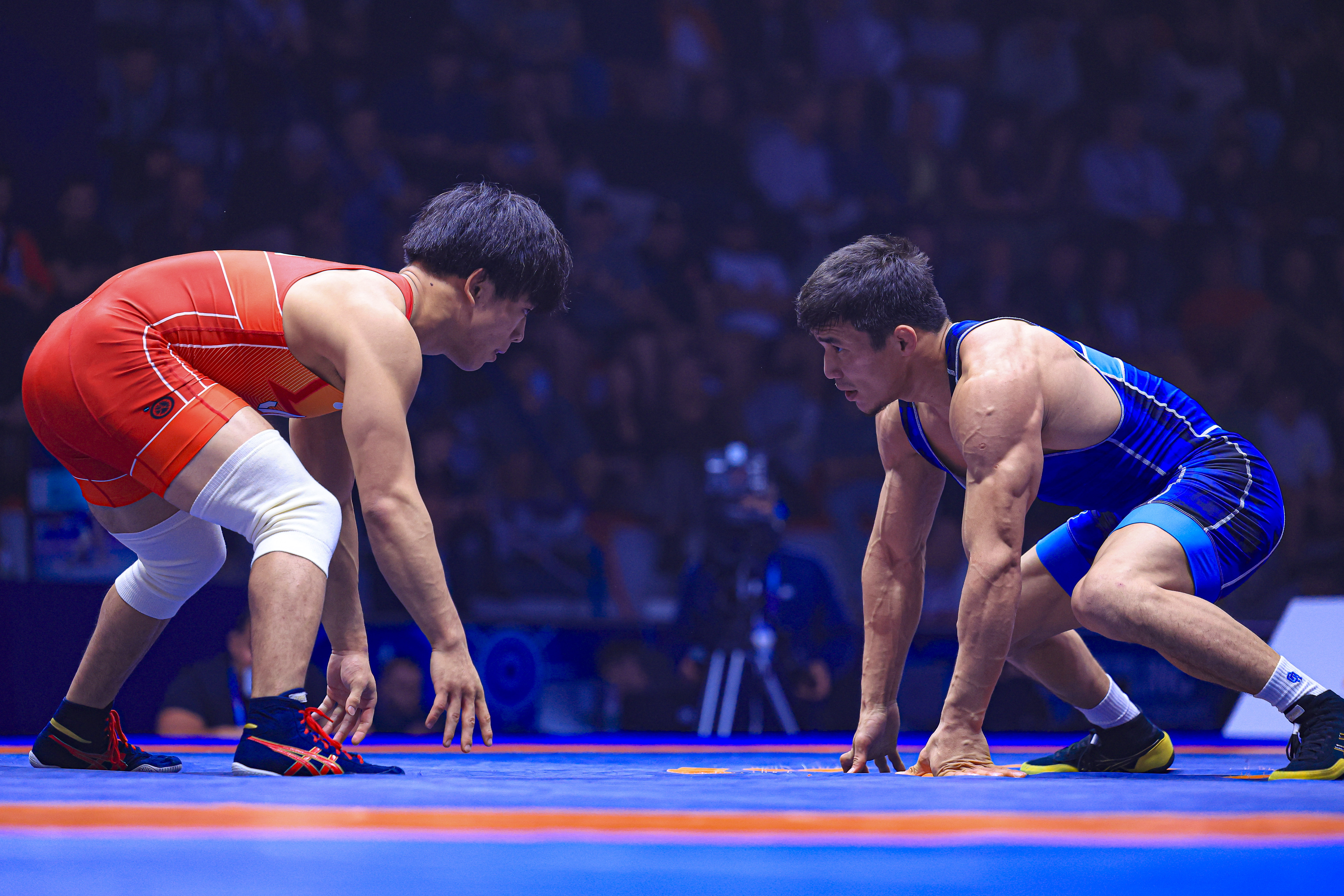
Uguev, Olympic and 2019 world champion, returned to form by winning the European title in April. He finished fifth last year after losses to Ono and Vitali ARAJAU (USA). Can he now stop Suda, the Ranking Series and Asian champion? Suda has found ways to win but struggles with conditioning.

Abakarov, a former world champion, will also be in the mix, having beaten Uguev in 2023. Other contenders include Asian silver medalist Udit, Taiyrbek ZHUMASHBEK UULU (KGZ) -- back at 61kg -- and Jaxen FORREST (USA), who beat Arajau to claim the U.S. team spot.

Sidakov set to return

At 74kg, 2023 world champion Zaurbek SIDAKOV (UWW) has managed to recover just in time for the World Championships. He suffered an injury in his European Championships loss to Chermen VALIEV (ALB) and will likely go through the Albanian if he wants to defend his gold.

Also Read: Valiev opens up Olympics, his style

Valiev has had close encounters against Sidakov and the win at Europeans was his first over Sidakov. His strategy to keep a close score or defend a lead may not always play out well. But his defensive skills are top notch, and he doesn't let anyone score easily.

Kota TAKAHASHI (JPN) and David CARR (USA) are two youngsters who can surprise a few. Both have lethal attacks and can move quickly. Takahashi won the clash in Budapest but Carr nearly pulled off a comeback against a tiring Takahashi.

World silver medalist Tajmuraz SALKAZANOV (SVK) would like to return to the podium, while Yones EMAMI (IRI) and veteran Soner DEMIRTAS (TUR) remain strong contenders.

Nurkozha KAIPANOV (KAZ)Nurkozha KAIPANOV (KAZ), blue, and Yoshinosuke AOYAGI (JPN) wrestled in the 70kg final at 2024 World Championships. Kaipanov won gold. (Photo: United World Wrestling / Kadir Caliskan)
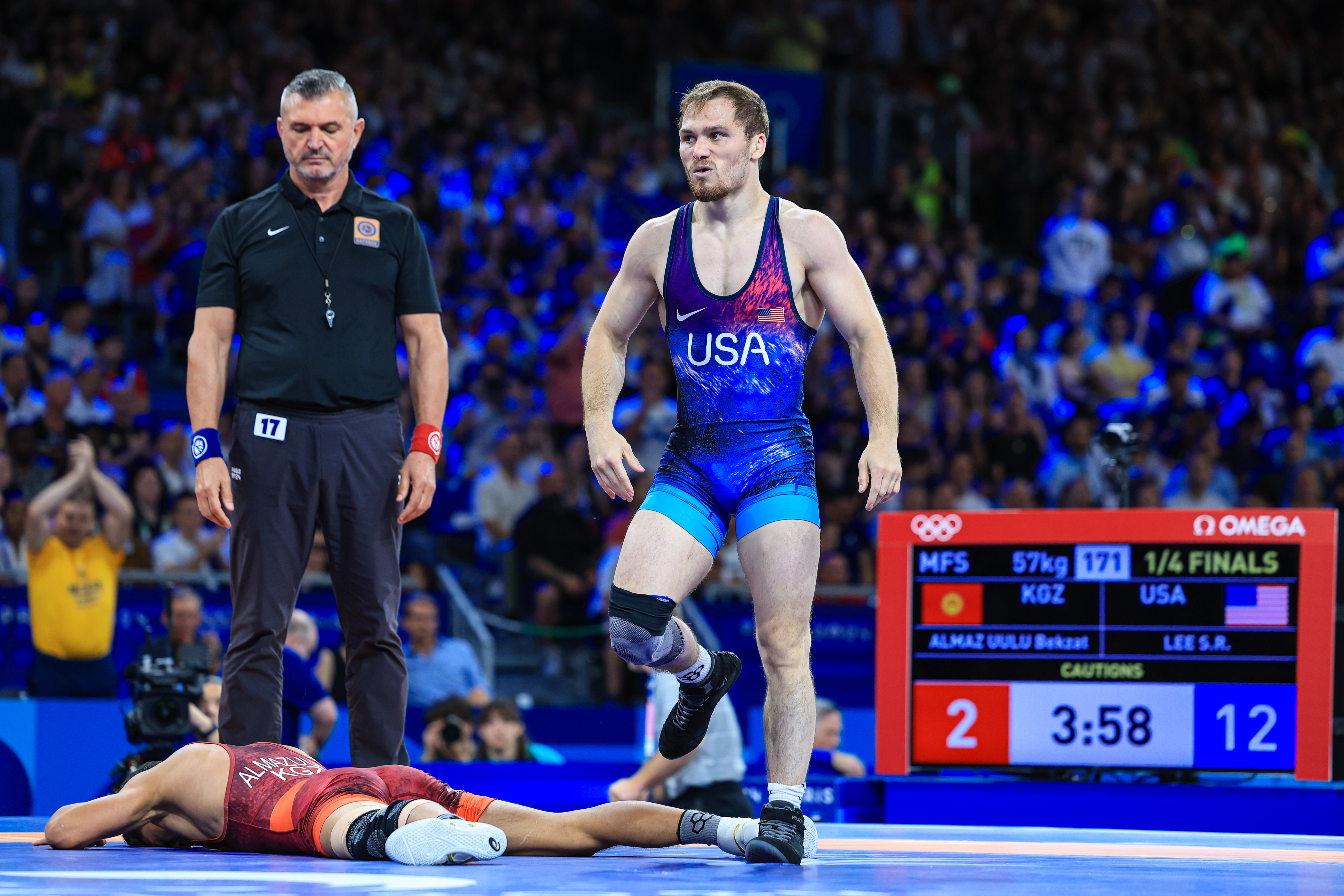
Top-seeded Yoshinosuke AOYAGI (JPN) and world champion Nurkozha KAIPANOV (KAZ) will go for the 70kg title. Kaipanov defeated Aoyagi in last year’s final to win gold. Aoyagi seemed in form with a win at the Budapest Ranking Series but will be challenged in Zagreb.

Kaipanov won 74kg gold at the Asian Championships but is now back at 70kg to defend his world title. While Aoyagi is a key challenger, others may break Kaipanov’s defensive wall.

Former world silver medalist Amirmohammad YAZDANI (IRI) will be the biggest threat as he hunts for his first world title. His attacking style troubles many, though his conditioning is still a work in progress. The field is deeper with Asian champion Ernazar AKMATALIEV (KGZ), who entertains with crafty moves, though that can be his undoing.

Viktor RASSADIN (TJK), a Paris Olympian and second to Akmataliev in Asia, is also a medal threat. Tulga TUMUR OCHIR (MGL) will be at 70kg. Saiyn KAZYRYK (UWW) can make a run to the final but will be tested on the international level.

PJ DUKE (USA), coming off a world U20 gold, and world medalist Arman ANDREASYAN (ARM), will look to add to their success.

Spencer LEE (USA)Olympic silver medalist Spencer LEE (USA) is chasing his first world title at 57kg. (Photo: United World Wrestling / Amirreza Aliasgari)
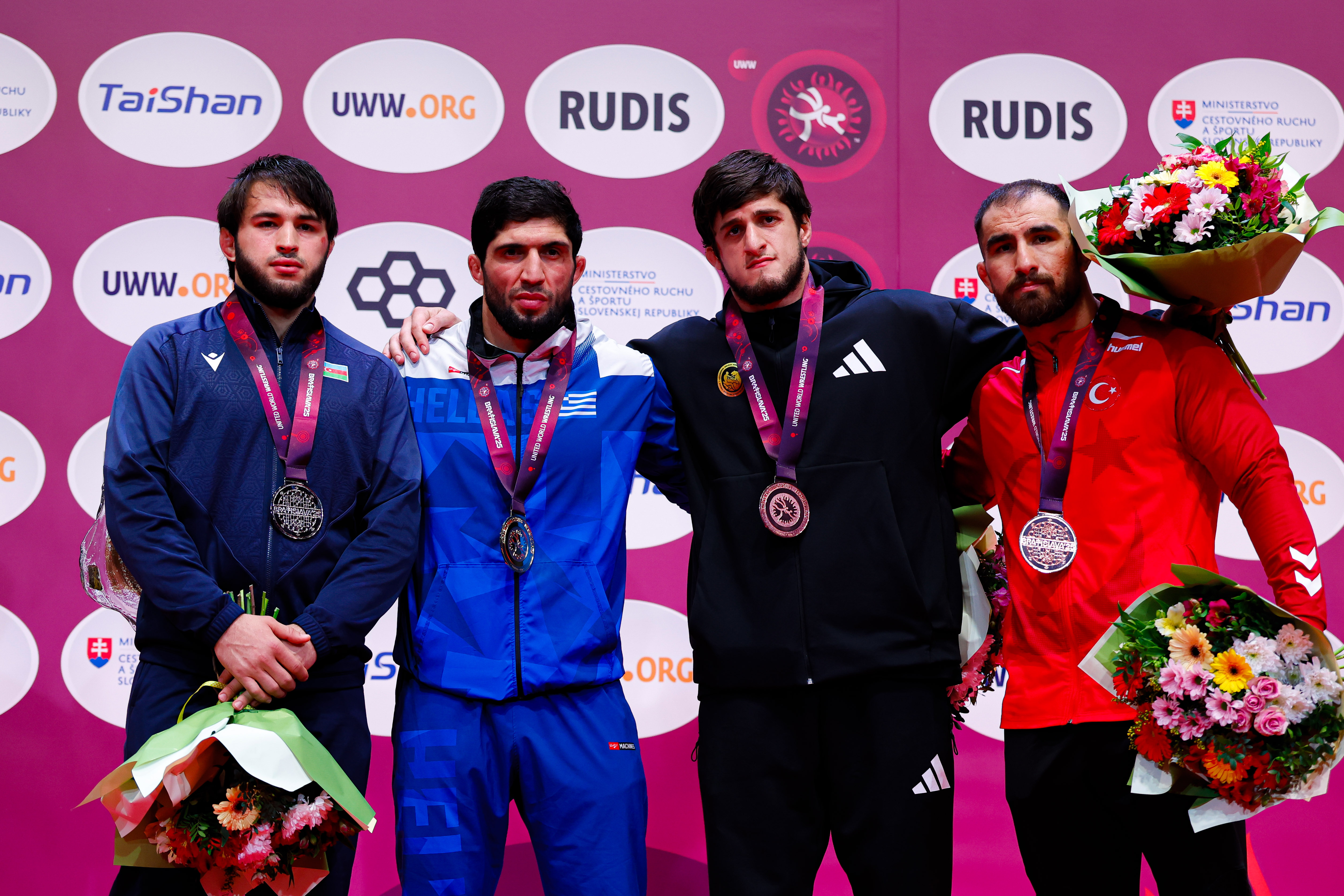
Lee chases world gold

In other weight classes, Spencer LEE (USA) will be looking to win a world medal. A United States wrestler winning the gold medal in the lowest weight category is a rare occurrence. Thomas GILMAN (USA) won gold in 2021 and silver in 2022; however, the country drew a blank in 2023.

Now, Paris Olympic silver medalist Lee is primed to win gold at 57kg in Zagreb. This will be his first World Championships, but he is the favorite to claim the title. It is unlikely he will face much trouble, but if he does, it will likely come from 2023 world bronze medalist Arsen HARUTYUNYAN (ARM) and Paris bronze medalists AMAN (IND) and Gulomjon ABDULLAEV (UZB).

The field is further intensified by Asian champion Chong Song HAN (PRK), European silver medalist Azamat TUSKAEV (SRB), and Iran’s Ali MOMENI (IRI).

At 79kg, Akhmed USMANOV (UWW), world champion in 2023, should have no trouble winning his second title despite familiar foes like Vladimeri GAMKRELIDZE (GEO) and Mohammad NOKHODI (IRI).

Usmanov defeated both en route to his 2023 gold and has since won the European Championships in 2024 and 2025. In the final in Slovakia, Usmanov overcame veteran Zelimkhan KHADJIEV (FRA).

Khadjiev remains a podium contender but recently suffered a close loss to Georgios KOUGIOUMTSIDIS (GRE) in Budapest, making the Greek wrestler a real medal threat. Also not to be counted out is Vasyl MYKHAILOV (UKR), who has consistently been competitive at the World Championships.

New dawn at 86kg
The 86kg category will see a big shift in Zagreb. Since 2017, Hassan YAZDANI (IRI) and David TAYLOR (USA) have shared the gold medals at Worlds. However, that near-decade-long reign is ending. Taylor has retired, and Yazdani has moved up a weight class, skipping this year.

So who will be champion in Zagreb? Two-time world champion Kamran GHASEMPOUR (IRI), second to Yazdani at 86kg, will be the favorite. He was competing at 92kg and was close to a third world title before losing heartbreakingly in the semifinals to Sadulaev.

Also Read: "I was destroyed" - Ghasempour on Sadulaev loss

Now back at the Olympic weight class, Ghasempour aims to deliver his best performance in Zagreb. He is unseeded, which means he can be drawn anywhere in the bracket.

The weight class is packed with talent. European silver medalist Mahamedkhabib KADZIMAHAMEDAU (UWW) is thriving at 86kg and nearly won gold at the European Championships. Former world U20 champion Ibragim KADIEV (UWW) is another strong contender despite limited top-level international experience.

Zahid VALENCIA (USA) has improved significantly over the past year and is a potential podium finisher with his attacking pace. Arsenii DZHIOEV (AZE) and Azamat DAULETBEKOV (KAZ) are dark horses who could surprise in this competitive field.

PodiumAll four 2025 European Championships medalist Osman NURMAGOMEDOV (AZE), left, Dauren KURUGLIEV (GRE), second from left, Miriani MAISURADZE (GEO), third from left, and Feyzullah AKTURK (TUR) are medal threats in Zagreb. (Photo: United World Wrestling / Kostadin Andonov)

Two-time world silver medalists Osman NURMAGOMEDOV (AZE) and Miriani MAISURADZE (GEO), European champion Dauren KURUGLIEV (GRE), Asian champion Amirhossein FIROUZPOUR (IRI), and former world silver medalists Batyrbek TSAKULOV (SVK) and Deepak PUNIA (IND) make the 92kg category one of the toughest in Zagreb.

Though he lacks a World Championships medal, Trent HIDLAY (USA) is a top gold-medal contender after winning gold in Budapest. He is currently one of the strongest wrestlers globally.

Firouzpour, moving into the spotlight after Ghasempour’s shift down a weight class, enters Zagreb as a favorite. Though new to Worlds, his Iranian style with underhook pushouts and takedowns makes him a serious threat.

Nurmagomedov and Kurugliev battled at the European Championships and Budapest, with Kurugliev prevailing both times. Maisuradze remains a strong competitor despite a recent dip in form.

At 125kg, Amir Hossein ZARE (IRI) stands head and shoulders above the rest, though European champion Giorgi MESHVILDISHVILI (AZE), Solomon MANASHVILI (GEO), Lkhagvagerel MUNKHTUR (MGL), and Wyatt HENDRICKSON (USA) aim to challenge him.