

Rotter Focken Delivers in Final Women's Match in Belgrade
Wednesday, December 16, 2020 - 20:52 By Andrew Hipps

Links:
Finals Highlights
Day 5 Photos
Interview with Anastasia NICHITA (MDA)
BELGRADE, Serbia (December 16) -- On Wednesday night, Aline ROTTER FOCKEN (GER) delivered in a big way in the final women's wrestling match of the Individual World Cup in Belgrade, Serbia.
The 29-year-old German secured the gold medal at 76kg with a fall over 2017 world champion Yasemin ADAR (TUR).
Rotter Focken, a 2014 world champion and four-time world medalist, led 1-0 at the break after a tactical opening period. Early in the second period, Adar, who defeated Olympic champion Erica WIEBE (CAN) by fall in the semifinals, fired off a double leg. Rotter Focken defended the shot and whipped the Turkish wrestler to her back to secure the fall.
Russia claimed the team title in women's wrestling, finishing with seven medals, including two gold medals. A day after Ekaterina POLESHCHUK (50kg) won gold, Svetlana LIPATOVA gave Russia its second gold in women's wrestling by edging Mariana CHERDIVARA ESANU (MDA) 2-1 at 59kg.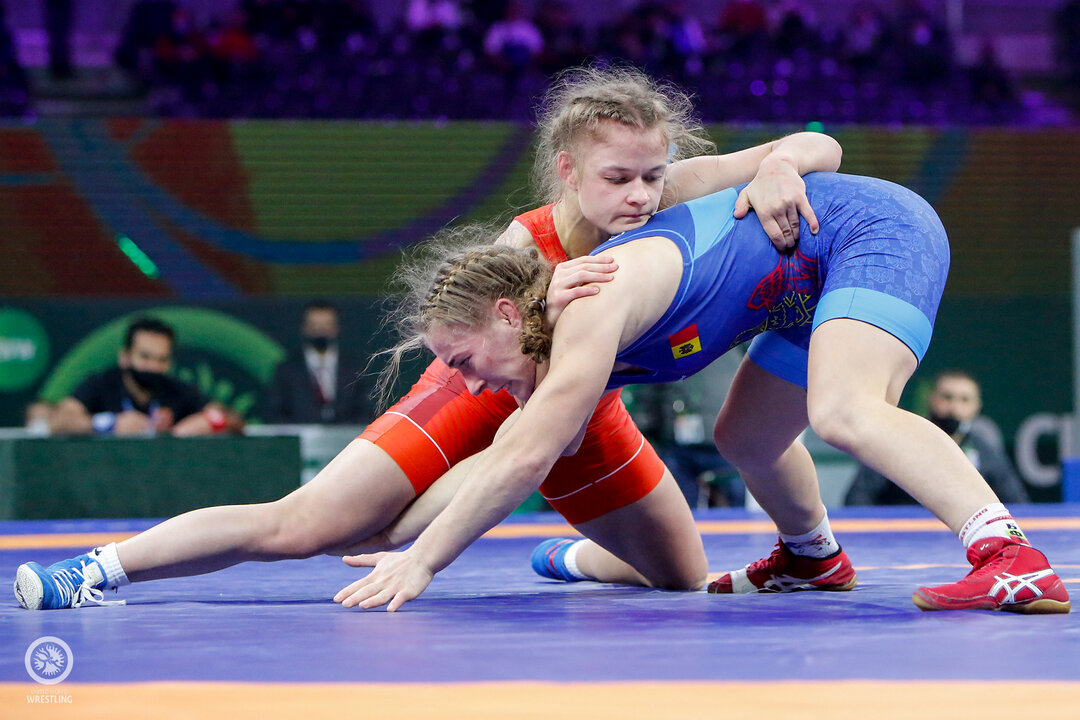
Svetlana LIPATOVA (RUS) gave Russia its second gold in women's wrestling at the Individual World Cup (Photo: Gabor MARTIN, UWW)
After Lipatova scored the only point of the opening period off the activity clock, Cherdivara Esanu came back to take the criteria lead in the second period after scoring a point of her own off the activity clock. A short time later, the Moldovan wrestler was put on the activity clock for a second time. She was unable to score, giving Lipatova her lead back, which was enough to earn the narrow victory.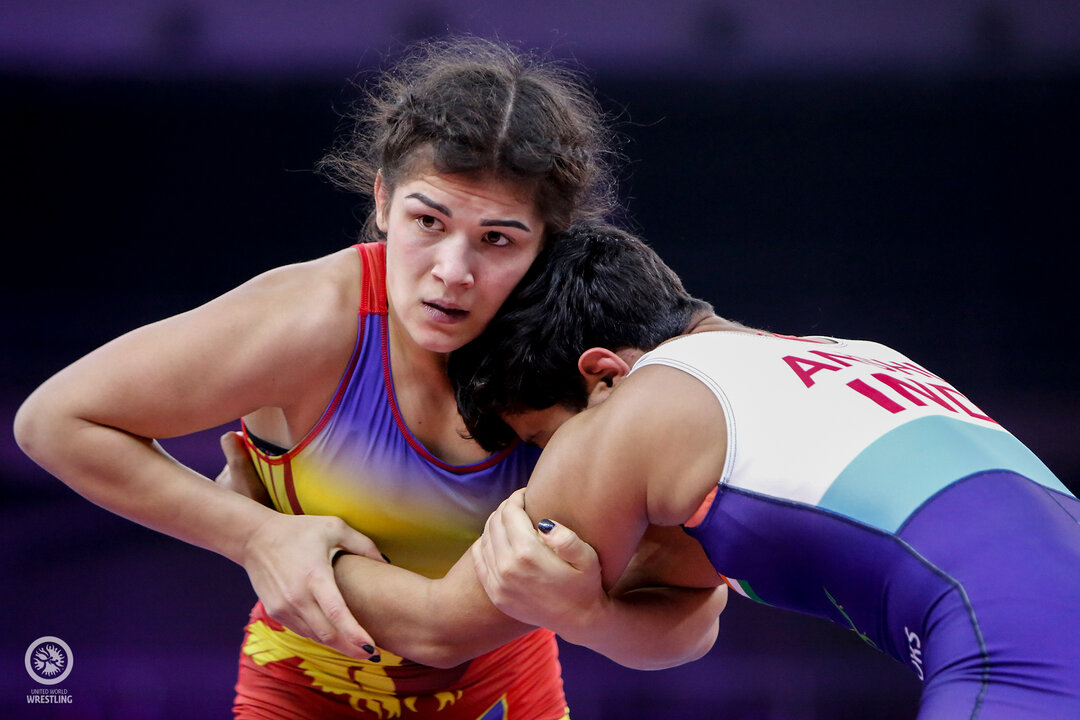
Anastasia NICHITA (MDA) won the title at 57kg (Photo: Gabor MARTIN, UWW)
Three Moldovan women competed for gold on Wednesday, but only European champion Anastasia NICHITA (57kg) came out victorious.
Nichita earned the gold medal at 57kg with a 5-1 victory over world No.7 Anshu ANSHU (IND). Nichita led 1-0 at the break. She tacked on more points in the second period, scoring a two-point exposure with a throw before adding a takedown midway through the final period.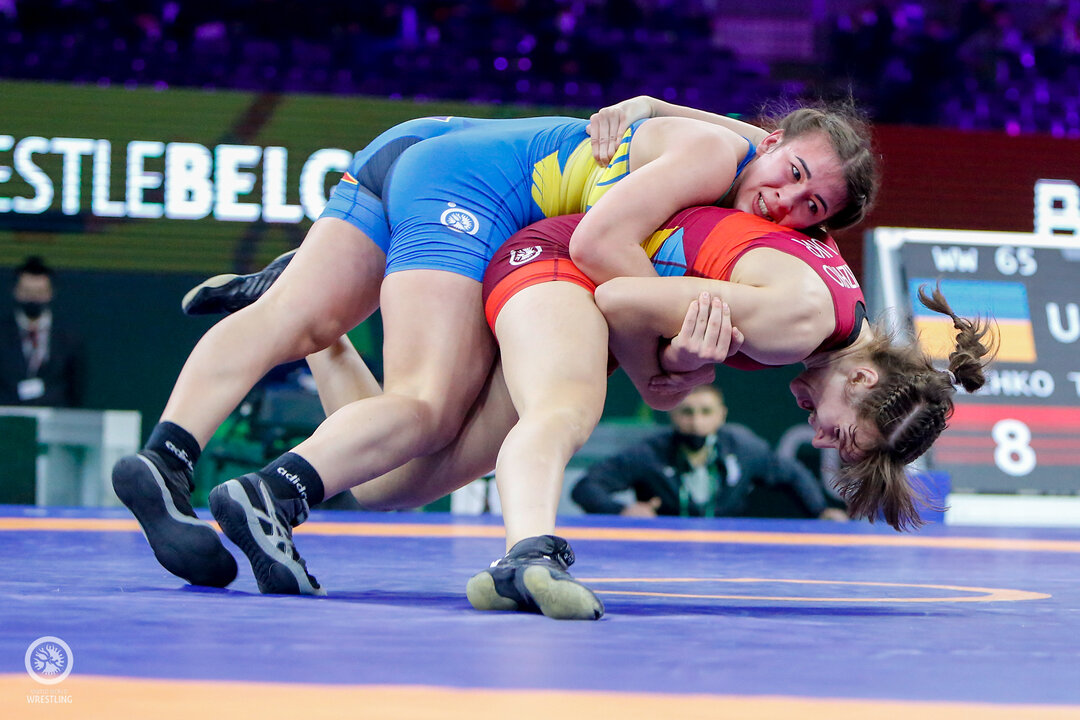
Tetiana RIZHKO (UKR) throws Irina RINGACI (MDA) for four points (Photo: Gabor MARTIN, UWW)
Tetiana RIZHKO (UKR), a 2018 junior world bronze medalist, used a big second period to help her earn a 14-4 technical superiority over Irina RINGACI (MDA) and capture the gold medal at 65kg. Rizhko went up 4-0 early before Ringaci responded with a takedown and gut wrench to grab the criteria lead heading into the break. Rizhko came out strong in the second period, throwing Ringaci to her back and nearly securing the fall. The Ukrainian built her lead to 8-4 before tossing Ringaci again to her back for four points to go up 12-4. She closed out the match by getting a takedown with 25 seconds remaining. 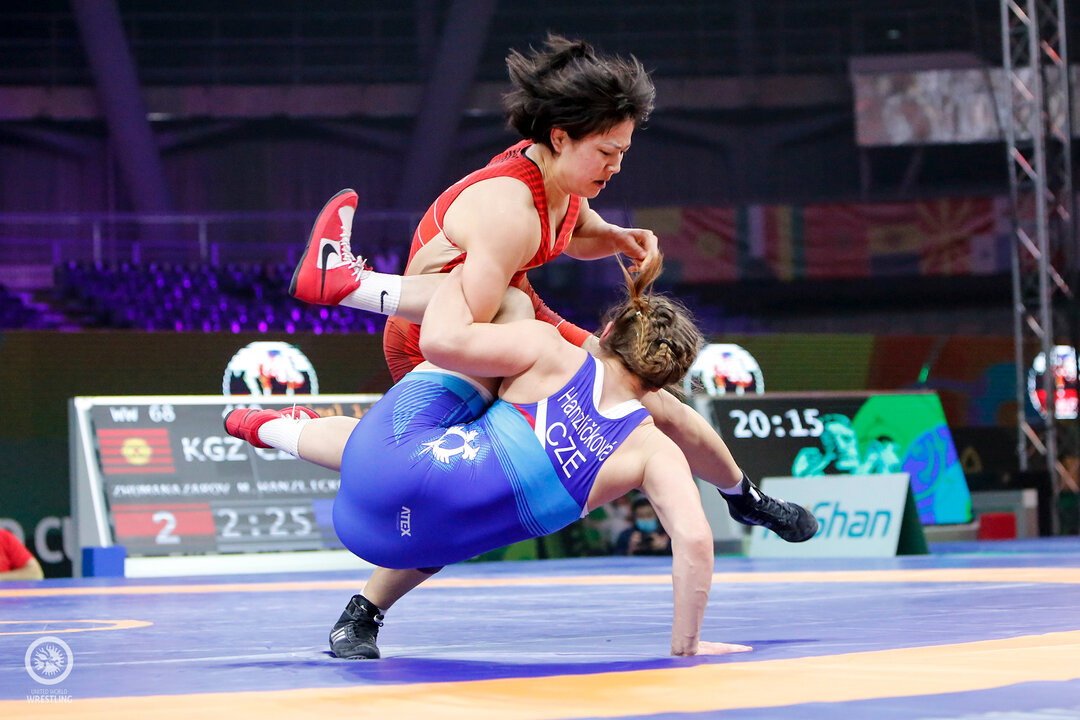
Meerim ZHUMANAZAROVA (KGZ) topped Adela HANZLICKOVA (CZE) to win gold at 68kg (Photo: Gabor MARTIN, UWW)
Meerim ZHUMANAZAROVA (KGZ), a junior world silver medalist, overcame a slow start to defeat Adela HANZLICKOVA (CZE) 8-2 and claim the gold at 68kg. Hanzlickova, a 2020 Yasar Dogu champion, led 1-0 at the break after scoring off the activity clock. The 21-year-old Zhumanazarova quickly took the lead in the second period after shooting a double leg and scoring the match's first takedown. She added to her lead with another takedown before Hanzlickova scored a point off a step out to cut the deficit to 4-2. With less than 20 seconds remaining, Zhumanazarova shot a double leg and scored a four-point takedown to blow the match wide open.
Both Russia and Ukraine finished the day with one gold medal and two bronze medals.
Veronika CHUMIKOVA (57kg) and Khanum VELIEVA (68kg) won bronze medals for Russia, while Kateryna ZELENYKH (59kg) and Alina BEREZHNA STADNIK MAKHYNIA (68kg) earned bronze for Ukraine.
Elis MANOLOVA (AZE) and Mimi HRISTOVA (BUL) took the bronze medals at 65kg.
Mehlika OZTURK (TUR) won a bronze at 57kg after getting a fall over Arianna CARIERI (ITA).
Magdalena GLODEK (POL) edged Sandra PARUSZEWSKI (GER) to win a bronze medal at 59kg.
Vasilisa MARZALIUK (BLR) defeated the Rio Olympic champion Wiebe to win a bronze at 76kg. The other bronze at 76kg was won by Aiperi MEDET KYZY (KGZ).
Women's Wrestling Medal Match Results
57kg
GOLD: Anastasia NICHITA (MDA) df. Anshu ANSHU (IND) by VPO1, 5-1
BRONZE: Veronika CHUMIKOVA (RUS) df. Alyona KOLESNIK (AZE) by VPO1, 2-2
BRONZE: Mehlika OZTURK (TUR) df. Arianna CARIERI (ITA) by VFA, 5-0
59kg
GOLD: Svetlana LIPATOVA (RUS) df. Mariana CHERDIVARA ESANU (MDA) by VPO1, 2-1
BRONZE: Kateryna ZELENYKH (UKR) df. Elif YANIK (TUR) by VSU, 10-0
BRONZE: Magdalena GLODEK (POL) df. Sandra PARUSZEWSKI (GER) by VPO1, 8-7
65kg
GOLD: Tetiana RIZHKO (UKR) df. Irina RINGACI (MDA) by VSU1, 14-4
BRONZE: Elis MANOLOVA (AZE) df. Asli DEMIR (TUR) by VPO, 4-0
BRONZE: Mimi HRISTOVA (BUL) df. Mariia KUZNETSOVA (RUS) by VFA, 6-6
68kg
GOLD: Meerim ZHUMANAZAROVA (KGZ) df. Adela HANZLICKOVA (CZE) by VPO1, 8-2
BRONZE: Khanum VELIEVA (RUS) df. Sofiya Hristova GEORGIEVA (BUL) by VSU1, 13-2
BRONZE: Alina BEREZHNA STADNIK MAKHYNIA (UKR) df. Hanna SADCHANKA (BLR) by VSU, 10-0
76kg
GOLD: Aline ROTTER FOCKEN (GER) df. Yasemin ADAR (TUR) by VFA, 3-0
BRONZE: Vasilisa MARZALIUK (BLR) df. Erica Elizabeth WIEBE (CAN) by VPO1, 3-1
BRONZE: Aiperi MEDET KYZY (KGZ) df. Ekaterina BUKINA (RUS) by VPO1, 11-8

 Ji-Woo Lee holds the highest Category IS License. (photo by Japan Wrestling Federation)
 Lee faces Saori YOSHIDA at the 2004 Asian Championships in Tokyo. (photo by Takeo Yabuki / Japan Wrestling Federation)
 Lee made her Olympic refereeing debut at the Tokyo Games in 2021. (Photo by Japan Wrestling Federation)
 Lee was on the whistle when Nonoka OZAKI defeated Ami ISHII in a vital 68kg match with Olympic implications. (photo by Takeo Yabuki / Japan Wrestling Federation)
 Lee poses with the three Japanese female referees at the All-Japan Championships, from right, Mariko SHIMIZU, Airi FURUSATO and Honoka SAITO. (photo courtesy of Airi FURUSATO)
 World champion Akari FUJINAMI tries her hand as a referee at a men's collegiate event last May. ((photo by Ikuo Higuchi / Japan Wrestling Federation)
Share your thoughts.
Comments