

#WrestleBelgrade

Rotter Focken Delivers in Final Women's Match in Belgrade

By Andrew Hipps

Links:
Finals Highlights
Day 5 Photos
Interview with Anastasia NICHITA (MDA)

BELGRADE, Serbia (December 16) -- On Wednesday night, Aline ROTTER FOCKEN (GER) delivered in a big way in the final women's wrestling match of the Individual World Cup in Belgrade, Serbia.

The 29-year-old German secured the gold medal at 76kg with a fall over 2017 world champion Yasemin ADAR (TUR).

Rotter Focken, a 2014 world champion and four-time world medalist, led 1-0 at the break after a tactical opening period. Early in the second period, Adar, who defeated Olympic champion Erica WIEBE (CAN) by fall in the semifinals, fired off a double leg. Rotter Focken defended the shot and whipped the Turkish wrestler to her back to secure the fall.

Russia claimed the team title in women's wrestling, finishing with seven medals, including two gold medals. A day after Ekaterina POLESHCHUK (50kg) won gold, Svetlana LIPATOVA gave Russia its second gold in women's wrestling by edging Mariana CHERDIVARA ESANU (MDA) 2-1 at 59kg.
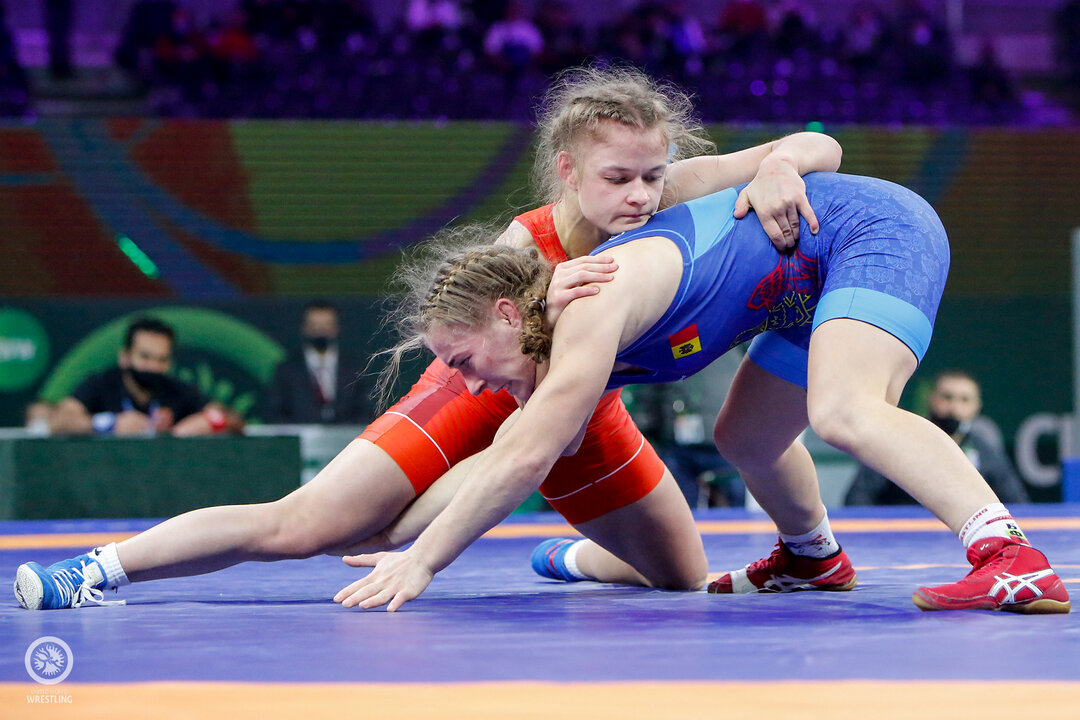
Svetlana LIPATOVA (RUS) gave Russia its second gold in women's wrestling at the Individual World Cup (Photo: Gabor MARTIN, UWW)

After Lipatova scored the only point of the opening period off the activity clock, Cherdivara Esanu came back to take the criteria lead in the second period after scoring a point of her own off the activity clock. A short time later, the Moldovan wrestler was put on the activity clock for a second time. She was unable to score, giving Lipatova her lead back, which was enough to earn the narrow victory.
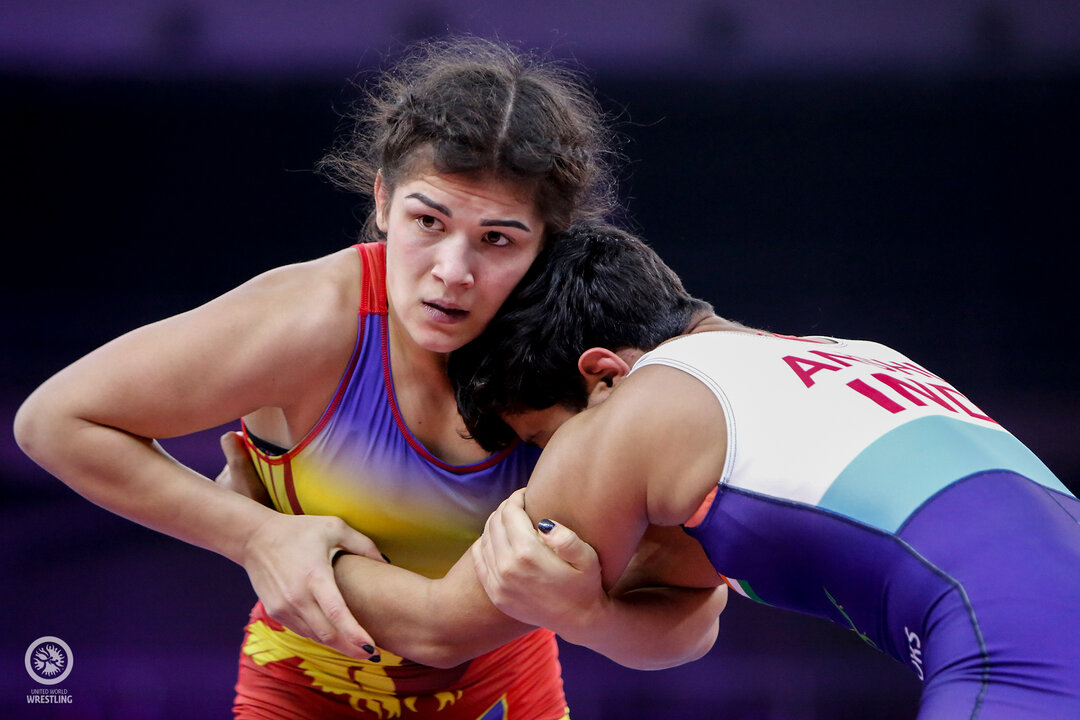
Anastasia NICHITA (MDA) won the title at 57kg (Photo: Gabor MARTIN, UWW)

Three Moldovan women competed for gold on Wednesday, but only European champion Anastasia NICHITA (57kg) came out victorious. 

Nichita earned the gold medal at 57kg with a 5-1 victory over world No.7 Anshu ANSHU (IND). Nichita led 1-0 at the break. She tacked on more points in the second period, scoring a two-point exposure with a throw before adding a takedown midway through the final period.
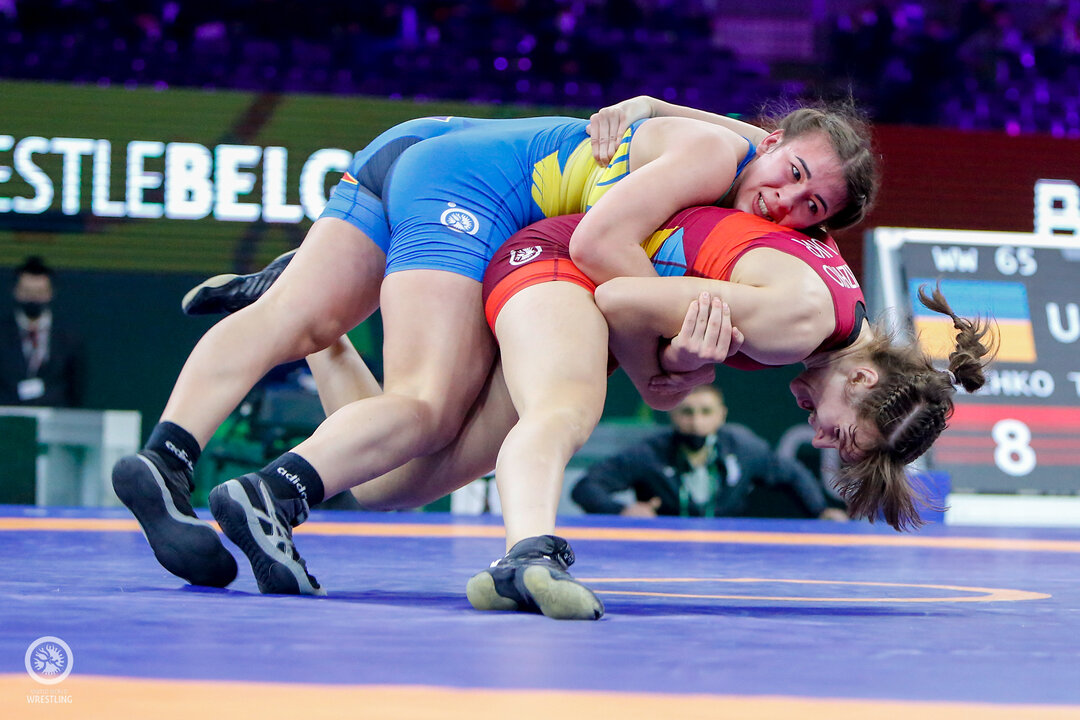
Tetiana RIZHKO (UKR) throws Irina RINGACI (MDA) for four points (Photo: Gabor MARTIN, UWW)

Tetiana RIZHKO (UKR), a 2018 junior world bronze medalist, used a big second period to help her earn a 14-4 technical superiority over Irina RINGACI (MDA) and capture the gold medal at 65kg. Rizhko went up 4-0 early before Ringaci responded with a takedown and gut wrench to grab the criteria lead heading into the break. Rizhko came out strong in the second period, throwing Ringaci to her back and nearly securing the fall. The Ukrainian built her lead to 8-4 before tossing Ringaci again to her back for four points to go up 12-4. She closed out the match by getting a takedown with 25 seconds remaining. 
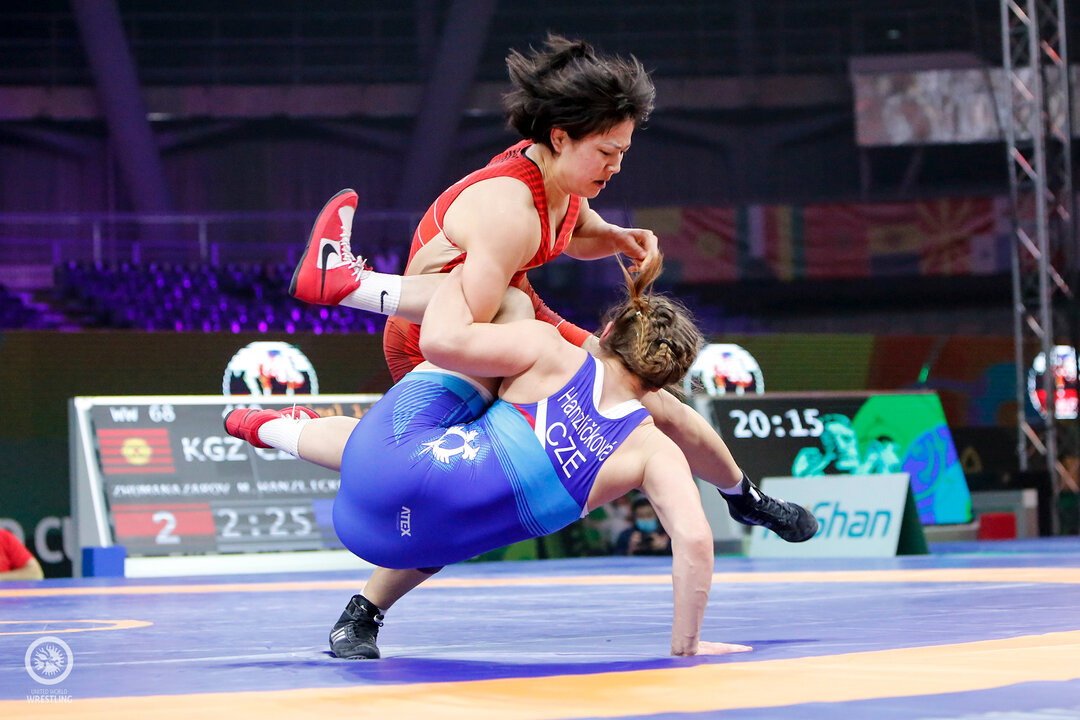
Meerim ZHUMANAZAROVA (KGZ) topped Adela HANZLICKOVA (CZE) to win gold at 68kg (Photo: Gabor MARTIN, UWW)

Meerim ZHUMANAZAROVA (KGZ), a junior world silver medalist, overcame a slow start to defeat Adela HANZLICKOVA (CZE) 8-2 and claim the gold at 68kg. Hanzlickova, a 2020 Yasar Dogu champion, led 1-0 at the break after scoring off the activity clock. The 21-year-old Zhumanazarova quickly took the lead in the second period after shooting a double leg and scoring the match's first takedown. She added to her lead with another takedown before Hanzlickova scored a point off a step out to cut the deficit to 4-2. With less than 20 seconds remaining, Zhumanazarova shot a double leg and scored a four-point takedown to blow the match wide open.

Both Russia and Ukraine finished the day with one gold medal and two bronze medals.

Veronika CHUMIKOVA (57kg) and Khanum VELIEVA (68kg) won bronze medals for Russia, while Kateryna ZELENYKH (59kg) and Alina BEREZHNA STADNIK MAKHYNIA (68kg) earned bronze for Ukraine. 

Elis MANOLOVA (AZE) and Mimi HRISTOVA (BUL) took the bronze medals at 65kg. 

Mehlika OZTURK (TUR) won a bronze at 57kg after getting a fall over Arianna CARIERI (ITA).

Magdalena GLODEK (POL) edged Sandra PARUSZEWSKI (GER) to win a bronze medal at 59kg.

Vasilisa MARZALIUK (BLR) defeated the Rio Olympic champion Wiebe to win a bronze at 76kg. The other bronze at 76kg was won by Aiperi MEDET KYZY (KGZ).

Women's Wrestling Medal Match Results

57kg
GOLD: Anastasia NICHITA (MDA) df. Anshu ANSHU (IND) by VPO1, 5-1
BRONZE: Veronika CHUMIKOVA (RUS) df. Alyona KOLESNIK (AZE) by VPO1, 2-2
BRONZE: Mehlika OZTURK (TUR) df. Arianna CARIERI (ITA) by VFA, 5-0

59kg
GOLD: Svetlana LIPATOVA (RUS) df. Mariana CHERDIVARA ESANU (MDA) by VPO1, 2-1
BRONZE: Kateryna ZELENYKH (UKR) df. Elif YANIK (TUR) by VSU, 10-0
BRONZE: Magdalena GLODEK (POL) df. Sandra PARUSZEWSKI (GER) by VPO1, 8-7

65kg
GOLD: Tetiana RIZHKO (UKR) df. Irina RINGACI (MDA) by VSU1, 14-4
BRONZE: Elis MANOLOVA (AZE) df. Asli DEMIR (TUR) by VPO, 4-0
BRONZE: Mimi HRISTOVA (BUL) df. Mariia KUZNETSOVA (RUS) by VFA, 6-6

68kg
GOLD: Meerim ZHUMANAZAROVA (KGZ) df. Adela HANZLICKOVA (CZE) by VPO1, 8-2
BRONZE: Khanum VELIEVA (RUS) df. Sofiya Hristova GEORGIEVA (BUL) by VSU1, 13-2
BRONZE: Alina BEREZHNA STADNIK MAKHYNIA (UKR) df. Hanna SADCHANKA (BLR) by VSU, 10-0

76kg
GOLD: Aline ROTTER FOCKEN (GER) df. Yasemin ADAR (TUR) by VFA, 3-0
BRONZE: Vasilisa MARZALIUK (BLR) df. Erica Elizabeth WIEBE (CAN) by VPO1, 3-1
BRONZE: Aiperi MEDET KYZY (KGZ) df. Ekaterina BUKINA (RUS) by VPO1, 11-8
 

Obituary

Remembering Saitiev: Master on mat who inspired many

By Vinay Siwach

CORSIER-SUR-VEVEY, Switzerland (April 7) -- Buvaisar SAITIEV was an unknown before the 1996 Atlanta Olympics. And after that he became the legend. 

At 21, Saitiev thrilled the crowd and displayed techniques that the world thought were impossible to execute at 74kg. Saitiev would go on to win two more Olympic golds -- 2004 and 2008 -- as he became the best 74kg wrestler out there. A three-time Olympic champion, six-time world champion, and an inspiration to the wrestling world, Saitiev passed away earlier this month at the age of 49.

"Biggest and greatest wrestler" - Nenad LALOVIC, UWW President

Brandon SLAY (USA) was in that crowd at the 1996 Atlanta Olympics. The 21-year-old was amazed what he saw. He watched another 21-year-old win the gold medal.

"It was an honor to watch him in Atlanta," Slay said. "Then study him and compete against him four years later."

Believe it or not, that was the first time Russia won Olympic gold medal at 74kg, a weight class now synonymous with their domination, both at senior and youth level.

Buvaisar SAITIEV (RUS)Buvaisar SAITIEV (RUS). (Photo: United World Wrestling / Martin Gabor)

At the time, the U.S. was focused on defending its dominance at 74kg, with Iran also challenging for supremacy, while Saitiev had yet to make his mark internationally. The Olympic history saw wrestlers from Turkiye, Japan, the United States and Korea win gold medal in this weight class. So when Saitiev arrived, he was the underdog. In the 1996 Atlanta final, he defeated the defending Olympic champion Park JANG SOON and ushered an era of Russian dominance at this weight class.

It took a once-in-a-lifetime talents like Jordan BURROUGHS (USA) and Hassan YAZDANI (IRI) to deny the gold medals to Russia in 2012 and 2016 respectively. However, Russia is now at top. Zaurbek SIDAKOV (ROC) won gold medals at the 2018 and 2019 World Championships, 2020 Tokyo Olympics [held in 2021] before winning it again in 2023 and Russian transfer to Uzbekistan and Saitiev's student Razambek JAMALOV (UZB) won in 2024.

A little insight on how the U.S. discovered Saitiev is provided in the the documentary 'Slaying Saitiev". Pat SMITH (USA), who was wrestling at the 1995 Ivan Yarygin Memorial, recalls when he first saw Saitiev, his opponent in the final.

Saitiev had not wrestled senior-level yet internationally and was till three months away from winning his first World Championships gold. So Smith and his team thought they are favorites to win the gold medal at the Yarygin.

"I go out on the mat, I see Saitiev, the fight starts," Smith recalls in the documentary. "And right away, right away I thought: “This is the best they have.” Because the way he was punching, his movement, the way he was flowing from one position to another... he was simply unstoppable. I did some takedowns, but in the end he gave me a pretty good beating. I come off the mat, Bruce is standing there, I say: “You were wrong. That guy from the semi-finals wasn’t the best. This is the best . ” – “I didn’t even know who it was!” – “Now you know. Buvaisar Saitiev.” And two months later he won the world championship. The best wrestler I’ve ever wrestled. There’s no question about that. The best.

"He looked like a librarian, skinny, gangly. But the positions he scores from, the way he moves you around the mat... I've never wrestled anyone like that again."

Smith’s observation wasn’t just a fleeting comment. It captured the essence of what made Saitiev so formidable on the mat. Saitiev, standing at 6 feet, defied convention of a tall wrestler standing upright. He would engage in ties which forced his opponents to shoot while he was in control. Saitiev would counter rather easily and score.

Saitiev used to engage with his opponents and yet they found it extremely difficult to score a takedown on him.

Brandon SLAY (USA)Brandon SLAY (USA) over Buvaisar SAITIEV (RUS) at the 2000 Olympics. (Photo: United World Wrestling / Martin Gabor)

Slay, who defeated Saitiev at the 2000 Sydney Olympics, had to study Saitiev for years before breaking through in their Olympic meeting.

"The greatness of Saitiev came from how extremely hard it was to finish takedowns on him," Slay says. "Most of the time when people attacked Saitiev, either he scored or no one scored. And, most of the time when he attacked, he scored. That makes for a very challenging opponent to beat, which is why he rarely lost. I am so thankful I had the opportunity to wrestle the greatest wrestler of all time."

Saitiev had it all. Snapdowns, feints, two-on-one, underhooks, overhooks, defense, attack, chain wrestling, innovations, and techniques that made him score points from any positions. So many options to immobilize his opponents who would eventually break down.

On March 3, the day he passed away, the internet saw outpouring tributes to his legacy. But some of the most shared posts were his clips from various bouts on his career. A few wrote how they began wrestling because of him, others explained why he inspired them to adapt and study wrestling.

Buvaisar SAITIEV (RUS)Buvaisar SAITIEV (RUS). (Photo: United World Wrestling)

2008 Olympic champion Henry CEJUDO (USA) called him the "greatest" and he was a 'fanboy.'

"A man that was poetry in motion at its finest, and in my opinion, the greatest athlete who has ever ever lived or walked on planet Earth," Cejudo wrote on his Instagram. "I would never fanboy over anybody but Buvaisar. I was so honored of the times that I did get a chance to hang out as I had a permanent smile the whole day. Thank you for all the great years that you gave the wrestling community and inspiring millions of people across the world. I can honestly say without Saitiev I wouldn’t be the wrestler that I am today."

John DIAKOMIHALIS (USA), a wrestler known for his crafty moves and detailing of wrestling, tributed his passion to Saitiev, who himself was known as a wizard on the mat for his moves.

"Buvaisar Saitiev was how I fell in love with the art of wrestling, I wanted to be like him," Diakomihalis wrote on X. "His innovation and passion for improvement were some of the staples of how I approached learning the sport or learning anything in my life."

Saitiev had that impact on people. Jamalov, who won the 2024 Paris Olympic gold medal, was Saitiev's student. Jamalov said that Saitiev was family.

"His approach was very subtle and deep, he always knew how to choose the right and necessary words for support," Jamalov said. "Every meeting with him was unforgettable and every word of his was unforgettable. Outside of wrestling, he was very caring and compassionate towards me, he was always worried about my injuries and operations."

While Jamalov was his student, Saitiev never backed from helping any wrestler. He 'couldn't stop himself from talk to even strangers if he had a broken ear.'


After Tokyo Olympic champion Yui SUSAKI (JPN) lost her first-ever international bout to VINESH (IND) in Paris, she talked to Saitiev who had lost in Sydney after winning Atlanta but still won two more Olympic golds.

"I had a video call with him right after the Paris Olympics," Susaki said. "Like me, he didn't do well in his second Olympics. But he won gold medals in two more Olympics. I vowed to him that I would win gold medals in two more Olympics like him to become a legend.

"He also taught me that to become a legend, I should never lose again. I owe it all to him that I was able to stand up strong after losing. Thanks to him, I decided to keep fighting to win two more Olympic gold medals. And I vowed to become a legendary wrestler like him. I won't lose anymore. I will keep winning. Your message is a treasure for my life. He is a legend and his wrestling has always fascinated me. His matches are always amazing to watch and I think he is the most talented wrestler in history."

This off the mat personality of Saitiev resonated with many, even with people outside of wrestling. He was humble, witty and respectful.

Sports Express journalist Yuri GOLYSHAK recalled his moments with Saitiev who was part of many reception after his 2008 Beijing gold medal. 

"I was sure that we would meet again. Saitiev had enough stories for ten interviews," Golyshak wrote in his tribute. "I even imagined how it would be - not in a hurry, like after Beijing. Not in a car, no. Everything will be different. I will come to his home in Khasavyurt. It will be a fairy tale. We will go to the mountains. I will understand something that I did not understand before, in this amazing, invincible man. And in life in general."

Saitiev's influence transcends mere records and titles. His tactics on the mat just when the internet era arrived gave insights into a wrestler may only be imagined. He passed on that mastery to a special few who remember him as a mentor, inspiration and the greatest ever.