

Rio Olympic champion Dosho announces retirement
Friday, March 31, 2023 - 19:30 By Ken Marantz

TOKYO (March 30) -- Sara DOSHO (JPN), a gold medalist at the 2016 Rio Olympics whose bid for further glory was hampered by a shoulder injury suffered in 2018 from which she never fully recovered, announced her retirement on her Twitter account Thursday.
The 28-year-old Dosho, who now goes by her married name of OKADA, won the women's 69kg gold in Rio, following up on the lone senior world title that she captured in 2017 in Paris. She also won a world silver in 2014 and bronzes in 2013 and 2015.
"Looking back at my life in wrestling, I can say with pride that I gave it my all," wrote Dosho, who next month will start a new life as a civil servant in her hometown of Matsusaka City, Mie Prefecture, in central Japan.
Dosho, who needed to win a domestic playoff at 68kg to make the Tokyo Olympics in 2021, came up well short of an Olympic repeat when she finished fifth. Her loss in a bronze-medal match to Alla CHERKASOVA (UKR) would prove to be the final match of her career.
"It's been 21 years since I started wrestling at age 7," Dosho wrote. "I have devoted everything to wrestling.
"After the Tokyo Olympics ended, I thought I would like to aim to get back to the big stage again. But as the days went on, my physical condition and the effects of the shoulder and all the little injuries that built up kept me from giving all I could to wrestling as I did before, and that led to this decision."
Dosho had seemed well positioned for a run at a second straight Olympic gold when she injured her left shoulder on the opening day of the World Cup in March 2018 in Takasaki, Japan.
Dosho managed to hold on and defeat Danielle LAPPAGE (CAN) 2-1 in the match, but was forced to skip the gold-medal match the following day against China, which Japan won 6-4 for its fourth straight title. The team captain, she could only join the celebration on the mat.
The injury necessitated surgery, forcing her to miss that year's World Championships in Budapest and abdicate her throne. She was able to return in time for the All-Japan
Championships in December that year, where she barely managed to secure her eighth straight but final national title.
As one who relies on a strong tackle attack, Dosho was forced on the defensive in her final years and never regained her previous dominance. She captured a fourth gold at the Asian Championships in Xi'an, China, in April 2019, but five months later had to settle for a disappointing fifth place at the World Championships in Nur-Sultan.
Her loss in the quarterfinals to eventual champion Tamyra MENSAH-STOCK (USA) ended a 41-match winning streak that spanned four years and dated back to the 2015 World Championships in Las Vegas.
While the fifth place in Nur-Sultan earned Japan a spot at 68kg at the Tokyo Olympics, failing to win a medal meant Dosho did not earn the place for herself outright. She needed to win the All-Japan to clinch the spot, but was instead dealt a one-sided 9-2 loss in the semifinals by Miwa MORIKAWA.
That put the 68kg berth up for grabs in a playoff between the two. Dosho, who was coming off an injured knee suffered two months earlier, scored her only technical points with a counter for a takedown and beat Morikawa 3-1. The one-year delay of the Tokyo Games benefitted her in terms of allowing her time to recover, but it wasn't enough to strike gold again.
She faced Mensah-Stock in the first round, and again the American dominated the encounter. Dosho defeated long-time Asian rival Feng ZHOU (CHN) in the repechage, but lost by fall to Cherkasova in the bronze-medal match. Ironically, it was Cherkasova who won the world title in 2018 that Dosho missed.
Dosho started wrestling at the Ichishi Wrestling Club in Mie Prefecture that produced three-time Olympic champion Saori YOSHIDA (JPN) and many other stars. She won three national titles in the elementary school grades, then won the national high school crown in each of her three years at Shigakukan High School, the feeder to powerhouse Shigakkan University.
In her freshman year at Shigakkan, she won the first of four senior world medals with a third place at the 2013 World Championships in Budapest. The next year she finished second at 69kg to Aline FOCKEN (GER), a loss she would avenge three years later in the final in Paris.
Heading into the next stage of her life, Dosho recently resigned from Toshin Housing Co., the Aichi Prefecture-based housing construction company that sponsors the
wrestling team that she joined in 2017 out of Shigakkan. Among her teammates were fellow Olympic champion Eri TOSAKA and Sae NANJO.
Dosho now enters the world of civil service, working in the Matsusaka municipal office in the sports promotion section of the board of education. According to Japanese media, Dosho was not recruited, instead applying for the job to take advantage of a program that promotes the return of people who have moved to big cities to their local areas.
"When her application came through the internet and I saw the name, I was surprised," the head of the personnel department was quoted as saying by The Tokyo Shimbun, adding that in their interview, "She said she wants to work on promoting sports using the experience she has acquired in the Olympics and elsewhere."
The daily reported that Matsusaka Mayor Masato TAKEGAMI said, "I hope she does work that gives dreams to children."
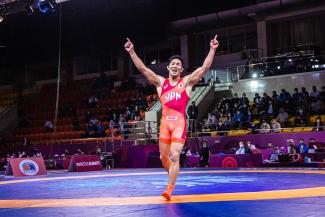
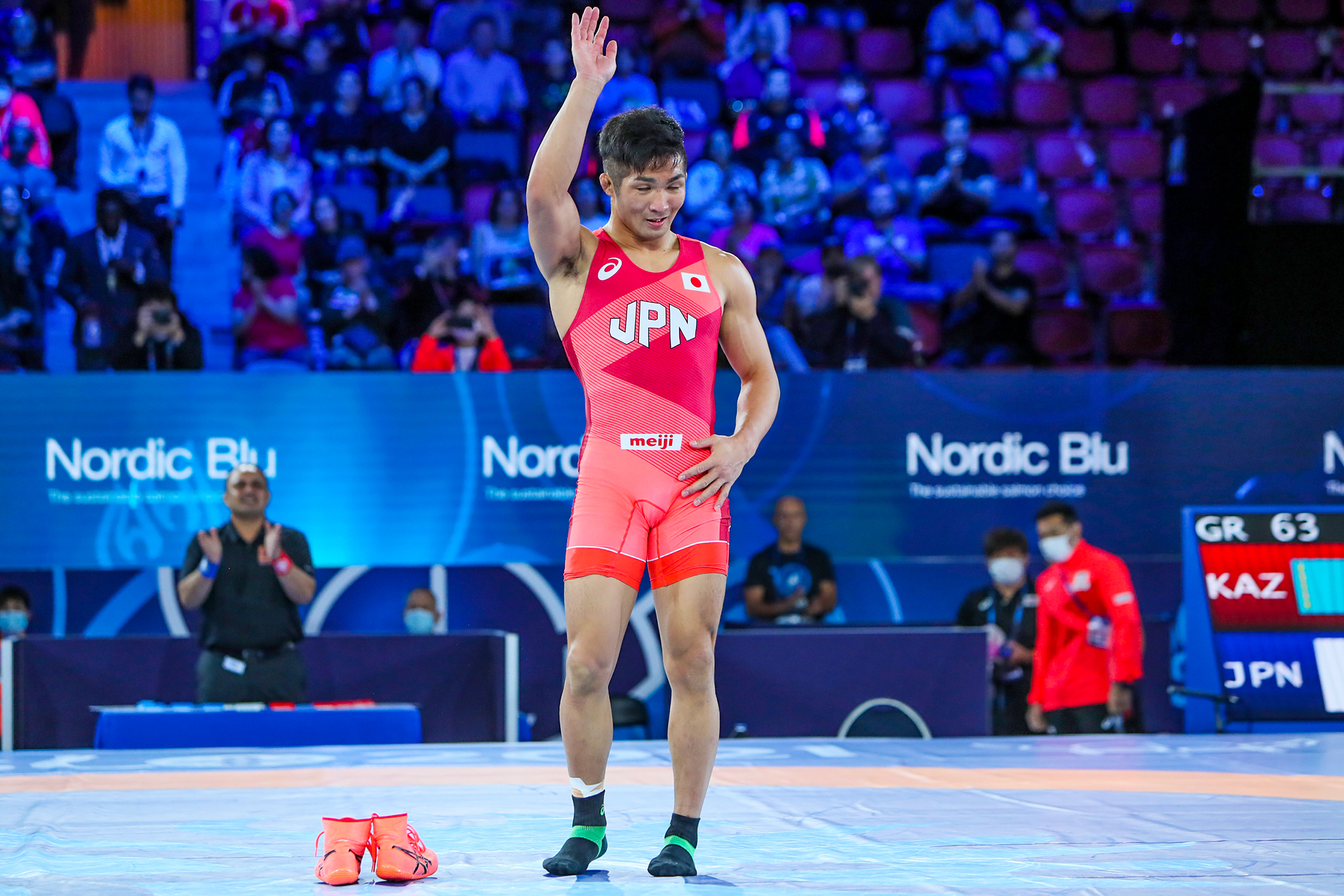 Tsuchika SHIMOYAMADA (AUS) had left his shoes on the mat during the 2021 World Championships to mark his retirement. (Photo: United World Wrestling / Martin Gabor)
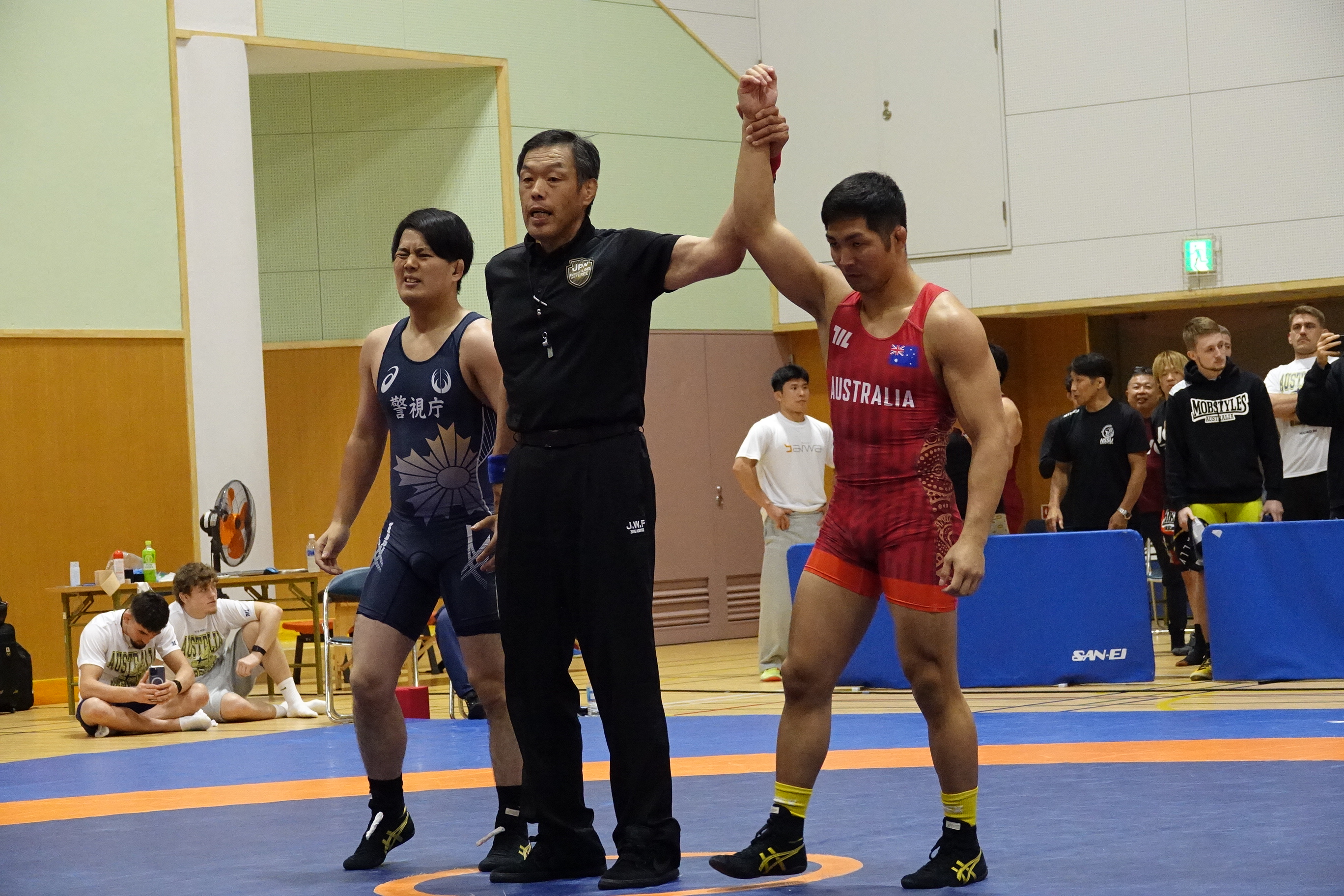 Tsuchika SHIMOYAMADA advances to the semifinals at the All-Japan Non-Student Championships in July with a 52-second win over Kokoro GOTO. (Photo: Koji Fuse / wrestling-spirits.jp)
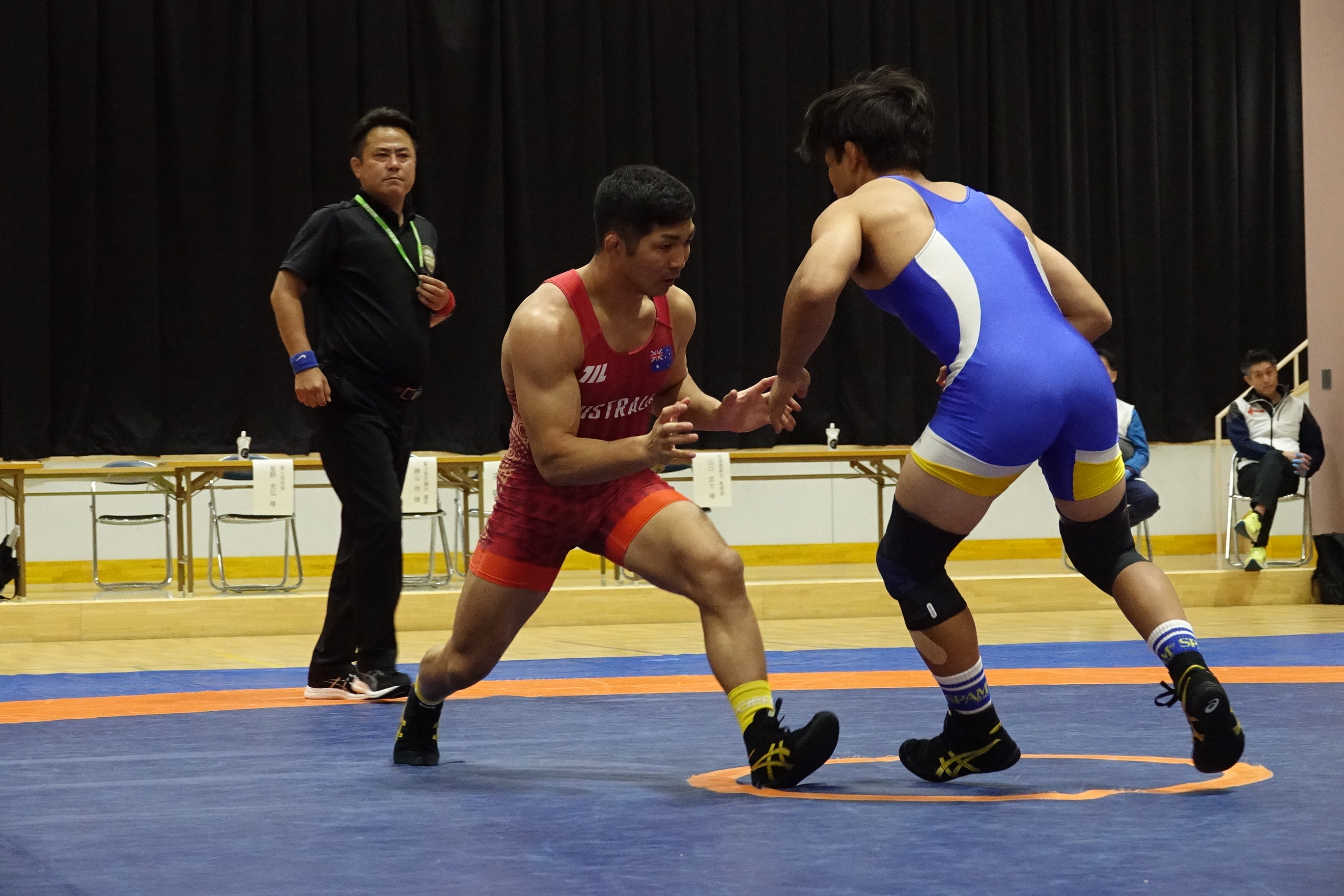 Tsuchika SHIMOYAMA faces Keitaro ONO in his opening match at the All-Japan Non-Student Championships in July. (Photo: Koji Fuse / wrestling-spirits.jp)
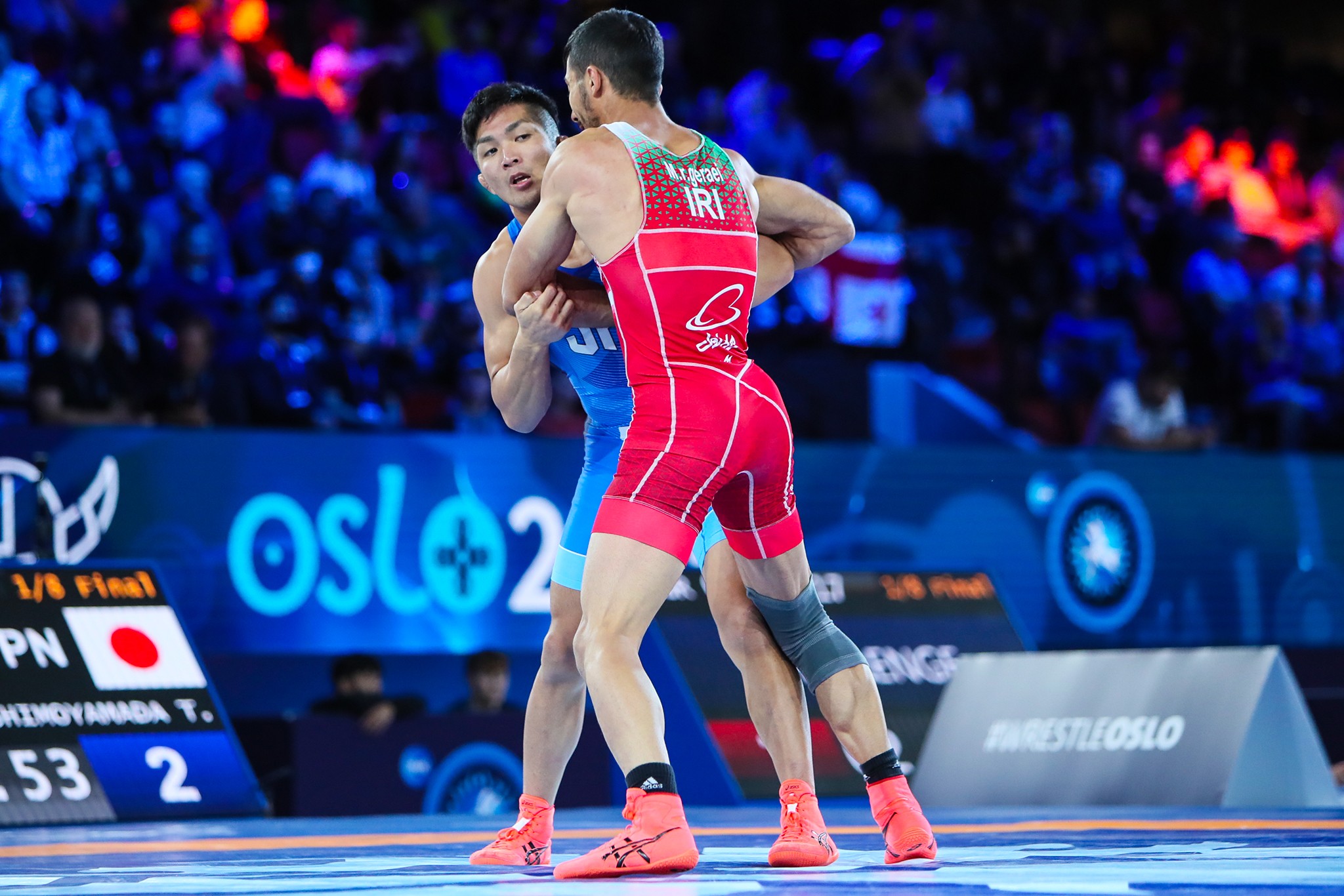 Tsuchika SHIMOYAMADA (AUS) was dominating Mohammadreza GERAEI (IRI) in their match at the 2021 World Championships before being pinned. (Photo: United World Wrestling / Martin Gabor)
Share your thoughts.
Comments