TOKYO (May 23) -- Making the most of her raw determination and an effective low single, Ami ISHII will get a chance at a third straight world title after all. And she earned a ticket to the Asian Games as a bonus.
Ishii notched consecutive victories over rival Miwa MORIKAWA on Saturday, first in the women's 68kg final at the Meiji Cup All-Japan Invitational Championships then again in a playoff for a place on the national team at Tokyo's Komazawa Gym.
"What went well at the tournament was not so much how I handled my matches, but the process I went through in the six months since I lost [to Morikawa] in December," Ishii said. "To get where I am today, after my loss in December, I spent every day thinking about making the national team. The difficult times became my ally."
Ishii, the reigning world champion at 68kg, fell to world 65kg champion Morikawa last December in the final of the Emperor's Cup All-Japan Championships which, along with the Meiji Cup, are the domestic qualifiers for the World Championships and Asian Games.
Wrestlers who win both tournaments automatically earn tickets to both big events. If the winners are different, a playoff is held between the two in an extra session following the medal ceremony.
There were four playoffs in total among the nine weight classes that had finals on Saturday, with Paris Olympic champion Yuka KAGAMI also making the grade by completing a double victory over Yasuha MATSUYUKI at women's 76kg.
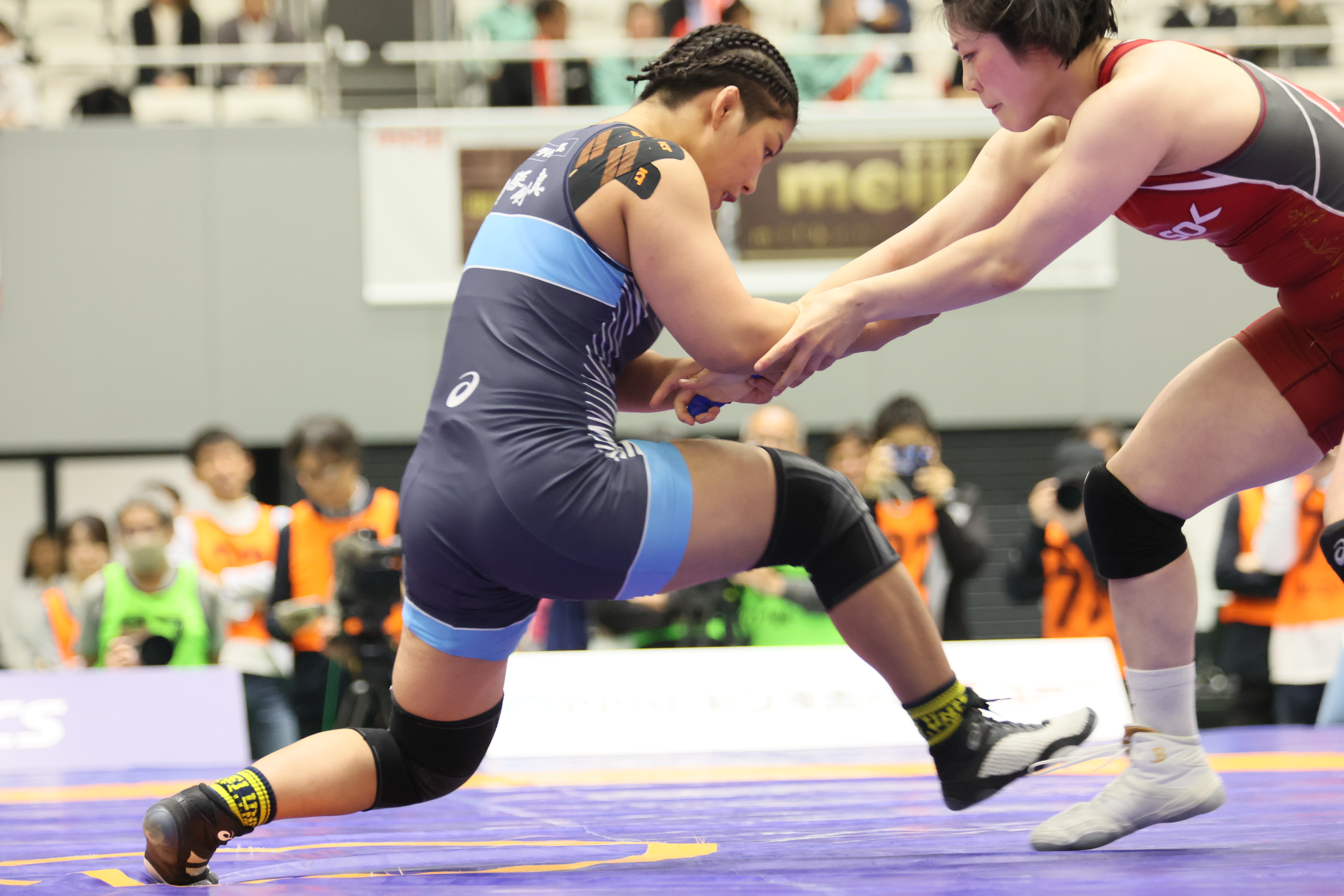 Ami ISHII (JPN) wrestles off Miwa MORIKAWA (JPN) in the 68kg playoff. (Photo: wrestling-spirits.jp / Takeo Yabuki)
Ishii, who lost 5-3 to Morikawa at the Emperor's Cup, never gave her opponent an opening to go the offensive, and both of their bouts revolved around actions initiated by Ishii low singles, which Morikawa would counter by reaching over the top.
"From the new year to today, I have worked on various things, but the major issue was how to finish off [the takedown]," Ishii said. "I'm really happy that that became the key to victory."
In the Meiji Cup final, Ishii notched a 2-1 win, with a first-period stepout accounting for the difference when both received activity points in the second period. On the scoring move, Ishii got in deep on a single, then got the point when a scramble took them over the edge.
Returning to the mat several hours later for the playoff, Morikawa was able to score off a counter, but it wasn't enough as Ishii held on to win 4-2.
After receiving an activity point, Ishii scored a stepout to take a 2-0 lead into the break. In the second period, she got in exceptionally deep on a single, giving her the leverage to dump Morikawa onto her back for 2. Morikawa squirmed to her knees and reached back to fling Ishii for a 2-point exposure of her own, but that would be the end of the scoring.
Ishii will get a chance to win a third straight world gold, having also taken the 72kg title in 2024. She also has a silver from 2022, but her fifth-place finish in 2023 led to her eventually missing out on the Paris Olympics.
Ishii's medal collection also includes an Asian gold from 2022, but as with other Japanese wrestlers, this year's Asian Games holds special appeal for her, as Japan will be hosting the quadrennial event for the first time in 30 years.
"As for the Asian Games, it has the same frequency as the Olympics being once every four years, making it an important competition," Ishii said. "I will work hard to win and make it one of my memories."
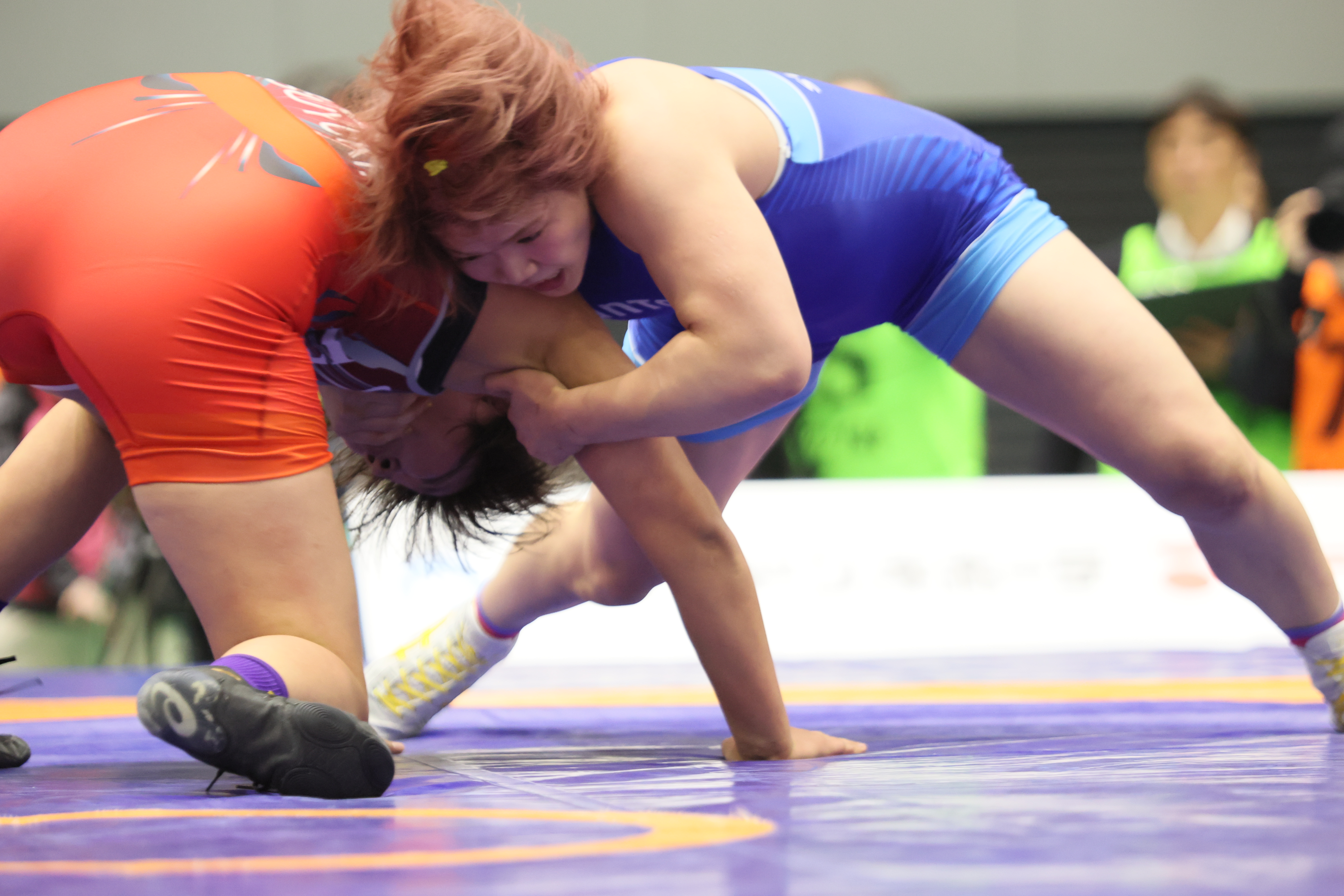 Yuka KAGAMI (JPN) won the 76kg Meiji Cup final and the playoff against Yasuha MATSUYUKI. (Photo: wrestling-spirits.jp / Takeo Yabuki)
Like Japan's other Olympic medalists, Kagami took her time returning to competition after Paris, enjoying the limelight and adoration that comes with the sport's most important gold medal.
She acknowledged that she might have taken her preparation for granted, which resulted in a stunning last-second 4-2 loss to Matsuyuki at the Emperor's Cup.
Kagami wasn't going to let that happen again and, in winning the final and playoff 6-2 and 3-2, respectively, she quickly responded after making an aggressive mistake in each match.
"After I lost, I trained harder than anyone," Kagami said. "Even with my busy schedule, I never cut down on my time in practice. Maybe noone could see it, or I didn't let it be seen. I continued progressing and getting more confident, and the result here shown a light on it."
In the final, Kagami received an activity point in the first period, then started the second period by scoring a 2-point exposure to off her opponent's single-leg attempt. But when she got behind and attempted a gut wrench, Matsuyuki stopped her cold to cut the gap to 3-2.
Kagami fired right back with a driving double-leg takedown, which, with an unsuccessful challenge point tacked on, made it 6-2.
In the playoff, Kagami again led 1-0 in the first period, this time from a stepout. She added an activity point in the second period to make it 2-0, only to fall behind on criteria when Matsuyuki countered a takedown attempt for 2.
Again, Kagami went right back to business, shooting in on a single, lifting it up and marching Matsuyuki over the edge for the go-ahead stepout point. She never let Matsuyuki get close to scoring the rest of the way.
"I had absolutely no anxiety," Kagami said of falling behind in the playoff. "What I gave up came from a counter to my tackle. I knew I could get in on my tackle and after she countered, I went right back to taking another shot. There was still about a minute and 20 seconds and there was nothing for me to fear."
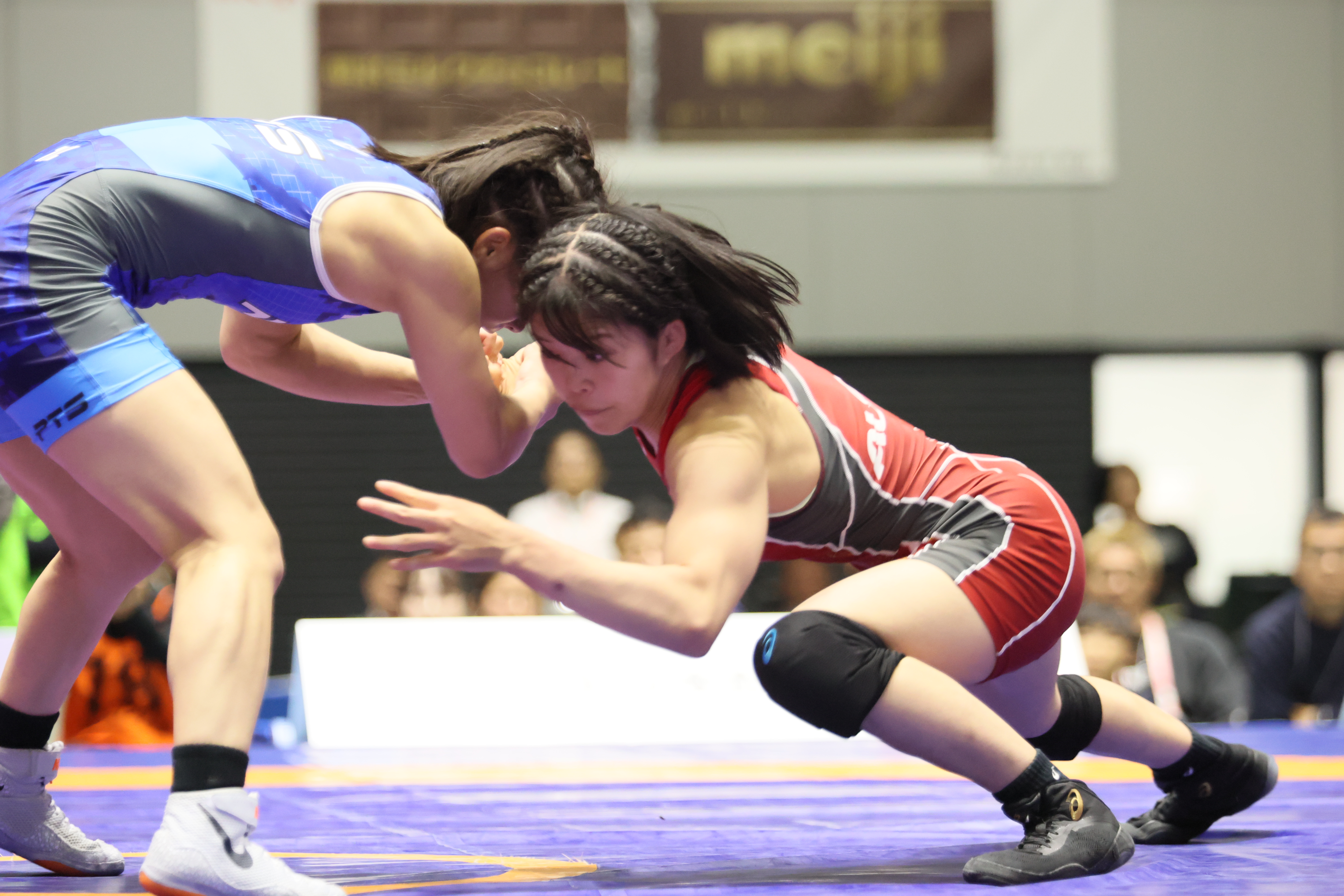 Moe KIYOOKA (JPN) defeated Haruna MURAYAMA (JPN), 11-1, in the 53kg final. (Photo: wrestling-spirits.jp / Takeo Yabuki)
In another high-profile final, former world champion Moe KIYOOKA took advantage of the first opening that reigning world champion Haruna MURAYAMA gave her and ran with it to capture the women's 53kg title with an 11-1 win.
Kiyooka, who won the Emperor's Cup in Murayama's absence, was trailing 1-0 in the second period when she noticed a lapse and pounced at the three-time world champion's open foot.
Kiyooka swept it up by the heel for a takedown, then transitioned to a position favored by her brother, Paris Olympic champion Kotaro KIYOOKA, in which she gets her head between the opponents legs from behind. From there, she executed four quick rolls and the match was over in 4:11.
Kiyooka will now get a chance add to the world title she won at 55kg in 2022 when she makes the trip to Astana, where it is likely she will be accompanied by her brother. He made the final at Freestyle 65kg, to be contested on Sunday.
In other action, the rivalry between Nippon Sport Science University alumni and practice partners Kyotaro SOGABE and Katsuaki ENDO at Greco 67kg added another chapter to its long-running saga, with Sogabe coming out on top this time.
Sogabe nullified his loss to Endo at the Emperor's Cup by winning the Meiji Cup final 4-0, then took the playoff with a 3-1 victory.
In both matches, Sogabe was able to score with a gut wrench from par terre, while keeping from being rolled himself while on the bottom.
"Recently in practice, I often gave up points from the ground," Sogabe said. "Up to this tournament, I worked on that, and the fact that I didn't give up points from the ground, I think was the reason behind my victory."
It proved to be a banner day for the Sogabe family. Following Sogabe's victory, his younger brother Rintaro SOGABE won his first-ever senior national title with a wild 12-12 win in the Greco 72kg final over Hajime KIKUTA.
"I came here coming off the disappointment of losing at the All-Japan," Kyotaro Sogabe said. "Today, I was able to win the title along with my brother. He was able to see it through to victory, and I could win out in the playoff, so I'm really happy."
Rintaro also earned the ticket to the World Championships, as Emperor's Cup champion Taishi NARIKUNI was unable to take part in the playoff after suffering a broken facial bone his quarterfinal match on Friday. According to a family member, Narikuni will undergo surgery on Tuesday.
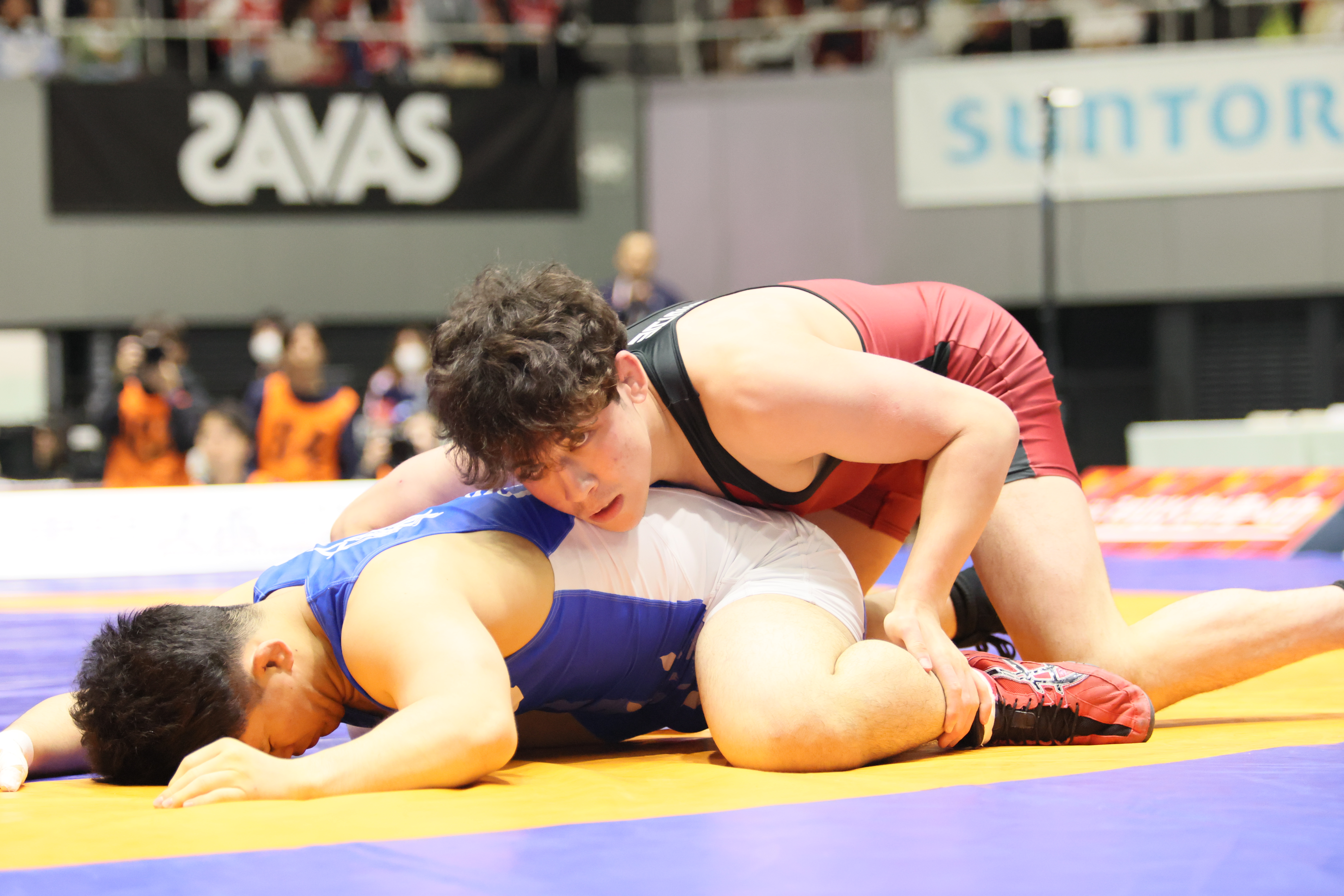 Keyvan GHAREHDAGHI (JPN) won the 79kg gold to earn his spot for the World Championships. (Photo: wrestling-spirits.jp / Takeo Yabuki)
Also heading to his first senior World Championships will be rising star Keyvan GHAREHDAGHI, who repeated his victory at the Emperor's Cup over Kanata YAMAGUCHI with a 4-0 win the the Freestyle 79kg final.
Waseda University's Gharehdaghi scored all of his points in the first period with a takedown, stepout and activity point, then spent the second period holding off Yamaguchi.
"I'm happy, but in the second period, I wasn't able to do my wrestling, and that's something I want to fix," Gharehdaghi said.
Gharehdaghi, whose father is Iranian, was coming off a gold-medal run at last month's Asian Championships in Bishkek.
"It really gave me a boost of confidence," he said. "Being Asian champion makes me look anew at what I should be doing. The matches at the World Championships will be even harder, so I must continue practicing as I have been, without letting up at all."
Day 3 Results
Freestyle
79kg
GOLD: Keyvan GHAREHDAGHI df. Kanata YAMAGUCHI, 4-0
BRONZE: Shunsuke GOTO df. Kohei KITAMURA, 6-3
BRONZE: Ariya YOSHIDA df. Kojiro SHIGA by Fall, 4:57 (7-5)
86kg
GOLD: Hayato ISHIGURO df. Natsura OKAZAWA by TS, 12-1, 2:25
BRONZE: Ryunosuke KAMIYA df. Tatsuya SHIRAI by Def.
BRONZE: Yudai TAKAHASHI df. Rintaro INOUE by TS, 11-1, 3:57
125kg
GOLD: Taiki YAMAMOTO df. Hosei FUJITA by TS, 10-0, :29
BRONZE: Akinari ORIYAMA df. Yamato HASEGAWA, 5-2
BRONZE: Keivan YOSHIDA df. Kazushi IWASAKI by TS, 10-0, 5:12
Greco-Roman
67kg
GOLD: Kyotaro SOGABE df. Katsuaki ENDO, 4-0
BRONZE: Kojiro HASEGAWA df. Chiezo MARUYAMA, 6-2
BRONZE: Komei SAWADA df. Kensuke SHIMIZU, 3-1
World team playoff: Sogabe df. Endo, 3-1
72kg
GOLD: Rintaro SOGABE df. Hajime KIKUTA, 12-12
BRONZE: Zenji ANADA df. Taishi NARIKUNI by Inj. Def.
BRONZE: Daigo KOBAYASHI df. Takeru KOZUKA, 5-2
97kg
GOLD: Yuri NAKAZATO df. Takahiro TSURUTA, 5-3
BRONZE: Sorato KANAZAWA df. Issa KIKUCHI, 7-1
BRONZE: Koki MATSUMOTO df. Riku NAKAHARA by Fall, 2:50 (5-5)
World team playoff: Nakazato df. Tsuruta, 1-1
Women's Wrestling
53kg
GOLD: Moe KIYOOKA df. Haruna MURAYAMA by TS, 11-1, 4:11
BRONZE: Umi IMAI df. Mai OGAWA, 5-2
BRONZE: Mayu SHIDOCHI df. Saki YUMIYA, 2-0
68kg
GOLD: Ami ISHII df. Miwa MORIKAWA, 2-1
BRONZE: Rey HOSHINO df. Masako FURUICHI, 6-0
World team playoff: Ishii df. Morikawa, 4-2
76kg
GOLD: Yuka KAGAMI df. Yasuha MATSUYUKI, 6-2
BRONZE: Mahiru FUJITA df. Mizuki NAGASHIMA, 5-0
BRONZE: Ayano MORO df. Sakura NAKANO by Fall, 1:08 (2-0)
World team playoff: Kagami df. Matsuyuki, 3-2



 df. Aline FOCKEN (GER) by 3-0 A.jpg) Sara DOSHO (JPN) df. Aline FOCKEN (GER) by 3-0 to win the gold medal at the 2017 World Championship. Photo by Martin Gabor.
Sara DOSHO (JPN) df. Aline FOCKEN (GER) by 3-0 to win the gold medal at the 2017 World Championship. Photo by Martin Gabor.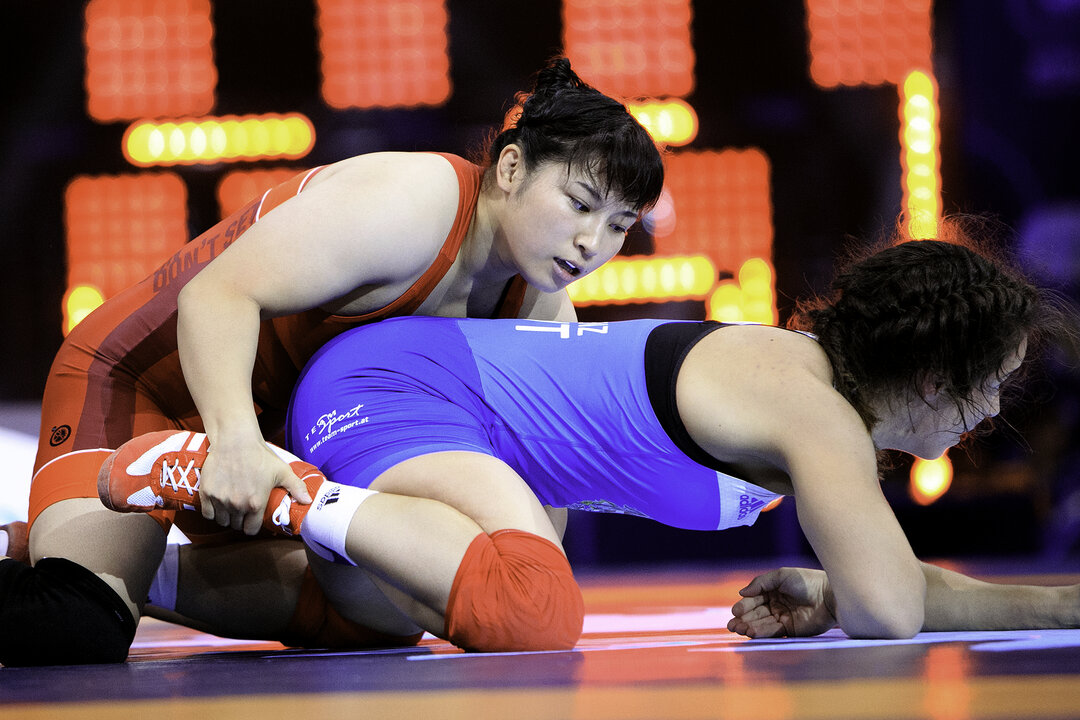 df. Martina KUENZ (AUT) by 6-0 (1).jpg)
Share your thoughts.
Comments