ULAANBAATAR, Mongolia (June 6) -- The Ulaanbaatar Open action will see five Women's Wrestling and three Freestyle weight classes on day three in the Mongolian capital. Olympic champion Magomed RAMAZANOV (BUL) will also be marking his return to competition after a year.
WATCH LIVE | LIVE MATCH ORDER
14:30: Azamat DAULETBEKOV (KAZ) beats Punit KUMAR (IND), 10-0, to enter the final at 92kg. He will face defending champion Askhab SAADULAEV (RUS) who moved into the final after a 5-0 win over Bat-Erdene BYAMBASUREN (MGL).
14:15: Top tier final at 86kg as Olympic champion Magomed RAMAZANOV (BUL) and Mohammad NOKHODI (IRI) reach the gold medal bout. Ramazanov rolls Batbilguun NAADAMBAT (MGL), 10-0, in the semifinal while Nokhodi has to work harder for his win against Malik SHAVAEV (KGZ). Nokhodi scored a stepout before getting a point for Shavaev's passivity to lead 2-0. But the Kyrgyzstan wrestler hit a quick leg attack to score a takedown and then a turn. Nokhodi managed to toss Shavaev as well and then a gut-wrench to lead 6-4 after the scramble. In the second period, Nokhodi used a duckunder to score two points but as he tried to turn Shavaev, he gave up a reversal. He still led 8-5, the winning score.
14:05: Sagar JAGLAN (IND) makes it to the final at 74kg after a 10-0 win over Tolui MUNKHBAT (MGL) and awaits his toughest test yet in Tamir ESHINIMAEV (RUS) who held on for a 2-1 win over Tumen BODIEV (RUS).
Freestyle Semifinals
13:55: KAJAL (IND) with a fall over Elmira SZYDYKOVA (KAZ) to enter the final at 76kg. But it won't be an all-India final as Damola OJO (NGR) beats PRIYA (IND), 5-1, to put breaks to Priya's run.
13:45: It would have been perfect for DPR Korea will all eight wrestlers in the final in Women's Wrestling but former world silver medalist Delgermaa ENKHSAIKHAN (MGL) denies that by beating Sol Gum PAK (PRK) in the 68kg semifinals, 7-3. In the other semifinal, Elizaveta PETLIAKOVA (RUS) stuns European champion Nesrin BAS (TUR), 9-8. The U23 world champion gave up the first takedown but managed to lead 2-2 on criteria at the break. She brought Bas down for four points in the second period to extend the lead to 6-4. As Bas hit a leg-attack, Petliakova scored epxosure points for an 8-4 lead before Bas reversed for a takedown and cradle looking for a fall. Leading 8-8 on criteria, Petliakova managed to get out of the position and Bas could not score in the remaining 30 seconds. Bas challenged for a turn but it was not complete and the lost challenge gave one more point to the Russian.
13:30: Another DPR Korea wrestler in the final! Hyon Gyong MUN (PRK) holds off Enkhjin TUVSHINJARGAL (MGL) 5-3 in the 65kg semifinal. After getting a point for Tuvshinjargal's passivity, Mun scored a takedown and trap-arm gut to lead 5-0. However, Tuvshinjargal blocked her in danger to get two points before the break. Mun was called passive in the second period but one point was all Tuvshinjargal got. Mun will face Shuai ZHANG (CHN) in the final after the China wrestler pinned PULKIT (IND). The Indian led 4-2 with 24 seconds left when Zhang brought her down from standing and secured the fall.
13:20: At 62kg, Ok Ji KIM (PRK) becomes the sixth wrestler from DPR Korea to reach the women's final in Ulaanbaatar. She beats Huan YANG (CHN), 10-0 in the semifinals. For the gold medal bout, she will face Bilyana DUDOVA (BUL) after she defeated MANSI (IND), 6-4. The first period saw Mansi score a takedown to lead 2-0 but Dudova fired one back during her activity clock in the second period to lead 2-2 on criteria. She also turned Mansi to extend the lead to 4-2. The lead changed hands when Mansi scored using a slideby. Leading 4-4 on criteria, Mansi had 19 more seconds to defend when Dudova used a two-on-one grip to bring her down and score the match-winning takedown.
13:10: Leg lace is the weapon that Hyogyong CHOE (PRK) uses to complete a 10-0 win over Ariunzaya ODONCHIMEG (MGL) in the 55kg semifinals. She will face Natsumi MASUDA (JPN) for the gold medal after the Japanese wrestler humbled age-group world medalist Tuba DEMIR (TUR), 14-4, in the other semifinal
13:00:Semifinals begin with Women's Wrestling
12:55: Last match of the qualification rounds and Azamat DAULETBEKOV (KAZ) stuns Abofazl RAHMANI (IRI) at 92kg! Rahmani led 4-0 with just 15 seconds left but had Dauletbekov in the zone when the Kazakhstan wrestler hit a chest wrap throw for four points and take a 4-4 criteria lead based on his bigger technique to score. Rahmani had 11 seconds to score but failed.
12:31: Olympic champion Magomed RAMAZANOV (BUL) was slightly troubled by Abdulmuslim ABULMUSLIMOV (RUS) but he controls the bout at 86kg to win 5-0. He got a point for Abulmuslimov's passivity before scoring a takedown in the second period to lead 3-0. The second takedown came just before the clock expired.
12:27: Sagar JAGLAN (IND) defeated JAIDEEP (IND) in the domestic selection trials for the Asian Games in India. He repeats his victory in Ulaanbaatar and beats Jaideep 7-2 on Saturday. Leading 3-0, he scores a takedown and turn to extend his points while Jaideep was able to score only a takedown.
12:25: Nesrin BAS (TUR) with three turns using the lace over Odzaya ERDENEBAT (MGL) to lead 8-0 before she finishes the match with a takedown. A 10-0 win inside the first period for Bas to start her campaign in Mongolia
12:10: PRIYA (IND) takes out Urtnasan GAN OCHIR (MGL) in under a minute. She beats the Mongolian 10-0 in just 54 seconds. She makes it to the semifinals.
12:05: Ok Ju KIM (PRK) survives against Esther KOLAWOLE (NGR) at 62kg! Leading 5-2, Kim gives up a takedown in the final 10 seconds but Kolawole runs out of time to score that one point needed for victory.
12:00: KAJAL (IND) with some relentless pressure wrestling and she beats Saihan AO (CHN) at 76kg, 12-1. Ao could not find a single way to stop a barging Kajal.
11:45: Bilyana DUDOVA (BUL) becomes a rock in the second period after taking a 4-0 lead against NITIKA (IND). She gives up one takedown but manages to hold her off 4-2 and win at 62kg
11:22: Not the results Asian silver medalist Mukul DAHIYA (IND) would have expected in his first bout. Up against Malik SHAVAEV (KGZ), Dahiya gives up a takedown in the first period but keeps it close to be down only 2-0 at the break. Shavaev keeps his distance from Dahiya in the second period. Dahiya is forced to attack and Shavaev manages to catch his leg and complete a takedown after some resistance from Dahiya. He then completes three turns using a gut-wrench and wins 10-0
11:15: Mohammad NOKHODI (IRI), who has moved up from 79kg to 86kg, takes two minutes and 37 seconds to complete a 10-0 victory over Byambadorj BAT ERDENE (MGL). A trusts the gut-wrench to score his points.
11:12: Olympic champion Magomed RAMAZANOV (BUL) opens his day with an 8-2 win over Bolat SAKAYEV (KAZ) at 86kg. Ramazanov with a slow first period and gets a point for Sakayev's passivity. But he begins the second with a duck under to suplex and gut wrench and races to 7-0 lead. Kazakhstan challenge but lose it and that gives one more point to Ramazanov. Sakayev gets a takedown but that is all as Ramazanov keeps his distance to win.
11:00: KAJAL (IND) with a slow start but she manages to score three takedowns and beat Gulmaral YERKEBAYEVA (KAZ), 7-1 at 76kg.
10:45: European silver medalist Amina TANDELOVA (RUS) cannot match the power of world bronze medalist Esther KOLAWOLE (NGR), who blanks Tandelova 6-0 at 62kg.
10:40: Quick results at 62kg as European bronze medalist Bilyana DUDOVA (BUL) rolls to an 11-0 victory over Subeen JO (KOR) in just a minute and 47 seconds.
10:30: Third day of the Ulaanbaatar Open and weights in action are Women's 55kg, 62kg, 65kg, 68kg and 76kg. In Freestyle it will be 74kg, 86kg and 92kg



 df. Aline FOCKEN (GER) by 3-0 A.jpg) Sara DOSHO (JPN) df. Aline FOCKEN (GER) by 3-0 to win the gold medal at the 2017 World Championship. Photo by Martin Gabor.
Sara DOSHO (JPN) df. Aline FOCKEN (GER) by 3-0 to win the gold medal at the 2017 World Championship. Photo by Martin Gabor.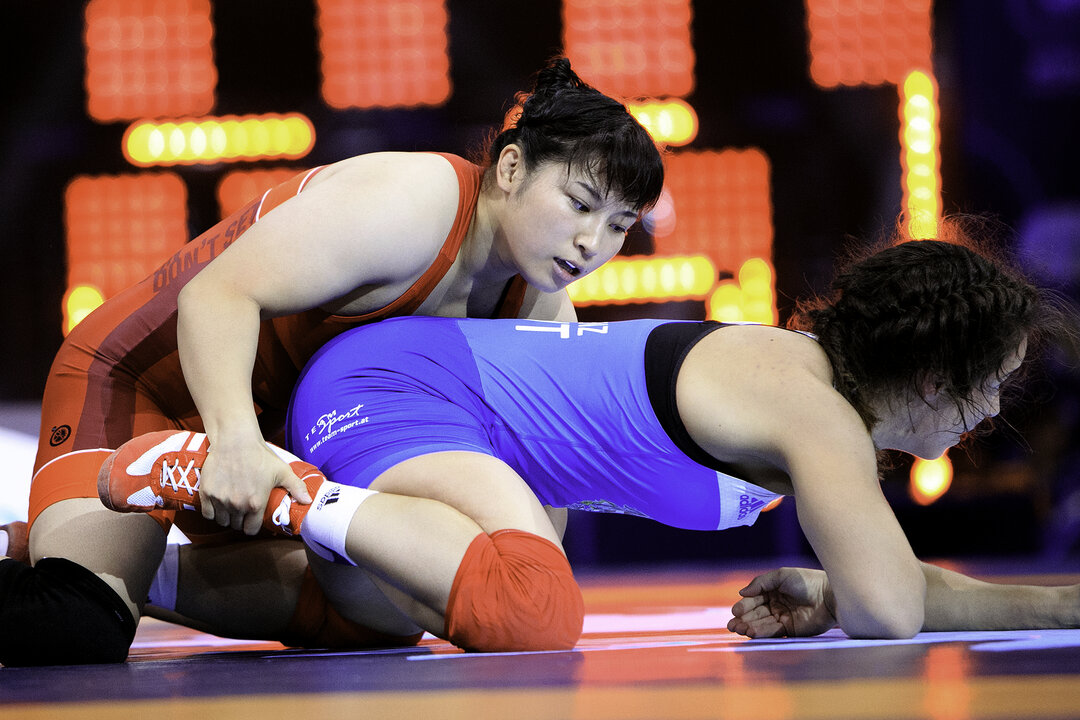 df. Martina KUENZ (AUT) by 6-0 (1).jpg)
Share your thoughts.
Comments