ATHENS, Greece (August 1) -- The World U17 Championships will be moving to Freestyle action with 48kg, 55kg, 65kg, 80kg and 110kg.
WATCH LIVE | LIVE MATCH ORDER | DAY 4 RESULTS
14:30: The big three at 110kg -- Magomedrasul OMAROV (UWW), Amirhossein NAGHDALIPOUR (IRI) and LACKY (IND) -- win their respective quarterfinals and enter the semifinals.
14:15: Zhakshylyk BOROBAEV (KGZ) thought he had the win at 55kg. But Jinnosuke OKONOGI (JPN) still had something in him and then. He scores a takedown manages to turn Borobaev for two more points and lead 9-8. He is ecstatic! He will wrestle Burnett later.
14:00: Greyton BURNETT (USA) shuts down Jaiveer SINGH (IND) and gets a 3-0 win over Singh at 55kg. Burnett gave no opening to Singh to score.
13:45: Big match on Mat A at 65kg between Asian U17 champion Gaurav PUNIA (IND) and Pan-Am U17 champion Arseni KIKINIOU (USA). Punia tries a leg-attack but Kikinou with a counter and turn for two points. Punia with a reversal. Kikinou led 3-1 at the break. Punia gets the exposure for two points to take a 3-3 criteria lead but Kikinou manages to put Punia in danger in the same scramble which makes it 5-3 for him. Kikinou cautioned for fleeing but he wins 5-4.
13:35: Morteza HAJ (IRI) gets a takedown in the final seconds to beat Ivan ZALISKO (UKR) at 65kg. Zalisko led 4-4 on criteria but Haj makes a big comeback.
13:10: LACKY (IND) gut-wrenches Hanto HAYASHI (JPN) and wins his 110kg bout 10-0. He is looking to add a world title to his Asian title he won in June
13:06: In a match that saw six stepouts, Amirhossein NAGHDALIPOUR (IR) manages keep his breath and beat Zekeriya DOGAN (TUR) 6-2 at 110kg.
12:56: Aaron STEWART (USA) cuts shorts Marshall EVERETT JONES (GBR) tournament with an 11-0 hammering at 80kg. Stewart just overpowered Everett Jones.
12:55: Jinnosuke OKONOGI (JPN) hands Mohammadreza BARARI (IRI) a 4-1 loss at 55kg. Solid positioning from Okonogi. Barari's tactics of keeping it slow did not work out.
12:45: Nihad SULEYMANLI (AZE) is shocked after Issa ZANGIEV (UWW) gets front roll for two points and wins the 80kg 1/8 final 6-5. Suleymanli did well to keep his lead but failed in the final second. Azerbaijan challenges but it loses it. Zangiev wins 7-5
12:35: Greyton BURNETT (USA) gets a takedown with 20 seconds remaining to lead 3-1 against Armen PAPIKYAN (ARM) who needed a two-point technique to win. He however gets one a stepout. Burnett wins 3-2 at 55kg.
12:27: Asian U17 champion Gourav PUNIA (IND) like a workhorse with five takedowns and he defeats Kodai IWASAKI (JPN) 10-0 at 65kg.
12:25: Adisbek ALTYNBEKOV (KGZ) went five on Kiryl PAULIUCHENKA (UWW), not once but twice to win his 65kg match 10-0. Those were some high level throws from the Kyrgyz, a bronze medalist from Asian U17 Championships
12:05: Magomedrasul OMAROV (UWW), European champion at 110kg, begins with a 11-0 win over Yu Chiao CHUANG (TPE), who had his own troubles with bleeding. He needed several medical timeouts
11:45: Marshall EVERETT JONES (GBR), European U17 bronze medalist, comes out with a huge underhook throw for four and then rolls Levan CHERTKOEV (FRA) to win 10-0 at 80kg.
11:40: Mohammadparsa KARAMI (IRI) keeps his strong positions and beats Buyantogtokh BYAMBADORJ (MGL) 7-2 at 80kg to give Iran the third win of the day. Iran is hoping to reclaim the U17 team title.
11:19: European champion Ruslan ALIZADA (AZE) has no trouble seeing off Dan BULGARU (MDA) 10-0 at 55kg. Alizada is one of more exciting prospects in this Azerbaijan team.
11:15: Iran with back-to-back wins! Morteza HAJ (IRI) beats Yandro SOTO RIVERA (PUR) at 65kg and Mohammadreza BARARI (IRI) defends a late attack from Aleksandar DELCHEV (BUL) to win at 55kg.
11:05: Asian U17 champion Gourav PUNIA (IND) slams Changxin WU (CHN) for a big four and then exposes his two times to win 11-0 at 65kg.
10:50: Quick results at 65kg as Magomed IBRAGIMOV (UWW) beats Nikos SOURAILOV (CYP) 10-0, followed by European U17 silver medalist Huseyn ISMAYILOV (AZE) getting a 4-2 win over Liam GORTON (CAN). Pan-Am champion Arseni KIKINIOU (USA) also has a technical superiority win over Nikita KOZICH (ISR).
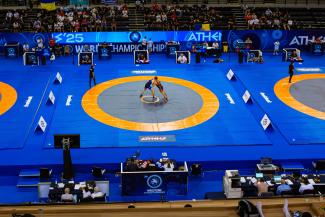
10:30: Freestyle action will take centerstage at the World U17 Championships in Athens. The United States will once again be favorite to win the team title but Iran will look to challenge them.



Share your thoughts.
Comments