DA NANG, Vietnam (June 9) -- Billy KINGI (NZL) was the only fighter that was able to stop the Kazakhstan juggernaut at the Amateur MMA Asian Championships in Da Nang, Vietnam.
The Asian Championships was held at the U15 and U17 level in Pankration and at the U20 and Senior level in Amateur MMA from June 7 to 9 in Da Nang.
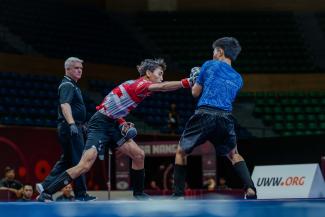
In Men's Amateur MMA, Kazakhstan won eight out of nine gold medals while Kingi captured the remaining one via a technical knockout against Yerbol BAINAZAROV (KAZ) at 100kg.
After the first three-minute round, Kingi was down as all three judges scored the round in Bainazarov's favor. However, Kingi went for two double-leg takedowns in the second round. He secured the knockout when Bainazarov stopped defending as Kingi continued to land his punches.
That was the only results that did no go Kazakhstan's way for the gold medal in an otherwise solid campaign in Da Nang.
Mansur SEPTEGEN (KAZ) got the gold rush going by winning the 57kg final against Yedenkachew TELAHUNE (NZL). Septegen was awarded the first round unanimously by all three judges and kept the momentum in the second round as well, and submitted Telahune barely seconds into the round.
Oleg PEKHOTIN (KAZ) was the next champion for Kazakhstan after he defeated Denzel ALIPIO (PHI) in the 62kg final. Pekhotin used a variation of triangle choke to get the submission from Alipio in under a minute of the final.
At 66kg, Dinmukhammed TURGANBEKOV (KAZ) won his qualification and semifinals via knockout and technical knockout respectively. In the final against Mukhammadamin SHAMOLOV (TJK), Turganbekov got the first round via split decision as two judges gave the round to him and one to Shamolov.
Thirty seconds into the second period, Shamolov used a knee kick to the face of Turganbekov which left he Kazakhstan wrestler bleeding the ending the match in favor of Turganbekov as default.
The fourth straight gold medal was won by Marat ASHIMTAYEV (KAZ) at 71kg final, dashing the hopes of local favorite Bach TRAN QUAN (VIE). Ashimtayev dominated the first round and then slammed Tran Quan at the start of the second before the Vietnamese fighter submitted.
Aslan GELOGAYEV (KAZ) and Mekhrdod GUREZZODA (TJK) were off to an electric start in the 77kg final as both traded punches and takedowns. However, Gelogayev managed to return on top and Gurezzoda had no defense to the Kazakhstan fighter's barrage of punches. The technical knockout was called 90 seconds into the final.
At 84kg, Eljan GASSANOV (KAZ) and Aditya BUKKI (IND) were the only fighters entered and it took the former just one minute to confirm his technical knockout over the Indian. After a takedown, he locked Bukki's one arm and landed solid punches to the face to win the gold medal.
The 93kg final was even quick as Abylay SHAKIRBEKOV (KAZ) scored a stunning head knockout over Sudhir PUNDEKAR (IND). Shakirbekov was 20 seconds into the final when he hit one straight to Pundekar's face who fell instantly, confirming Shakirbekov's win.
While he did not get a head knockout, Agaly KHASSANOV (KAZ) finished the 130kg final against Atul GHULE (IND) in 18 seconds with a swinging kick to win via technical knockout and claim Kazakhstan's eighth gold medal
In the women's AMMA, Lily HOUBEN (NZL) submitted Aruzhan BERKINBAYEVA (KAZ) in the 90kg final to claim the gold medal. Houben got Berkinbayeva in a triangle hold early in the bout but switched to arm bar which Berkinbayeva defended for almost two minutes but finally tapped out with nine seconds remaining in the first round.
The result was similar to Houben's victory over Berkinbayeva in the 90kg final earlier in U20 Amateur MMA.
At 65kg, Zhansaya YERMAGAMBETOVA (KAZ) went on the aggressive right off the whistle in the final against compatriot Kamila FAZYLOVA (KAZ) and ultimately won via a technical knockout to clinch the gold medal.
RESULTS
Men's AMMA
57kg
GOLD: Mansur SEPTEGEN (KAZ)
SILVER: Yedenkachew TELAHUNE (NZL)
BRONZE: Huynh Tai LE (VIE)
BRONZE: Nam NGUYEN NHAT (VIE)
62kg
GOLD: Oleg PEKHOTIN (KAZ)
SILVER: Denzel ALIPIO (PHI)
BRONZE: Aayush DIPU (IND)
BRONZE: Thai HA NGOC (VIE)
66kg
GOLD: Dinmukhammed TURGANBEKOV (KAZ)
SILVER: Mukhammadamin SHAMOLOV (TJK)
BRONZE: Khoa HUYNH DANG (VIE)
BRONZE: Rudransh AZAD (IND)
71kg
GOLD: Marat ASHIMTAYEV (KAZ)
SILVER: Bach TRAN QUAN (VIE)
BRONZE: James INGE (HKG)
77kg
GOLD: Aslan GELOGAYEV (KAZ)
SILVER: Mekhrdod GUREZZODA (TJK)
BRONZE: Shebin KOZHIKKODAN (IND)
84kg
GOLD: Eljan GASSANOV (KAZ) df. Aditya BUKKI (IND), via technical knockout
93kg
GOLD: Abylay SHAKIRBEKOV (KAZ) df. Sudhir PUNDEKAR (IND), via head knockout
100kg
GOLD: Billy KINGI (NZL)
SILVER: Yerbol BAINAZAROV (KAZ)
BRONZE: Alibek NURMUKHAMETOV (KAZ)
130kg
GOLD: Agaly KHASSANOV (KAZ) df. Atul GHULE (IND), via technical knockout
Women's AMMA
65kg
GOLD: Zhansaya YERMAGAMBETOVA (KAZ)
SILVER: Kamila FAZYLOVA (KAZ)
BRONZE: Sheetal KHARATMAL (IND)
90kg
GOLD: Lily HOUBEN (NZL) df. Aruzhan BERKINBAYEVA (KAZ), via submission
U20 Men's AMMA
57kg
GOLD: Duc Manh LA (VIE)
SILVER: Bankerlang MARTHONG (IND)
BRONZE: Quang PHAN (VIE)
62kg
GOLD: Muhammadkabir NAZARZODA (TJK)
SILVER: Jan TABUNOT (PHI)
BRONZE: Vu Quoc Trieu MAI (VIE)
BRONZE: Ngoc Hop UNG (VIE)
71kg
GOLD: Alisher AKBAKHYTOV (KAZ)
SILVER: Le Thai Bao NGUYEN (VIE)
BRONZE: Amir SERIK (KAZ)
77kg
GOLD: Alisher SABIT (KAZ) df. Daniyar FAIZRAKHMANOV (KAZ), via points
84kg
GOLD: Nurgissa ANARBEK (KAZ) df. Gurvansh ARORA (IND), via technical knockout
U20 Women's AMMA
90kg
GOLD: Lily HOUBEN (NZL) df. Aruzhan BERKINBAYEVA (KAZ), via submission




Share your thoughts.
Comments