

Beach wrestling

Pakistan's Inam Reaches for Beach Wrestling Glory

By Vinay Siwach

Muhammad Inam had never been to the beach. His hometown of Gujranwala is a hamlet, landlocked enclave in the northeast corner of Pakistan. For Inam the ocean, the salty air, and the wave pounded sands of the beach were nothing more than fantasy.

That was until Inam was entered to compete in the 80+ kg beach wrestling category during the 2014 Asian Beach Games in Phuket, Thailand. There Inam tasted the salt air, but also defeat.

A star wrestler in Pakistan having won Commonwealth Games gold medal in 2010, Inam finished with a bronze medal in Phuket. For a man of his stature and ability, Inam thought, a bronze medal was an underachievement.

But it was also an opportunity.

Inam decided that in the coming beach games and championships he’d be more prepared than his opponents and decided to include beach wrestling in his daily mat training and lifting routines.

"The closest beach for us was 1,300 kilometres away in Karachi," Inam said. "Going there is not possible as I have an akhara [wrestling centre] here. Pakistan's wrestling lives Gujranwala."


Muhammad INAM (PAK) and friends pose together next to the sandpit they constructed with the sand from a nearby lake.

With the help of his teammates, Inam traveled to a nearby lake and extracted sand to bring back to his akhara. Once collected he constructed a small circular practice pit.

The idea of making a sand pit for wrestling struck when he returned from Phuket and failed to find a similar training area close-by.

"I brought the sand from ponds and lakes and then made a circular ring at my center," he said. "I practice here daily. It's not costly and the young kids enjoy playing on the sand. It does not hurting them so they like the environment."

"I cannot wrestle everyday so we have small activities like beach volleyball or beach football. But I am on that sand for two hours a day so I get that feeling. My muscles get used to it."

His participation in mud wrestling competitions also grew as he wanted to increase his stamina. In 2016, Inam traveled to Vietnam for the Asian Beach Games. He returned home with a gold medal in the 90kg after beating Mohammad Sadati of Iran in the final. Out of the five bouts in the tournament, he did not concede a single point while scoring 17 of his own.
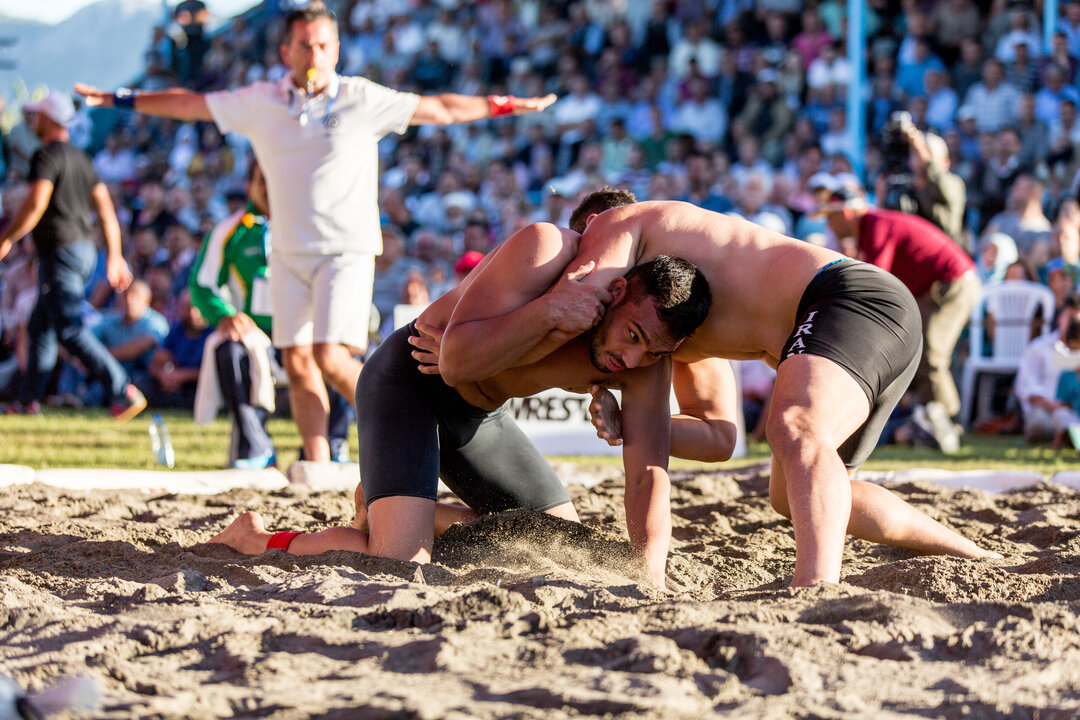
Muhammad INAM (PAK) edged Pejman Fazlollah TABAR NAGHRACHI (IRI) 2-1, and became Pakistan's first-ever wrestling world champion. (Photo: Max Rose-Fyne)

A year later, Inam became Pakistan's first-ever world champion in any form of wrestling. In Dalyan, Turkey, Inam captured the gold medal after beating Pejman Fazlollah TABAR NAGHRACHI (IRI) 2-1 in the final.

He returned to Turkey in 2018 to successfully defended his 90kg title by beating Irakli MTSITURI (GEO). In the two World Championships combined, Inam conceded only three points. His run in 2018 included four victories by fall including the final.

Hailed as the finest wrestler in Pakistan, Inam has kept his struggle going looking forward the newly minted 2019 Beach Wrestling World Series – a prize money event that touched on four location around the world. And after that a chance at the World Beach Games in Doha.

After making the pit at his wrestling centre, he practiced in that for two hours a day to adapt to the beach sand. This was not entirely new for him as he had been wrestling on mud since he was 10-years-old.

"Pakistan and India have mud wrestling and that is the base of this beach wrestling as well," he said. "My great grandfather wrestled, do did my grandfather and then my father. All of them were wrestlers in dangals so that is what helped me be good at beach wrestling."

Both the South Asian countries have traditional wrestling competitions on mud with a circular boundary, like in beach wrestling. In mud wrestling or dangals the winner is declared when one of the wrestler touches both shoulders of his opponents on the ground, a rule similar to beach.

With the easy rules and experience of competing in mud wrestling tournaments since he was a teenager, Inam knew that he has a bright chance of excelling in beach wrestling.

"I was always a mud wrestler. Pakistan had only five mats in the whole country," he said. "I would go around wrestling dangals and in 2014 I won the bronze medal at Asian Beach Games and I told myself that this is what I can be best at.

"It was a weird feeling as I was very comfortable on the sand. I had no problem find a grip in the sand because I had always practiced in mud."

Inam, a senior superintendent at the Gujranwala Electric Power Company, explains that his success on beach revolves around the fact that he decided to do what international wrestlers do on mat.

Muhammad INAM (PAK) and members of his team stand next to their makeshift sandpit. 

"It's like the side are flipped. Earlier, I used to practice for mat competitions for one month prior to competition," he said. "The Georgia, Iran and Russia wrestlers would be practicing on mat throughout the year. But now, I am practicing beach wrestling for 12 months while the mat wrestlers are practicing only a one month before the competition."

With that confidence, he wanted to win the gold medal at the World Ranking Series Final in Zagreb, Croatia this year but an unexpected problem denied him the opportunity.

"I could not get a visa to Croatia because Pakistan does not have that an embassy there," he said. "I have been dealing with such troubles for a long time."

Despite being held out of the last event for the Beach Wrestling World Series, Inam still had his sties placed on winning gold at the World Beach Games as he was the only Pakistani athlete to qualify for the Games and therefore felt more pressure to win.

Inam was drawn in a tough Group B that also had 2012 London Olympics bronze medalist Dato Marsagishvili (GEO), among wrestlers from Azerbaijan, Turkey and Portugal. He began the day with a quick win over Kanan ALIYEV (AZE).

Next up was Murat Ozkan of Turkey. Inam was tested more than his first bout the results was not different. A 1-0 win was enough to keep him on track to reach the knockout stages. But before that, Inam had a tough one to crack in the group itself.

Dato Marsagishvili (GEO), the winner of 2019 Beach Wrestling World Series Final and the only wrestler to beat Inam on beach in last two years, was up next.

Perhaps Inam was waiting for it. The bout saw a lot of action however no wrestler was able to break the deadlock for the first two minutes. It was only in the final minute that Marsagishvili was awarded a point as Inam was warned for an eye poke. Inam did not agree with the decision but had no option but to continue. In the dying seconds of the bout, Inam scored a go-behind to win the 1-1 and avenge his earlier loss.

Inam comfortably topped the group after beating Adao ANDRADE (POR) 3-0 and reached the semi-finals. Marsagishvili also made it to the last-four as a result of his second-place in the group.

As fate would have it, both wrestler won the semi-finals. Inam defeated Pedro GARCIA (ESP) 3-0 while Marsagishvili got the better of Mihai PALAGHIA (ROU) 4-0. The two were now set for a third bout inside five months. Marsagishvili had taken the first win 2-0 at the Beach Wrestling World Series stop in Rio de Janeiro in May. Inam won the bout in the group stages in Doha. The stage was set for the third bout of the rivalry in Doha with the gold medal at the inaguaral World Beach Games on line.
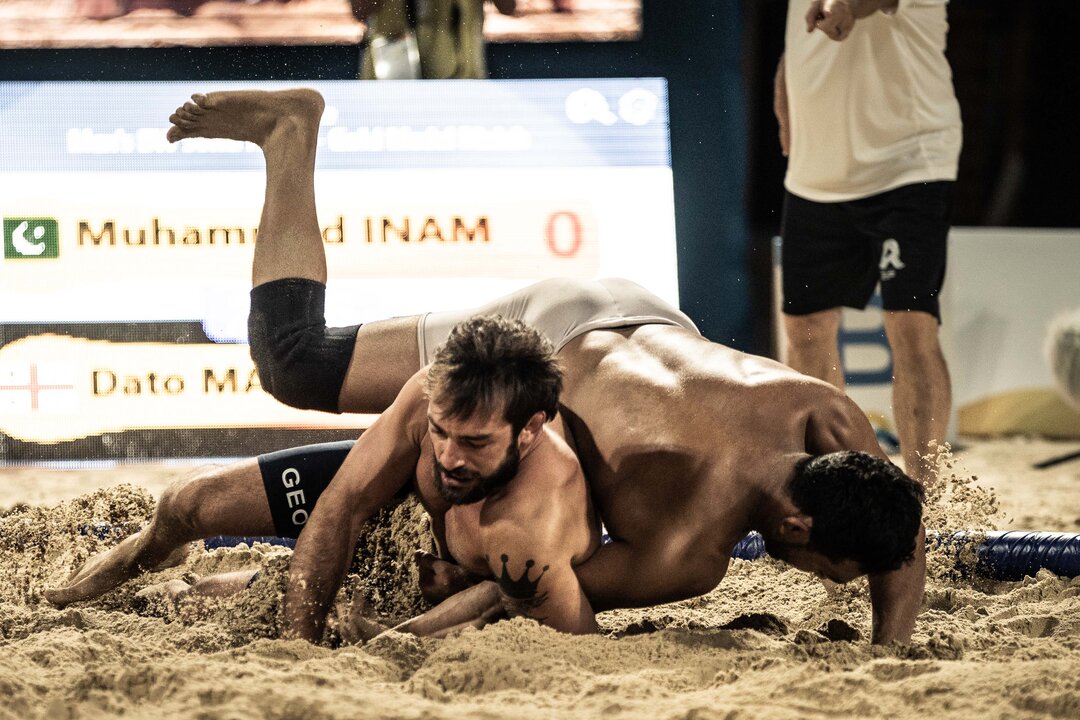

Muhammad INAM (PAK) downed London Olympic bronze medalist Dato Marsagishvili (GEO), 5-3, in the World Beach Games finals. (Photo: Theo Lowenstein)

Marsagashvili build a two-point lead with two single-point takedowns. Inam roared back with two of his own to lead 2-2 on criteria and knew he has to play the clock for the last 40 seconds to win the gold medal.

Marsagashvili wanted to avenge his loss to Inam earlier in the day. In a desperate move in the closing seconds of the bout, he tried to trip Inam for the win but it was the latter who managed to balance himself and exposed Marsagishvili's back. Inam was awarded three points and the top medal.

"I have wrestled him before and I knew what I lacked in that bout in Rio," Inam said. "I loved winning in Doha because everyone was shouting in the arena and I was wrestling for Pakistan. The bout was so tough and to win it after a comeback gave me more joy. I cannot explain the atmosphere that day."

Back home, he was given a hero's welcome. Everyone wanted a piece of Inam and he had interviews lined-up with channels for several days.

After a successful campaign in Doha, Inam is hoping that beach wrestling can be included in the Olympic program for 2024 Games in Paris. Though he will be 35-years-old by then, he wants to win a wrestling medal for Pakistan which last won an Olympic medal in the sport back in 1960 Games in Rome.
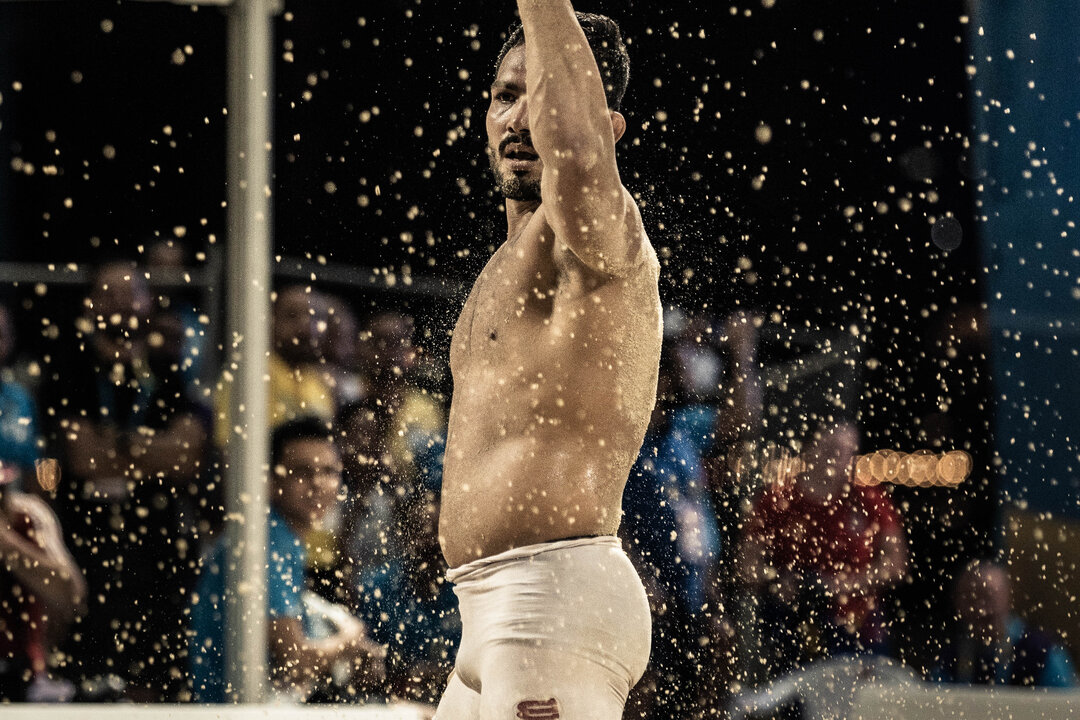

Muhammad INAM (PAK) celebrates after winning the World Beach Games gold medal. (Photo: Theo Lowenstein)

"Beach wrestling will keep growing as it's so easy for both wrestlers and crowd," he said. "It is viewer friendly and only three minutes long. The rules are you need to touch a wrestler's back on the ground to win. This rule in common in all dangals across Pakistan and India and most wrestling styles around the world. If not that then push out your opponent to win."

"Freestyle and Greco-Roman is different because there are typical rules. The aggressive wrestler is also going down on his back and people get confuse as to why he is being awarded points when he is down on his back."

Olympic glory would definitely bring more money and fame for Inam but he thinks it will help wrestling, which is currently 'neglected' in the country. Though the boys still practice at the few centers that are left in the countries, Inam thinks it unfortunate that Pakistan could not build a women's wrestling team.

Freestyle wrestling is yet to pick up in Pakistan while belt wrestling is seen as the more acceptable form of the sport. Inam, however, thinks that beach wrestling can pick up in Pakistan and women will also be able to take up the sport.

"Pakistan has women's teams of karate, judo, taekwondo and even cricket. So why not wrestling?" he asks. "Beach wrestling is amazing to remove these culture problems and oppression which are same for everyone.

"If they are allowed in other sports, then allow them in wrestling as well. For gender equality, it is the best way to start. I think girls should be free to think if they want to go into sports. World has changed and with that we have to change and allow girls in wrestling."

#JapanWrestling

Former Japan high school star aims to put Samoa on wrestling map

By Ikuo Higuchi

(Editor's Note: The following appeared on the Japan Wrestling Federation website on Nov. 2. It has been translated and published by permission.)

TOKYO -- On the Japan wrestling schedule, the National Non-Student Open falls far below the level of major tournaments like the Emperor's Cup and Meiji Cup, which serve as the qualifiers for the world and Olympic teams.

As such, it is rare to see a prospective Olympic team member entering the tournament. Yet at this year's event, which was held for the first time in three years due to the pandemic, there was one, although it is not Japan's team that Gaku AKAZAWA is hoping to make for the 2024 Paris Olympics.

A former high school star, Akazawa won the freestyle 70kg title as a member of a team from the Pacific Island nation of Samoa, which he hopes to represent in Paris. 

The 32-year-old Akazawa, whose quest for Olympic glory included a four-year sabbatical in Russia, was wrestling in his native country for the first time in three years at the Non-Student Open, which was held Oct. 29-30 in Fujimi, Saitama Prefecture, north of Tokyo.

Akazawa, who was unable to obtain Samoan citizenship in time for the Tokyo Olympics, is hoping the paperwork comes through in time for Paris. "I have never stopped dreaming of appearing in the Olympics," he said. "I will make every effort as I try to become an Olympian from Samoa."

JPNGaku Akazawa celebrates his victory at freestyle 70kg for Team Samoa. (Photo by Japan Wrestling Federation)

Akazawa last competed in Japan at the 2016 Emperor's Cup All-Japan Championships. The victory in Fujimi was his first anywhere since winning the National Inter-High School title at 66kg in 2008, which made him the first-ever national champion from Hanasaki Tokuharu High School in Saitama Prefecture.

His coach at Hanasaki Tokuharu, Takuya TAKASAKA, was on hand to watch the former prodigy show his fighting spirit with tough wins over several opponents with pedigrees. In the semifinals, Akazawa defeated 2018 national collegiate champion Hayato OGATA 8-2, then took the title with a 6-2 win over Kantaro YAMAZAKI, who won both the spring and fall titles of the East Japan collegiate league in 2018.

"It was a long time since I've wrestled in Japan, so I had no idea what level I am presently at," Akazawa said. "I was nervous. By winning the title, it gave me some idea of where I stand, and I'm honestly really happy."

Asked what was the source of his tenacity and stamina that allowed him to rally to victories, he replied, "Every morning and night, and sometimes three times a day, I train intensely. I think that came out today."

In Samoa, wrestling is still far from popular, and with the pandemic limiting activities, there are only about 10 wrestlers over the age of 14 in the entire country. The majority of competitors are still beginners, and he cannot train in a way that sharpens his skills. "Instead, I think I was able to win on physical strength," he said.

JPN1Akazawa, right, poses with competitors at the Samoan national championships in the capital Apia in August 2021, where he served as a referee. (Photo courtesy of Gaku Akazawa)

From Russia, with determination

The Non-Student Open, as the name implies, is for anyone out of school, and draws a wide mix of wrestlers with various backgrounds, from former high school champions to more than a few who started the sport after leaving college to keep in shape and maybe practice on weekends at a local club.

But for Akazawa, it presented a challenge directly related to getting to Paris. "I hadn't wrestled in Japan for a long time, so I think there were people who thought I had retired," he said with a smile.

Akazawa, who had won national junior high school and JOC Junior Olympic titles, went to Nihon University following his Inter-High School success, but was unable to repeat it on the collegiate level. Plagued by injuries, Akazawa's file in the database of the Japan Wrestling Federation website, which lists all results, has no entries for his years at Nihon.

He would not make his first appearance at the Emperor's Cup (held in December) until 2013, the year he graduated from Nihon. He placed fifth at 60kg.

Never abandoning his Olympic dream, he chose a path that took him to one of the premier powerhouses in the sport, Russia. He headed to Krasnoyarsk, the Siberian city well known in Japan as the host of the prestigious Ivan Yarygin Grand Prix, to continue his career.

He had no sponsor. When his visa expired, he would return to Japan, work some odd jobs to save up money, then return to Krasnoyarsk. He endured this unstable life for four years from 2013 to 2017, all because of his love for the sport and his desire to become an Olympic champion.

But no matter how much he trained in a top wrestling country, such instability in his daily life certainly made it difficult to focus on the sport. He would return to Japan to compete in the Emperor's Cup and Meiji Cup (the All-Japan Invitational Championships, held in the spring), but was unable to finish on the podium.

The Olympics seemed farther away than ever. But his dream never faded. What caught his attention was that one of his Russian wrestling buddies, instead of competing for the stacked Russian team, had changed nationalities and made it to the 2016 Rio Olympics.

While such a move is exceedingly rare in Japan, it is not without precedent. A minor comedian named Neko HIROSHI (neko means cat; his real name is Kuniaki TAKIZAKI) became a Cambodian citizen so he could run the men's marathon at the 2016 Rio Olympics.

While his move gained attention as a celebrity, he also faced criticism as his best time would not have even made the Japanese women's team. He finished 138th in Rio, 37 minutes behind the winner with a time that would have placed 85th in the women's race.

Akazawa, whose case is different in that he is already on a global level, began to think about how he could go about changing nationality. Thinking of countries with the easiest route for qualifying he was attracted to Oceania. An English teacher from his junior high school days just happened to be dispatched to Samoa under a Japan International Cooperation Agency program as a judo instructor, and Akazawa got the wheels in motion by contacting him.

With that as the turning point, he relocated to Samoa in June 2017.

JPN3Maulo Willie ALOFIPO, a former rugby player, accompanied Akazawa to Japan and finished second in both styles. (Photo by Japan Wrestling Federation)

Spreading the word in Samoa

Jerry WALLWORK, president of the Samoan Wrestling Federation, bought into Akazawa's enthusiasm and dedication and pledged his support. The following year, Akazawa married a local nurse named Sinevalley. He applied for a change of nationality with eyes on the Tokyo Olympics, but it did not come in time. "It's hard to get Samoan nationality," Akazawa said.

Akazawa currently earns a living as the owner of a massage parlor, and is able to continue his wrestling career through support from the federation. For the Non-Student Open, Samoa had come out of lockdown and Akazawa had needed to return to Japan for a family matter, so he decided to use the opportunity to enter the tournament and see where he stood.

He was to be accompanied by two Samoan wrestlers, who entered the individual tournaments in both styles. The trio would also enter the team event. However, the father of one wrestler took ill and was unable to make the trip, and Team Samoa had to withdraw.

The remaining wrestler, Maulo Willie ALOFIPO, made the most of his trip, winning silver medals in both styles at 97kg and gaining valuable international experience. The 25-year-old  was originally a rugby player and has only been wrestling for two years.

"There are common points between rugby and wrestling," Akazawa told Alofipo in recruiting him to the latter. "You can do it just once a week if you want, but why don't you give it a try?"

Alofipo gradually started spending more time in wrestling. He practices in the morning before going to his day job on a cacao plantation, then returns to the mat for an evening session.  He made his international debut in August this year, finishing fifth at freestyle 97kg at the Commonwealth Games in Birmingham, England.

As for his runner-up finishes in the Japan tournament, he commented, "I'm really happy. Japan is a very high level. It's a thrill to be able to fight here."

Asked about his goal from here, he replied, "The Olympics."

Both Akazawa and Alofipo remained in Japan after the tournament with plans to stay until late December. Akazawa said they will work out at his alma maters of Hanasaki Tokuharu High School and Nihon University.

Although his victory earned him a spot in the Emperor's Cup in December, Akazawa did not enter. His latest foray was to test his current level, and, regarding himself now as "Samoan," he said he draws the line at competing for the title of No. 1 in Japan.

 JPN3Akazawa records a fall in the second round at the National Non-Student Championships. (Photo by Japan Wrestling Federation)

Building a new powerhouse

When deciding what high school he would go to, Akazawa bypassed the powers of the day for Hanasaki Tokuharu, which was virtually unknown in wrestling circles. "Rather than get stronger on a strong team, I wanted to go to a no-name school and beat the powerhouses one after another," he said at the time.

And that was pretty much what he did. In his third year in 2008, he helped Hanasaki Tokuharu end the 14-year reign of Ibaraki Prefecture's Kasumigaura High School at the Kanto High School Championships (Kanto is the region of Japan that includes Tokyo and its environs).

Kasumigaura would get revenge later in the team final at the Inter-High School Championships, but in that match, Akazawa defeated the reigning national champion (shown in the top photo). He made a name for himself and helped launch a new powerhouse on the scene just four years after its founding.

The energy and enthusiasm that Akazawa feels in Samoa now are incredibly similar to "those days." Samoa enjoys warm weather year round, with average lows of 23 C and highs of 31 C. The wrestling room is an open-air facility with a roof, much like in the Japan of another era when each town had an outdoor sumo ring located next to the local shrine.

Whereas gyms in Japan are now air-conditioned, it is a world of difference in Samoa. "Every day, I practice drenched in sweat," Akazawa said.

Rugby is still king in Samoa, and trying to increase participation in other sports is no easy task. But there have been inroads made, as Samoa has been represented at the Olympics in judo. In wrestling, the lone Olympic entry in its history was at the 2000 Sydney Games, when Faafatai IUTANA qualified at Greco-Roman 76kg. Samoa had a fair number of gold medalists at the Oceania Championships, although none since 2011. So the potential is there.

Achieving his own Olympic dream will be a link to the spread of wrestling in Samoa. For now, as he awaits word of being granted citizenship, Akazawa will continue to focus all of his efforts on making it to Paris. Most of his high school teammates have long left the mat and have followed a path into coaching. But at least one of the "Class of 2008" still has a burning passion for the Olympics.

-- Translation by Ken Marantz