

Beach wrestling

Pakistan's Inam Reaches for Beach Wrestling Glory

By Vinay Siwach

Muhammad Inam had never been to the beach. His hometown of Gujranwala is a hamlet, landlocked enclave in the northeast corner of Pakistan. For Inam the ocean, the salty air, and the wave pounded sands of the beach were nothing more than fantasy.

That was until Inam was entered to compete in the 80+ kg beach wrestling category during the 2014 Asian Beach Games in Phuket, Thailand. There Inam tasted the salt air, but also defeat.

A star wrestler in Pakistan having won Commonwealth Games gold medal in 2010, Inam finished with a bronze medal in Phuket. For a man of his stature and ability, Inam thought, a bronze medal was an underachievement.

But it was also an opportunity.

Inam decided that in the coming beach games and championships he’d be more prepared than his opponents and decided to include beach wrestling in his daily mat training and lifting routines.

"The closest beach for us was 1,300 kilometres away in Karachi," Inam said. "Going there is not possible as I have an akhara [wrestling centre] here. Pakistan's wrestling lives Gujranwala."


Muhammad INAM (PAK) and friends pose together next to the sandpit they constructed with the sand from a nearby lake.

With the help of his teammates, Inam traveled to a nearby lake and extracted sand to bring back to his akhara. Once collected he constructed a small circular practice pit.

The idea of making a sand pit for wrestling struck when he returned from Phuket and failed to find a similar training area close-by.

"I brought the sand from ponds and lakes and then made a circular ring at my center," he said. "I practice here daily. It's not costly and the young kids enjoy playing on the sand. It does not hurting them so they like the environment."

"I cannot wrestle everyday so we have small activities like beach volleyball or beach football. But I am on that sand for two hours a day so I get that feeling. My muscles get used to it."

His participation in mud wrestling competitions also grew as he wanted to increase his stamina. In 2016, Inam traveled to Vietnam for the Asian Beach Games. He returned home with a gold medal in the 90kg after beating Mohammad Sadati of Iran in the final. Out of the five bouts in the tournament, he did not concede a single point while scoring 17 of his own.
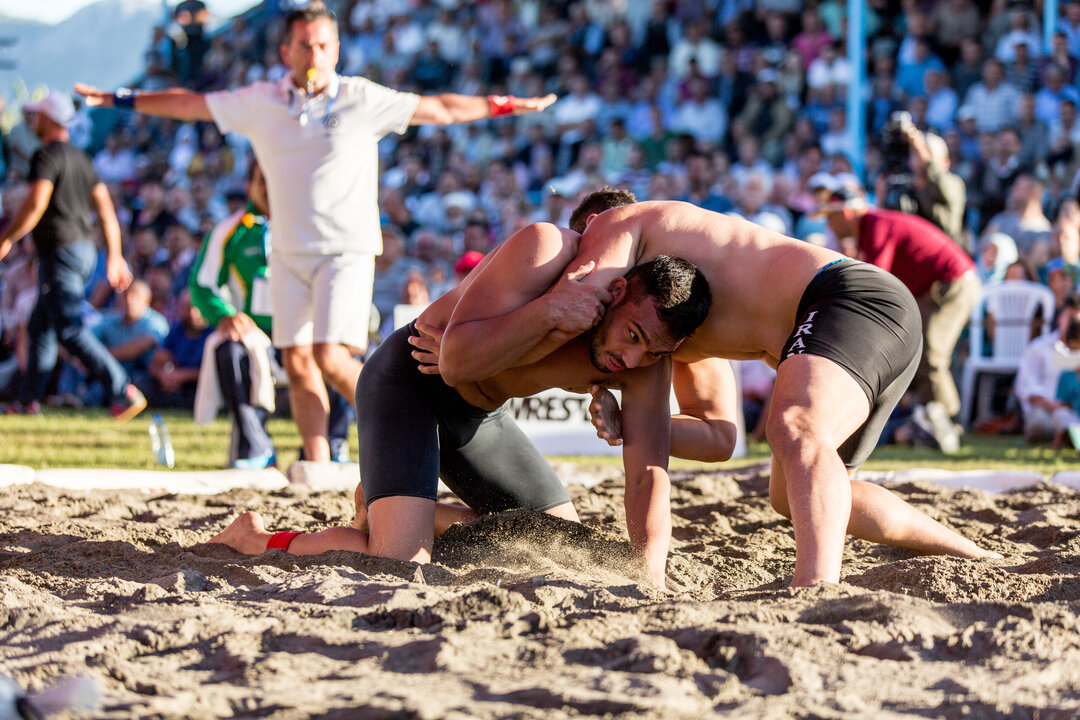
Muhammad INAM (PAK) edged Pejman Fazlollah TABAR NAGHRACHI (IRI) 2-1, and became Pakistan's first-ever wrestling world champion. (Photo: Max Rose-Fyne)

A year later, Inam became Pakistan's first-ever world champion in any form of wrestling. In Dalyan, Turkey, Inam captured the gold medal after beating Pejman Fazlollah TABAR NAGHRACHI (IRI) 2-1 in the final.

He returned to Turkey in 2018 to successfully defended his 90kg title by beating Irakli MTSITURI (GEO). In the two World Championships combined, Inam conceded only three points. His run in 2018 included four victories by fall including the final.

Hailed as the finest wrestler in Pakistan, Inam has kept his struggle going looking forward the newly minted 2019 Beach Wrestling World Series – a prize money event that touched on four location around the world. And after that a chance at the World Beach Games in Doha.

After making the pit at his wrestling centre, he practiced in that for two hours a day to adapt to the beach sand. This was not entirely new for him as he had been wrestling on mud since he was 10-years-old.

"Pakistan and India have mud wrestling and that is the base of this beach wrestling as well," he said. "My great grandfather wrestled, do did my grandfather and then my father. All of them were wrestlers in dangals so that is what helped me be good at beach wrestling."

Both the South Asian countries have traditional wrestling competitions on mud with a circular boundary, like in beach wrestling. In mud wrestling or dangals the winner is declared when one of the wrestler touches both shoulders of his opponents on the ground, a rule similar to beach.

With the easy rules and experience of competing in mud wrestling tournaments since he was a teenager, Inam knew that he has a bright chance of excelling in beach wrestling.

"I was always a mud wrestler. Pakistan had only five mats in the whole country," he said. "I would go around wrestling dangals and in 2014 I won the bronze medal at Asian Beach Games and I told myself that this is what I can be best at.

"It was a weird feeling as I was very comfortable on the sand. I had no problem find a grip in the sand because I had always practiced in mud."

Inam, a senior superintendent at the Gujranwala Electric Power Company, explains that his success on beach revolves around the fact that he decided to do what international wrestlers do on mat.

Muhammad INAM (PAK) and members of his team stand next to their makeshift sandpit. 

"It's like the side are flipped. Earlier, I used to practice for mat competitions for one month prior to competition," he said. "The Georgia, Iran and Russia wrestlers would be practicing on mat throughout the year. But now, I am practicing beach wrestling for 12 months while the mat wrestlers are practicing only a one month before the competition."

With that confidence, he wanted to win the gold medal at the World Ranking Series Final in Zagreb, Croatia this year but an unexpected problem denied him the opportunity.

"I could not get a visa to Croatia because Pakistan does not have that an embassy there," he said. "I have been dealing with such troubles for a long time."

Despite being held out of the last event for the Beach Wrestling World Series, Inam still had his sties placed on winning gold at the World Beach Games as he was the only Pakistani athlete to qualify for the Games and therefore felt more pressure to win.

Inam was drawn in a tough Group B that also had 2012 London Olympics bronze medalist Dato Marsagishvili (GEO), among wrestlers from Azerbaijan, Turkey and Portugal. He began the day with a quick win over Kanan ALIYEV (AZE).

Next up was Murat Ozkan of Turkey. Inam was tested more than his first bout the results was not different. A 1-0 win was enough to keep him on track to reach the knockout stages. But before that, Inam had a tough one to crack in the group itself.

Dato Marsagishvili (GEO), the winner of 2019 Beach Wrestling World Series Final and the only wrestler to beat Inam on beach in last two years, was up next.

Perhaps Inam was waiting for it. The bout saw a lot of action however no wrestler was able to break the deadlock for the first two minutes. It was only in the final minute that Marsagishvili was awarded a point as Inam was warned for an eye poke. Inam did not agree with the decision but had no option but to continue. In the dying seconds of the bout, Inam scored a go-behind to win the 1-1 and avenge his earlier loss.

Inam comfortably topped the group after beating Adao ANDRADE (POR) 3-0 and reached the semi-finals. Marsagishvili also made it to the last-four as a result of his second-place in the group.

As fate would have it, both wrestler won the semi-finals. Inam defeated Pedro GARCIA (ESP) 3-0 while Marsagishvili got the better of Mihai PALAGHIA (ROU) 4-0. The two were now set for a third bout inside five months. Marsagishvili had taken the first win 2-0 at the Beach Wrestling World Series stop in Rio de Janeiro in May. Inam won the bout in the group stages in Doha. The stage was set for the third bout of the rivalry in Doha with the gold medal at the inaguaral World Beach Games on line.
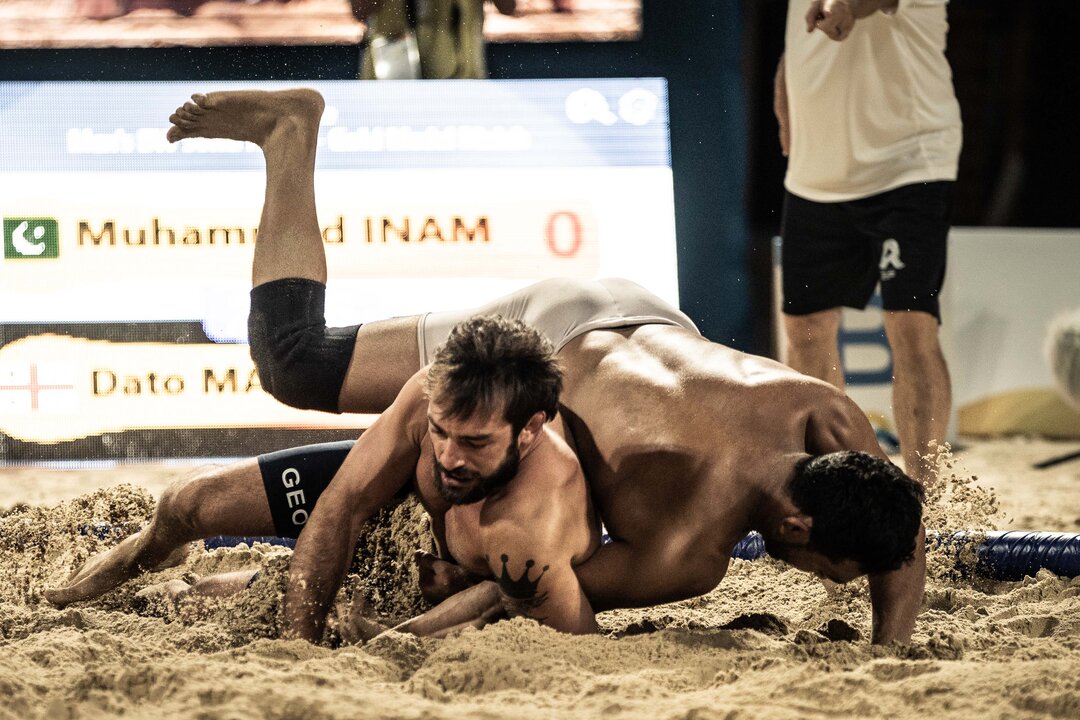

Muhammad INAM (PAK) downed London Olympic bronze medalist Dato Marsagishvili (GEO), 5-3, in the World Beach Games finals. (Photo: Theo Lowenstein)

Marsagashvili build a two-point lead with two single-point takedowns. Inam roared back with two of his own to lead 2-2 on criteria and knew he has to play the clock for the last 40 seconds to win the gold medal.

Marsagashvili wanted to avenge his loss to Inam earlier in the day. In a desperate move in the closing seconds of the bout, he tried to trip Inam for the win but it was the latter who managed to balance himself and exposed Marsagishvili's back. Inam was awarded three points and the top medal.

"I have wrestled him before and I knew what I lacked in that bout in Rio," Inam said. "I loved winning in Doha because everyone was shouting in the arena and I was wrestling for Pakistan. The bout was so tough and to win it after a comeback gave me more joy. I cannot explain the atmosphere that day."

Back home, he was given a hero's welcome. Everyone wanted a piece of Inam and he had interviews lined-up with channels for several days.

After a successful campaign in Doha, Inam is hoping that beach wrestling can be included in the Olympic program for 2024 Games in Paris. Though he will be 35-years-old by then, he wants to win a wrestling medal for Pakistan which last won an Olympic medal in the sport back in 1960 Games in Rome.
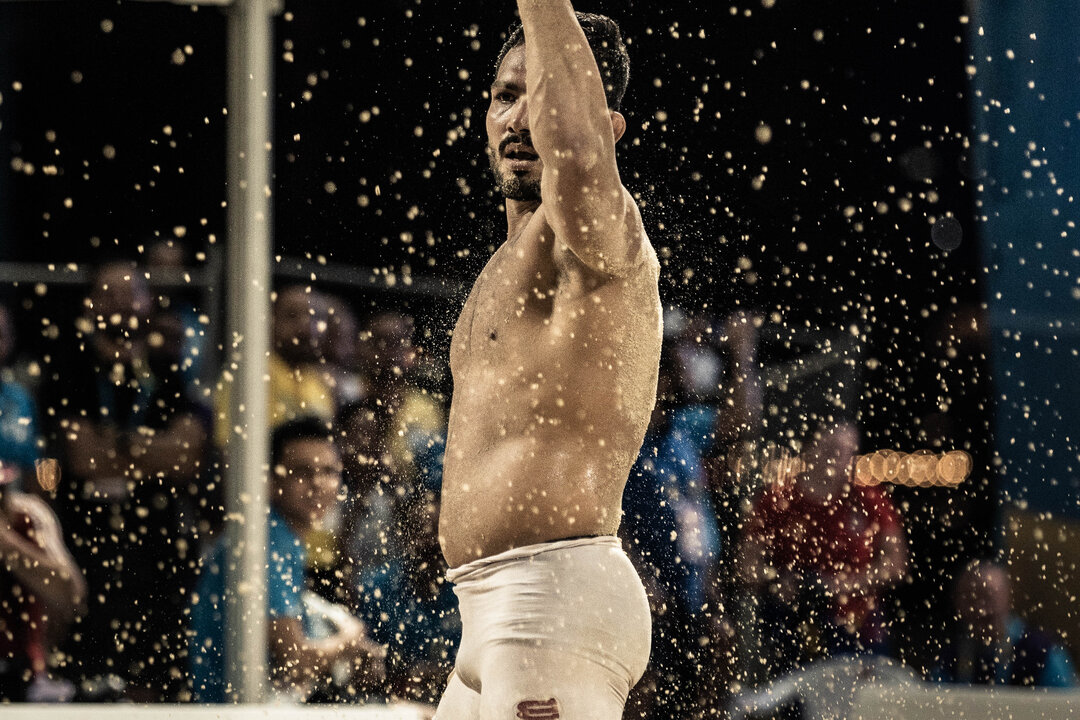

Muhammad INAM (PAK) celebrates after winning the World Beach Games gold medal. (Photo: Theo Lowenstein)

"Beach wrestling will keep growing as it's so easy for both wrestlers and crowd," he said. "It is viewer friendly and only three minutes long. The rules are you need to touch a wrestler's back on the ground to win. This rule in common in all dangals across Pakistan and India and most wrestling styles around the world. If not that then push out your opponent to win."

"Freestyle and Greco-Roman is different because there are typical rules. The aggressive wrestler is also going down on his back and people get confuse as to why he is being awarded points when he is down on his back."

Olympic glory would definitely bring more money and fame for Inam but he thinks it will help wrestling, which is currently 'neglected' in the country. Though the boys still practice at the few centers that are left in the countries, Inam thinks it unfortunate that Pakistan could not build a women's wrestling team.

Freestyle wrestling is yet to pick up in Pakistan while belt wrestling is seen as the more acceptable form of the sport. Inam, however, thinks that beach wrestling can pick up in Pakistan and women will also be able to take up the sport.

"Pakistan has women's teams of karate, judo, taekwondo and even cricket. So why not wrestling?" he asks. "Beach wrestling is amazing to remove these culture problems and oppression which are same for everyone.

"If they are allowed in other sports, then allow them in wrestling as well. For gender equality, it is the best way to start. I think girls should be free to think if they want to go into sports. World has changed and with that we have to change and allow girls in wrestling."

#JapanWrestling

Ishii wins showdown with Morikawa for 68kg gold; Kinjo claims 59kg crown

By Ken Marantz

TOKYO (December 23) -- Already a world silver medalist, Ami ISHII picked up her first national title at women's 68kg with a dramatic victory over world 65kg champion Miwa MORIKAWA, while two-time Olympic champion Risako KINJO was content with a title in a non-Olympic weight as she transitions back to the mat from childbirth.

Ishii denied Morikawa in her bid to move up to the Olympic weight class, scoring all of her points in the second period for a 5-2 victory in the final at the Emperor's Cup All-Japan Championships on Friday in Tokyo.

Kinjo, who plans to make a run for her third Olympic gold at the 2024 Paris Games at 57kg, forged out a 4-1 victory over former world U23 champion Yui SAKANO in the 59kg final in the tournament that is serving as the first domestic qualifier for next year's World Championships in Belgrade.

Meanwhile, Rei HIGUCHI and Sae NANJO both avenged losses to old nemeses in reaching the final of their respective weight classes, while Tokyo Olympic champion Yui SUSAKI, well, just did what Yui Susaki always does.

Ami ISHII (JPN)Ami ISHII, right, and Miwa MORIKAWA square off in the women's 68kg final. (Photo: Japan Wrestling Federation/Takeo Yabuki)

The Ishii-Morikawa clash came about due to the fact that the tournament has implications on qualifying for the Paris Olympics. Combined with the Meiji Cup All-Japan Invitational Championships in June, it helps determine the team to Belgrade, where a medal by a Japanese wrestler in an Olympic weight will mean an automatic place in Paris.

To better prepare the wrestlers for the worlds and Olympics, the format of the four-day tournament has been tweaked so that the Olympic weights are run over two days, while the non-Olympic classes are started and finished in one day.

Ishii moved a step closer to Paris by emerging victorious in a field that included four current or past world medalists and two former U20 world champions.

"When the buzzer sounded, I was really happy," said Ishii, who also picked up the world U20 gold this year. "But when I look at it calmly, this match was the first in the qualifying process, it didn't decide the Olympics. It's just a point along the way."

Morikawa, who missed out on the Tokyo Olympics when she lost a playoff for the 68kg spot to Sara DOSHO, took the lead in the final with a spin-behind takedown off an Ishii shot in the first period. In the second period, Ishii tied it with a single-leg takedown.

As Morikawa tried to press for a stepout, her strength was not enough against the rock-solid Ishii, who reversed the roles and forced Morikawa out. Ishii stuffed a last-ditch lateral drop attempt in the final seconds for her final points.

"The first two points I gave up, I started the attack and she scored off my mistake," Ishii said. "To tie the match, I went with my regular single. At 2-2, there was still a lot of time left, but I didn't want to just keep defending and I kept on the attack."

It was a major blow for Morikawa, who won the 68kg title in 2019 before winning consecutive crowns at 65kg in 2020 and 2021.

"At 65kg, I often press ahead to get stepout points," Morikawa said. "But she held me off and I couldn't get her out. I have to get [my strength] to the level of this weight class."

Risako KINJO (JPN)Risako KINJO clamps down on Yui SAKANO in the women's 59kg final. (Photo: Japan Wrestling Federation/Takeo Yabuki)

For the 28-year-old Kinjo, who won her Olympic golds and three world titles under her maiden name of KAWAI, the road ahead goes the opposite direction, as she will be returning to 57kg for the Meiji Cup.

Kinjo got married soon after the Tokyo Olympics -- to a fellow wrestler, of course -- and gave birth to her first child, a girl, in May. She returned to competition in October at the second-tier All-Japan Women's Open, where she won the 59kg title.

While her mother and others help with the childcare, Kinjo finds she must budget her time, which means quality over quantity when it comes to practice. But it makes her more appreciative of being able to still compete in the sport she loves.

"On days that I practice, putting on the shoes and taking the mat for a hard workout is tough, but just that alone is pleasureable and I can feel that wrestling is still fun," she said.

In contrast to her credentials, Kinjo did not have an easy time on Friday. In her opening match in the quarterfinals against collegian Natsuki YAMAGUCHI, she received an activity point just before giving up a takedown, then held on for a 3-2 victory.

"I'm usually tight in the first match," Kinjo said. "Even if it's only one point, I have more experience than the others, so it may seem like a little, but I think it's big. After the first match, I make changes that I need to make."

The most surprising aspect of the victory was the fact that Kinjo was not aware it had been five years since she won her last Emperor's Cup title. Since then, she came out on the short end of a classic battle with the legendary Kaori ICHO in 2018, then skipped the tournament the next three years.

Ayano MORO (JPN)High schooler Ayano MORO gets emotional after winning the women's 76kg title in her first senior competition. (Photo: Japan Wrestling Federation/Takeo Yabuki)

Meanwhile, there was no outburst of joy like that of one of the youngest participants in the tournament, as world U20 champion Ayano MORO's victory in the women's 76kg final left the high schooler wailing in tears on the medal podium.

Moro, making her debut in a senior level tournament, scored a takedown with 20 seconds left to take a three-point lead, then held on for a 4-3 victory over Nodoka YAMAMOTO, who opened some eyes by winning both of her matches at the recent World Cup.

The 17-year-old Moro, a junior at Tokyo's Abe Gakuin High School, has not lost since November 2017, a span that includes a victory at the U20 World Championships in August this year in Sofia, Bulgaria, as she looks to fill the opening at the heaviest weight class once dominated by world medalists Kyoko HAMAGUCHI and Hiroe MINAGAWA.

In other action, Daichi TAKATANI combined with older brother Sohsuke for a sibling double for the second year in a row and third time overall when he defeated Kirin KINOSHITA 5-2 in the freestyle 74kg final.

Takatani scored with a front headlock roll late in the first period, then added a second-period takedown to defeat Kinoshita for his third career title. He still has a way to catch up to Sohsuke, who notched his 12th straight title on Thursday with a victory at 92kg.

Yuki TANAKA (JPN)Yuki TANAKA failed to get another shot at Yui SUSAKI after losing in the women's 50kg quarterfinals. (Photo: Japan Wrestling Federation/Takeo Yabuki)

Susaki cruises into final

Susaki, coming off her historic win at the world U23 two months ago, advanced to the women's 50kg final with an 11-0 technical fall over Nanami IRIE, the 2019 world silver medalist at 55kg.

The current world champion set up a clash for the gold with Remina YOSHIMOTO, the 2021 world champion in Susaki's absence and has lost all four previous encounters between the two, including the final of this year's Meiji Cup.

The 23-year-old Susaki moved into another stratosphere with her victory at the world U23 in Pontevedra, Spain, as it made her the first wrestler in history to complete the Grand Slam of Olympic gold and all four age-group titles. It also came a month after she captured her third senior world gold.

While Susaki disposed of one Irie sister in gaining a chance for her third career Emperor's Cup title and first since 2019, she was relieved of the burden of facing another one with whom she is much more familiar.

Yuki TANAKA, who remains the only wrestler on the planet to have beaten Susaki from her junior high school days, was ousted in her quarterfinal match by Hanano SAKURAI, the younger sister of 57kg world champion Tsugumi SAKURAI, who used a nifty barrel roll twice to score a 7-0 victory.

Tanaka, the oldest of the three Irie wrestling sisters, had stepped away from the sport when she failed to get to the Tokyo Olympics. Newly married, she only returned to competition in July this year.

"The level [of opponents] has gotten higher, and I haven't reached that yet," said Tanaka, who defeated Susaki three times in her career but eventually lost out to her for a place at the Tokyo Olympics. "I didn't wrestle for two years. Of course, I wanted to win the title, but I had a stronger feeling of just taking each and every match one at a time."

Rei HIGUCHI (JPN)Rei HIGUCHI, left, avenges a loss to Yuki TAKAHASHI in the playoff for the Tokyo Olympics to make the freestyle 57kg final. (Photo: Japan Wrestling Federation/Takeo Yabuki)

Higuchi, who won the world gold at 61kg this year, made a successful start in his drop back down to 57kg, the weight class in which he won the silver medal at the 2016 Rio Olympics.

On Friday, Higuchi advanced to the final with an 11-0 technical fall over former world champion Yuki TAKAHASHI, avenging a devastating loss to the Yamanshi Gakuin University coach in a playoff for a spot at the Tokyo Olympics.

Higuchi used an effective single-leg attack to score three takedowns, two of which he punctuated with gut wrenches with the last one ending the match at 3:43.

For Higuchi, the biggest problem at 57kg has been weight control, as he famously failed to make weight at the Asian Olympic qualifying tournament to open the door back up for Takahashi to gain the ticket to the Tokyo Olympics.

Higuchi refused to speak to the press after his win, saying he needed to focus on doing what he needs to do to make weight on Saturday.

Sae NANJO (JPN)Sae NANJO celebrates after holding on to beat Tsugumi SAKURAI in the women's 57kg semifinals. (Photo: Japan Wrestling Federation/Takeo Yabuki)

Nanjo made it third-time-lucky in her encounters with Tsugumi Sakurai, making the women's 57kg final by finally protecting a lead after twice seeing the Ikuei University star score a last-second victory over the past year.

Nanjo jumped out to a 5-0 lead in the first period with a takedown, penalty point and lace lock, then held on for a 5-4 win after Sakurai scored two takedowns in the second but couldn't manage to turn her over.

"In the first period, I allowed her to easily get to my legs and after that, to turn me on the ground, so it put me in a tough five-point deficit," Sakurai said.

"My style is to fight the full six minutes and put it on the line in the second period. But I had a tough match in the quarterfinals, so I started getting tired. My opponent stayed tough and I couldn't pull out the win."

In the final at last year's Emperor's Cup, Sakurai seized the title with a four-point takedown in the final seconds for a 5-2 victory over Nanjo. Then, at this year's Meiji Cup it was deja vu all over again as Sakurai scored a buzzer-beating takedown for a 5-3 win.

In going for her fifth career title and first since 2020, Nanjo will next face Sara NATAMI, who pulled off a late victory by fall over Umi IMAI in the other semifinal, a battle of reigning Asian champions.

Natami was trailing 2-1 in the last minute when she used a front headlock roll to put Imai on her back and secured the fall at 5:31. Natami won the 59kg title at this year's Asian Championships, while Imai took home the 55kg gold.

Shohei YABIKU (JPN)Olympic bronze medalist Shohei YABIKU, right, and Nao KUSAKA know each other well as training partners. (Photo: Japan Wrestling Federation/Takeo Yabuki)

Another big name to fall was Tokyo Olympic bronze medalist Shohei YABIKU, who was ousted in the Greco 77kg quarterfinals by collegiate champion Nao KUSAKU, with whom he trains at his alma mater Nippon Sports Science University.

Kusaku, a world U23 bronze medalist this year, led on criteria with the second of two passivity points handed out, then held on when placed on the bottom in par terre in the second period for a 1-1 victory.

Yabiku has been battling recent knee and other injuries since placing second at the Wladyslaw Pytlasinski Cup in Poland in July and made an early exit at the World Championships in Belgrade.

"It can't be said I'm in the best condition, but as long as I'm taking the mat, I'm thinking of winning, so I don't want that to be an excuse," Yabiku said.

Yabiku had two chances on top in par terre, but he was unable to execute the spectacular throws that he rode to an eye-opening run to the bronze medal at the Tokyo Olympics.

"What I mostly rely on was stopped," Yabiku said. "We practice together every day, so he knows me very well. The big reason for the loss was my ground attack. I'm confident I can defend on the ground, but the offense has become a source of anxiety. Bad things come out in me."

Meanwhile, Taishi NARIKUNI's bold quest to become the first wrestler in 49 years to pull off a freestyle-Greco double at the All-Japan never got started, as the world freestyle 70kg champion withdrew due to a broken rib suffered in practice.

Narikuni, who was entered at both freestyle 70kg and Greco 67kg, suffered the injury about a month ago, but only had it diagnosed last week after he continued to feel pain, according to a Facebook post by Narikuni's mother, a former two-time world champion.

Another less-heralded wrestler who was attempting the same feat, collegian Akito MUKAIDA, also withdrew due to injury. Mukaida is the younger brother of Olympic champion Mayu SHIDOCHI.

Results

Freestyle

57kg (11 entries)
Semifinal - Rikuto ARAI df. Ryuto SAKAKI, 5-4
Semifinal - Rei HIGUCHI df. Yuki TAKAHASHI by TF, 10-0, 3:43

74kg (14 entries)
Gold - Daichi TAKATANI df. Kirin KINOSHITA, 5-2

Bronze - Kojiro SHIGA df. Jintaro MOTOYAMA by TF, 10-0, 1:28
Bronze -Kota TAKAHASHI df. Ryutaro TOGIYA by TF, 10-0, 1:53

86kg (14 entries)
Semifinal - Hayato ISHIGURO df. Taisei MATSUYUKI, 4-3
Semifinal - Yudai TAKAHASHI df. Fumiya IGARASHI, 5-1

97kg (10 entries)
Gold - Takashi ISHIGURO df. Hibiki ITO by TF, 13-1, 5:51

Bronze - Shohei YAMAZAKI df. Toyoki HAMADA, 3-1
Bronze - Hiroto NINOMIYA df. Keiwan YOSHIDA by Def.

125kg (10 entries)
Gold - Daiki YAMAMOTO df. Ryusei FUJITA by TF, 12-0, 1:31

Bronze - Nozomi OISHI df. Takuya HIGUCHI by Def.
Bronze - Yuji FUKUI df. Kai SHUTTO, 3-0

Greco-Roman

63kg (16 entries)
Gold - Machiezo MARUYAMA df. Ryuto IKEDA, 6-1

Bronze - Kenshin MATSUMOTO df. Ryotaro FUJINAMI by Def.
Bronze - Yamato HAGIWARA df. Komei SAWADA, 7-1

Semifinal - Ryuto IKEDA df. Ryotaro FUJINAMI by TF, 8-0, 1:51
Semifinal - Machiezo MARUYAMA df. Komei SAWADA, 5-3

67kg (13 entries)
Semifinal - Katsuaki ENDO df. Haruto YABE, 5-5
Semifinal - Kyotaro SOGABE df. Shigeki TSUTSUMI by TF, 9-0, 2:01

77kg (13 entries)
Semifinal - Nao KUSAKA df. Tatsuya FUJII, 5-1
Semifinal - Kodai SAKURABA df. Minto MAEDA, 8-6

87kg (10 entries)
Gold - Masato SUMI df. So SAKABE, 5-1

Bronze - Yuto MATSUZAKI df. Daisei ISOE by TF, 9-0, 1:55
Bronze - Yoji KAWAMURA df. Kaito MIYAMOTO by Def.

97kg (11 entries)
Gold - Yuta NARA df. Masayuki AMANO, 3-0

Bronze - Yuri NAKAZATO df. Kairi YOSHIMURA by TF, 10-0, 4:09
Bronze - Riku NAKAHARA df. Kyo KITAWAKI by TF, 8-0, 4:07

130kg (10 entries)
Gold - Sota OKUMURA df. Shion OBATA, 3-3

Bronze - Daigo NISHI df. Koei YAMADA, 1-1
Bronze - Ryuta KONO df. Naoto YAMAGUCHI, 3-1

Women

50kg (16 entries)
Semifinal - Yui SUSAKI df. Nanami IRIE by TF, 11-0, 2:47
Semifinal - Remina YOSHIMOTO df. Hanano SAKURAI by Fall, 3:57 (10-0)

57kg (10 entries)
Semifinal - Sae NANJO df. Tsugumi SAKURAI, 5-4
Semifinal - Sara NATAMI df. Umi IMAI by Fall, 5:31 (3-2)

59kg (15 entries)
Gold - Risako KINJO df. Yui SAKANO, 4-1

Bronze - Akie HANAI df. Natsuki YAMAGUCHI, 6-5
Bronze - Miyu NAKANISHI df. Nana IKEHATA by Fall, 3:54 (2-1)

Semifinal - Risako KINJO df. Akie HANAI, 5-0
Semifinal - Yui SAKANO df. Miyu NAKANISHI by TF, 11-0, 5:51

68kg (9 entries)
Gold - Ami ISHII df. Miwa MORIKAWA, 5-2

Bronze - Rin MIYAJI df. Naruha MATSUYUKI by TF, 10-0, 3:27
Bronze - Miyu IMAI df. Yui ISAKI by TF, 10-0, 1:10

72kg (8 entries)
Gold - Sumire NIIKURA df. Kanon KOBAYASHI, 7-5

Bronze - Yawara SHIOSAWA df. Mei SHINDO, 3-0
Bronze - Misaki WACHI df. Nana SAKAMOTO by TF, 10-0, 2:45

Semifinal - Sumire NIIKURA df. Mei SHINDO, 4-0
Semifinal - Kanon KOBAYASHI df. Misaki WACHI, 6-3

76kg (7 entries)
Gold - Ayano MORO df. Nodoka YAMAMOTO, 4-3

Bronze - Mizuki NAGASHIMA df. Nanaha TAKASU, 4-0